At a zoological and working-dog level, Border Collies and Australian Shepherds are often grouped together because both are highly intelligent herding breeds with strong work drive, athleticism, and handler focus. But they are not the same dog in different colors. The Border Collie was developed in the border country between Scotland and England as a highly specialized sheepdog, while the Australian Shepherd was shaped in the American West as a versatile ranch dog with both herding and guarding instincts. Their overlap is real, but their emphasis is different.
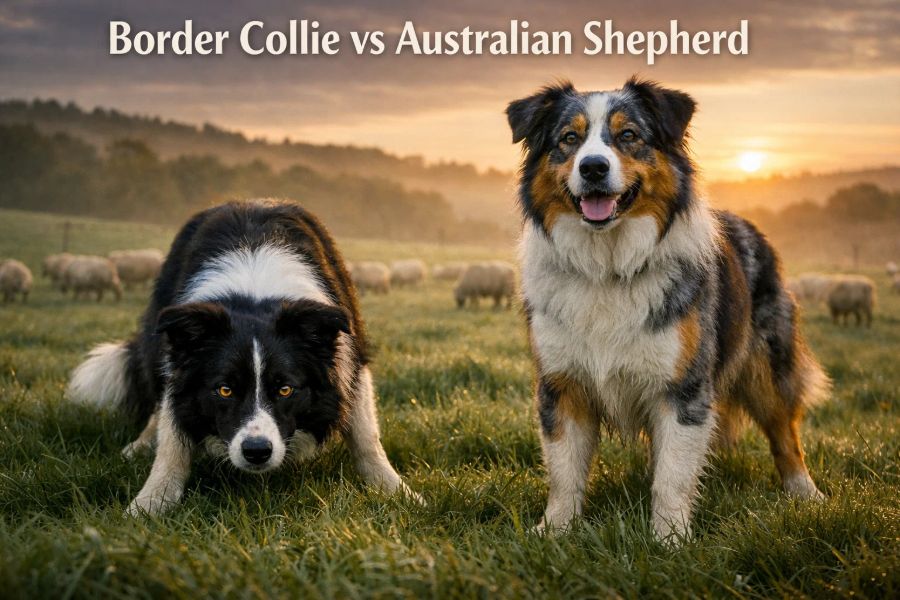
The short scientific summary is this: the Border Collie is usually the more specialized precision herder, especially famous for gathering stock with “eye,” while the Australian Shepherd is usually the more all-purpose ranch herder, combining stock work with broader farm-dog versatility. In daily life, Border Collies tend to be the more intense workaholics, and Aussies tend to be a little more socially flexible and robustly all-round, though both can be overwhelming for underprepared owners.
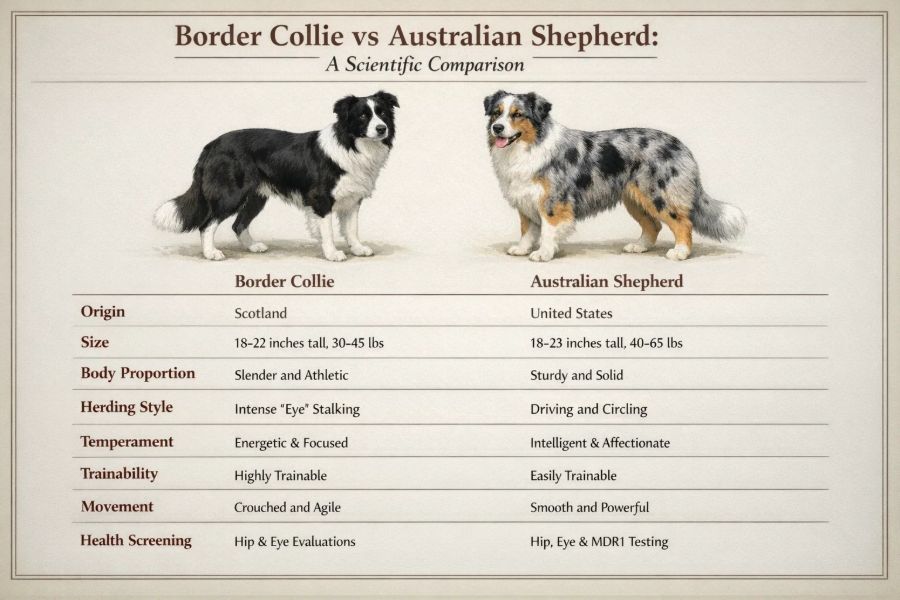
Quick comparison table
| Category | Border Collie | Australian Shepherd | Practical takeaway |
|---|---|---|---|
| Historical origin | Border region of Scotland and England | Breed perfected in California despite the name | Both are herding dogs, but from different working traditions |
| Core working identity | Premier sheep-gathering dog | Ranch herder with guarding instincts | Border Collie is more specialized; Aussie more multipurpose |
| Height | Males 19–22 in, females 18–21 in | Males 20–23 in, females 18–21 in | Similar overall size |
| Body proportion | Slightly longer than tall | Slightly longer than tall | Both balanced, athletic herders |
| Build | Moderate bone, very agile, endurance-focused | Medium bone, solid and muscular without cloddiness | Aussie often feels slightly sturdier; Border Collie slightly finer and more elastic |
| Signature herding style | Strong “eye,” stalking, wide outruns, gathering | Loose-eyed compared with Border Collie; adaptable ranch style | Border Collie is more classic precision sheepdog |
| Temperament | Keen, alert, responsive, tractable, reserved with strangers | Intelligent, active, even disposition, good-natured, somewhat reserved initially | Both can be reserved, but Border Collie is often more intense |
| Typical pet-home challenge | Mental overstimulation and work deprivation | High energy plus herding/guarding drive | Both need jobs; Border Collie often needs even more mental precision work |
| Common health screening focus | Hips, inherited eye problems | Hips/elbows, cataracts, epilepsy, eye disease | Both need serious breeder screening |
These comparisons are drawn from AKC, FCI, ASCA, and parent-club health statements.
Origins and breed purpose
The Border Collie standard is unusually explicit about function. The AKC standard says the breed originated in the border country between Scotland and England, where selection focused on biddable stock sense and the ability to work long days on rugged terrain. It adds that this selective breeding created the breed’s unique gathering style, with wide sweeping outruns and an intense gaze known as “eye.” The standard goes so far as to say that intensity, energy, and trainability are as important as appearance, and even calls the Border Collie “the world’s premier sheep herding dog.”
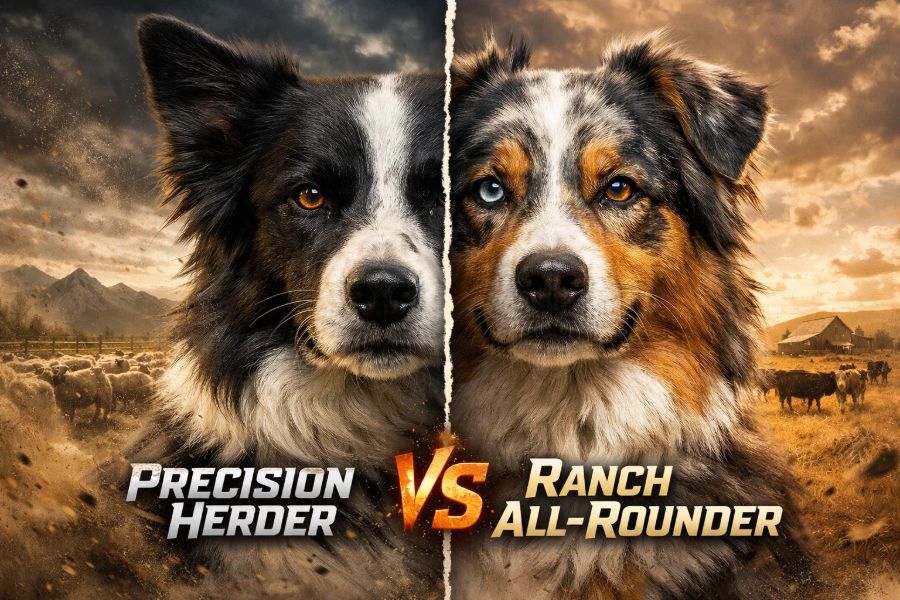
The Australian Shepherd standard describes a different emphasis. The AKC standard calls the Aussie an intelligent working dog of strong herding and guarding instincts, a loyal companion with the stamina to work all day. AKC’s breed page also notes that the Australian Shepherd is one of those “only in America” stories: a European-rooted breed perfected in California and strongly associated with ranch life and the rodeo world. That gives the Aussie a more general “ranch dog” identity than the Border Collie’s highly specialized sheepdog reputation.
So while both are herders, the Border Collie was refined toward precision control of stock, whereas the Australian Shepherd was refined toward broader stock and ranch versatility. That historical difference still shapes how the two breeds feel today.
Size and body structure
These breeds are closer in size than many people expect. The Border Collie standard gives preferred heights of 19–22 inches for males and 18–21 inches for females. The Australian Shepherd standard gives 20–23 inches for males and 18–21 inches for females. So the Aussie is not dramatically larger, but it often appears a bit more substantial because of coat, bone, and body style.
The Border Collie standard emphasizes moderate bone, athletic appearance, grace, power, agility, and “effortless movement and endless endurance.” The Australian Shepherd standard describes a dog that is well balanced, lithe and agile, yet also solid and muscular without cloddiness. In practical terms, the Border Collie often looks slightly finer and more spring-loaded, while the Aussie often looks somewhat more ranch-built and substantial.
Both are slightly longer than tall, but the Border Collie’s structure is tied very explicitly to efficiency over long working days and highly responsive movement around stock. The Aussie’s structure is similarly athletic, but its standard leaves a stronger impression of all-day ranch durability than of ultra-specialized stock precision.
Herding style: this is the biggest real difference
If you want the most important functional distinction in one sentence, it is this: Border Collies usually herd with more eye and precision; Aussies usually herd with more upright, versatile ranch style. The Border Collie standard specifically names the intense gaze known as “eye” and a stalking style of movement as defining traits. It also stresses the ability to work out of sight of the handler and still reason independently.
The Australian Shepherd standard does not define the breed through eye in the same way. Instead, it emphasizes strong herding and guarding instincts, attentiveness, stamina, and agility. That matches the breed’s reputation as a more general ranch dog—capable, adaptable, and highly intelligent, but not built around the Border Collie’s near-iconic gathering style.
So on livestock, the Border Collie is often the more specialized “sheepdog’s sheepdog,” while the Aussie is often the more flexible “cowboy dog.” That is a generalization, but it is strongly grounded in the official breed descriptions and historical usage.
Temperament and working mind
The Border Collie standard describes the breed as energetic, intelligent, keen, alert, and responsive, with “great tractability,” affectionate with friends, and sensibly reserved toward strangers. AKC’s public page goes even further, calling the breed a “remarkably bright workaholic” and warning that a Border Collie may be “too amazing” for owners without the time and energy to keep it occupied. That is unusually direct language, and it fits the breed’s real-world reputation.
The Australian Shepherd standard describes a dog that is intelligent, active, and of even disposition, good-natured and seldom quarrelsome, though somewhat reserved in initial meetings. AKC calls the breed smart, work-oriented, and exuberant. Compared with the Border Collie, the Aussie often comes across as a little broader in emotional style—still driven, still bright, but often less hyper-focused on precision control every waking moment.
A useful shorthand is this: the Border Collie often behaves like a specialist operator, while the Australian Shepherd often behaves like a multitool ranch hand. Both are intelligent. They simply express that intelligence in somewhat different ways.
Trainability and cognition
Both breeds are highly trainable, but modern dog-behavior research warns against reducing “intelligence” to a single ranking. A 2024 review on breed-related behavioral differences argues that breed comparisons are often oversimplified and that methodology matters greatly when people claim one breed is “smarter” than another. More broadly, a 2025 genomic study on herding dogs found evidence that herding breeds share selected behavioral tendencies related to social interaction, cognition, and instinctive stock-control behavior.
Within that framework, Border Collies tend to have the stronger reputation for rapid response to fine-grained handler input and stock movement, which fits the standard’s emphasis on tractability, reasoning, and working out of sight of the master without commands. Aussies are also highly trainable, but their standards lean slightly more toward all-day practical function than toward the Border Collie’s very refined sheep-control style.
So if the question is “which breed is usually easier to shape into high-level precision herding and dog-sport performance?” the Border Collie often gets the edge. If the question is “which breed combines trainability with a somewhat broader ranch-dog personality?” the Australian Shepherd often looks more balanced for that role.
Daily life and family fit
For the average pet home, both breeds can be difficult if underworked. The Border Collie’s challenge is often mental deprivation. AKC explicitly says Border Collies fare best when they have a job, and that keeping them active is essential to their behavior. A bored Border Collie may invent work, and humans do not usually enjoy the jobs it invents.
The Australian Shepherd is also high energy, but in many homes it feels slightly easier to live with because its working style is often less laser-precise and more generally active-companion oriented. That said, AKC still describes the Aussie as smart, work-oriented, and exuberant. This is not a low-maintenance breed. It is simply, on average, a bit less extreme than the Border Collie in compulsive work drive.
If you want a simple rule, it is this: most average homes underestimate both breeds, but they especially underestimate Border Collies.
Coat, appearance, and movement
The Border Collie can be rough- or smooth-coated, but its standard cares most about functionality and moderation. It should look natural, balanced, and capable of working hard all day. The Australian Shepherd standard emphasizes a coat of moderate length and coarseness, plus a natural or docked bobtail as an identifying characteristic. In appearance, the Aussie is often flashier in color presentation, while the Border Collie is often more function-first in expression.
Movement reflects this difference too. The Australian Shepherd standard says the breed must be agile and able to change direction or alter gait instantly. The Border Collie standard emphasizes effortless movement and endless endurance, which fits its classic wide outruns and sustained stock work. Neither is clumsy; they are simply optimized for somewhat different expressions of working athleticism.
Health and breeder screening
Neither breed should be discussed responsibly without mentioning health testing. The Border Collie Society of America strongly recommends screening breeding dogs for hip dysplasia and inherited eye problems, and AKC also lists health screening around hips and eyes for the breed.
For Australian Shepherds, AKC notes screening for hip dysplasia, epilepsy, cataracts, and some cancers, while ASCA’s health materials specifically flag cataracts and elbow dysplasia as important concerns and recommend elbow screening as part of standard health practice.
There is also overlap between the breeds in inherited eye issues. A 2022 study on the NHEJ1 mutation associated with Collie Eye Anomaly found carriers and affected-status frequencies in both Border Collies and Australian Shepherds, reinforcing the importance of DNA-informed breeding decisions.
So from a buyer’s perspective, the difference is not “one healthy breed and one unhealthy breed.” The real issue is whether the breeder is doing serious orthopedic and ophthalmic screening and breeding for stable working temperament as well as appearance.
So which one is better?
A zoologist or working-dog specialist would avoid a universal winner. The honest answer is role-based.
Choose the Border Collie if you want the more specialized sheepdog mind: more eye, more work focus, more precision, and usually more mental intensity.
Choose the Australian Shepherd if you want the broader ranch-dog style: still highly intelligent and active, but often a bit more general-purpose in temperament and function.
If you want one sentence to remember, it is this: the Border Collie is usually the better specialist; the Australian Shepherd is usually the better generalist.
References
AKC. Border Collie breed page.
AKC. Australian Shepherd breed page.
AKC. Official Standard of the Border Collie.
AKC. Official Standard of the Australian Shepherd.
FCI. Border Collie Standard No. 297.
ASCA. Breed Standard.
Border Collie Society of America. BCSA Health Statement.
Australian Shepherd Club of America. Diseases and Defects.
Australian Shepherd Club of America. Health Screening.
Jeong, H. et al. 2025. Genomic evidence for behavioral adaptation of herding dogs.
Pongrácz, P. et al. 2024. Behavioural differences and similarities between dog breeds.
Marelli, S. P. et al. 2022. Genotypic and allelic frequency of a mutation in the NHEJ1 gene associated with Collie Eye Anomaly.