From a zoological and working-dog perspective, German Shepherds and Belgian Malinois are often grouped together because both are herding-derived, highly trainable service dogs with strong guarding instincts. But they are not interchangeable dogs in different coats. The German Shepherd Dog was developed in Germany as a highly versatile all-purpose working dog, while the Belgian Malinois is one variety of the Belgian Shepherd, developed in Belgium as a square, agile, high-drive herding and service dog. Their modern reputations overlap in police, military, sport, and protection work, but their structure, energy style, and handling demands are meaningfully different.
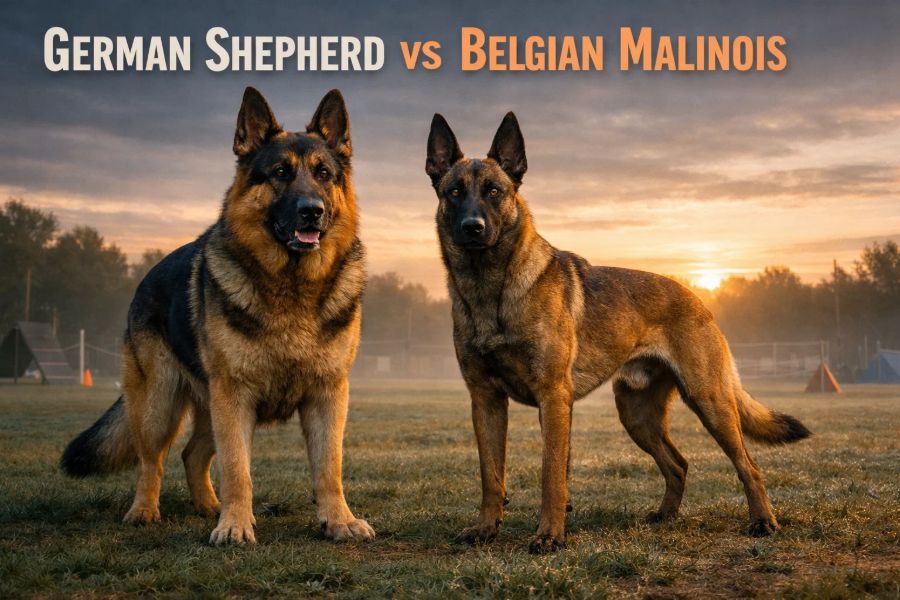
The short scientific summary is this: the German Shepherd is usually the more substantial, slightly longer-bodied, steadier all-purpose worker, while the Belgian Malinois is usually the lighter-framed, squarer, faster-reacting, more intense high-drive worker. Neither is “better” in absolute terms. The better dog depends on whether the job calls for versatility and steadiness or speed, precision, and nonstop drive.
Quick comparison table
| Category | German Shepherd Dog | Belgian Malinois | Practical takeaway |
|---|---|---|---|
| Origin | Germany | Belgium | Both began as herding dogs, but under different breeding traditions |
| Official role | Companion, guard, protection, service, herding dog | Herding dog, guarding, defense, tracking, all-purpose service dog | Both are true multipurpose workers |
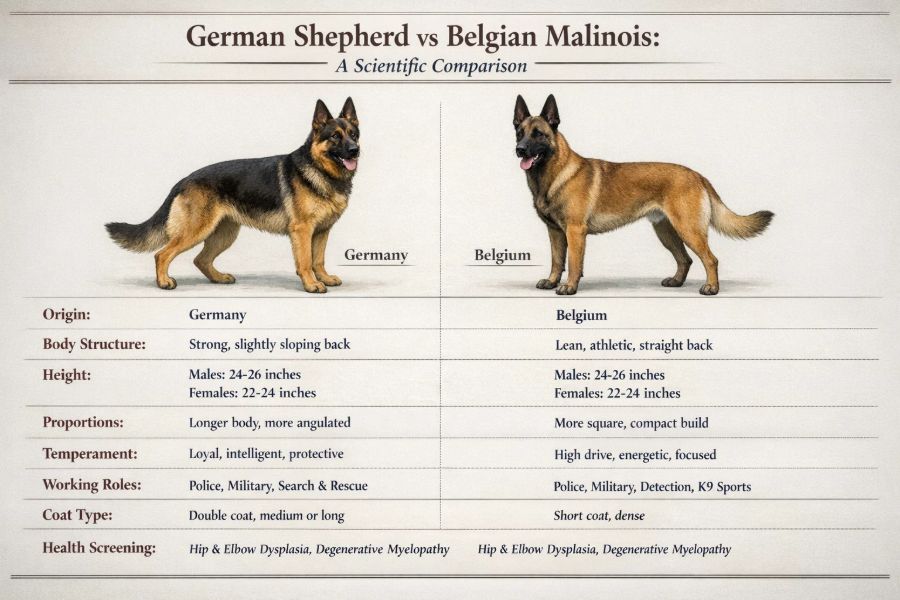
| General build | Medium-large, slightly elongated, powerful, well-muscled | Medium, square, elegant but strong, dry-muscled | GSD is usually heavier; Malinois is usually leaner and more compact |
| Height | Males 24–26 in; females 22–24 in | Males 24–26 in; females 22–24 in | Similar height, different proportions |
| Body proportion | Longer than tall | Roughly square | Malinois often looks quicker and tighter; GSD more ground-covering |
| Temperament language | Loyal, confident, courageous, steady, self-assured | Smart, confident, versatile; calm and fearless in FCI standard | Both are serious dogs, but Malinois is often more intense |
| Training feel | Highly trainable, often steadier for broad service roles | Highly trainable, but usually more demanding and higher drive | Malinois often needs more active management |
| Typical pet-home difficulty | High | Very high | Malinois is usually the harder average-home dog |
These comparisons come from AKC and FCI breed standards and parent-club health material.
Origins and breed purpose
The German Shepherd Dog was methodically developed beginning in 1899 from central and southern German herding dogs, with the explicit goal of creating a working dog inclined to high achievement. The FCI standard still defines the breed as suitable as a companion, guard, protection, service, and herding dog, which explains why the German Shepherd became one of the world’s most famous general-purpose working breeds.
The Belgian Malinois comes from the broader Belgian Shepherd tradition. The FCI standard explains that the Belgian Shepherd was formally organized in the 1890s, with type and temperament established early, and describes the breed as originally a sheepdog and today also a working dog for guarding, defense, tracking, and all-purpose service work. The Malinois is the short-haired variety of that larger Belgian Shepherd framework.
So, historically, both breeds are herding-rooted and service-capable, but the German Shepherd was bred toward a broader “universal worker” ideal, while the Malinois remained a more compact, harder-edged herding-service type. That difference still shows up in how people use them today.
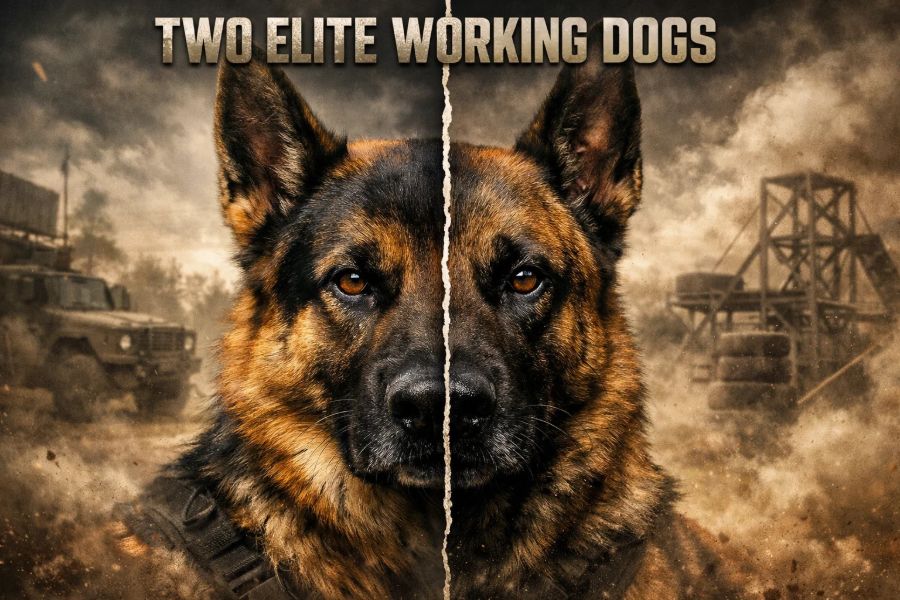
Structure: similar height, different machine
One of the most important physical facts is that these two breeds are about the same height, but they are not built the same way. The AKC standard places both males at 24 to 26 inches and females at 22 to 24 inches. That often surprises people who assume the German Shepherd is much taller.
What really differs is proportion. The German Shepherd standard says the breed is longer than tall, with a desirable proportion of 10 to 8½, while the Belgian Shepherd standard says the breed should fit into a square outline, and the Malinois-specific AKC standard repeats that the length should equal the height. In practical terms, the German Shepherd is built for powerful, ground-covering movement and versatility, while the Malinois is built as a tighter, more compact athletic package.
That is why a Malinois often looks quicker, more spring-loaded, and more “live wire,” while a German Shepherd often looks more substantial and imposing. Those impressions are not just subjective; they reflect real breed-standard differences in frame and balance.
Temperament: steady confidence vs relentless intensity
The AKC describes the German Shepherd as loyal, confident, courageous, and steady, and the AKC breed standard adds that the dog should show self-confidence and a certain aloofness, but not hostility. The FCI standard similarly says the breed must be well-balanced, self-assured, good-natured, attentive, and willing to please.
The Belgian Malinois is described by AKC as smart, confident, and versatile, a “world-class worker” that forms an unbreakable bond with its handler. The FCI standard emphasizes a calm and fearless temperament, while the AKC standard highlights the breed’s attentiveness and readiness for action. Taken together, that points to a dog that is often more reactive in a working sense—not unstable, but very ready to move, engage, and perform.
A useful field-style summary is this: the German Shepherd often presents as the more composed and versatile all-purpose worker, while the Malinois often presents as the more intense, kinetic, high-drive specialist. Both are intelligent and serious, but the Malinois usually asks more from the handler every day.
Training and working style
Both breeds are famous for trainability, but they do not always feel the same in training. The German Shepherd’s standards repeatedly emphasize suitability for many roles: protection, service, guarding, companionship, and herding. That broad suitability is one reason the breed became so dominant in police, guide-dog, and general service work.
The Malinois is also highly trainable, but the breed is usually described as needing work almost constantly. AKC notes that denying a Malinois activity and close partnership deprives it of its reason for being. That is a strong clue that the Malinois is not just trainable; it is work-hungry. This is one reason the breed has become especially prominent in modern detection, military, and high-level sport environments.
In practical handling terms, the German Shepherd often tolerates a wider range of homes and training styles, while the Malinois usually rewards expert structure and punishes inconsistency faster. That is not because the Malinois is “smarter” in any simple sense, but because it is often bred and maintained at a higher average arousal and work intensity.
Movement and athletic expression
The German Shepherd was designed as a working trot dog with strength and endurance. The FCI standard describes it as powerful and well-muscled, with movement suited to its many duties, while the AKC standard stresses fitness and nimbleness without clumsiness.
The Belgian Shepherd standard says the breed has a lively and free movement at all gaits and is a good galloper, while the Malinois-specific standard describes a dog that is strong and well-muscled but more elegant than bulky. This helps explain why Malinois often dominate in protection sports and modern high-speed work that rewards acceleration, fast recovery, and explosive engagement.
That does not mean the German Shepherd is unathletic. It means the two breeds express athleticism differently: the German Shepherd as a broader all-round worker, the Malinois as a more elastic and high-frequency athlete.
Coat, maintenance, and climate
The German Shepherd has a dense double coat and is often more heavily coated than a Malinois. The Malinois standard says the coat should conform closely to the body and notes that the breed is a natural breed with no need for excessive grooming.
The Malinois is therefore usually easier to keep clean and lighter to manage in hot or highly active working environments, while the German Shepherd often carries more coat and a more dramatic outline. Both can work in varied climates, but the Malinois’s tighter coat and lighter build often make it feel more “practical” under continuous physical workload. That is an inference grounded in the standards’ coat and structure descriptions.
Health and structural concerns
Health is one area where the comparison becomes especially important. The German Shepherd Dog Club of America lists hip dysplasia and elbow dysplasia in its CHIC requirements, along with temperament testing, and notes ongoing research into the SOD1 risk mutation for degenerative myelopathy. The same page also includes cardiac and thyroid testing in its Health Award of Merit requirements.
The Belgian Malinois parent-club FAQ says the breed is generally healthy, with an average lifespan of 10 to 12 years, but notes that hip and elbow dysplasia do occur and recommends eye exams for breeding stock.
There is also an important structural caution on the German Shepherd side. FCI breed-specific instructions identify risk areas such as over-angulated hindquarters and instability in hocks. That does not apply to every German Shepherd, but it does show that exaggeration in structure has been a recognized breed concern.
So the general health comparison is this: both breeds require careful screening, but the German Shepherd carries a more publicly recognized burden of orthopedic and conformation-related controversy, while the Malinois is widely viewed as the more naturally athletic and structurally straightforward breed overall.
Which breed is harder for pet homes?
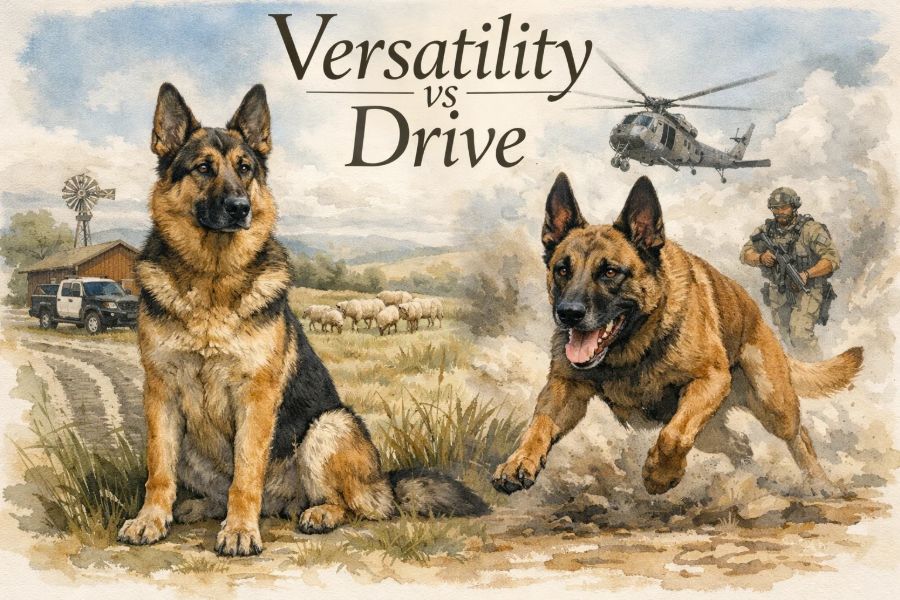
For the average household, the Belgian Malinois is usually the harder dog. Its intensity, work need, speed, and sensitivity make it a poor fit for casual ownership. AKC’s language that a Malinois must have activity and partnership is not just praise; it is a warning.
The German Shepherd is not easy either, but it is generally more adaptable across pet, family, and service contexts. That broader adaptability is reflected in both AKC’s “all-purpose worker” description and the FCI’s explicit statement that the breed should be suitable as companion, guard, service, and herding dog.
So if the question is “Which breed is more manageable for a skilled but not sport-obsessed owner?”, the German Shepherd usually has the edge. If the question is “Which breed thrives when given a demanding working outlet and an expert handler?”, the Malinois often does.
So which one is “better”?
A zoologist or working-dog specialist would avoid a simple winner. The honest comparison is role-based:
German Shepherd: better fit for people wanting a steadier, more substantial, more generally versatile working dog.
Belgian Malinois: better fit for people wanting a faster, tighter, more intense, highly driven performance and service dog.
If you want a concise verdict: the German Shepherd is usually the more balanced all-rounder; the Belgian Malinois is usually the more extreme specialist.
References
AKC. German Shepherd Dog breed page.
AKC. Belgian Malinois breed page.
FCI. German Shepherd Dog Standard No. 166.
FCI. Belgian Shepherd Dog Standard No. 15.
AKC. Official Standard of the German Shepherd Dog.
AKC. Official Standard of the Belgian Malinois.
German Shepherd Dog Club of America. Health & Genetics Committee.
American Belgian Malinois Club. FAQs.
FCI. Breed Specific Instructions noting German Shepherd structural risk areas.