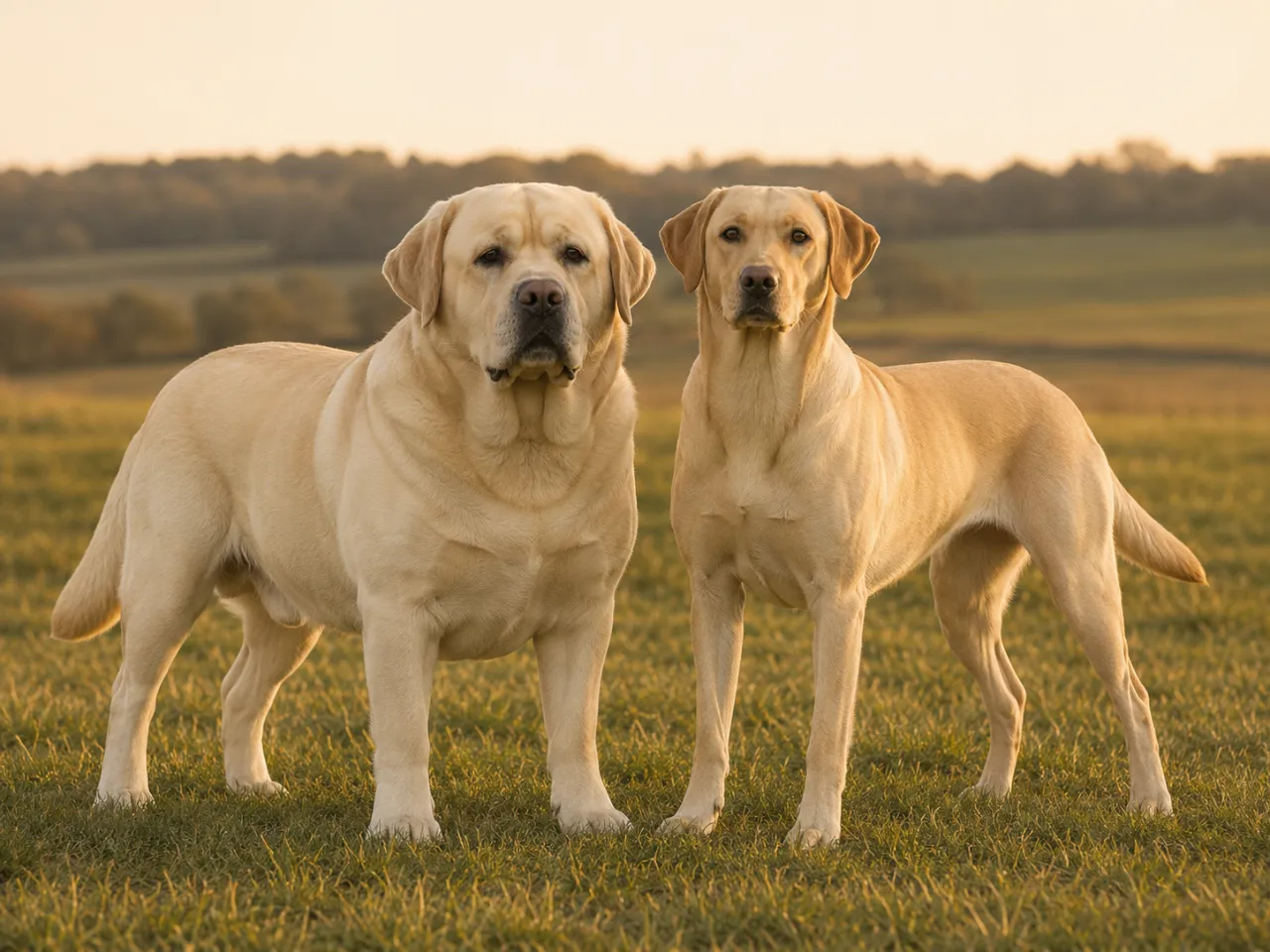
English Labradors and American Labradors are not separate breeds. They are two common types of Labrador Retriever. English Labs are usually stockier, calmer, broader-headed, and often associated with show or family companion lines. American Labs are usually leaner, faster, more energetic, and often associated with field, hunting, and working lines. Both can be excellent dogs, but they suit different lifestyles.
English Labrador vs American Labrador Quick Answer
The English Labrador is usually the better choice for families who want a calmer, heavier-built, affectionate companion. The American Labrador is often better for active owners who want a high-energy dog for hunting, field work, running, hiking, retrieving, or advanced training. However, both are Labrador Retrievers, and individual temperament depends heavily on genetics, breeding line, training, exercise, and socialization.
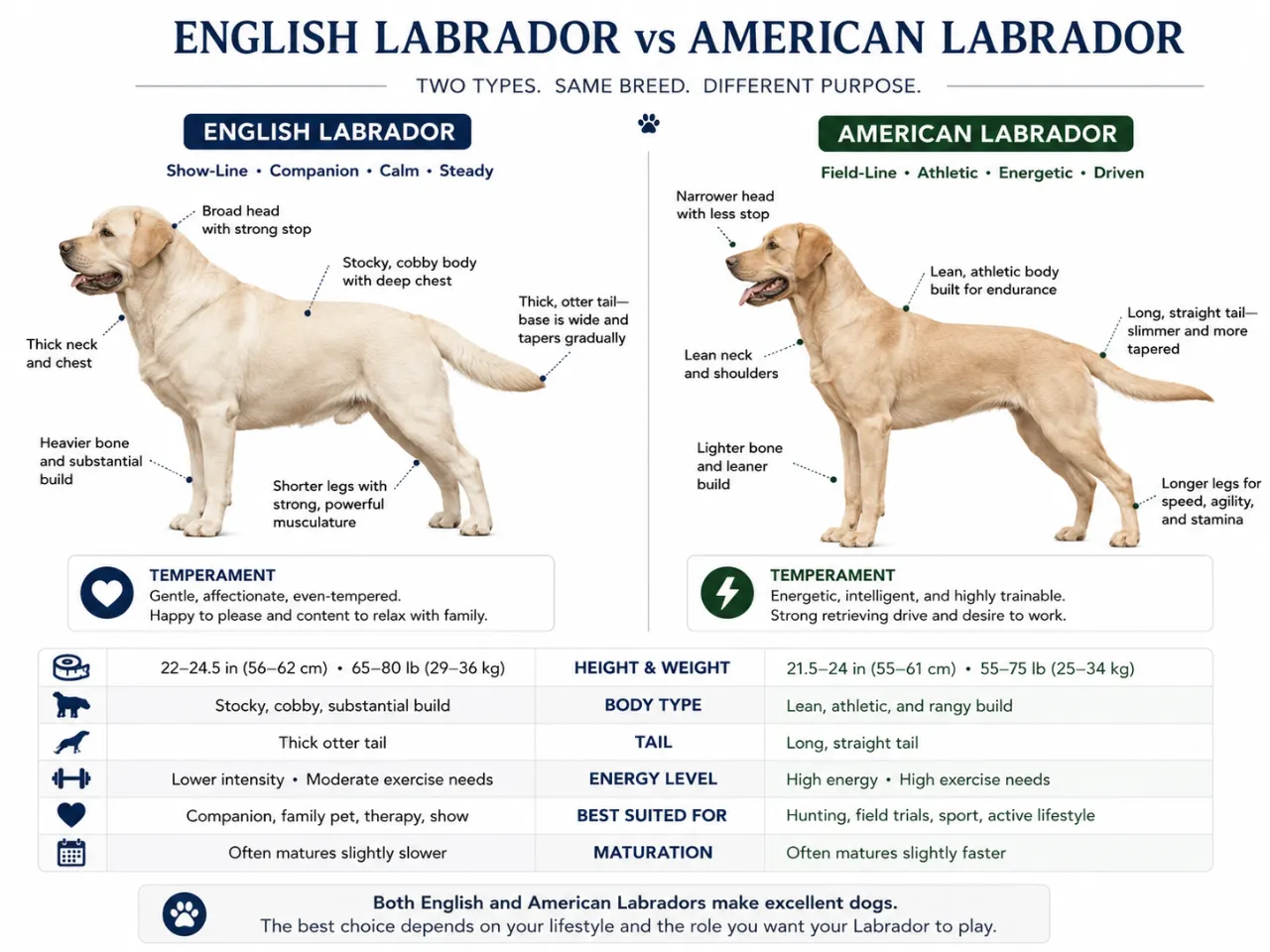
English Labrador vs American Labrador Summary Table
| Feature | English Labrador | American Labrador |
|---|---|---|
| Breed status | Same breed: Labrador Retriever | Same breed: Labrador Retriever |
| Common type | Show, bench, or companion line | Field, hunting, or working line |
| Body build | Stockier, broader, heavier-looking | Leaner, taller-looking, more athletic |
| Head shape | Broader skull, shorter muzzle, blockier face | Narrower head, longer muzzle, more streamlined face |
| Chest and neck | Broad chest, thick neck, powerful body | More streamlined chest, longer neck, lighter frame |
| Legs | Often slightly shorter and heavier-boned | Often longer-legged and more agile |
| Tail | Thick “otter tail,” often very noticeable | Still has an otter tail, but may look slimmer |
| Energy level | Moderate to high | High to very high |
| Temperament | Often calmer, steadier, more relaxed indoors | Often more intense, driven, alert, and energetic |
| Trainability | Highly trainable, usually food-motivated and people-focused | Highly trainable, often more driven and fast-reacting |
| Best for | Families, therapy work, companionship, show homes, moderate activity | Hunting, field trials, detection, sport, hiking, active working homes |
| Potential challenge | Weight gain, food obsession, lower stamina in some lines | Restlessness, overexcitement, high exercise needs |
| Quick identification clue | Blocky head, thick body, calmer show-line appearance | Lean body, longer legs, athletic field-line appearance |
What Is an English Labrador?
An English Labrador is a Labrador Retriever from show, bench, or conformation-style lines. The term “English” is informal in many countries, but it is widely used to describe Labs that have a stockier body, broader head, thicker neck, deeper chest, and calmer companion temperament.
English Labs are often bred to match the classic Labrador Retriever breed standard in the show ring. They tend to look powerful, balanced, and substantial. Their faces are often softer and more blocky, with expressive eyes and a broad skull. Many English Labs are affectionate, steady, food-motivated, and people-oriented.
This does not mean every English Lab is lazy. They are still sporting dogs with energy, intelligence, and retrieving instincts. However, compared with many field-line American Labs, English Labs are often easier for typical family homes to manage.
What Is an American Labrador?
An American Labrador is a Labrador Retriever from field, hunting, or working lines. Like “English Labrador,” the term is informal, but it is commonly used to describe Labs bred more for performance than show-ring appearance.
American Labs are usually leaner, faster, more athletic, and more intense. They often have longer legs, a narrower head, a more streamlined body, and a strong desire to retrieve, run, swim, search, and work. Many are excellent hunting dogs, field trial dogs, detection dogs, search-and-rescue dogs, and high-energy sport companions.
An American Lab can be a wonderful family dog, but it usually needs more exercise, training, and mental work than a calmer show-line English Lab. Without enough activity, an American Lab may become restless, mouthy, noisy, destructive, or hard to settle indoors.
Are English and American Labradors Separate Breeds?
No. English Labradors and American Labradors are both Labrador Retrievers. They are not separate official breeds. The difference is mainly about breeding style, body type, and working purpose.
The terms usually mean:
English Labrador: show-line, bench-line, stockier Labrador Retriever.
American Labrador: field-line, working-line, athletic Labrador Retriever.
Because these are informal labels, some dogs fall between the two types. A Labrador can have both show and field ancestry. A breeder may produce Labs that are calm but athletic, or field-bred Labs that still look fairly solid. The individual dog matters more than the label.
Quick Visual Difference
The easiest visual difference is body shape. English Labs usually look broader, shorter, heavier, and more blocky. American Labs usually look taller, leaner, longer-legged, and more athletic.
English Labrador: broad head, thick neck, deep chest, heavier bone, stockier body.
American Labrador: narrower head, longer muzzle, leaner frame, longer legs, athletic outline.
English Labrador: often has a calmer, show-line appearance.
American Labrador: often looks like a fast working retriever built for speed and stamina.
Origin and Breeding Purpose
All Labrador Retrievers trace their ancestry to working water dogs connected with Newfoundland and later developed in Britain as retrievers for hunters. Over time, breeding goals created different styles within the same breed.
English-type Labs were shaped more by conformation shows and companion qualities. Breeders often selected for a broad head, strong body, dense coat, good temperament, and appearance close to the breed standard.
American-type Labs were shaped more by field performance. Breeders often selected for speed, endurance, drive, marking ability, water confidence, birdiness, trainability, and desire to retrieve under demanding conditions.
In simple terms, the English Lab is often the bench-line Labrador, while the American Lab is often the field-line Labrador.
Size and Body Build
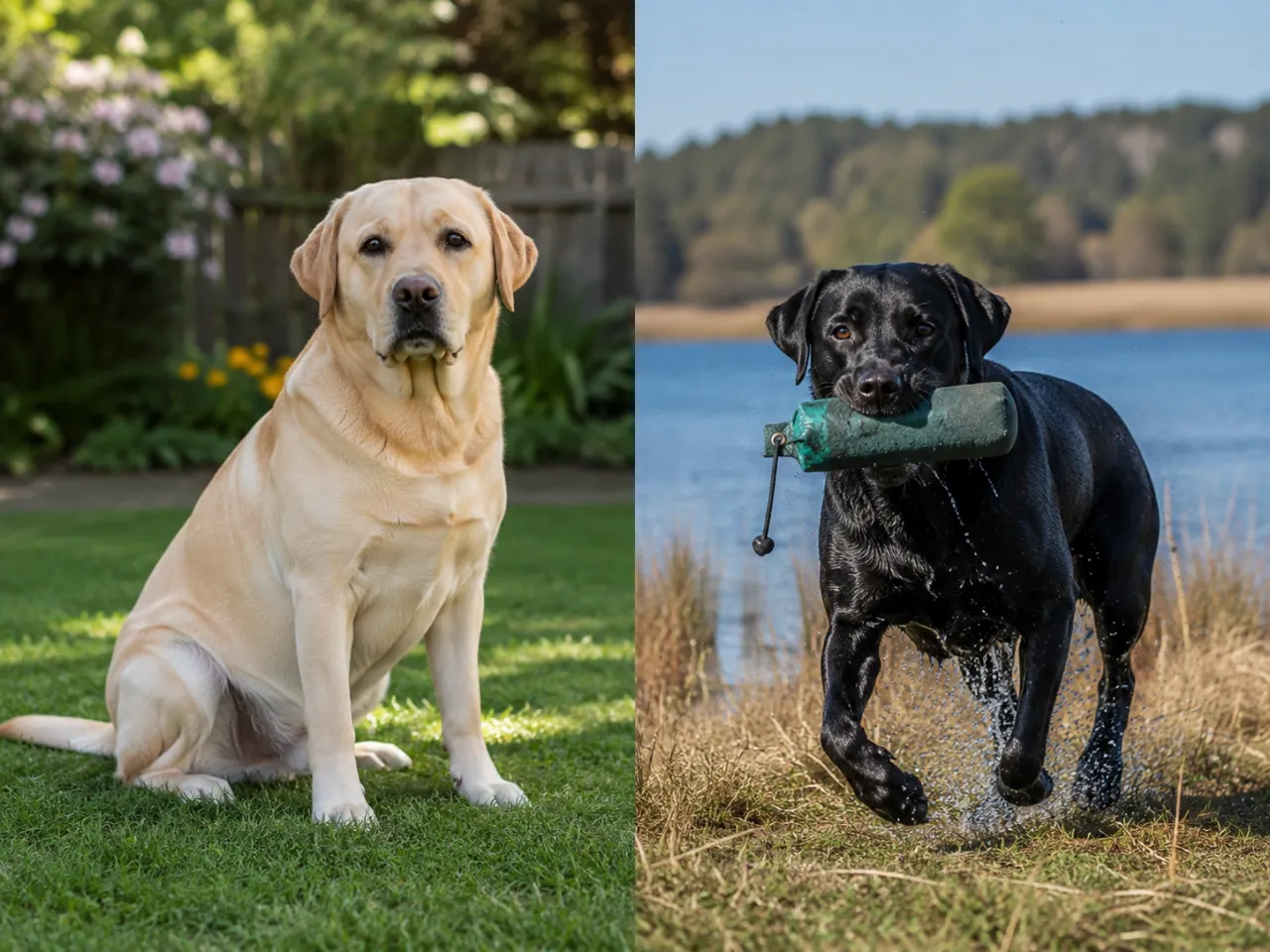
Both types are medium-to-large sporting dogs, but they can look quite different. English Labs usually appear heavier and more compact. Their bodies are broad, their bones are substantial, and their chests are deep. Many have a thick, powerful neck and a wide head.
American Labs usually appear more athletic and lighter on their feet. Their bodies are often longer-legged and less bulky. They may look slightly taller and more streamlined, even when their actual height is within the Labrador range.
The English Lab is built like a powerful all-around companion retriever. The American Lab is built more like a field athlete.
Head, Face, and Expression
English Labradors often have a broad skull, shorter muzzle, pronounced stop, and soft, expressive eyes. This gives them the classic “blocky Lab” look many families love. Their head may appear large and rounded compared with the body.
American Labradors often have a narrower head, longer muzzle, and more alert expression. Their faces may look less blocky and more streamlined. This does not make them less pure or less Labrador-like; it simply reflects field-line selection.
If the dog has a very broad head and thick body, it may be English-type. If it has a leaner head and athletic outline, it may be American-type.
Coat and Colors
Both English and American Labradors can come in the traditional Labrador colors: black, yellow, and chocolate. Yellow can range from pale cream to fox red. Coat color does not determine whether a Lab is English or American.
Both types should have a dense double coat that helps protect them in water and cold weather. English Labs may sometimes appear to have a thicker, plusher coat, while American Labs may appear sleeker, but this varies by individual dog and line.
Both shed. Labradors are not hypoallergenic, and seasonal shedding can be heavy. Regular brushing helps control loose hair.
Temperament and Personality
English Labs are often described as calmer, more settled, and more relaxed indoors. Many are affectionate, gentle, food-motivated, and easygoing with family members. They are often a strong choice for homes that want a friendly companion but still enjoy outdoor activity.
American Labs are often more intense, driven, and energetic. They may be highly focused on retrieving, running, swimming, searching, and training. Many are excellent working partners, but they can be too much for owners who expect a calm couch dog.
Both types are usually friendly and people-oriented, but their energy expression can be different. An English Lab may ask for attention and food. An American Lab may ask for work, movement, and a job.
Energy Level and Exercise Needs
English Labs need daily exercise, but many are easier to satisfy than field-line American Labs. A good routine may include walks, swimming, retrieving games, training sessions, scent games, and playtime. They still need activity to stay healthy and avoid weight gain.
American Labs usually need more intense exercise. They may require long walks, field training, running, swimming, retrieving, hiking, obedience work, scent work, or other structured outlets. A few casual walks may not be enough for a high-drive American Lab.
If you want a Labrador for an active outdoor lifestyle, the American type may be a better match. If you want a family companion with moderate activity needs, the English type may be easier.
Trainability
Both English and American Labradors are highly trainable. Labradors are famous for their intelligence, food motivation, retrieving instinct, and willingness to work with people. However, the training experience can feel different.
English Labs are often steady learners. They may be slightly more forgiving, calmer, and easier for everyday owners to train. Food motivation can be very strong, which helps with training but also requires weight management.
American Labs may learn very quickly and work with great enthusiasm. They can be outstanding in advanced training, but their speed and drive can overwhelm inexperienced owners. They may need more impulse-control work, calmness training, and structured exercise.
Hunting and Field Work
American Labradors are usually the stronger choice for serious hunting, field trials, and high-performance retrieving work. They are often bred for stamina, speed, marking ability, water entry, bird drive, and willingness to work at a distance.
English Labradors can also hunt and retrieve, especially if they come from dual-purpose or working-capable lines. Some English Labs are excellent gun dogs. However, compared with many American field lines, they may be slower, heavier, and less intense.
If the goal is competitive field work, an American Lab is often preferred. If the goal is a companion that can also enjoy casual retrieving and outdoor life, an English Lab may be ideal.
Family Life and Children
Both types can be wonderful family dogs. English Labs often fit family homes well because they tend to be calmer and more settled indoors. Their affectionate, patient nature can make them excellent companions for children when properly trained and supervised.
American Labs can also be excellent with families, especially active families who enjoy outdoor activities. However, young American Labs may be very energetic, jumpy, mouthy, and excitable. They need training so their enthusiasm does not overwhelm children or older adults.
No Labrador should be expected to behave perfectly without guidance. Children should be taught not to climb on dogs, pull ears or tails, disturb sleeping dogs, or tease dogs with food or toys.
Apartment Living
An English Labrador may adapt better to apartment living than an American Labrador, but both need daily exercise. A calm adult English Lab with regular walks and training may do well in an apartment if the owner is committed.
An American Lab can live in an apartment only with a highly active owner who provides serious exercise and mental work. Without enough outlets, the dog may bark, chew, pace, jump, or become difficult indoors.
For both types, a yard is helpful but not enough by itself. Labradors need interaction, training, movement, and enrichment.
Grooming and Shedding
Both English and American Labs have double coats that shed. English Labs may appear thicker-coated in some lines, while American Labs may look sleeker, but neither is low-shedding.
Basic grooming includes brushing several times a week, more during seasonal shedding, regular nail trimming, ear cleaning when needed, dental care, and bathing as appropriate. Labradors that swim often may need more ear monitoring because moisture can contribute to ear problems.
Because both types love food and may gain weight, grooming time is also a good opportunity to check body condition, skin, lumps, paws, and coat health.
Health Considerations
English and American Labs share many Labrador health concerns. These may include hip dysplasia, elbow dysplasia, obesity, ear infections, allergies, exercise-induced collapse in some lines, eye conditions, and certain inherited diseases.
English Labs may be more prone to weight gain because they are often stockier and may be less intensely active. American Labs may be more prone to athletic injuries if they are worked hard without proper conditioning or recovery.
Responsible breeders should test breeding dogs for relevant orthopedic, eye, and genetic conditions. Whether choosing English or American type, health testing and temperament should matter more than appearance alone.
Weight Gain and Food Motivation
Labradors are famous for loving food. This is true for both English and American types. English Labs, especially, can gain weight if overfed or under-exercised. Their stocky build can hide early weight gain, so owners should monitor body condition carefully.
American Labs may burn more calories if they are very active, but they can still become overweight if food intake is too high. Treat-based training should be balanced with measured meals and healthy rewards.
A healthy Lab should have a visible waist from above and ribs that can be felt without heavy fat cover. Keeping a Labrador lean is one of the best ways to protect joints and long-term health.
Behavior Problems When Under-Exercised
Both types can develop behavior problems if bored. English Labs may chew, beg, gain weight, raid trash, or become stubborn if they lack structure. American Labs may become restless, overexcited, destructive, mouthy, or difficult to control on leash.
Common under-stimulation problems include:
Chewing furniture or shoes
Jumping on people
Pulling hard on leash
Stealing food
Digging
Barking from frustration
Inability to settle indoors
Mouthy play or grabbing objects
Training, exercise, puzzle feeding, retrieving games, scent work, swimming, and calm routines can help both types live better in human homes.
English Labrador vs American Labrador for First-Time Owners
An English Labrador is often the better choice for first-time owners because it is usually calmer and more manageable. However, it is still a large, strong, energetic dog that needs training, exercise, and food control.
An American Labrador can be challenging for first-time owners unless they are very active and committed to training. Field-line Labs may have more drive than a casual owner expects. They may need a job, not just affection.
If you are a first-time dog owner, do not choose only by looks. Meet adult dogs from the breeder’s lines, ask about energy level, and be honest about your daily schedule.
English Labrador vs American Labrador for Seniors
For many seniors, an adult English Labrador may be a better fit than a young American Labrador. English Labs are often calmer, heavier, and more settled, though they can still be strong on leash.
A young American Lab may be too energetic for some seniors because of pulling, jumping, speed, and exercise needs. However, an older trained American Lab with a calmer temperament could still be a good companion.
Age, training, and temperament matter more than label. A calm 5-year-old American Lab may be easier than a wild 1-year-old English Lab.
English Labrador vs American Labrador for Hunting
For serious hunting and field trial work, American Labs are often preferred because they are bred for speed, stamina, retrieving drive, and working intensity. They may handle long days in the field better and respond quickly to advanced training.
English Labs can still be capable hunting companions, especially if they come from working or dual-purpose lines. They may be steadier and calmer, which some hunters appreciate. However, they may not have the same field speed and drive as high-performance American lines.
The best hunting Labrador is not simply English or American. It is the dog with the right genetics, training, health, temperament, and drive for the work.
English Labrador vs American Labrador for Service and Therapy Work
English Labs are often excellent candidates for therapy work and some service roles because of their calmer temperament, steady nature, and strong human bond. Their food motivation and friendly personality can make training easier.
American Labs can also work as service dogs, detection dogs, and assistance dogs, especially when their drive is properly matched to the job. However, very high-energy field lines may be too intense for calm public-access work unless carefully selected and trained.
For therapy visits, emotional support, or calmer family companionship, English-type Labs often have an advantage. For detection, search work, or high-activity roles, American-type Labs may be stronger candidates.
Common Misidentifications
People often assume that a blocky Labrador is automatically English and a slim Labrador is automatically American. This is often true in a general sense, but not always. Some Labs are mixed between show and field lines. Some young English Labs are lean, and some American Labs become stockier with age.
Another common mistake is linking color to type. A fox red Lab is not automatically American. A pale yellow Lab is not automatically English. Black, yellow, and chocolate Labs can appear in both English and American lines.
The most reliable clues are pedigree, breeder goals, body structure, and temperament, not coat color alone.
How to Identify One in a Photo
When looking at a photo, use several clues together:
Check the head: broad, blocky head suggests English type; narrower head suggests American type.
Check the body: stocky, deep-chested body suggests English type; lean athletic body suggests American type.
Check the legs: shorter, heavier legs suggest English type; longer legs suggest American type.
Check the tail: thick otter tail is common in both, but may look heavier in English Labs.
Check the posture: calm show stance may suggest English type; alert field posture may suggest American type.
Check the context: show ring photos often show English Labs; field trial or hunting photos often show American Labs.
Which Labrador Is Better for You?
Choose an English Labrador if you want a friendly, affectionate, stockier dog that is often calmer indoors and better suited to family companionship. This type may be ideal for owners who want a Labrador personality without the extreme drive of a field-line dog.
Choose an American Labrador if you want a highly active, athletic, driven dog for hunting, running, hiking, retrieving, advanced obedience, scent work, or outdoor adventure. This type is best for people who genuinely enjoy training and exercising their dog every day.
Do not choose either type if you want a low-maintenance dog. Labradors are loving, but they need exercise, training, food management, grooming, and attention.
Final Comparison
English Labradors and American Labradors are both Labrador Retrievers, but they represent different styles within the breed. The English Lab is usually broader, stockier, calmer, and more associated with show and family companion lines. The American Lab is usually leaner, faster, more energetic, and more associated with hunting and field performance.
Neither type is better overall. The best Labrador is the one that matches your lifestyle. For a calmer family companion, an English Lab may be the better fit. For an athletic working partner, an American Lab may be the better choice.
Related Dog Comparisons
Labrador Retriever vs Golden Retriever
Black Lab vs Yellow Lab
Chocolate Lab vs Black Lab
Golden Retriever vs English Cream Golden Retriever
Flat-Coated Retriever vs Labrador Retriever
Chesapeake Bay Retriever vs Labrador Retriever
FAQs About English Labrador vs American Labrador
Are English Labradors and American Labradors different breeds?
No. They are both Labrador Retrievers. The terms English and American usually describe different breeding styles: English Labs are often show or bench lines, while American Labs are often field or working lines.
Which is calmer, an English Lab or an American Lab?
English Labs are usually calmer and more settled indoors. American Labs are often more energetic, intense, and driven. However, individual temperament varies by breeding, training, and lifestyle.
Which is bigger, English Labrador or American Labrador?
English Labs often look heavier and stockier, while American Labs often look taller and leaner. Actual size can overlap, but English Labs usually have more body mass and broader bone.
Which Labrador is better for families?
English Labs are often easier for family homes because they tend to be calmer and more companion-focused. American Labs can also be great family dogs, especially for very active families.
Which Labrador is better for hunting?
American Labs are usually preferred for serious hunting and field work because they are often bred for speed, stamina, drive, and retrieving performance. English Labs can still hunt, especially from working-capable lines.
Do English Labs shed more than American Labs?
Both shed. English Labs may have a thicker-looking coat in some lines, but shedding depends on the individual dog, coat condition, season, grooming, and health.
Are American Labs harder to train?
American Labs are highly trainable, but they may be more energetic and intense. They often need more impulse control, exercise, and structured work. English Labs may be easier for many everyday owners.
Which Labrador is better for first-time owners?
An English Labrador is often a better choice for first-time owners because it is usually calmer and easier to manage. Still, any Labrador needs training, exercise, socialization, and weight control.