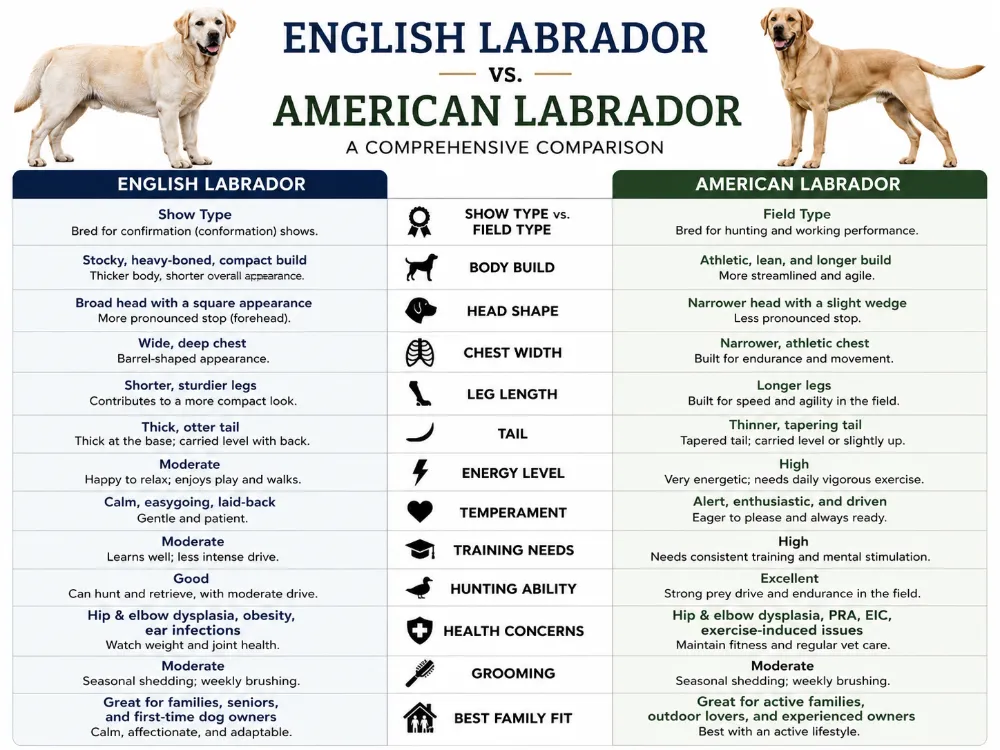
English and American Labradors are the same breed, Labrador Retriever, but they are different “types.” English Labs are usually show or bench-bred dogs with a stockier body, broader head, thicker neck, and calmer style. American Labs are usually field or working-bred dogs with a leaner body, longer legs, narrower head, and higher energy. Both can be loving, intelligent, trainable family dogs.

| Feature | English Labrador | American Labrador | Quick Takeaway |
|---|---|---|---|
| Breed status | Labrador Retriever | Labrador Retriever | They are not separate breeds. |
| Common type | Show type, bench type, conformation type | Field type, working type, hunting type | English Labs are often bred for show; American Labs for work. |
| Body shape | Stockier, broader, heavier-looking | Leaner, taller-looking, more athletic | English Labs look blockier; American Labs look sportier. |
| Head | Broad head, shorter muzzle, stronger stop | Narrower head, longer muzzle, more refined look | The head is one of the easiest visual clues. |
| Chest and neck | Broad chest, thick neck, powerful front | Narrower chest, longer neck, lighter frame | English Labs look more compact and muscular. |
| Legs | Often shorter and heavier-boned | Often longer and lighter-boned | American Labs usually look more leggy. |
| Tail | Thick “otter tail,” often straighter | Still thick, but may look longer, thinner, or more active in motion | Both should have a strong Labrador tail. |
| Energy level | Moderate to high, often calmer indoors | High to very high, often more intense | American Labs usually need more work and exercise. |
| Temperament | Friendly, steady, sociable, often more settled | Driven, energetic, eager, athletic, highly responsive | Both are friendly, but their “speed” of life can differ. |
| Best for | Families, show homes, therapy work, calm active owners | Hunters, sport handlers, runners, trainers, very active homes | Choose by lifestyle, not only appearance. |
Are English and American Labradors Different Breeds?
English Labradors and American Labradors are not different breeds. Both are Labrador Retrievers. The terms “English” and “American” usually describe two broad breeding styles within the same breed: show or bench lines and field or working lines.
An English Labrador usually means a dog bred more toward the show ring, breed standard appearance, and a steadier companion temperament. An American Labrador usually means a dog bred more toward hunting, field trials, retrieving work, athletic performance, and higher drive.
These labels are useful, but they are not perfect. A calm American Lab can exist, and a lively English Lab can exist. Individual genetics, breeder goals, training, age, and lifestyle matter greatly.
What Is an English Labrador?
An English Labrador is usually a bench-bred or show-type Labrador Retriever. These dogs are often bred to match the traditional conformation appearance: broad head, strong neck, deep chest, dense coat, thick otter tail, and a compact, powerful body.
English Labs are often described as:
Stockier and broader
Shorter-legged than field Labs
Broad-headed with a shorter muzzle
Thicker through the chest and neck
Friendly and sociable
Often calmer indoors after maturity
Good for families that want a classic Labrador companion
English Labs still need exercise and training. “Calmer” does not mean lazy. A young English Lab can still chew, jump, pull, dig, steal food, and act like a powerful puppy if under-exercised or poorly trained.
What Is an American Labrador?
An American Labrador is usually a field-bred or working-type Labrador Retriever. These dogs are often bred for athletic ability, retrieving drive, stamina, trainability, speed, and responsiveness in hunting or field trial environments.
American Labs are often described as:
Leaner and more athletic
Longer-legged and lighter-framed
Narrower in the head and muzzle
More intense and high-energy
Very eager to work
Excellent for retrieving, field training, and active sports
Better suited to owners who enjoy structured exercise and training
An American Lab can be a wonderful family dog, but it often needs more daily activity, mental work, and impulse-control training than casual owners expect.
The Main Difference Between English and American Labs
The main difference is breeding purpose. English Labs are usually bred for conformation shows and a classic Labrador appearance. American Labs are usually bred for field work, hunting performance, speed, stamina, and drive.
This difference shapes both body and behavior. Show lines often favor a broader, stockier dog with a calm, steady presence. Field lines often favor a leaner, faster dog that can work long hours, respond quickly to commands, and retrieve with intensity.
In simple terms:
English Lab: show type, stockier body, broader head, often calmer.
American Lab: field type, leaner body, longer legs, often higher energy.
Both: friendly, intelligent, food-motivated, people-loving Labrador Retrievers.
Body Shape and Appearance
English and American Labs can often be identified by body shape. English Labs usually look shorter, wider, and more solid. American Labs usually look taller, narrower, and more athletic.
| Body Feature | English Labrador | American Labrador |
|---|---|---|
| Overall build | Stocky, compact, powerful | Lean, athletic, lighter-framed |
| Head | Broad and blocky | Narrower and more refined |
| Muzzle | Shorter and wider | Longer and narrower |
| Chest | Deep and broad | Often narrower and more streamlined |
| Neck | Thick and strong | Longer and leaner |
| Legs | Often shorter and heavier-boned | Often longer and more athletic |
| Tail | Thick, straight, classic otter tail | Still strong, but may look slimmer or more active |
These are tendencies, not strict rules. Some Labradors are blended between show and field lines. Others may be clearly one type.
Head and Face Differences
The head is one of the easiest places to see the difference. English Labs usually have a broader skull, stronger stop, fuller cheeks, and a shorter-looking muzzle. Their face often looks soft, powerful, and classic.
American Labs usually have a narrower head, longer muzzle, lighter cheek structure, and more alert working-dog expression. Their head often looks more streamlined and athletic.
Quick visual clues include:
Broad, blocky head: often English Lab.
Longer, narrower head: often American Lab.
Thick neck and heavy front: often English Lab.
Leggy, athletic outline: often American Lab.
Size and Weight
Both English and American Labradors are medium-large dogs. Their official breed size range overlaps because they are the same breed. However, English Labs often look heavier because of their stockier build, broader chest, thicker neck, and heavier bone. American Labs may look taller or longer-legged even when their actual weight is similar.
| Size Trait | English Labrador | American Labrador |
|---|---|---|
| Height impression | Often appears shorter and more compact | Often appears taller and leggier |
| Weight impression | Often appears heavier and wider | Often appears lighter and leaner |
| Bone structure | Heavier bone | Lighter bone |
| Body condition risk | Can become overweight easily if overfed | Can stay leaner with work but still can gain weight |
Body condition matters more than type. An English Lab should not be fat, and an American Lab should not be underweight. A healthy Labrador should have muscle, a visible waist from above, and ribs that can be felt without heavy fat cover.
Coat and Color
English and American Labs have the same recognized Labrador colors: black, yellow, and chocolate. Color does not determine whether a dog is English or American. A black Lab can be English or American. A yellow Lab can be English or American. A chocolate Lab can be either type too.
Both types should have a dense, water-resistant double coat. English Labs may sometimes look thicker-coated because of their stockier body and show-line appearance. American Labs may look sleeker because of their leaner frame and working build.
Important coat notes:
Both types shed.
Both need brushing.
Both can be black, yellow, or chocolate.
Neither type is hypoallergenic.
Color does not predict temperament or working ability.
Temperament Differences
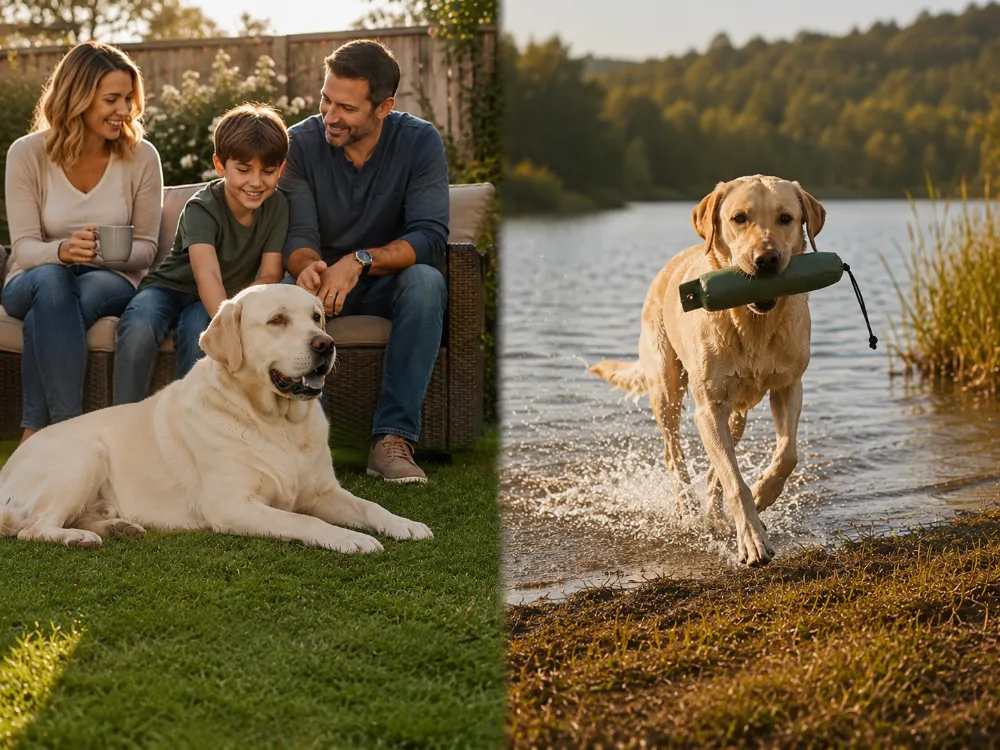
Both English and American Labradors are usually friendly, social, affectionate, and intelligent. The difference is often intensity. English Labs are often steadier and more relaxed after maturity. American Labs are often more driven, alert, active, and work-focused.
| Temperament Trait | English Labrador | American Labrador |
|---|---|---|
| General mood | Friendly, steady, sociable | Friendly, intense, eager, athletic |
| Energy expression | Playful but often more settled | Highly active and ready to work |
| Human focus | Strong family bond | Strong handler focus when trained |
| Drive | Moderate to high | High to very high |
| Common challenge | Weight gain, stubborn food-seeking, puppy silliness | Overexcitement, pulling, restlessness, under-stimulation |
Temperament is not guaranteed by type. A well-bred field Lab can be stable and gentle. A poorly bred show Lab can be hyper or anxious. Always evaluate the individual dog and the breeder’s selection goals.
Energy Level
American Labs usually have higher energy and stronger working drive. They are often bred to retrieve, run, swim, mark fallen birds, respond to whistles, and work at distance. That kind of dog needs real activity.
English Labs usually need exercise too, but many are easier to settle indoors, especially after puppyhood. They may be more suitable for families who want a Labrador personality without the same level of field intensity.
Daily exercise may include:
Long walks
Fetch
Swimming
Retrieving games
Obedience training
Scent games
Food puzzles
Hiking
Field or gundog training
A bored Labrador of either type can become destructive. Chewing, digging, barking, jumping, counter-surfing, and stealing food are common signs that a Lab needs better structure.
Training Differences
Both English and American Labs are highly trainable. They are usually food-motivated, people-oriented, and eager to engage. The difference is often training style and intensity.
American Labs may learn quickly but can be fast, excitable, and easily over-aroused. They often need clear structure, impulse control, recall, steadiness, and calm focus around distractions. English Labs may be slightly easier for average families, but they still need consistency.
Important training goals include:
Loose-leash walking
Reliable recall
Polite greetings
Drop it and leave it
Crate comfort
Calm behavior indoors
Impulse control around food
Not jumping on guests
Safe retrieving rules
Swimming recall and water safety
Hunting and Working Ability
American Labs are often the first choice for serious hunting, field trials, hunt tests, and high-level retrieving work. Their lean build, stamina, speed, drive, and focus make them excellent field dogs when properly trained.
English Labs can also hunt and retrieve. Many have strong retrieving instincts and enjoy water work. However, they are more often bred for show, companionship, therapy work, or calm family life rather than intense field performance.
| Working Trait | English Labrador | American Labrador |
|---|---|---|
| Retrieving instinct | Often strong | Usually very strong |
| Field stamina | Moderate to high | High to very high |
| Speed | Good | Often faster and more athletic |
| Steadiness | Often naturally steadier | May need more training for steadiness |
| Best working role | Companion retrieving, therapy, show, light field work | Hunting, field trials, sport, high-energy training |
Family Compatibility
Both types can be excellent family dogs. Labrador Retrievers are popular because they are usually affectionate, social, playful, and good-natured. However, they are strong dogs with powerful tails, big mouths, and high enthusiasm.
An English Lab may be better for many family homes because it is often more settled and less intense. An American Lab may fit very active families who hike, run, swim, hunt, train, or spend a lot of time outdoors.
Family suitability depends on:
Exercise routine
Training commitment
Children’s ages
Dog’s energy level
Space at home
Time alone each day
Owner experience
Breeder quality
A Labrador puppy of either type can be a lot of work. Families should prepare for months of chewing, jumping, house training, leash training, and daily exercise.
Which Type Is Better With Children?
Both English and American Labs can be good with children when properly bred, trained, and supervised. English Labs are often a little easier for households with young children because they may be stockier, calmer, and less frantic after maturity. American Labs may be too energetic for some small children unless carefully trained.
Important child safety rules include:
Do not let children climb on the dog.
Teach children not to pull ears, tail, or fur.
Supervise all dog-child interactions.
Train the dog not to jump on children.
Do not allow rough teasing or food guarding situations.
Give the dog a quiet resting place.
Teach children to respect the dog’s body language.
A friendly Labrador can still knock down a child by accident. Training and supervision matter more than type.
Which Type Is Better for First-Time Owners?
An English Lab is often easier for first-time owners because it is usually less intense than a field-bred American Lab. The stockier show-line dog may still be playful and energetic, but many are easier to manage in ordinary family life.
An American Lab can be a good first dog only if the owner is active, patient, and ready for structured training. A field-bred Lab with too little exercise can become difficult quickly.
First-time owners should look for:
Calm parent dogs
Health-tested breeding lines
Good early socialization
A breeder who matches puppy temperament to home
A realistic exercise plan
A training class or trainer support
A clear plan for puppy chewing and jumping
Apartment Living
A Labrador can live in an apartment if it receives enough exercise, training, mental stimulation, and outdoor time. However, an apartment is usually easier with a calmer English Lab than with a high-drive American Lab.
Apartment owners must manage:
Daily walks
Noise control
Elevator and hallway manners
Potty schedule
Shedding
Chewing prevention
Indoor calm training
Safe access to exercise areas
A young American Lab in an apartment can become restless if under-exercised. A mature English Lab may adapt more easily, but it still needs activity and structure.
Health Comparison
English and American Labradors share many of the same health risks because they are the same breed. The biggest differences are often related to body condition and activity. English Labs may be more prone to obesity if overfed. American Labs may be more prone to sports injuries if overworked or under-conditioned.
Common Labrador health concerns include:
Hip dysplasia
Elbow dysplasia
Obesity
Ear infections
Allergies and skin problems
Exercise-induced collapse in some lines
Progressive retinal atrophy and other eye conditions
Cruciate ligament injuries
Bloat risk in some individuals
Arthritis in older dogs
Responsible breeding and lifelong weight control are essential for both types. A lean Labrador is usually healthier than an overweight one, regardless of whether it is English or American.
Health Testing to Ask For
A good Labrador breeder should provide health testing information for the parent dogs. Do not accept vague statements such as “our dogs are healthy” without documentation.
Useful health testing may include:
Hip evaluation
Elbow evaluation
Eye examination
Genetic testing for relevant inherited diseases
Exercise-induced collapse testing where appropriate
Progressive retinal atrophy testing where appropriate
Cardiac evaluation if recommended
Clear veterinary records
Good breeders care about temperament as much as appearance. A Labrador should be friendly, stable, confident, and suitable for the home it is going to.
Weight Management
Labradors are famous for loving food. Both English and American Labs can become overweight if overfed. English Labs may look naturally stockier, but stocky should not mean fat. American Labs may stay leaner with heavy activity, but they can still gain weight if calories exceed exercise.
Healthy weight management includes:
Measuring food instead of free-feeding
Using treats carefully during training
Maintaining regular exercise
Checking body condition every few weeks
Reducing calories after neutering if needed
Using part of meals as training rewards
Asking a veterinarian for an ideal weight plan
A Labrador should have a waist and should not feel like a barrel under the hands. Excess weight increases joint stress and can shorten quality of life.
Grooming and Shedding
Both English and American Labs shed. Their short double coat is water-resistant, but it drops hair throughout the year and heavily during seasonal shedding periods.
Basic grooming needs include:
Brushing several times per week
More brushing during shedding season
Regular ear checks
Nail trimming
Dental care
Bathing when dirty or smelly
Checking paws after field work or swimming
Labs that swim often may need extra ear care because moisture can contribute to ear infections. Their floppy ears reduce airflow, making ear checks important.
Swimming and Water Drive
Both English and American Labradors usually love water. The breed was developed as a retrieving dog with a dense coat, strong tail, webbed feet, and enthusiasm for carrying objects. Many Labs enjoy swimming, dock diving, retrieving toys, and playing in lakes or safe rivers.
American Labs may show more intense retrieving and water-drive in working lines. English Labs may still love water but may be less frantic or more casual, depending on the individual dog.
Water safety tips include:
Introduce swimming gradually.
Use a dog life jacket in deep or moving water.
Avoid icy, polluted, or fast-moving water.
Rinse after swimming in saltwater or dirty water.
Dry ears after swimming.
Do not allow repeated high-impact water retrieves without rest.
Behavior Problems to Watch For
Most Labrador behavior problems come from a mismatch between energy, training, and owner expectations. Labs are friendly, but friendliness does not replace manners. A 70-pound excited dog can be difficult even if it is happy.
Common problems include:
Jumping on people
Pulling on leash
Chewing furniture
Stealing food
Counter-surfing
Digging
Barking from boredom
Rough play
Overexcitement around guests
Ignoring recall when distracted
American Labs may show these problems more intensely if under-stimulated. English Labs may show them too, especially during puppyhood and adolescence.
English Lab Pros and Cons
| Pros | Cons |
|---|---|
| Often calmer and steadier | Can still be energetic as puppies |
| Classic stocky Labrador appearance | May gain weight easily |
| Often easier for average family homes | May be less intense for serious field work |
| Usually friendly and sociable | Still needs training and exercise |
| Good for show, therapy, companionship, and family life | Can be expensive from quality show lines |
American Lab Pros and Cons
| Pros | Cons |
|---|---|
| Highly athletic and trainable | May be too energetic for casual homes |
| Excellent for hunting, sport, and field work | Needs serious exercise and mental work |
| Lean, fast, and responsive | Can become restless if under-stimulated |
| Often strong retrieving and water drive | May need more impulse-control training |
| Great for active handlers | Not ideal for owners wanting a relaxed couch companion |
Which Type Is Better for Hunting?
American Labs are usually better for serious hunting, field trials, and high-level retrieving work because many are bred specifically for those jobs. They often have more stamina, speed, marking ability, and drive.
English Labs can still hunt, especially if they come from dual-purpose or working-capable lines. They may be steadier and easier to live with, but some may lack the extreme field intensity desired by competitive handlers.
If hunting is a major goal, choose a puppy from parents that actually work in the field, not simply a dog labeled English or American.
Which Type Is Better as a Family Pet?
For many ordinary families, an English Lab is often the easier choice. The typical English Lab has a steadier temperament, stockier body, and slightly lower intensity. It may fit better in homes where the dog will be a companion rather than a hunting or sport partner.
An American Lab can be a fantastic family pet for active families. It may be ideal for people who love hiking, running, swimming, training, and outdoor routines.
Choose an English Lab if you want:
A calmer family companion
A classic blocky Labrador look
A dog more likely to settle indoors
A show or therapy-type temperament
Choose an American Lab if you want:
A high-energy working companion
A hunting or sport dog
A leaner athletic build
A dog that thrives on daily training and action
How to Choose a Good Breeder
The breeder matters more than the label. A responsible breeder should produce healthy, stable, well-socialized puppies suited to their future homes. A poor breeder can produce difficult dogs of either type.
Look for a breeder who:
Health-tests parent dogs
Explains show and field lines honestly
Allows you to meet or learn about the parents
Raises puppies in a clean, enriched environment
Matches puppies to homes by temperament
Answers questions clearly
Does not sell only by color
Does not promise impossible perfection
Provides records and a contract
Will take the dog back or help if rehoming is ever needed
Be cautious of breeders who focus only on “English blockhead,” “rare color,” or “champion blood” without discussing health, temperament, and daily lifestyle fit.
Adoption and Rescue Options
Many Labradors and Labrador mixes are available through shelters and rescue groups. Adult dogs can be excellent choices because their size, energy, temperament, and behavior are already visible.
Adopting an adult Lab may help you avoid surprises about:
Energy level
Adult size
Shedding level
Behavior around children
Behavior around other dogs
House training
Leash manners
Ability to settle indoors
If you want a calmer family dog, a mature English-type Lab may be easier than a high-drive puppy. If you want a field partner, a rescue may still be possible, but working ability and training history should be evaluated carefully.
Common Myths About English and American Labs
Myth: English and American Labs are separate breeds.
Fact: They are both Labrador Retrievers.Myth: English Labs are lazy.
Fact: They are often calmer, but they still need daily exercise and training.Myth: American Labs are too hyper for families.
Fact: Many are excellent family dogs in active homes with good training.Myth: Coat color tells you the type.
Fact: Black, yellow, and chocolate Labs can be English or American.Myth: English Labs cannot hunt.
Fact: Many can retrieve and hunt, though field-bred American Labs are usually more specialized.Myth: American Labs are always healthier because they are leaner.
Fact: Health depends on genetics, testing, weight control, and care.
How to Tell Them Apart Quickly
To identify an English vs American Labrador, look at the whole dog rather than one feature.
Quick clues for an English Lab:
Broad blocky head
Shorter-looking muzzle
Thick neck
Wide chest
Stocky body
Shorter legs
Calmer, steadier presence
Quick clues for an American Lab:
Narrower head
Longer muzzle
Leaner body
Longer legs
More athletic outline
Higher energy
Stronger field-drive impression
Final Takeaway
English and American Labradors are two broad types within the same breed. English Labs are usually show or bench-bred, with a stockier body, broader head, thick neck, and often calmer household style. American Labs are usually field or working-bred, with a leaner body, longer legs, narrower head, and higher energy.
Neither type is automatically better. The English Lab is often easier for many families, first-time owners, and people wanting a classic companion. The American Lab is often better for hunters, sport handlers, runners, and very active homes.
The best Labrador is not simply English or American. It is a healthy, well-bred, well-matched dog whose energy, temperament, structure, and training needs fit your real life.
FAQs About English vs American Labrador Dogs
Are English and American Labradors different breeds?
No. English and American Labradors are the same breed, Labrador Retriever. The terms describe different breeding styles: show or bench type versus field or working type.
What is the main difference between an English Lab and an American Lab?
The main difference is body type and energy. English Labs are usually stockier, broader-headed, and calmer. American Labs are usually leaner, longer-legged, more athletic, and higher-energy.
Which Labrador is calmer, English or American?
English Labs are often calmer and more settled, especially after maturity. American Labs are usually more intense and energetic, but individual temperament varies.
Which Labrador is better for families?
English Labs are often easier for average family homes because they tend to be steadier. American Labs can be excellent family dogs for active families that provide plenty of exercise and training.
Which Labrador is better for hunting?
American Labs are usually better for serious hunting and field work because many are bred for retrieving drive, stamina, speed, and responsiveness.
Can English Labs hunt?
Yes. Many English Labs can retrieve and hunt, especially if trained well. However, they are usually less specialized for intense field competition than American field-bred Labs.
Are English Labs bigger than American Labs?
English Labs often look heavier and stockier, while American Labs often look taller and leaner. Their official size ranges overlap because they are the same breed.
Do English Labs shed more than American Labs?
Both types shed. Shedding depends on coat density, season, grooming, health, and individual genetics. Neither type is low-shedding.
Are English or American Labs hypoallergenic?
No. Labrador Retrievers are not hypoallergenic. Both types shed and produce dander, saliva proteins, and other allergens.
Which Labrador is easier to train?
Both are highly trainable. American Labs may have more drive and speed, which is useful for field work but may require more control. English Labs may be easier for average household obedience.
Which Labrador is better for first-time owners?
An English Lab is often better for first-time owners because it is usually less intense. However, breeder quality, puppy temperament, and training commitment matter more than the label.
Do American Labs need more exercise?
Usually yes. American Labs are often bred for field work and may need more vigorous daily exercise and mental stimulation than English Labs.
Can an American Lab live in an apartment?
Yes, but only with enough exercise, training, and mental work. A high-drive American Lab may struggle in an apartment if under-stimulated.
What colors do English and American Labs come in?
Both English and American Labs can be black, yellow, or chocolate. Color does not determine whether a Lab is English or American.
How do I choose between an English and American Labrador?
Choose an English Lab if you want a calmer, stockier family companion. Choose an American Lab if you want a high-energy field, sport, or hunting partner. In both cases, choose a responsible breeder or rescue and match the dog to your lifestyle.