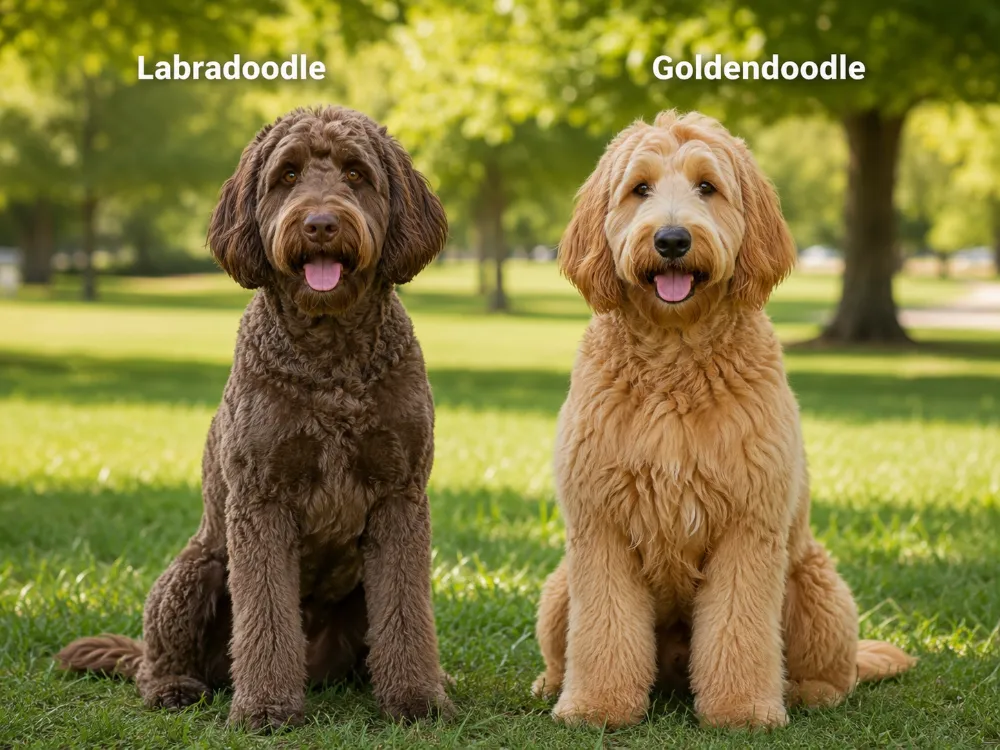
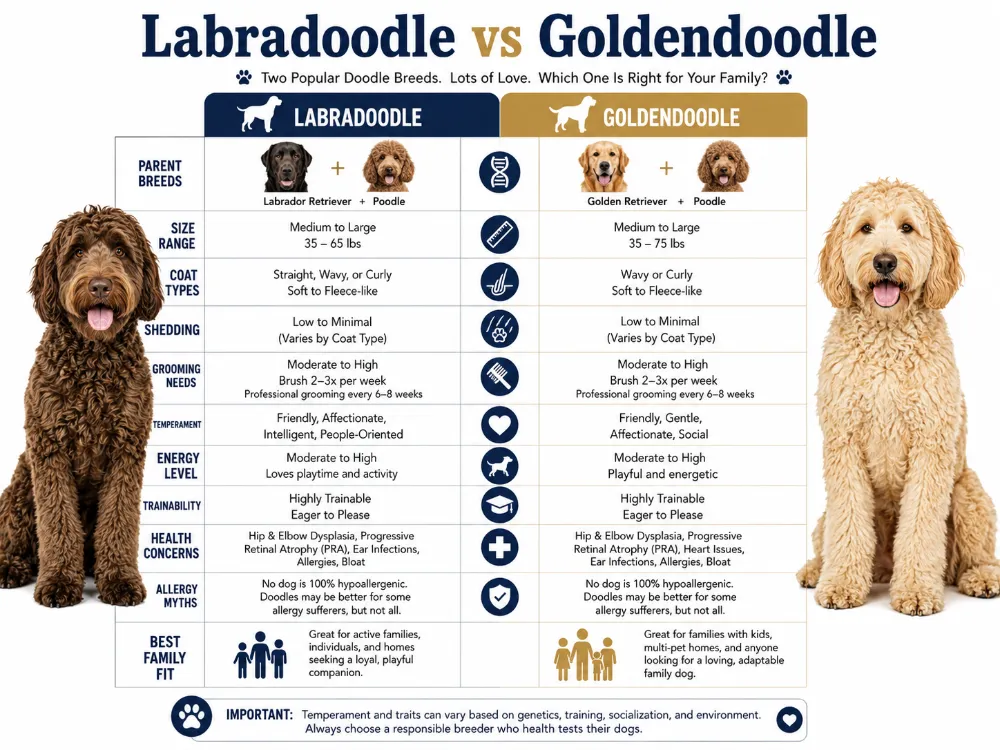
Labradoodles and Goldendoodles are both popular Poodle mixes, but they are not identical. A Labradoodle is usually a Labrador Retriever and Poodle cross, while a Goldendoodle is a Golden Retriever and Poodle cross. Labradoodles are often more athletic, bouncy, and work-oriented; Goldendoodles are often softer, more people-focused, and affectionate. However, coat, size, shedding, and temperament vary widely by generation, breeder, and parent dogs.
| Feature | Labradoodle | Goldendoodle | Quick Takeaway |
|---|---|---|---|
| Parent breeds | Labrador Retriever + Poodle | Golden Retriever + Poodle | Both are Poodle crosses, but the retriever parent differs. |
| Typical personality | Energetic, playful, social, athletic, often very food-motivated | Affectionate, gentle, social, eager to please, often very people-oriented | Labradoodles may be more high-drive; Goldendoodles may be softer and more cuddly. |
| Energy level | Moderate to high | Moderate to high | Both need daily exercise and mental stimulation. |
| Trainability | Usually high, but may be excitable | Usually high, often very eager to please | Both respond best to positive, consistent training. |
| Coat type | Can be straight, wavy, fleece-like, or curly | Can be straight, wavy, fleece-like, or curly | Coat type is not guaranteed in either mix. |
| Shedding | Low to moderate, depending on coat genetics | Low to moderate, depending on coat genetics | Neither is automatically non-shedding. |
| Allergy friendliness | May be better for some allergy sufferers, but not guaranteed | May be better for some allergy sufferers, but not guaranteed | No Doodle is truly hypoallergenic for everyone. |
| Grooming needs | High if wavy or curly | High if wavy or curly | Both need brushing, trimming, ear care, and professional grooming. |
| Best for | Active families, outdoor owners, training-focused homes | Families wanting a friendly, affectionate, people-loving companion | Choose based on the individual puppy and breeder, not just the label. |
| Main caution | Can be energetic, mouthy, or hard to manage without training | Can develop separation stress if left alone too much | Both need structure, grooming, exercise, and socialization. |
What Is a Labradoodle?
A Labradoodle is a cross between a Labrador Retriever and a Poodle. The Poodle parent may be standard, medium, miniature, or sometimes toy-sized, although standard Labradoodles are the most common in larger family-dog discussions.
Labradoodles were originally popularized because breeders hoped to combine the intelligence and lower-shedding coat of the Poodle with the friendly, trainable, working-dog nature of the Labrador Retriever. In real life, Labradoodles can inherit different traits from either side of the family.
A typical Labradoodle may be:
Friendly and outgoing
Energetic and playful
Highly food-motivated
Good at training when focused
Strong, athletic, and active
Social with people and other dogs
Sometimes bouncy, mouthy, or overly excited as a young dog
Because Labrador Retrievers were bred as active working retrievers, many Labradoodles need more exercise and training than first-time owners expect.
What Is a Goldendoodle?
A Goldendoodle is a cross between a Golden Retriever and a Poodle. Like Labradoodles, Goldendoodles can vary in size depending on the Poodle parent. Standard Goldendoodles are often medium to large dogs, while mini Goldendoodles are smaller but still active.
Goldendoodles became popular because many families wanted a dog with the affectionate, gentle personality of a Golden Retriever and the intelligence and coat qualities of a Poodle. Many Goldendoodles are friendly, social, and emotionally sensitive dogs.
A typical Goldendoodle may be:
Affectionate and people-focused
Gentle and friendly
Playful and energetic
Eager to please
Good with children when properly socialized
Social with other dogs
Prone to clinginess if not taught independence
Goldendoodles are often wonderful companion dogs, but they are not low-maintenance teddy bears. They still need exercise, training, grooming, and time with their family.
Labradoodle vs Goldendoodle: Main Difference
The main difference is the retriever parent. A Labradoodle has Labrador Retriever ancestry, while a Goldendoodle has Golden Retriever ancestry. Both have Poodle ancestry, so both can be intelligent, trainable, curly-coated, and low-shedding compared with many other dogs.
The Labrador side may bring more athletic drive, food motivation, confidence, and physical enthusiasm. The Golden Retriever side may bring more emotional softness, affection, and people-focused behavior. These are general tendencies, not strict rules.
The individual puppy matters more than the name. A calm Labradoodle from carefully selected parents may be easier than a hyper Goldendoodle from poor breeding. A confident Goldendoodle may be more independent than a clingy Labradoodle. Genetics, early socialization, training, and breeder quality are crucial.
Temperament Comparison
Both Labradoodles and Goldendoodles are usually bred as companion dogs. They are often friendly, sociable, intelligent, and eager to interact with people. However, the emotional style can differ.
| Temperament Trait | Labradoodle | Goldendoodle |
|---|---|---|
| Social behavior | Outgoing, enthusiastic, often playful with strangers | Warm, affectionate, often gentle with familiar people |
| Energy expression | May be bouncy, athletic, and physically excited | May be playful but often more emotionally soft |
| Independence | May be slightly more confident and busy | May be more attached and people-oriented |
| Training style | Responds well to food, games, and structured work | Responds well to praise, affection, food, and gentle consistency |
| Common challenge | Jumping, pulling, chewing, overexcitement | Separation stress, clinginess, sensitivity, overfriendliness |
For families who want a more athletic adventure dog, a Labradoodle may be a better fit. For families who want a softer, cuddly, people-centered companion, a Goldendoodle may be more appealing.
Size Comparison
Both Labradoodles and Goldendoodles come in different sizes because Poodles also come in different sizes. A standard Poodle parent usually produces larger Doodles, while a miniature Poodle parent produces smaller Doodles.
| Size Type | Labradoodle | Goldendoodle | Notes |
|---|---|---|---|
| Mini | Often about 15–30 lb | Often about 15–35 lb | Size varies widely depending on parent dogs. |
| Medium | Often about 30–50 lb | Often about 30–50 lb | Popular for families wanting a manageable companion. |
| Standard | Often about 50–80+ lb | Often about 50–90 lb | Large individuals need space, training, and strength control. |
Do not choose a puppy based only on the label “mini” or “standard.” Ask for the actual weights of the parents, grandparents, and previous litters. Mixed-breed size can be less predictable than purebred size.
Coat Differences
Both Labradoodles and Goldendoodles can have several coat types. This is one of the most misunderstood parts of Doodle ownership. Not every Doodle has a soft, curly, low-shedding coat.
Common coat types include:
Straight coat: More retriever-like, often easier to brush but more likely to shed.
Wavy coat: Often soft and teddy-bear-like, but still needs frequent brushing.
Curly coat: More Poodle-like, often lower-shedding but prone to matting.
Fleece-like coat: Soft and popular, but requires regular grooming.
Hair coat: More like a Labrador or Golden coat, usually more shedding.
Labradoodles may sometimes inherit a coarser or more Labrador-like coat. Goldendoodles may often have a softer, longer, Golden-like wave. However, both mixes can produce straight, wavy, or curly puppies.
Shedding and Allergy Friendliness
Neither Labradoodles nor Goldendoodles are guaranteed to be non-shedding or hypoallergenic. Some individuals shed very little. Others shed much more, especially if they inherit a retriever-like coat.
Dog allergies are usually triggered by proteins found in dander, saliva, and urine, not just visible hair. A low-shedding coat may reduce loose hair and dander spread, but it does not make the dog allergen-free.
For allergy-sensitive homes, consider:
Meeting the individual dog before adoption
Spending time with the puppy’s parents if possible
Choosing a reputable breeder who understands coat genetics
Considering an adult dog with a known coat and shedding pattern
Keeping grooming consistent
Using washable bedding and air filtration
Creating dog-free sleeping areas if allergies are serious
If someone in the household has severe dog allergies, do not assume a Doodle will solve the problem. A purebred Poodle or another lower-shedding breed with a predictable coat may be a safer choice.
Grooming Needs
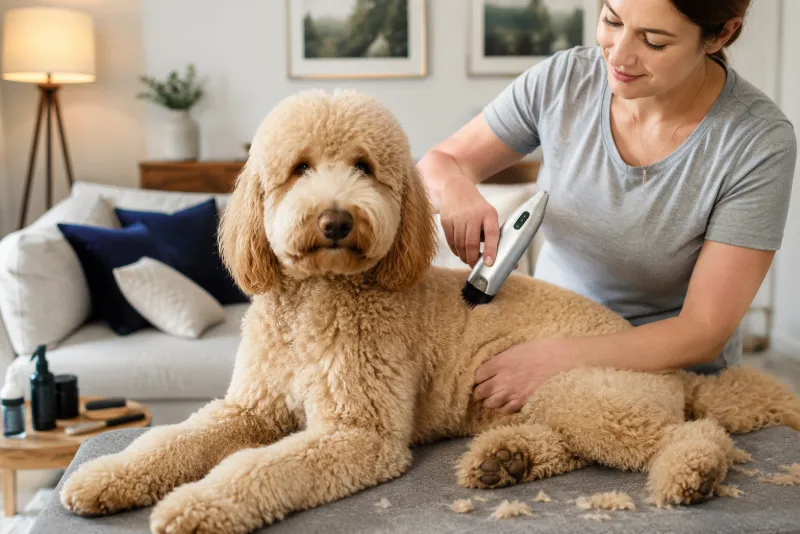
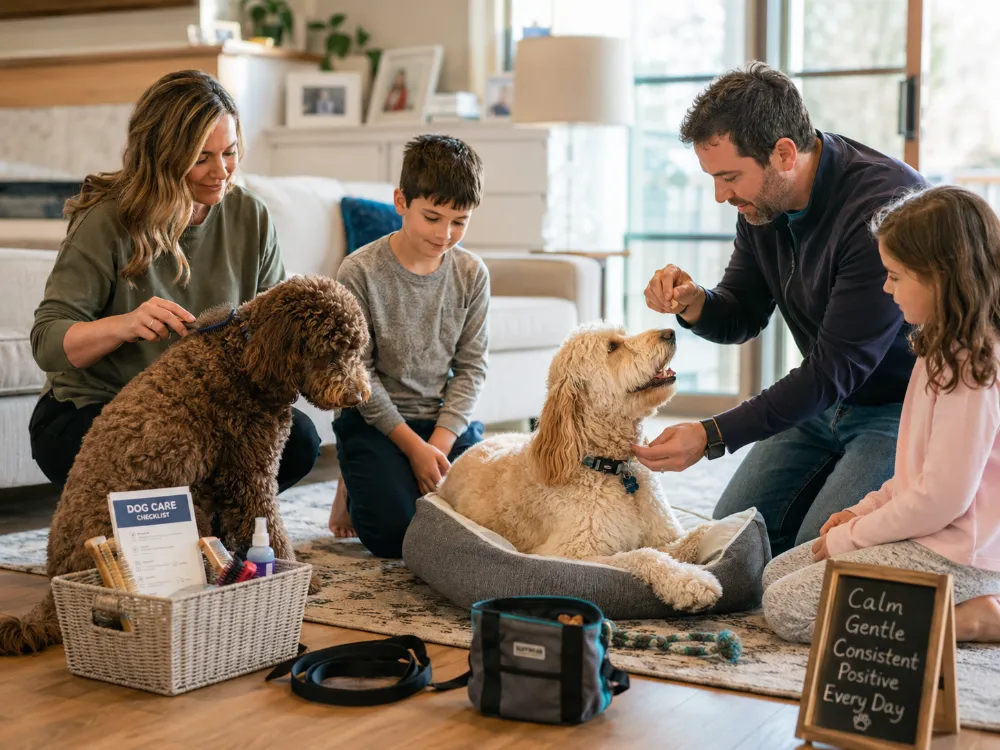
Both Labradoodles and Goldendoodles are high-grooming dogs when they have wavy, fleece, or curly coats. Their coats can trap loose hair instead of dropping it on the floor. This may reduce shedding, but it also increases matting risk.
Basic grooming needs include:
Brushing several times per week
Daily brushing for longer or curlier coats
Professional grooming every 6 to 8 weeks for many dogs
Regular ear cleaning and ear checks
Nail trimming
Dental care
Trimming around eyes, paws, and sanitary areas
Matting is not just a cosmetic problem. Tight mats can pull on the skin, trap moisture, cause pain, hide wounds, and increase skin infection risk. Many Doodle owners underestimate grooming cost and time.
Exercise Needs
Labradoodles and Goldendoodles are both active dogs. They are not ideal for owners who want a low-energy couch companion unless adopting an older, calmer individual.
Most need daily exercise such as:
Walks
Fetch
Swimming when safe
Training games
Food puzzles
Hide-and-seek
Leash skills practice
Dog sports or agility-style play
Labradoodles often have a more athletic, go-go-go style, especially when they strongly inherit Labrador energy. Goldendoodles are also active but may be more likely to seek affection and human closeness after exercise.
Training and Intelligence
Both mixes are usually intelligent because Poodles, Labradors, and Golden Retrievers are all highly trainable dogs. Intelligence is a gift only when paired with structure. A smart, bored Doodle can become a smart problem-maker.
Training should focus on:
Loose-leash walking
Polite greetings
Recall
Crate comfort
Being calm around guests
Handling and grooming tolerance
Impulse control
Alone-time training
Drop it and leave it
Labradoodles may need extra work on jumping, pulling, mouthiness, and excitement control. Goldendoodles may need extra work on independence, confidence, and not becoming overly dependent on constant human attention.
Family Compatibility
Both Labradoodles and Goldendoodles can be excellent family dogs when bred, trained, and socialized well. They are often friendly with children, playful, and eager to be part of family life.
However, size and energy matter. A large young Doodle can accidentally knock over small children or elderly adults. A high-energy puppy may chew, jump, steal food, and demand more attention than expected.
| Family Type | Better Fit | Reason |
|---|---|---|
| Very active outdoor family | Labradoodle | Often athletic and energetic, especially with Labrador drive. |
| Family wanting a gentle cuddle companion | Goldendoodle | Often affectionate, soft, and people-focused. |
| First-time dog owner | Either, but choose carefully | A calm adult or well-bred puppy is more important than the mix label. |
| Family with allergies | Neither guaranteed | Meet the dog first and consider coat genetics carefully. |
| Apartment living | Smaller, calmer individual of either mix | Exercise, grooming, and noise control matter more than breed name. |
Which Is Better With Children?
Both can be good with children. Goldendoodles are often described as gentle and emotionally soft, while Labradoodles are often playful and energetic. The best dog for children is calm, tolerant, well-socialized, and trained to behave politely.
Important child-safety rules include:
Teach children not to climb on dogs
Do not let children pull ears, tails, or fur
Supervise all dog-child interactions
Train the dog not to jump on children
Give the dog a quiet resting area
Teach children to respect growling, hiding, or avoidance
A gentle Goldendoodle can still jump. A playful Labradoodle can still be careful. Training and supervision make the difference.
Which Is Better for First-Time Owners?
A Goldendoodle may be slightly easier for some first-time owners because many are eager to please and emotionally responsive. However, a poorly bred or undertrained Goldendoodle can still be difficult. A Labradoodle may suit a first-time owner who is active, consistent, and ready for training.
First-time owners should avoid choosing only by appearance. The cute teddy-bear coat can hide a dog that needs serious grooming, exercise, and behavior guidance.
A first-time owner should look for:
A responsible breeder or rescue
Stable parent temperaments
Health testing
Early puppy socialization
A realistic grooming plan
Training support
A puppy or adult dog matched to lifestyle
Which Is Better for Apartments?
Neither mix is automatically an apartment dog, but either can live in an apartment if the individual dog is the right size, receives enough exercise, and is trained to settle indoors.
Apartment owners should consider:
Adult size
Energy level
Barking tendency
Elevator and hallway manners
Daily walking schedule
Grooming space
Ability to tolerate alone time
A mini or medium Goldendoodle may be easier for some apartment homes. A medium Labradoodle can also do well if the owner provides enough exercise and training. A large, untrained, high-energy Doodle of either type can be difficult in small spaces.
Health Comparison
Labradoodles and Goldendoodles can inherit health risks from both the Poodle side and the retriever side. Mixed-breed dogs are not automatically healthy. Responsible breeding still matters.
Potential health concerns may include:
Hip dysplasia
Elbow dysplasia
Eye disease
Ear infections
Allergies and skin problems
Progressive retinal atrophy
Patellar luxation in smaller lines
Hypothyroidism
Epilepsy in some lines
Certain cancers, especially from retriever lines
Bloat risk in large, deep-chested dogs
Because both mixes have floppy ears and often grow hair around the ear canal, ear care is important. Moisture, swimming, allergies, and poor airflow can increase ear infection risk.
Health Testing to Ask For
A responsible breeder should not simply say, “Doodles are healthier because they are mixed.” Ask for real health testing on the parent dogs. The exact tests depend on the parent breeds and size lines.
Useful health checks may include:
Hip evaluation
Elbow evaluation
Eye exams
Genetic testing for known Poodle and retriever conditions
Cardiac screening when appropriate
Patella evaluation for smaller dogs
Clear veterinary records
Temperament assessment of parents
Good breeders welcome questions. Be cautious if a breeder focuses only on color, size, or “hypoallergenic” claims while avoiding health and temperament documentation.
Generations: F1, F1B, and Multigenerational Doodles
Doodle generations affect coat, shedding, and predictability. These labels can be confusing, but they matter when comparing puppies.
| Generation | Meaning | Possible Coat Result |
|---|---|---|
| F1 | Purebred retriever parent crossed with purebred Poodle parent | Often variable; may be straight, wavy, or curly |
| F1B | F1 Doodle bred back to a Poodle | Often more Poodle-like and lower-shedding, but not guaranteed |
| F2 | Two F1 Doodles bred together | Can be very variable |
| Multigenerational | Doodle bred from several generations of selected Doodles | May be more predictable if breeder carefully selects traits |
If coat predictability is important, generation and parent coat genetics matter. For allergy-sensitive owners, an adult dog with a known coat may be more predictable than a young puppy.
Labradoodle Pros and Cons
| Pros | Cons |
|---|---|
| Often athletic, fun, and outgoing | Can be very energetic and bouncy |
| Usually intelligent and trainable | May become destructive if bored |
| Can suit active families and outdoor lifestyles | Needs consistent exercise and manners training |
| May be lower-shedding depending on coat | Coat and shedding are not guaranteed |
| Often social with people and dogs | Can be mouthy or overexcited as a puppy |
Goldendoodle Pros and Cons
| Pros | Cons |
|---|---|
| Often affectionate and gentle | Can become clingy or anxious if not taught independence |
| Usually eager to please and trainable | May be overfriendly and excitable with guests |
| Often excellent with family life | Still needs exercise, grooming, and structure |
| May have a soft, teddy-bear coat | That coat can mat badly without maintenance |
| Often emotionally responsive | May be sensitive to harsh handling or long isolation |
Which One Is Easier to Groom?
Neither is truly easy to groom if it has a wavy or curly Doodle coat. A straight-coated Labradoodle or Goldendoodle may be easier to brush but may shed more. A curly-coated Doodle may shed less but require more brushing, combing, and professional trims.
Many owners make the mistake of brushing only the top layer. Mats often form close to the skin, especially behind the ears, under the collar, in the armpits, around the tail, under the legs, and on the chest.
Useful grooming tools may include:
Slicker brush
Metal comb
Detangling spray
Ear cleaner recommended by a veterinarian
Nail clippers or grinder
Professional grooming appointment schedule
If you cannot commit to grooming, a Labradoodle or Goldendoodle may not be the right choice.
Which One Is Better for Allergies?
Neither is guaranteed better for allergies. The best choice depends on the individual dog’s coat, dander, saliva proteins, grooming routine, and the allergic person’s sensitivity.
In general, curlier, more Poodle-like coats may shed less visible hair. However, lower shedding does not mean allergen-free. A person may react strongly to one Labradoodle and tolerate another, or react to a Goldendoodle but not a Poodle.
For allergy concerns, the safest steps are:
Spend time with the individual dog before committing
Meet adult relatives if buying a puppy
Ask about coat testing and shedding history
Consider adopting an adult dog with known shedding
Do not trust “100% hypoallergenic” claims
Which One Is Calmer?
Goldendoodles are often perceived as calmer or softer, especially after puppyhood, but this is not guaranteed. Labradoodles can also be calm if well-bred, well-exercised, and trained. Puppyhood for both mixes can be energetic and demanding.
Calm behavior comes from:
Stable genetics
Proper early socialization
Enough exercise
Mental enrichment
Clear household rules
Teaching the dog how to settle
Avoiding constant overstimulation
If you want a calm dog, consider adopting an adult Labradoodle or Goldendoodle whose temperament is already visible.
Which One Is Smarter?
Both are usually very smart. Poodles, Labrador Retrievers, and Golden Retrievers are all known for trainability and working ability. The difference is less about intelligence and more about motivation.
A Labradoodle may be more driven by food, activity, and games. A Goldendoodle may be more driven by human approval, affection, and social connection. Both can learn quickly, but both can also learn bad habits quickly.
Smart Doodles need training, not just love. Without structure, they may invent their own activities, such as stealing socks, counter-surfing, barking, chewing furniture, or jumping on visitors.
Which One Is Better for Therapy or Service Work?
Both Labradoodles and Goldendoodles can succeed in therapy or service roles when they have the right temperament, health, training, and stability. The original appeal of Labradoodles was partly connected to the idea of an allergy-friendlier working dog, while Goldendoodles are often chosen for their gentle social nature.
However, not every Doodle is suited for service or therapy work. A good candidate must be calm, confident, predictable, healthy, focused, and comfortable in many environments.
Important traits include:
Low reactivity
Stable nerves
Strong human focus
Good body handling tolerance
Calm behavior around strangers
Trainability
Healthy joints and body structure
For service work, temperament testing and professional training matter more than whether the dog is a Labradoodle or Goldendoodle.
Choosing a Responsible Breeder
Because Doodles are popular, breeding quality varies widely. Some breeders carefully health-test, temperament-test, socialize puppies, and support buyers. Others breed mainly for profit, color, size, or trendy coat labels.
A responsible breeder should:
Health-test parent dogs
Explain coat genetics honestly
Allow questions
Discuss temperament, not only appearance
Raise puppies in a clean, enriched environment
Match puppies to homes thoughtfully
Provide veterinary records
Offer a clear contract
Take dogs back or help rehome if needed
Avoid promising that every puppy is hypoallergenic
Red flags include constant available litters, no health testing, pressure to pay quickly, no questions about your lifestyle, vague parent information, and claims that Doodles have no health or grooming issues.
Adoption and Rescue Options
Many Labradoodles and Goldendoodles are available through rescues, shelters, and breed-specific rehoming groups. Some are surrendered because owners underestimated grooming, energy, size, cost, or behavior needs.
Adopting an adult Doodle has advantages:
Adult size is known
Coat type is known
Shedding level is easier to assess
Temperament is more visible
Energy level is clearer
Some may already be house-trained
For many families, an adult dog may be a better match than a puppy, especially if allergies, apartment life, or calm temperament are priorities.
Cost of Ownership
The purchase price is only one part of Doodle ownership. Labradoodles and Goldendoodles can be expensive over their lifetime because of grooming, training, food, veterinary care, and supplies.
Common costs include:
Professional grooming
High-quality food
Training classes
Veterinary checkups
Vaccines and parasite prevention
Pet insurance or emergency savings
Dental care
Ear infection treatment if problems occur
Grooming tools
Crates, beds, toys, and enrichment items
A low-shedding coat may mean less hair on the sofa, but it often means more money spent at the groomer.
Which Doodle Should You Choose?
Choose a Labradoodle if you want a potentially athletic, playful, trainable dog and you enjoy active routines. A Labradoodle may fit well with hiking, swimming, fetch, training games, and a busy family lifestyle.
Choose a Goldendoodle if you want a potentially affectionate, gentle, people-focused companion and you can provide regular companionship, training, and grooming. A Goldendoodle may fit well with families wanting a loving, social dog that bonds closely.
Choose neither if you want a low-maintenance dog, dislike grooming, are away from home all day, want guaranteed allergy safety, or are not ready for an energetic puppy phase.
Final Takeaway
Labradoodles and Goldendoodles are both intelligent, social, active Poodle mixes, but they differ in general style. Labradoodles often lean more athletic, bouncy, and Labrador-like. Goldendoodles often lean more affectionate, gentle, and Golden Retriever-like.
Both can be wonderful family dogs, but neither is automatically hypoallergenic, low-maintenance, calm, or easy. Coat type, shedding, size, temperament, and health vary widely.
The best choice is not simply “Labradoodle vs Goldendoodle.” The best choice is a healthy, well-bred or well-matched individual dog whose energy level, grooming needs, temperament, and size fit your real life.
FAQs About Labradoodle vs Goldendoodle
What is the main difference between a Labradoodle and a Goldendoodle?
A Labradoodle is a Labrador Retriever and Poodle mix, while a Goldendoodle is a Golden Retriever and Poodle mix. Labradoodles often lean more athletic and energetic, while Goldendoodles are often softer and more affectionate.
Which is better, Labradoodle or Goldendoodle?
Neither is automatically better. Labradoodles may suit active owners who want an energetic adventure dog. Goldendoodles may suit families wanting a gentle, affectionate companion. The individual dog matters most.
Are Labradoodles or Goldendoodles calmer?
Goldendoodles are often perceived as slightly calmer or softer, but both mixes can be energetic. Calmness depends on genetics, age, training, exercise, and socialization.
Which sheds less, Labradoodle or Goldendoodle?
Either can shed less if it inherits a more Poodle-like coat. Either can also shed more if it inherits a retriever-like coat. Coat generation and individual genetics matter more than the name.
Are Labradoodles hypoallergenic?
Labradoodles are not guaranteed hypoallergenic. Some shed very little and may be tolerated by some allergy sufferers, but no dog is allergen-free for everyone.
Are Goldendoodles hypoallergenic?
Goldendoodles are not guaranteed hypoallergenic. Curly or wavy coats may shed less, but allergies depend on the individual dog and person.
Which is easier to train, Labradoodle or Goldendoodle?
Both are usually trainable. Labradoodles may be highly food- and activity-motivated, while Goldendoodles may be very eager to please. Both need consistent positive training.
Which is better with kids?
Both can be good with children if properly bred, socialized, and trained. Goldendoodles may be softer, while Labradoodles may be more playful and energetic. Supervision is important with any dog.
Which is better for apartments?
A smaller, calmer individual of either mix may do well in an apartment if exercised daily. Large, high-energy Doodles can be difficult in small spaces without training and routine.
Do Labradoodles need more exercise than Goldendoodles?
Labradoodles often need slightly more vigorous exercise because of their Labrador background, but many Goldendoodles are also highly active. Both need daily walks, play, and mental enrichment.
Which is more affectionate?
Goldendoodles are often described as very affectionate and people-focused. Labradoodles can also be loving, but they may express themselves through play, activity, and excitement.
Which has fewer health problems?
Neither mix is automatically healthier. Both can inherit problems from Poodles and retrievers. Responsible breeding, health testing, good nutrition, and veterinary care are more important than the mix name.
Are Doodles good for first-time dog owners?
They can be, but only if the owner is ready for grooming, exercise, training, and puppy energy. A calm adult Doodle may be easier for a first-time owner than a high-energy puppy.
How often do Labradoodles and Goldendoodles need grooming?
Many need brushing several times per week and professional grooming every 6 to 8 weeks. Curly and wavy coats may need even more frequent brushing to prevent mats.
Should I get a Labradoodle or Goldendoodle?
Choose a Labradoodle if you want a more athletic, playful, outgoing companion. Choose a Goldendoodle if you want a more affectionate, gentle, people-centered dog. In both cases, choose based on breeder quality and individual temperament.