Archerfish shoot water by using a specialized groove in the roof of their mouth, their tongue, and pressure generated inside the mouth and gill chambers. Together, these structures help form a narrow water jet that can knock insects from vegetation above the water. Archerfish do more than simply squirt water. Research shows that they adjust the timing of their mouth movements to shape the jet, compensate for optical and physical challenges, and learn to hit moving targets. Large individuals of some species can hit targets approximately two to three meters away.
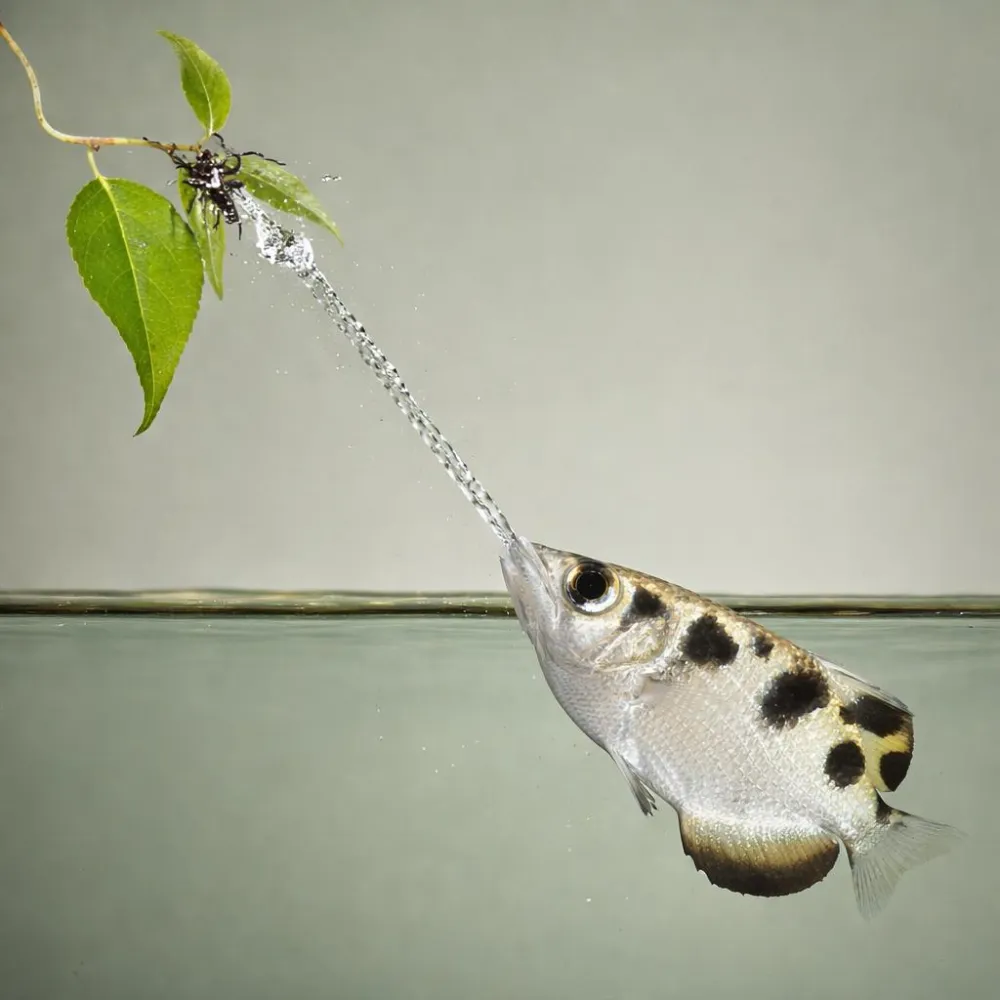
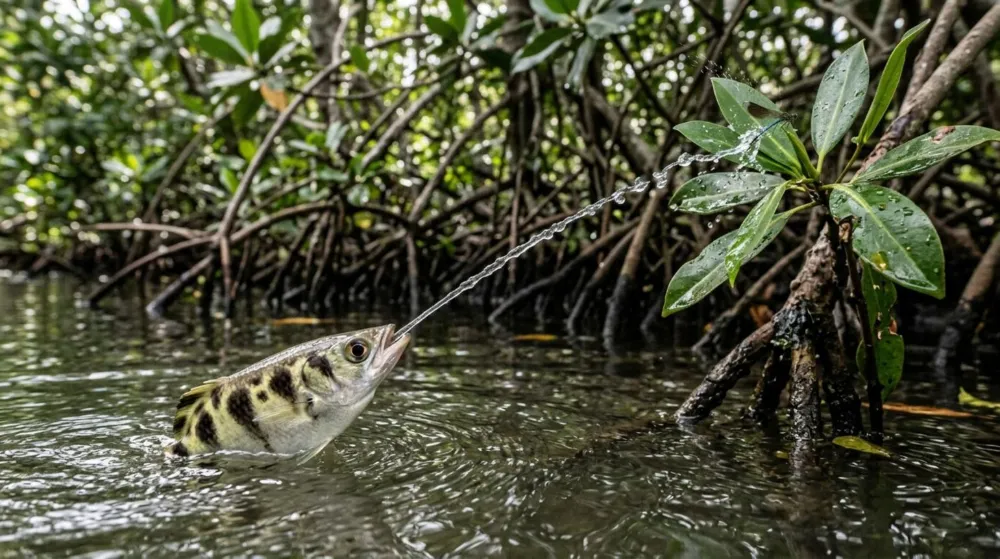
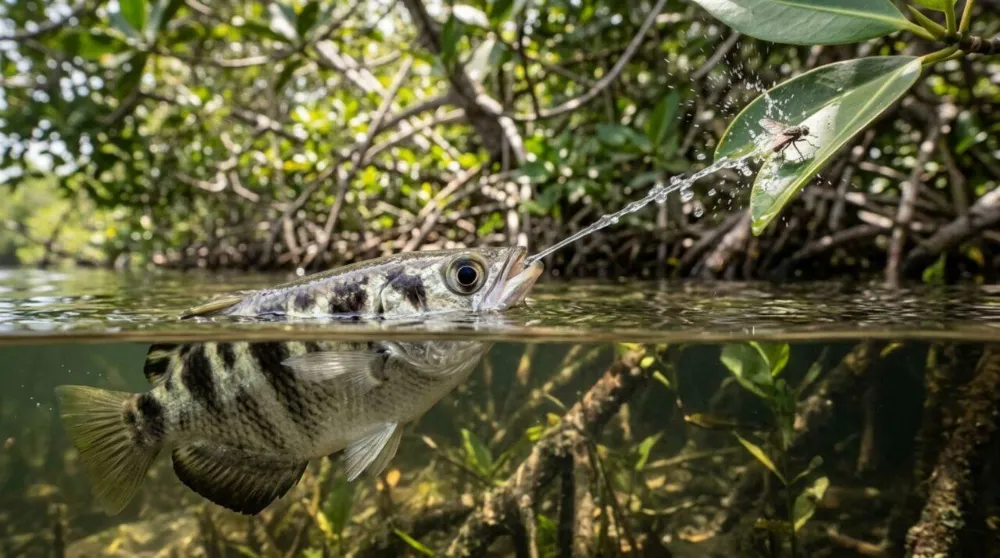
A banded archerfish can dislodge insects above the water by directing a concentrated jet toward its prey.
How Do Archerfish Shoot Water?
Archerfish are predatory fishes known for their ability to knock insects from leaves and branches above the water surface. They do this by firing a directed jet of water from their mouths.
The process begins when a fish spots a suitable target. It positions itself near the surface, usually angling its snout toward the insect. It then uses specialized mouth structures and pressure generated by movements of the oral and gill-cover system to expel water.
The shot travels through the air and strikes the target. If the insect falls into the water, the fish can quickly swim toward it and swallow it.
However, the precision of the shot depends on more than mouth anatomy. The fish must also account for distance, viewing angle, and the movement of both the target and the water jet.
What Is an Archerfish?
Archerfishes are ray-finned fishes belonging to the family Toxotidae. They live in freshwater and brackish habitats across parts of the Indo-West Pacific region.
Many have laterally compressed bodies, relatively large eyes, and silvery coloring with darker bars or spots. These markings vary among species.
The banded archerfish, Toxotes jaculatrix, is one of the best-known examples. Another extensively studied species is the sevenspot archerfish, Toxotes chatareus.
Although they are famous for shooting insects, archerfish also use ordinary underwater feeding behavior and can consume a variety of small animals.
Why Do Archerfish Spit Water at Insects?
Water shooting allows archerfish to obtain prey that is outside the water and otherwise difficult to reach.
Insects may rest on leaves or branches above rivers, mangrove channels, and other aquatic habitats. A well-aimed jet can knock them from their perch without the fish leaving the water.
The falling insect then becomes available as food.
However, the ability is not a guarantee of a meal. A shot may miss, an insect may remain attached, or another fish may reach the fallen prey first.
What Is Special About an Archerfish's Mouth?
Archerfish have anatomical features that help them form a narrow stream of water.
The Australian Museum describes a deep groove along the roof of the mouth. A raised region of the tongue fits against this groove, creating a temporary channel.
Rapid movements associated with the gill covers help force water through that channel.
The tongue also participates in controlling the opening through which the water exits.
These structures work together as a biological nozzle rather than a permanently open tube.
Does an Archerfish Have a Water Gun Inside Its Mouth?
An archerfish does not possess a separate organ equivalent to a manufactured water gun.
Instead, it modifies the shape and movement of normal fish feeding structures. Its mouth cavity, tongue, palate, and gill-cover system work together to produce a directed pulse of water.
This is an example of evolutionary specialization: structures associated with ordinary fish feeding and respiration have acquired an additional role in capturing prey above the surface.
However, archerfish anatomy should not be described as a literal pump with metal-like valves or a rigid nozzle.
How Does the Tongue Help an Archerfish Shoot?
The tongue helps create and control the channel that shapes the water stream.
As the Australian Museum explains, a ridge along the top of the tongue fits into a corresponding groove in the roof of the mouth.
This arrangement helps direct water through a relatively narrow passage.
However, the fish's shot is not produced by the tongue acting alone. Water pressure, mouth opening and closing, and the movements of surrounding structures are all important.
What Happens During an Archerfish Shot?
A typical shot involves several closely coordinated events:
The fish visually locates a target above the water.
It positions its body and mouth at a suitable angle near the surface.
The mouth and associated structures create a directed water passage.
Water is rapidly expelled from the mouth.
The fish adjusts the timing and shape of the jet so that water is concentrated near the target.
If the target falls, the fish quickly swims toward its predicted landing point.
The sequence happens rapidly, and individual movements are difficult to resolve without high-speed video.
Different species, target distances, and shooting conditions can produce variations in the process.
How Powerful Is an Archerfish's Water Jet?
An archerfish water jet can strike with enough force to knock a small insect from vegetation.
Researchers have shown that the jet's power at impact is not explained simply by the instantaneous power available from the fish's muscles.
Instead, the moving water can become concentrated into a larger mass near the target. This produces a strong, brief impact.
However, there is no single fixed force value that applies to every shot. Impact depends on water volume, velocity, distance, jet formation, and target conditions.
What Did the 2012 Water Jet Study Discover?
In 2012, Vailati, Zinnato, and Cerbino published How Archer Fish Achieve a Powerful Impact: Hydrodynamic Instability of a Pulsed Jet in Toxotes jaculatrix in PLOS ONE.
The researchers used high-speed imaging to analyze the water jets of two banded archerfish.
They observed that later-moving water could catch up with water released earlier. This caused the stream to develop a concentrated water mass near the front.
The researchers estimated an unusually high specific power at impact, approximately 3,000 watts per kilogram under the studied conditions.
However, this figure describes a calculation based on the water jet's impact dynamics. It is not the continuous metabolic power output of the entire fish.
The finding demonstrated how hydrodynamic effects outside the animal can amplify the mechanical impact of a biological movement.
Why Does Water Collect at the Tip of the Jet?
The water leaving an archerfish's mouth does not necessarily travel at a uniform speed.
If water released later moves faster than water ahead of it, the trailing portion can catch up. The stream then becomes concentrated into a larger mass of water.
This concentration increases the momentum delivered over a brief interval at impact.
The physical process is related to the behavior of moving liquid jets and their instabilities.
However, the exact shape of the water mass depends on how the fish produces the jet and how far the stream travels.
Can Archerfish Change the Shape of Their Water Jets?
Yes. Research has demonstrated that archerfish can adjust the dynamics of their water jets depending on target distance.
This means they are not limited to producing one identical pulse whenever they shoot.
By controlling how their mouths open and close, the fish influence the timing and velocity of water entering the jet.
These adjustments affect where and when water collects into a forceful mass.
Such control is especially important when the target is far from the water surface.
What Did the 2014 Jet Control Study Show?
In 2014, researchers published Archerfish Actively Control the Hydrodynamics of Their Jets in Current Biology.
The study examined how archerfish fired at targets over different distances.
Researchers found that jets traveling farther needed to remain effective for longer. The fish adjusted the time at which water became concentrated at the jet tip.
The adjustments were associated with fine control of mouth opening and closing.
As a result, the fish could arrange for a strong water mass to form shortly before reaching the target.
The findings showed that archerfish actively shape their shots rather than relying only on a fixed anatomical nozzle.
How Far Can Archerfish Shoot Water?
Large archerfish can hit targets approximately two to three meters away, according to the Australian Museum.
However, shooting range varies with species, body size, environmental conditions, and the characteristics of the target.
A fish may be capable of launching water farther than it can strike a small insect reliably.
Therefore, maximum shooting distance and typical hunting distance should not be treated as interchangeable measurements.
Can Archerfish Shoot Three Meters?
Yes. The Australian Museum describes large archerfishes as capable of hitting targets two to three meters away.
However, this does not mean every young or small archerfish can reliably hit an insect at that distance.
Long-distance shooting requires sufficient water momentum and appropriate control of the stream.
It also presents a demanding visual problem because the fish must identify the target through the water's surface.
How Do Archerfish Aim So Accurately?
Archerfish depend strongly on vision to identify targets and direct their shots.
They must align the mouth and body with a target positioned in the air while the fish itself remains underwater.
This creates several challenges. Light bends when passing between air and water, and the water jet changes direction under the influence of gravity after leaving the mouth.
Experiments show that archerfish can learn and modify their shooting behavior in response to changing physical conditions.
However, scientists do not assume that the fish consciously performs mathematical calculations like a human engineer.
What Is Refraction, and Why Does It Matter?
Refraction occurs when light changes direction as it passes between materials with different optical properties.
When an archerfish looks from water toward an insect in the air, light from the target passes through the water surface before reaching the fish's eyes.
This changes the apparent direction of the target.
A fish that did not account for the optical geometry might aim at the wrong position.
Archerfish nevertheless learn to shoot accurately under many conditions.
However, the light ray and the water jet do not follow identical paths. The water jet also experiences gravity and potentially airflow after leaving the fish's mouth.
Do Archerfish Understand Physics?
Archerfish behave as though they can account for important physical properties of their shooting task.
They adjust for target location, water-jet dynamics, and changes that disturb the trajectory.
However, this does not mean they explicitly understand Snell's law or fluid mechanics in the way a human scientist does.
The demonstrated ability is better described as sophisticated sensory-motor control supported by learning and experience.
The fish can produce effective movements without consciously deriving mathematical equations.
Can Archerfish Learn to Correct Their Aim?
Yes. A study published in 2024 investigated whether archerfish adjust their shooting movements after repeated errors.
The researchers trained fish to hit targets above an aquarium and then introduced airflow that deflected the water jets.
Immediately after the airflow began, the fish missed more often.
Over repeated trials, the shooting errors became smaller as the fish modified their movements.
When the airflow was removed, the fish temporarily made errors in the opposite direction. This aftereffect is evidence of motor adaptation.
What Did the 2024 Motor Adaptation Study Discover?
The 2024 study, The Archerfish Uses Motor Adaptation in Shooting to Correct for Changing Physical Conditions, was published in eLife.
Researchers measured the position of water-jet impacts as the fish responded to a controlled disturbance.
They found that archerfish could gradually compensate for a consistent change in the trajectory.
The study also investigated whether the animals adapted their movements in a body-centered reference frame.
Results supported the interpretation that the fish changed their motor commands based on experience.
However, the experiment does not establish that every correction to refraction in nature is learned through exactly the same mechanism.
Can Archerfish Shoot Moving Targets?
Yes. Archerfish can learn to hit moving targets under controlled experimental conditions.
This is more challenging than shooting at a stationary insect because the target changes position while the water jet is traveling.
In a 2006 study published in Current Biology, researchers demonstrated that archerfish could learn to strike rapidly moving targets.
The animals had to coordinate the motion of the target with the motion of the water stream.
However, the study involved training and specific experimental conditions. It should not be interpreted as proof that every archerfish is born with identical moving-target accuracy.
Can Archerfish Learn by Watching Other Fish?
Yes. The 2006 research also found evidence that archerfish can acquire a difficult shooting skill through observation.
In the experiments, fish were able to improve at hitting moving targets after watching another trained fish perform the task.
This is an important example of social learning in a fish.
However, observational learning does not necessarily mean the animal imitates every movement or understands another fish's intentions.
The finding is that information obtained by watching a successful performer can influence later shooting performance.
How Do Archerfish Catch Falling Insects?
Knocking an insect into the water is only the first part of a successful hunt.
Once the prey falls, the fish must reach it before competitors do.
Archerfish can perform rapid turns and swim toward the expected landing point.
A study published in 2002 demonstrated that the fish could begin a turn approximately 100 milliseconds after prey was dislodged.
Rather than simply following the insect's current location, the fish could head toward the point where the prey was expected to hit the surface.
Do Archerfish Predict Where Prey Will Land?
Research provides strong evidence that archerfish can predict the landing location of falling prey.
In the 2002 Journal of Experimental Biology study, the fish responded rapidly to prey moving through three-dimensional space.
They turned toward the anticipated point of impact at the water surface.
However, the researchers did not conclude that the fish reconstructs the entire falling trajectory in the same way as a computer simulation.
Instead, the animal appears capable of extracting key visual information that is sufficient to guide an effective interception movement.
Why Do Archerfish Need to Be Fast After Shooting?
Several fish may be attracted to a falling insect.
Sometimes the fish that dislodges the prey is not the first to reach it.
Fast interception reduces the opportunity for another animal to take the food.
This means the success of archerfish hunting depends on more than the accuracy of the water jet.
Target selection, rapid movement, and competition with other fish are all important.
Can Archerfish Shoot Underwater?
Yes. Scientists have demonstrated that archerfish can use directed water jets underwater as well as above the surface.
Research published in 2017 examined how the fish used jets to disturb bottom sediment and expose buried food.
The fish modified the duration of their shots depending on the properties of the substrate.
However, underwater shooting differs mechanically from sending a stream across the air-water boundary.
The same general mouth-control system can operate in different physical contexts.
What Did the 2017 Underwater Shooting Study Find?
Researchers trained archerfish to release jets toward food buried beneath substrate.
The fish adjusted their mouth movements and water pulses according to the material covering the food.
Brief pulses could be effective with coarse particles, while finer material was associated with longer pulses in the tested conditions.
The results suggest that the fish can adapt a specialized motor behavior to more than one feeding problem.
However, the study does not prove that every archerfish uses underwater jets equally often in its natural habitat.
Are Archerfish Intelligent?
Archerfish demonstrate several abilities associated with learning and flexible behavior.
They can adjust water-jet timing, learn to strike moving targets, respond to observed demonstrations, and modify shots after disturbances.
Research also shows that some archerfish can learn challenging visual discrimination tasks.
However, intelligence is difficult to summarize with one number or compare directly across unrelated animals.
The strongest conclusion is that archerfish have sophisticated visual and motor-learning abilities adapted to the demands of their environment.
Can Archerfish Recognize Human Faces?
In a 2016 study published in Scientific Reports, researchers trained sevenspot archerfish, Toxotes chatareus, to distinguish particular photographs of human faces.
In one experiment, the fish learned to identify a target face among 44 other face images.
The researchers also tested recognition under conditions where simple visual cues such as color and overall head shape were reduced.
The fish achieved discrimination accuracy above chance in the experiments.
However, this shows learned discrimination of face photographs. It does not prove that archerfish naturally identify individual people by sight in the wild or understand human identity.
Where Do Archerfish Live?
Archerfish live in tropical and subtropical fresh and brackish waters of the Indo-West Pacific.
Habitats include mangrove-lined waterways, estuaries, rivers, and other sheltered aquatic environments.
Branches and vegetation extending over the water provide opportunities to target insects.
However, the distribution and salinity tolerance of archerfish differ among species.
Some are commonly associated with brackish water, while others also inhabit freshwater environments.
How Big Do Archerfish Grow?
Size varies among archerfish species.
The Australian Museum reports that the banded archerfish can reach approximately 30 centimeters in length.
However, many individuals are smaller than this maximum.
Body size matters because it can influence the volume and momentum of water available for a shot.
Still, shooting performance also depends on coordination, experience, mouth anatomy, and environmental conditions.
What Do Archerfish Eat?
Archerfish consume a variety of animal prey.
They are famous for targeting insects resting above water, but their diet can also include aquatic invertebrates and other suitable food items.
Some studies describe underwater water-jet use to uncover food hidden in sediment.
However, the exact diet varies among species, habitats, and prey availability.
Archerfish are opportunistic predators rather than animals that feed exclusively on flying insects.
Do All Archerfish Shoot Water?
The family Toxotidae is famous for water-shooting behavior, but the anatomy and performance of individual species vary.
Most detailed experimental studies have concentrated on particular species, including Toxotes jaculatrix and Toxotes chatareus.
A 2022 phylogenetic investigation examined differences in the shooting apparatus across archerfish species and their relatives.
However, data from one species should not automatically be used to assign identical firing distance, precision, or learning performance to every other species.
Is Shooting Water Unique to Archerfish?
Archerfish are particularly well known for using precisely aimed aerial water jets to knock prey from vegetation.
However, other aquatic animals can also move or expel water in unusual ways.
The archerfish system is distinctive because it combines a specialized oral apparatus with coordinated visual targeting and the ability to control the hydrodynamics of the water stream.
It is the integration of these abilities, rather than the simple fact that water leaves the mouth, that makes archerfish remarkable.
What Can Archerfish Teach Scientists?
Archerfish offer an unusual opportunity to investigate the connection between fluid mechanics and animal behavior.
Their water jets demonstrate how changes in flow speed can produce a concentrated impact.
Their aiming behavior helps researchers study how nervous systems adjust movements to visual information and changing physical conditions.
Experiments also reveal learning and rapid decision-making in a fish without the brain structures found in mammals.
However, biological discoveries do not automatically imply that an archerfish consciously understands engineering principles.
Common Archerfish Myths vs. Facts
| Claim | Scientific Answer |
|---|---|
| Archerfish shoot water to knock down prey | True |
| Their mouth has specialized structures for directing water | True |
| Every archerfish can hit a target three meters away | Not established |
| Archerfish can adjust the shape and timing of water jets | True |
| Light refraction makes underwater aiming challenging | True |
| Archerfish can learn to hit moving targets | Demonstrated experimentally |
| Some archerfish learn shooting skills by observing others | Demonstrated experimentally |
| Archerfish can never shoot underwater | False |
| Archerfish can distinguish trained human face photographs | Demonstrated in a laboratory |
| Archerfish can consciously calculate mathematical equations | Not established |
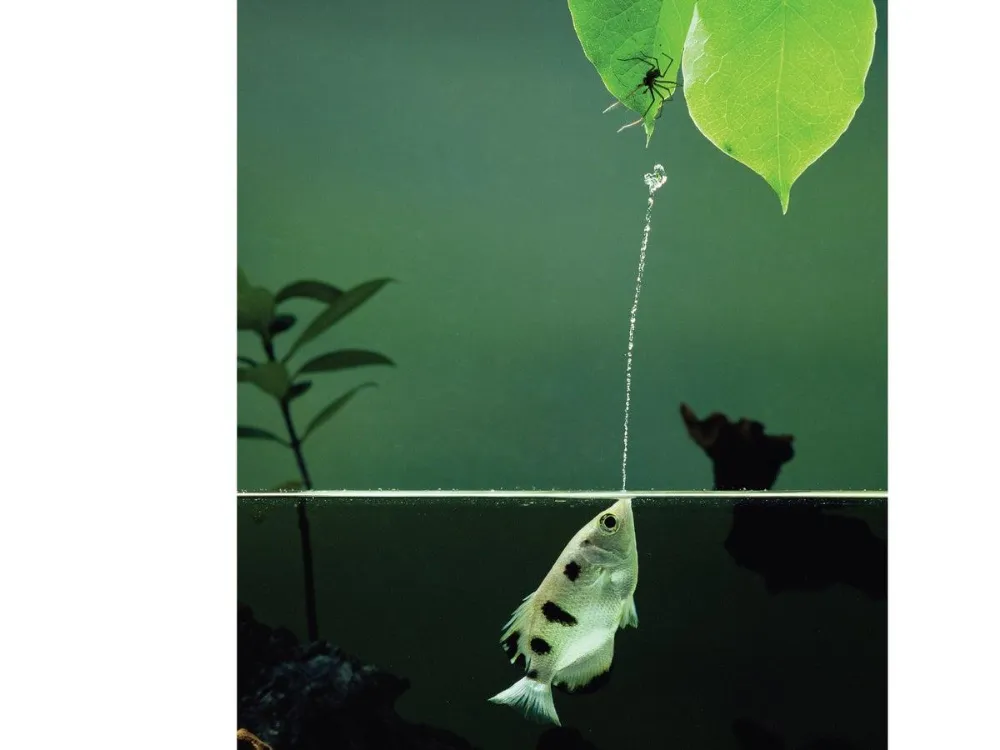
The archerfish must coordinate its aim with the trajectory of a water stream traveling from water into air.
Frequently Asked Questions
How do archerfish shoot water?
They use a channel formed by the tongue and roof of the mouth, together with pressure generated by mouth and gill-cover movements, to produce a directed jet.
Why do archerfish spit water?
They use water jets to dislodge insects and other small prey from vegetation above the surface.
How far can archerfish shoot water?
Large individuals of some species can hit targets approximately two to three meters away, although performance varies.
How do archerfish aim accurately?
They combine visual information with coordinated body and mouth movements. Research also demonstrates learning and adaptation to changes in the water-jet trajectory.
Does refraction affect archerfish shooting?
Yes. Light bends between air and water, changing the apparent location of an aerial target as seen by the fish underwater.
Can archerfish shoot moving insects?
Yes. Controlled experiments have shown that archerfish can learn to hit moving targets.
Can archerfish learn from other fish?
Yes. A 2006 study found evidence that observing trained group members helped other fish acquire a difficult shooting skill.
How do archerfish make their water jets powerful?
They control water velocity and timing so that later water can catch up with earlier water, creating a concentrated mass near impact.
Can archerfish change the shape of a water jet?
Yes. A 2014 study demonstrated adjustments in mouth opening and closing that shape jets according to target distance.
Can archerfish shoot underwater?
Yes. Research shows that they can use water jets to disturb sediment and expose buried food.
Are archerfish smart?
They demonstrate sophisticated learning, visual discrimination, motor adaptation, and rapid target-interception behaviors.
Can archerfish recognize human faces?
In laboratory experiments, sevenspot archerfish learned to distinguish photographs of different human faces. This does not prove natural recognition of individual people.
Where do archerfish live?
They inhabit freshwater and brackish environments across parts of the Indo-West Pacific, including mangroves and estuaries.
Do archerfish eat only insects?
No. They can eat insects and various other small animals, including underwater prey.
Are all archerfish equally accurate?
No. Shooting performance varies among individuals and species and can be affected by learning, size, distance, and conditions.
The Bottom Line
Archerfish shoot water through a specialized mouth channel formed by the roof of the mouth and tongue, with pressure generated by coordinated movements of the oral and gill-cover system.
Their remarkable shooting ability depends on more than anatomy. They can control the development of the water jet, target prey above the surface, compensate for disturbances, and predict where falling insects will land.
Experimental research has also demonstrated that archerfish can learn to strike moving targets and discriminate complex visual patterns.
These abilities make archerfish an important example of how evolution can combine biomechanics, visual perception, learning, and rapid decision-making in a highly specialized feeding behavior.
Sources & Further Reading
Australian Museum — Sevenspot Archerfish, Toxotes chatareus. Describes the palatal groove, tongue, and water-shooting mechanism.
Australian Museum — Banded Archerfish, Toxotes jaculatrix. Species identification and reported shooting distance.
Vailati, Zinnato and Cerbino (2012) — How Archer Fish Achieve a Powerful Impact: Hydrodynamic Instability of a Pulsed Jet in Toxotes jaculatrix. PLOS ONE. Original high-speed analysis of concentrated water-jet impact.
Gerullis and Schuster (2014) — Archerfish Actively Control the Hydrodynamics of Their Jets. Current Biology. Experimental research on jet shaping and mouth movement.
Schuster et al. (2006) — Animal Cognition: How Archer Fish Learn to Down Rapidly Moving Targets. Current Biology. Original moving-target and observational-learning experiments.
Rossel, Corlija and Schuster (2002) — Predicting Three-Dimensional Target Motion: How Archer Fish Determine Where to Catch Their Dislodged Prey. Journal of Experimental Biology. Study of rapid turns toward prey landing points.
The Archerfish Uses Motor Adaptation in Shooting to Correct for Changing Physical Conditions (2024). eLife. Experimental evidence of error correction under airflow disturbances.
Archerfish Use Their Shooting Technique to Produce Adaptive Underwater Jets (2017). Study of underwater jet use for uncovering buried food.
Newport et al. (2016) — Discrimination of Human Faces by Archerfish (Toxotes chatareus). Scientific Reports. Experimental evidence of complex visual discrimination.
Schuster (2019) — Hunting in Archerfish: An Ecological Perspective on a Remarkable Combination of Skills. Review of shooting, learning, interception, and competition for prey.
Phylogenetics of Archerfishes (Toxotidae) and Evolution of the Toxotid Shooting Apparatus (2022). Integrative Organismal Biology. Comparative anatomy and evolution of the shooting system.