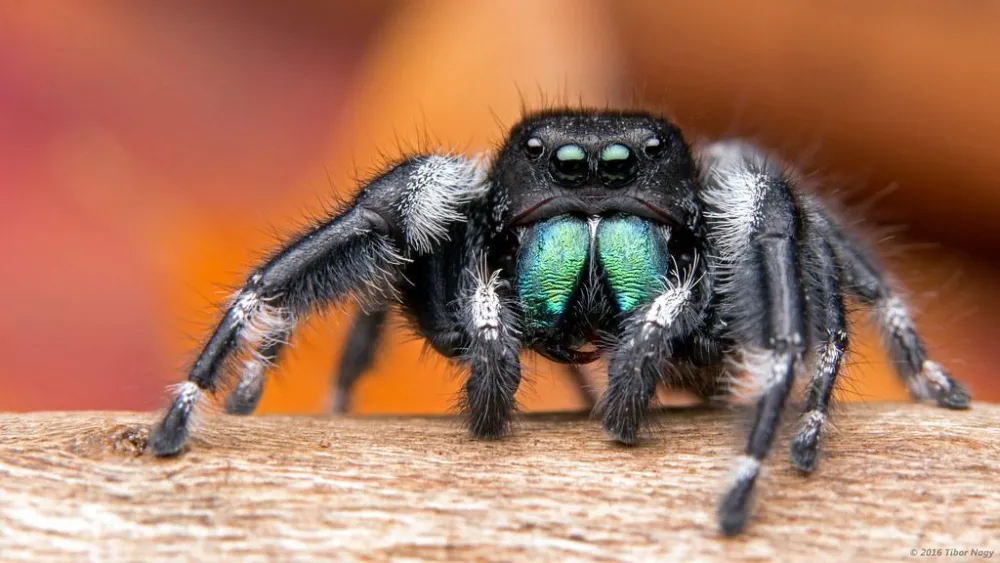
Yes, some spiders can hear airborne sounds even though they do not have ears or eardrums like humans. Instead, they detect tiny physical movements caused by sound waves using sensitive structures on their legs. Certain jumping spiders and net-casting spiders can respond to sounds from several meters away. Some orb-weaving spiders also use their silk webs as large acoustic sensors. However, not every spider has been shown to hear in the same way, and detecting sound does not mean spiders understand human speech or music.
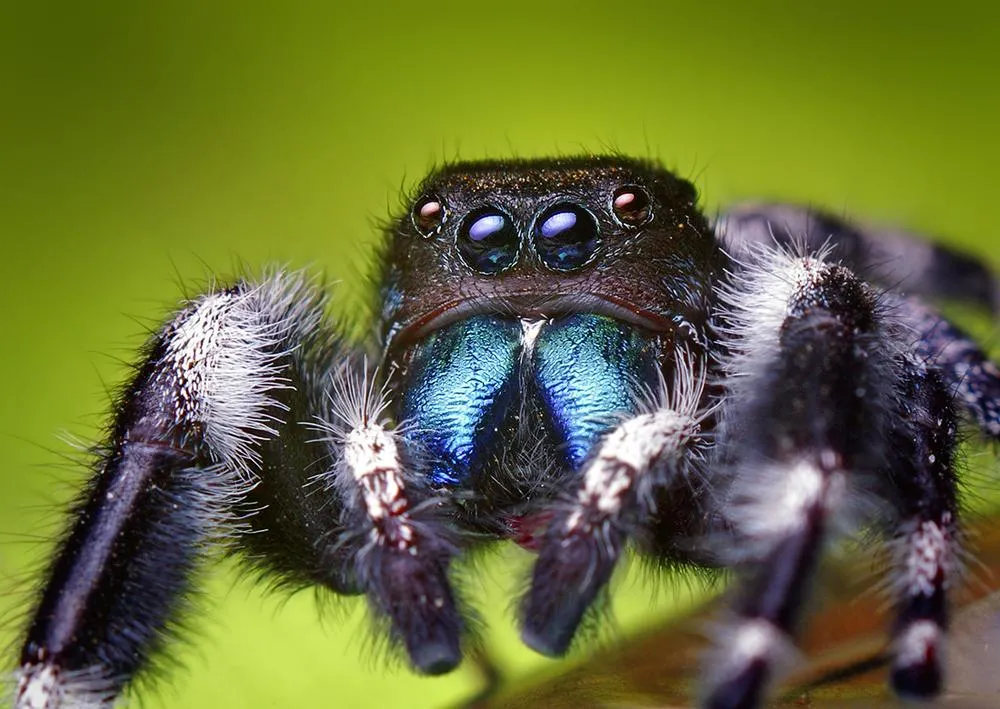
Experiments with the bold jumping spider have demonstrated that some spiders can detect airborne sounds without conventional ears.
Can Spiders Hear?
Some spiders can detect sounds traveling through the air, including sounds originating several meters away.
This ability has been demonstrated through experiments measuring both spider behavior and neural activity.
Scientists have studied jumping spiders, net-casting spiders, and orb-weaving spiders to understand how sound perception works in animals without ordinary ears.
However, the sensory mechanisms are not identical across these groups. Some spiders use sensitive structures on their bodies, while others can benefit from sound-induced movement of their webs.
The most accurate answer is that hearing exists in certain spider species, but its range and biological function vary.
Do Spiders Have Ears?
Spiders do not possess external ears or tympanic eardrums comparable to those found in humans.
A mammalian ear detects pressure changes carried by sound waves and transforms them into signals that the nervous system can process.
Spiders instead possess mechanosensory structures that respond to extremely small movements or mechanical strains.
These structures can detect disturbances traveling through solid surfaces and, in certain species, movement associated with airborne sound.
Therefore, the absence of conventional ears does not mean spiders are incapable of detecting sound.
How Do Spiders Hear Without Ears?
Airborne sound consists of changes in pressure and movement of air particles.
Some spiders possess sensitive hairs that move when exposed to tiny air movements. Other species have sensory organs in their legs that detect mechanical strain or vibration.
When these structures are stimulated, sensory cells produce electrical signals that travel into the nervous system.
The spider may respond by freezing, turning, or performing a hunting movement.
However, researchers must distinguish responses to airborne sound from responses caused by vibrations traveling through the ground or an object touching the spider.
What Are Spider Trichobothria?
Trichobothria are long, fine sensory hairs found on the bodies or appendages of many spiders and other arachnids.
They are particularly sensitive to movements of the surrounding air.
When air particles move, a trichobothrium may bend. Sensory structures at its base can detect the movement.
These hairs help certain spiders detect nearby disturbances, including airflow associated with approaching insects.
However, not every study of spider hearing identifies trichobothria as the only receptor responsible for detecting distant sounds.
How Do Spider Sensory Hairs Detect Air Movement?
Each sensitive hair acts as a tiny mechanical structure that responds to movement in the air.
The interaction between airflow and the hair can produce small changes in its position.
These changes are detected by sensory cells associated with the hair's base.
The resulting nerve signals can provide information about the surrounding environment.
A 2016 experiment on jumping spiders found that directly moving certain leg hairs activated neural units that also responded to airborne sound. This provided evidence that these hairs contribute to sound perception.
What Are Slit Sensilla?
Slit sensilla are mechanosensory structures found in the exoskeleton of spiders.
They detect tiny mechanical strains produced when the surrounding cuticle changes shape.
Groups of these structures may form organs that are particularly sensitive to vibrations.
In some spiders, leg-based slit sensilla are important for detecting mechanical information from the environment.
However, a slit sensillum does not function in exactly the same way as a sensitive hair. The two structures detect different aspects of mechanical stimulation.
What Is a Lyriform Organ?
A lyriform organ is a group of slit-like mechanical receptors in the exoskeleton.
These organs can detect extremely small deformations of the cuticle.
They provide information related to vibrations, movement, and mechanical loading.
Research on orb-weaving spiders suggests that strain-sensitive organs in the legs help detect web vibrations produced by airborne sound.
However, the precise contribution of individual receptors varies among species and sensory tasks.
Is Hearing the Same as Feeling Vibrations?
Sound and vibration are closely related physical phenomena, but the way they reach an animal matters.
Airborne sound travels through air. Substrate-borne vibrations travel through solid materials such as soil, leaves, branches, or silk threads.
Some spiders are sensitive to both.
For many years, scientists emphasized the ability of spiders to sense vibrations from nearby prey or movements on a web.
Later research demonstrated that certain spiders can also respond to sound originating several meters away, even without direct contact with the sound source.
The distinction is important because distant airborne sound detection cannot be explained solely by prey touching a spider's web.
Which Spiders Can Hear Airborne Sound?
Research has demonstrated airborne sound perception in several spider groups.
These include the bold jumping spider, certain net-casting spiders, and an orb-weaving species that uses its silk web as a sound-sensitive structure.
However, different groups use different combinations of sensory hairs, strain receptors, and silk structures.
Evidence from one species should not automatically be extended to every spider.
Spider Hearing Research: Three Important Examples
| Spider | Scientific Name | Key Finding | Study |
|---|---|---|---|
| Bold jumping spider | Phidippus audax | Behavioral and neural responses to distant airborne sounds | Current Biology, 2016 |
| Ogre-faced net-casting spider | Deinopis spinosa | Airborne sound can trigger backward prey-catching strikes | Current Biology, 2020 |
| Bridge orb-weaver | Larinioides sclopetarius | Silk orb web acts as an external sound-sensitive surface | PNAS, 2022 |
Can Jumping Spiders Hear?
Yes. The ability to detect distant airborne sound has been demonstrated in the bold jumping spider, Phidippus audax.
Jumping spiders are famous for their excellent vision and precise movements.
However, a 2016 study revealed that their sensory abilities also include responses to certain low-frequency sounds.
Researchers measured neural activity and observed behavioral responses when spiders were exposed to controlled acoustic stimuli.
These results changed the earlier assumption that spiders without ears could detect only nearby air disturbances.
What Did the 2016 Jumping Spider Study Discover?
In 2016, scientists published Airborne Acoustic Perception by a Jumping Spider in Current Biology.
The researchers studied Phidippus audax using controlled sound playback and electrical recordings from the spider's nervous system.
The jumping spiders responded to low-frequency tones around 80 hertz at approximately 65 decibels sound pressure level.
Behavioral tests showed that some spiders froze when exposed to these sounds.
Neural recordings also demonstrated responses to airborne acoustic stimuli from distances of about three meters or more.
The findings provided evidence for a form of distant airborne sound perception in a spider that lacks conventional ears.
How Far Away Can Jumping Spiders Hear?
The 2016 experiments demonstrated neural responses to sounds originating more than three meters from the spiders.
This was a surprising distance for a small animal without tympanic hearing organs.
However, the result depends on the sound frequency, intensity, experimental environment, and sensory characteristics of the species.
It does not establish that every jumping spider can detect every sound from three meters away.
Nor does it establish that three meters is the absolute maximum hearing distance.
Why Do Jumping Spiders Freeze When They Hear Sound?
Freezing can be a defensive response to a possible threat.
In the 2016 experiments, jumping spiders exposed to certain low-frequency tones stopped moving.
The researchers interpreted this as an acoustic startle or antipredator response.
Remaining still may reduce the chance of being detected by a nearby predator.
However, freezing in response to a laboratory sound does not establish that every sound of the same frequency is interpreted as the same threat in nature.
What Sound Frequencies Can Jumping Spiders Detect?
The 2016 study documented behavioral responses to low-frequency sound around 80 hertz.
Neural recordings revealed responses across a wider tested range, including approximately 80 to 380 hertz.
However, neural sensitivity and a visible behavioral response are not identical measurements.
A spider's nervous system may detect a sound without necessarily producing an obvious change in movement.
It is therefore misleading to assign a universal hearing range to all jumping spiders based on one experiment.
Can Ogre-Faced Spiders Hear?
Yes. Research has shown that the ogre-faced net-casting spider, Deinopis spinosa, can detect airborne acoustic stimuli.
These spiders possess unusually large forward-facing eyes and hunt using a small net of silk held between their legs.
They can capture prey below them, but they also perform rapid backward strikes to intercept insects flying through the air.
Scientists investigated whether the sound of flying insects could help trigger these movements.
What Did the 2020 Net-Casting Spider Study Show?
A study published in Current Biology in 2020 examined the acoustic sensitivity of Deinopis spinosa.
Researchers found that the spiders could respond to sounds originating at least two meters away under the tested conditions.
Neural recordings showed responses to a broad range of frequencies, approximately 100 to 10,000 hertz.
Importantly, low-frequency acoustic stimulation could trigger a rapid backward prey-catching strike.
Higher-frequency sounds also produced neural responses but did not trigger the same hunting movement in the experiments.
This indicates that the animal can distinguish different acoustic information at the level of behavior.
How Do Ogre-Faced Spiders Catch Flying Insects?
Ogre-faced spiders prepare small silk nets that they hold with their legs.
They remain suspended and can rapidly extend or swing the net toward prey.
Some attacks are directed downward toward insects moving on the ground.
Other attacks involve a sudden backward movement that intercepts flying prey.
The 2020 study demonstrated that airborne sound can trigger the backward strike.
However, this does not mean the spider relies on hearing alone for every hunting movement. Vision and other sensory information contribute to its behavior.
Can Spiders Hear Insect Wingbeats?
Some spiders can detect acoustic information associated with flying insects.
Flying wings create disturbances in the surrounding air.
These disturbances can contain frequencies detectable by sound-sensitive spider structures.
In ogre-faced spiders, laboratory sounds resembling the frequencies of flying prey triggered backward net-casting behavior.
However, this result should not be interpreted as evidence that every spider can identify every insect species from its wingbeat sound.
Can Spiders Hear Predators Approaching?
Hearing may provide useful warning information about approaching threats.
The freezing response observed in jumping spiders is consistent with a defensive interpretation.
Ogre-faced spiders also show neural sensitivity to higher sound frequencies, potentially including signals produced by predators.
However, the exact use of those signals in natural antipredator behavior remains incompletely understood.
Researchers distinguish between demonstrating that a spider detects a sound and proving which ecological meaning the spider assigns to that sound.
Can Spider Webs Hear Sound?
Some spider webs can function as highly sensitive acoustic receivers.
Thin silk threads are capable of moving in response to tiny movements of air particles caused by sound waves.
A spider standing on the web can detect these movements through sensory structures associated with its legs.
Therefore, the web can extend the effective sound-sensitive area beyond the spider's body.
However, a web does not contain a separate nervous system. The spider itself must detect and interpret the mechanical information transmitted through the silk.
What Did the 2022 PNAS Spider Web Study Discover?
In 2022, researchers published Outsourced Hearing in an Orb-Weaving Spider That Uses Its Web as an Auditory Sensor in Proceedings of the National Academy of Sciences.
The scientists studied the orb-weaving spider Larinioides sclopetarius.
They exposed spiders resting in the centers of their webs to controlled airborne sounds.
The spiders responded with movements such as crouching, stretching their legs, or turning.
Experiments also measured how sound-induced air movement caused the silk threads to move.
The researchers concluded that the web can function as a large external acoustic sensor, allowing the spider to detect sound-induced vibrations transmitted through its own silk.
How Does Spider Silk Detect Sound?
Spider silk is extremely thin and lightweight.
Because of its mechanical properties, a silk strand can respond to small movements of the surrounding air.
Sound waves carry oscillating air-particle motion, which can cause the silk to move.
These movements travel through connected strands of the web.
When the spider maintains contact with the silk, sensory organs in its legs can detect the resulting mechanical signals.
The system allows the web to act as a sound-sensitive structure even though the spider does not possess conventional eardrums.
Is a Spider Web Like an Eardrum?
There is an important functional similarity.
Both a biological eardrum and a spider web can respond mechanically to sound-related changes in the surrounding air.
However, their physical structures are very different.
A mammalian eardrum is a tissue membrane located inside the auditory system.
A spider web is an external silk structure constructed by the animal.
The 2022 research described web-based hearing as outsourced because part of the acoustic reception process occurs outside the spider's body.
How Far Away Can Orb-Weaving Spiders Detect Sound?
The 2022 study demonstrated sound-related behavioral responses to acoustic stimuli presented from a source approximately three meters away.
Some experiments used tones around 200 hertz at measured sound levels near 68 decibels.
The scientists also tested other frequencies and intensities.
However, the detection range depends on the sound and the geometry of the web.
The researchers discussed the possibility of detecting biologically relevant sounds from greater distances, but those estimates should not be confused with a direct field demonstration at every proposed distance.
Can Spider Webs Detect High-Frequency Sound?
The 2022 investigators measured silk movement in response to acoustic stimuli over a broad frequency range.
Some measurements extended from approximately 100 to 10,000 hertz.
However, mechanical responsiveness of a web is not identical to proving that a spider consciously perceives or behaviorally responds to every frequency in that range.
The research separately measured silk movement and spider behavior.
Those different results should be kept distinct when describing the spider's hearing abilities.
Can Spiders Tell Where a Sound Comes From?
Some spiders appear capable of responding to the direction of an acoustic source.
In the 2022 orb-weaver study, scientists placed sound sources at different positions relative to the web.
They observed directional turning responses in some spiders.
This suggests that sound-induced movement across the web can provide information about the direction of the source.
However, the accuracy of sound localization varies with sound properties, web shape, and sensory conditions.

Scientific studies show that the orb web of Larinioides sclopetarius can move with airborne sound and transmit that information to the spider.
Can Spiders Adjust Their Webs to Detect Vibrations?
Spider webs are flexible structures that vary in tension, shape, and attachment to surrounding surfaces.
These physical properties can affect how vibrations move through the silk.
Researchers have investigated whether changes in web construction or tension alter the information available to a spider.
However, it is important to distinguish mechanical changes in vibration transmission from a spider deliberately choosing a particular hearing frequency.
Recent evidence shows that web characteristics can vary with environmental noise exposure, but the precise biological benefits require further testing.
What Did the 2025 Spider Web Noise Study Find?
In 2025, researchers Brandi Pessman and Eileen Hebets published a study in Current Biology examining vibration transmission through the webs of the funnel-weaving spider Agelenopsis pennsylvanica.
The team collected spiders from urban and rural environments and allowed them to construct webs under quiet or loud vibratory noise treatments.
Webs produced under these conditions differed in how vibrations were transmitted.
In particular, some webs made by rural spiders under loud conditions preserved more energy in certain longer-distance vibrations, while some urban spiders' webs damped short-range vibratory noise.
These results suggest that web construction and environmental history can influence the information received by the spider.
However, the study focused on vibration transmission, including substrate-borne noise. It did not prove that all funnel-weaving spiders possess the same airborne hearing mechanism demonstrated in orb-weavers.
Why Does Environmental Noise Matter to Spiders?
Spiders depend on mechanical information for activities such as hunting, predator detection, and social interactions.
Environmental disturbances can interfere with these signals.
For example, vibrations produced by human activity may overlap with frequencies that spiders use to detect prey or other spiders.
The 2025 research suggests that different webs can transmit or reduce particular ranges of vibration.
However, additional experiments are necessary to determine how consistently these differences improve survival or reproductive success in natural environments.
How Do Spiders Feel Vibrations Through Their Webs?
When an insect lands on a web, its movement creates mechanical vibrations in the silk.
These vibrations spread through connected threads.
A spider touching the web can detect changes in mechanical strain through receptors associated with its legs.
The signals help the animal determine that something has disturbed the web.
However, identifying whether a vibration comes from prey, another spider, wind, or another source may require additional information.
Can Spiders Identify Prey Through Vibrations?
Many web-building spiders use vibration patterns as important sources of information.
Different types of movement produce different mechanical signals.
A struggling insect may generate a different pattern from a courting mate or a light disturbance caused by wind.
Spiders can respond differently to these signals under appropriate conditions.
However, their ability to classify specific events varies by species and the available sensory information.
Do Spiders Communicate Using Vibrations?
Yes. Vibration is an important communication channel for many spiders.
During courtship, some males generate characteristic signals on the silk or nearby surfaces.
Females can respond to the timing, amplitude, or other properties of those signals.
However, the function and complexity of these interactions differ substantially among species.
The signals are not equivalent to spoken words but can communicate biologically relevant information.
Do All Spiders Need Webs to Hear?
No. Jumping spiders provide a clear example of airborne sound detection without relying on a large prey-catching web.
The 2016 jumping spider experiments demonstrated neural responses to airborne sound while the animals were not using an orb web as an acoustic receiver.
Ogre-faced spiders also possess sound-sensitive leg structures involved in detecting airborne prey.
Orb-weavers represent another strategy, in which the web itself contributes substantially to acoustic reception.
These examples show that spider hearing cannot be explained by one universal mechanism.
Do Jumping Spiders Build Webs?
Jumping spiders produce silk, but many do not construct the large circular capture webs associated with orb-weavers.
Instead, they frequently hunt by visually tracking prey and jumping toward it.
They may use silk as a safety line or to construct shelters.
Their ability to detect airborne sound therefore does not depend on maintaining a large orb web.
This distinction is useful when comparing jumping spider hearing with the web-based hearing demonstrated in some orb-weaving spiders.
Can Spiders Hear Human Voices?
Some spider species can respond to components of airborne sound within the frequencies and intensities they can detect.
Human speech contains a broad mixture of acoustic frequencies.
However, studies of spider hearing do not demonstrate that spiders understand words, recognize human language, or interpret a conversation as humans do.
A response to a particular sound component is not evidence of speech comprehension.
Therefore, claiming that a spider can understand what a person is saying would greatly exaggerate the research.
Can Spiders Hear Music?
Music contains sound frequencies and changing patterns of intensity.
Under suitable conditions, a sound-sensitive spider might detect some of the physical acoustic components associated with music.
However, scientific evidence does not show that spiders experience melody, harmony, or musical meaning in the same way humans do.
Different species may respond to different ranges of acoustic stimulation.
It would also be incorrect to assume that a spider is enjoying a particular song simply because it moves while music is playing.
Can Spiders Hear You Walking?
Spiders may detect vibrations or acoustic disturbances associated with movement nearby.
Walking can produce mechanical vibrations through floors, branches, soil, and other surfaces.
It can also generate airborne sounds.
However, detecting those movements depends on distance, surface characteristics, and the spider's sensory abilities.
It is not accurate to say that every spider can recognize human footsteps from a particular distance.
Can Spiders Hear Clapping?
A clap produces a brief burst of airborne sound across a wide range of frequencies.
A sound-sensitive spider might detect components of this acoustic event under suitable conditions.
However, the 2016 and 2020 studies primarily used controlled acoustic tones to investigate sensory responses.
The findings do not establish a universal behavioral response to hand clapping.
Clapping near a spider should not be treated as a reliable or humane way of testing its hearing.
Are Spiders Deaf?
It is inaccurate to describe all spiders as deaf simply because they lack conventional ears.
Researchers have demonstrated airborne sound perception in several species.
However, deafness is a term usually defined relative to the normal sensory capabilities of a particular animal.
Spiders have specialized sensory systems that differ greatly from the human auditory system.
A more accurate explanation is that many spiders are highly sensitive to mechanical information, and some can detect distant airborne sounds.
Do All Spiders Have the Same Hearing Ability?
No. Spider species differ widely in their sensory anatomy, habitat, and behavior.
Jumping spiders, net-casting spiders, and orb-weaving spiders have all provided important experimental evidence of sound perception.
However, the results cannot automatically be generalized to every tarantula, wolf spider, orb-weaver, or jumping spider species.
More comparative research is needed to understand the evolutionary distribution of airborne hearing across spiders.
Do Tarantulas Hear Sound?
Tarantulas possess sensitive hairs and other mechanosensory structures.
These allow them to respond to mechanical disturbances in their surroundings.
However, the detailed hearing range and behavioral interpretation of airborne sound have not been established for all tarantula species.
It is more accurate to say that tarantulas are sensitive to certain vibrations and air movements than to assign them a universal human-like hearing range.
Can Wolf Spiders Hear?
Wolf spiders possess mechanosensory structures capable of detecting environmental disturbances.
Vibrations also play roles in some wolf spider communication and courtship behaviors.
However, the ability to detect a surface vibration is not automatically equivalent to experimentally demonstrated distant airborne hearing.
Research findings from jumping spiders or orb-weavers should not be applied uncritically to every wolf spider species.
Can Spiders Hear Better Than Humans?
There is no meaningful single ranking that places all spiders above or below humans in hearing ability.
Humans detect sound using specialized ears and are sensitive to a broad range of audible frequencies.
Some spiders are extraordinarily sensitive to physical movement of air or silk, even without conventional ears.
However, the systems operate differently and are adapted to different biological tasks.
The fact that silk can respond efficiently to tiny air movements does not prove that a spider has better hearing than a human in every respect.
Do Spiders Have Eight Ears?
No. Spiders generally have eight legs, but those legs are not equivalent to eight separate ears.
Multiple legs contain different sensory structures that can provide mechanical information.
However, there is no basis for claiming that every spider possesses eight conventional auditory organs.
Their sensory anatomy varies, and sound perception can involve different structures across species.
Why Is Spider Hearing Important to Science?
Spider hearing research demonstrates that animals can detect environmental information using unexpected physical structures.
The 2016 study revealed distant airborne sound perception in a jumping spider.
The 2020 study showed that sound can guide an unusually fast prey-catching movement.
The 2022 research demonstrated how an orb web can become an external acoustic sensor.
The 2025 work showed that web vibration transmission can vary with environmental noise exposure.
Together, these findings help scientists understand the evolution of sensory systems and how animals use structures outside their bodies to collect information.
Could Spider Hearing Inspire New Technology?
Scientists and engineers are interested in the unusual mechanical sensitivity of spider silk and spider sensory hairs.
Thin fibers can respond to tiny movements in air, making them relevant to the design of sensitive acoustic detectors.
Research on web-based hearing may also inspire devices that use flexible external structures to collect sound-related mechanical information.
However, a laboratory demonstration of silk movement does not mean commercial microphones already reproduce all the abilities of living spiders.
The biological system combines mechanical structures, neural sensing, and behavioral control.
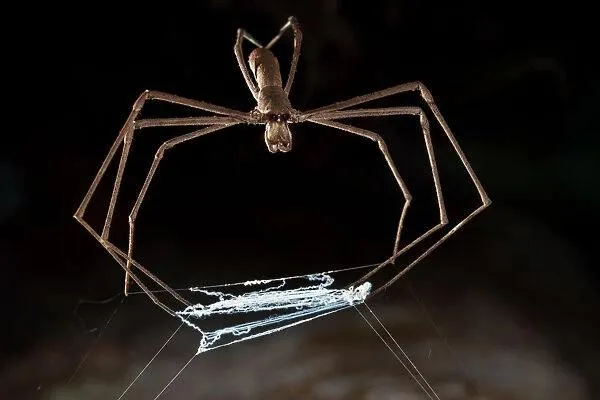
Ogre-faced net-casting spiders use airborne acoustic information to help intercept flying prey during nighttime hunting.
Frequently Asked Questions
Can spiders hear?
Yes. Research has demonstrated airborne sound perception in several spider species, including jumping spiders, net-casting spiders, and orb-weavers.
Do spiders have ears?
No. They do not possess conventional external ears or eardrums like humans. Instead, they use specialized mechanosensory structures.
How do spiders hear without ears?
Some detect tiny movements of sensory hairs or mechanical strain in their legs. Certain orb-weavers also use vibrations generated in their silk webs by airborne sound.
Can jumping spiders hear?
Yes. A 2016 study demonstrated that the bold jumping spider can detect low-frequency airborne sounds at distances of approximately three meters.
How far can spiders hear?
It depends on species and sound conditions. Experiments have demonstrated sound-related responses several meters away in some species.
Can spiders hear human voices?
Some may detect acoustic components of human speech, but there is no evidence that spiders understand spoken language.
Can spiders hear music?
Some species may detect certain sound frequencies present in music, but this does not mean they understand or experience music as humans do.
Can spiders hear footsteps?
They may detect vibrations or sounds produced by movement, depending on the surface, distance, and species.
Do spiders hear through their legs?
Many spiders possess sensitive hairs and mechanical receptors on their legs that detect movement and vibration.
What are trichobothria?
Trichobothria are fine sensory hairs that can detect very small movements of the surrounding air.
Can spider webs detect sound?
Yes. Research in 2022 demonstrated that the orb web of Larinioides sclopetarius can respond to airborne sound and transmit acoustic information through silk vibrations.
Do all spiders use their webs to hear?
No. Some species detect airborne sounds without relying on a large capture web, and not all spiders construct orb webs.
Why do jumping spiders freeze when they hear sounds?
Freezing may be an antipredator response. Laboratory experiments found that certain low-frequency tones triggered this behavior.
Can spiders hear flying insects?
Some can. Research on ogre-faced spiders showed that low-frequency acoustic cues can trigger their backward prey-catching strikes.
Can spiders tell where a sound comes from?
Some species can respond directionally. A 2022 study observed orb-weavers turning toward sound sources under controlled conditions.
Are spiders deaf?
No. Although their sensory systems differ from human ears, several species can detect airborne sound.
Do all spiders have good hearing?
No. Hearing abilities vary by species, and many spiders have not been experimentally tested for distant airborne sound perception.
Can spiders adjust their webs to environmental noise?
Research published in 2025 found that web vibration transmission varied with spiders' previous environments and experimental noise conditions.
The Bottom Line
Some spiders can hear airborne sounds despite lacking conventional ears.
Jumping spiders can detect certain low-frequency sounds from several meters away, and ogre-faced spiders use auditory information to help capture flying insects.
Orb-weaving spiders can also use their webs as external acoustic sensors, detecting the tiny movements of silk caused by sound waves.
However, spider hearing differs among species and should not be equated with human hearing.
Recent research shows that the physical properties of webs can also change with environmental vibration conditions, expanding our understanding of how spiders receive information.
Spider hearing is a remarkable example of how evolution can produce sensory abilities using structures that look nothing like familiar ears.
Sources & Further Reading
Shamble et al. (2016) — Airborne Acoustic Perception by a Jumping Spider. Current Biology. Original behavioral and neural evidence for distant airborne hearing in Phidippus audax.
Cornell University (2016) — Jumping Spiders Can Hear at a Distance, New Study Proves. University explanation of the original jumping spider experiment.
Stafstrom et al. (2020) — Ogre-Faced, Net-Casting Spiders Use Auditory Cues to Detect Airborne Prey. Current Biology. Experimental evidence that sound can trigger net-casting predatory behavior.
Cornell University (2020) — Buzz Kill: Spiders Hear Airborne Prey via Their Legs. Description of auditory receptors and hunting behavior.
Zhou et al. (2022) — Outsourced Hearing in an Orb-Weaving Spider That Uses Its Web as an Auditory Sensor. PNAS. Original measurements of sound-induced web motion and behavioral responses.
BrainFacts / Society for Neuroscience (2022) — Spiders Use Their Webs to Hear. Educational explanation of silk as an acoustic sensor.
Liu et al. (2024) — Influence of Spider Hair Structure on Acoustic Response. Extreme Mechanics Letters. Modeling research on acoustic sensitivity and spider sensory hair structure.
Pessman and Hebets (2025) — Web Transmission Properties Vary With a Spider's Past and Current Noise Exposure. Current Biology. Study showing differences in web vibration transmission under different environmental noise treatments.
PubMed — Web Transmission Properties Vary With a Spider's Past and Current Noise Exposure. Indexed record and scientific abstract of the 2025 study.
University of Nebraska–Lincoln — Innovative Study Reveals How Arachnids Tune Out Noises. Research summary distinguishing urban and rural spider responses to vibratory environments.