Reindeer eyes change color because a reflective layer behind the retina, called the tapetum lucidum, changes with the seasons. In Arctic summer, this layer reflects mostly golden light. During winter, it becomes deep blue, helping the animal detect light in the dim Arctic environment. Researchers have linked this shift to changes in the spacing of tiny collagen fibers within the reflective tissue. The winter arrangement increases retinal light sensitivity but may reduce visual sharpness. Importantly, it is the reflective layer inside the eye that changes color, not the iris or the entire eyeball.

Reindeer living in Arctic environments possess an unusual reflective eye layer that changes its optical properties between summer and winter.
Why Do Reindeer Eyes Change Color?
Reindeer live in environments where the amount of daylight changes dramatically throughout the year. Above the Arctic Circle, parts of summer may have nearly continuous daylight, while winter can bring weeks of darkness or extended twilight.
To cope with these conditions, reindeer possess a remarkable visual adaptation: the reflective layer behind their retinas changes from golden in summer to deep blue in winter.
The color shift affects how incoming light travels through the eye. In summer, the layer reflects light more directly. In winter, the altered reflection scatters more light through the retina, increasing the chance that photoreceptor cells will detect it.
However, this improvement in sensitivity appears to come with a trade-off. The winter eye may collect faint light more effectively while producing a less sharply focused image.
What Color Are Reindeer Eyes in Summer and Winter?
The reflective part of a reindeer's eye is generally golden, sometimes with turquoise tones, during summer. In winter, this reflective tissue becomes predominantly deep blue.
This seasonal difference was documented in a 2013 study comparing eyes obtained from Arctic reindeer near the summer and winter solstices.
The researchers measured clear differences in reflected wavelengths and the microscopic organization of the tissue.
However, the entire visible eye does not turn bright gold or neon blue. The seasonal change involves an internal reflective layer, and its appearance depends on lighting conditions and the direction from which it is viewed.
Reindeer Eyes in Summer vs. Winter
| Feature | Summer | Winter |
|---|---|---|
| Reflective layer color | Mostly gold or gold-turquoise | Predominantly deep blue |
| Environmental lighting | Long, often continuous daylight | Very low light and prolonged twilight |
| Collagen fiber spacing | Relatively wider | Relatively narrower |
| Light reflection | More direct | More scattered |
| Retinal light sensitivity | Lower than in the winter condition | Higher under studied conditions |
| Possible visual trade-off | Better preservation of image detail | Greater sensitivity at some cost to sharpness |
What Is the Tapetum Lucidum?
The tapetum lucidum is a reflective structure located behind the retina in the eyes of many animals.
When light enters the eye, some photons pass through the retina without being absorbed by its light-sensitive cells. The tapetum reflects part of this light back through the retina, providing another opportunity for detection.
This improves vision in dim conditions and explains the familiar eyeshine seen in cats, deer, and some other mammals when light enters their eyes from a suitable direction.
Reindeer are unusual because the optical characteristics of this reflective layer change seasonally.
Is the Reindeer's Iris Changing Color?
No. The well-documented seasonal change does not primarily involve the iris, the colored structure surrounding the pupil.
The iris helps regulate the amount of light entering the eye by controlling pupil size. The tapetum lucidum sits farther back, behind the retina.
Confusing these structures can produce misleading descriptions of the animal's appearance.
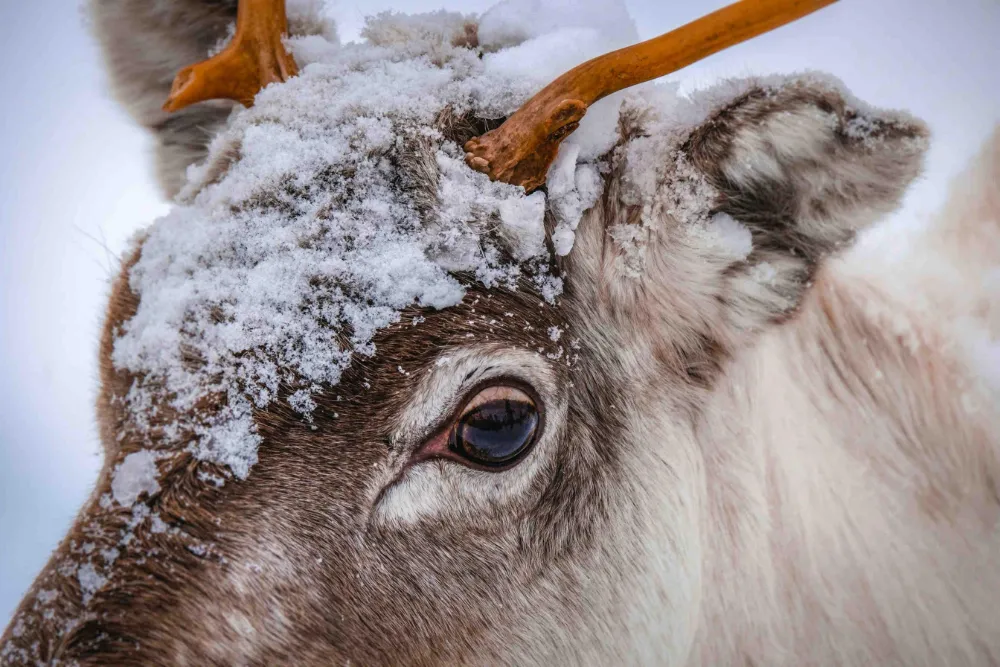
A close-up photograph of a live reindeer will not necessarily reveal the distinctive deep-blue tapetum observed in anatomical studies. In ordinary daylight, the eye may still look dark.
What Did the 2013 Reindeer Eye Study Discover?
In 2013, scientists published Shifting Mirrors: Adaptive Changes in Retinal Reflections to Winter Darkness in Arctic Reindeer in Proceedings of the Royal Society B.
The researchers compared eyes from reindeer obtained during summer and winter. They found a striking seasonal change in the color reflected by the tapetum lucidum.
They also measured differences in the spacing of collagen fibers within this layer. Winter samples had more closely packed fibers, corresponding to a shift toward shorter reflected wavelengths.
Electroretinographic measurements indicated that winter eyes were more sensitive to light than summer eyes.
However, the study did not mean that researchers had directly measured every aspect of the animals' real-world behavior in darkness. Its primary evidence came from the optical and physiological properties of the eyes.
How Do Reindeer Eyes Physically Change Color?
The tapetum lucidum contains a highly organized arrangement of tiny collagen fibers surrounded by fluid.
The distance between these fibers influences which wavelengths of light are reflected most strongly.
When the spacing is relatively large, the structure can produce a golden reflection. When the fibers become more tightly packed, the reflected light shifts toward shorter, bluer wavelengths.
This is an example of structural coloration. The appearance arises from the organization of microscopic material rather than simply from the addition or removal of colored pigments.
The precise arrangement is far smaller than structures visible to the naked eye.
What Is Structural Coloration?
Structural coloration occurs when microscopic or nanoscopic arrangements of material interact with light to produce particular colors.
It differs from pigment-based coloration, in which molecules absorb some wavelengths and reflect others.
Examples of structural color can be found in certain butterfly wings, bird feathers, and other biological materials.
In reindeer eyes, the collagen arrangement within the reflective layer influences which wavelengths are returned toward the retina.
However, the role of this structure is primarily optical rather than decorative. Its seasonal modification may help the animal function under extremely different light conditions.
Why Do Collagen Fibers Become More Tightly Packed in Winter?
Researchers have proposed that seasonal changes in pressure inside the eye alter the amount of fluid between the collagen fibers.
During the dark Arctic winter, reindeer pupils may remain widely dilated for long periods to admit as much light as possible.
This may interfere with normal fluid drainage and increase pressure within the eye.
Greater pressure could compress the reflective tissue, reducing the spacing between collagen fibers and shifting the reflected color toward blue.
The 2013 study documented higher intraocular pressure in winter animals. Nevertheless, the exact causal pathway remains a mechanistic explanation supported by evidence, rather than a complete account of every step in living animals.
What Did the 2022 Reindeer Eye Study Add?
In 2022, researchers Robert Fosbury and Glen Jeffery published Reindeer Eyes Seasonally Adapt to Ozone-Blue Arctic Twilight by Tuning a Photonic Tapetum Lucidum.
The study investigated the microscopic structure of the tapetum and its relationship to the unusual color of Arctic twilight.
Researchers analyzed how collagen-fiber spacing and fluid content influence reflected wavelengths. They also observed changes in the reflection spectrum as fluid evaporated from prepared tissue samples.
The experiments supported a physical model in which seasonal fluid redistribution modifies the optical properties of the tapetum.
However, controlled changes in isolated tissue do not establish the complete regulation of this process in a living reindeer.
Why Is Arctic Twilight So Blue?
Arctic twilight can have a distinctive spectral composition because sunlight travels through the atmosphere at a very low angle.
The atmosphere scatters shorter wavelengths of sunlight, while absorption by ozone contributes to the distribution of wavelengths that reach the ground.
The 2022 study examined how these atmospheric effects produce unusually blue twilight under certain Arctic winter conditions.
The researchers proposed that the winter reindeer tapetum is particularly well matched to this environment.
However, Arctic light is not uniformly blue at every location or time. Cloud cover, snow conditions, latitude, and seasonal changes influence the actual light available.
How Do Blue Winter Eyes Help Reindeer See in the Dark?
In very dim light, the most important visual challenge is obtaining enough information from a limited number of incoming photons.
The winter tapetum changes the way light is reflected through the retina, increasing the likelihood of stimulation of light-sensitive cells.
This improves visual sensitivity, particularly when precise image detail is less important than detecting the presence and movement of an object.
The 2013 researchers suggested that this could help reindeer detect moving predators during Arctic winter darkness.
However, no eye can create light from nothing. Reindeer still require at least some available light to form a visual image.
Does Better Night Vision Mean Sharper Vision?
No. Light sensitivity and visual acuity are different properties.
Sensitivity concerns the ability to detect weak light signals. Acuity concerns the ability to distinguish fine details.
Scattering incoming light across a larger region of the retina can improve the probability of detecting faint illumination, but it may reduce the precision with which an image is represented.
The winter reindeer eye appears to favor sensitivity over sharpness.
This can be a useful compromise in a dark environment where detecting the movement of a predator may be more urgent than seeing its fine details.
Can Reindeer See Ultraviolet Light?
Yes. Experimental research has shown that reindeer eyes respond to ultraviolet wavelengths that are largely outside normal human vision.
A 2011 study published in the Journal of Experimental Biology measured how much ultraviolet light passed through reindeer ocular tissues.
The researchers found that the cornea and lens did not block all ultraviolet light. They also recorded electrical responses to ultraviolet stimulation from the retina.
Importantly, the study did not identify a separate ultraviolet-specific photoreceptor system. Instead, existing rod and cone pathways were capable of responding to short wavelengths.
This means ultraviolet sensitivity in reindeer is not identical to the specialized ultraviolet vision found in some birds and insects.
Can Humans See Ultraviolet Light Like Reindeer?
Normal human vision is restricted mainly to visible wavelengths of light.
The human eye's lens and other structures absorb much of the ultraviolet radiation that would otherwise reach the retina.
Reindeer ocular tissues allow more short-wavelength radiation to pass through, enabling the retina to respond to wavelengths that typical human eyes do not detect effectively.
However, the existence of an electrical retinal response does not reveal exactly how a reindeer experiences ultraviolet information perceptually.
Scientists must distinguish physiological sensitivity from a complete description of an animal's subjective visual experience.
Why Might Ultraviolet Vision Be Useful in Snow?
Snow and ice can reflect substantial amounts of ultraviolet radiation.
Objects that absorb more ultraviolet light may therefore contrast strongly with a bright snowy background.
For example, the fur of certain animals and some types of vegetation reflect ultraviolet light differently from surrounding snow.
This could help reindeer detect predators or food under some conditions.
However, the ecological significance depends on the actual reflectance of the target, the lighting environment, and the animal's behavior.
Can Reindeer Use Ultraviolet Vision to Find Lichens?
Lichens are important foods for many reindeer populations, particularly during winter.
Some lichens absorb ultraviolet light more strongly than snow, potentially appearing as contrasting dark patches to an animal that can detect those wavelengths.
A 2023 study published in i-Perception measured ultraviolet reflectance from several lichen species associated with reindeer habitats.
The researchers found that some relevant lichens possessed properties consistent with improved contrast against snow.
However, the study did not directly demonstrate that wild reindeer locate more food because of ultraviolet vision. The proposed foraging advantage remains a plausible ecological hypothesis requiring behavioral tests.
What Did the 2023 Lichen Study Show?
Researchers Nathaniel Dominy, Catherine Hobaiter, and Julie Harris investigated the optical properties of lichens growing in Scotland's Cairngorms National Park.
They measured how different species reflected or absorbed ultraviolet wavelengths.
The findings showed that lichen species vary substantially in their ultraviolet characteristics.
Some lichens associated with reindeer diets absorbed ultraviolet light strongly enough to potentially create useful visual contrast against snow.
However, the researchers did not find that all lichens were equally dark under ultraviolet light.
The results support a more nuanced view: ultraviolet sensitivity may be useful for finding certain food sources under specific conditions, not every lichen in every Arctic habitat.
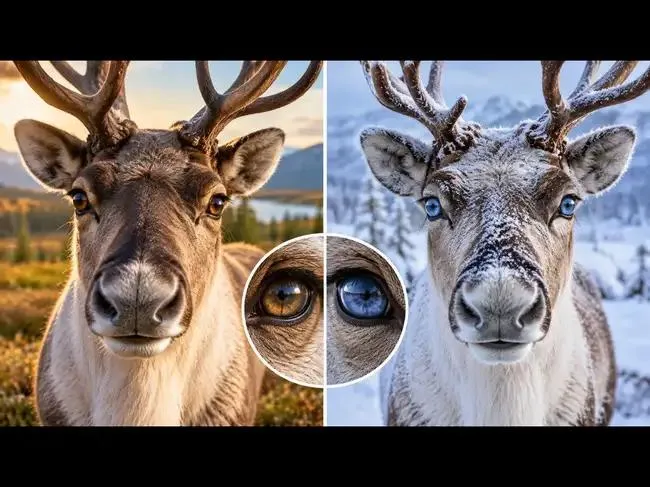
Scientific illustration: seasonal changes in collagen-fiber spacing within the tapetum lucidum alter the wavelengths of reflected light.
Does the Color Change Help Reindeer Spot Wolves?
It may. Wolves are important predators of reindeer in some parts of their range.
Under low-light conditions, movement and visual contrast can be especially valuable for detecting approaching animals.
Researchers have proposed that the increased sensitivity of the blue winter tapetum helps reindeer notice moving predators.
However, this explanation is based on plausible links between eye physiology and ecological demands.
The 2013 optical experiments did not directly measure how successfully reindeer avoided wolves in the wild.
Do Reindeer Eyes Glow Blue at Night?
Reindeer eyes can produce a blue reflection under suitable winter lighting conditions because of their tapetum lucidum.
However, this is reflected external light, not light generated by the animal's eyes.
The eyes do not naturally shine like self-powered blue lamps.
Photographs taken with a flash or other directed lighting may reveal colored eyeshine, but the visible appearance depends on camera angle, illumination, and eye position.
Therefore, photographs showing bright neon-blue pupils in ordinary daylight should be viewed cautiously.
Can You See the Eye Color Change in a Photograph?
The seasonal change can be demonstrated through carefully controlled photography and anatomical examination.
However, a typical portrait of a reindeer may show only a dark iris and pupil, regardless of season.
The strongest photographic evidence often involves a controlled view of the reflective layer or images taken under conditions that reveal eyeshine.
Comparing unrelated summer and winter wildlife photographs is not enough to prove the difference.
Lighting, camera settings, and reflections from the surrounding environment can all affect visible eye color.
Are Reindeer the Only Animals With a Seasonal Eye Color Change?
The reindeer has been described as the only mammal currently known to make this particular seasonal change in the optical color of its tapetum lucidum.
However, other animals possess reflective eye structures and adaptations to dim light.
Cats and many other mammals have a tapetum that improves light sensitivity without undergoing the same well-documented seasonal shift.
Therefore, the reindeer's adaptation is unusual, but having a reflective eye layer is not unique to reindeer.
Reindeer Eyes vs. Cat Eyes vs. Human Eyes
| Feature | Reindeer | Cat | Human |
|---|---|---|---|
| Tapetum lucidum | Present | Present | Absent |
| Seasonal gold-to-blue reflection documented | Yes | No | Not applicable |
| Reflective eyeshine | Yes | Yes | No comparable tapetal eyeshine |
| Adapted for dim-light vision | Yes | Yes | More limited |
| Ultraviolet retinal responses demonstrated | Yes | Different short-wavelength sensitivity | Strongly limited by ocular filtering |
Are Reindeer and Caribou the Same Animal?
Reindeer and caribou are common names used for animals within the group traditionally known as Rangifer tarandus.
The word reindeer is often associated with domesticated or Eurasian populations, while caribou commonly refers to wild North American populations.
However, modern taxonomy recognizes complex evolutionary differences among Rangifer populations, and some classifications distinguish additional species.
The eye studies discussed here primarily concern Arctic reindeer populations examined in Norway.
It would therefore be premature to assume that every Rangifer population has exactly the same seasonal eye response without population-specific evidence.
Could Climate Change Affect Reindeer Vision?
Climate change is altering Arctic environments, including snow cover, seasonal temperatures, and the timing of environmental transitions.
Changes in snow and vegetation can influence the visual background against which reindeer search for food and detect other animals.
However, scientists have not established that climate change has already eliminated the seasonal color-changing mechanism in reindeer eyes.
Any effects on this particular visual adaptation would require targeted physiological and behavioral investigation.
Could Artificial Light Affect Reindeer Eye Adaptation?
Artificial lighting changes the amount and timing of light experienced by animals.
Because the reindeer's seasonal eye adaptation is associated with prolonged differences in ambient illumination, artificial light could potentially interfere with some aspects of the process.
Researchers have reported unusual reflective colors in certain reindeer exposed to different winter lighting conditions.
However, the underlying responses are not fully understood, and these observations should not be generalized to all illuminated habitats.
The broader ecological effects of artificial light on Arctic animals remain an important area of research.
Why Is Reindeer Eye Research Important?
Reindeer eyes provide a striking example of how an animal can adjust the physical properties of a sensory organ according to the season.
The 2013 research established the seasonal difference in reflective color and retinal sensitivity.
The 2022 study investigated the nanoscale physical mechanism that could explain the change.
Additional work on ultraviolet vision and lichen reflectance has connected these optical adaptations to possible ecological benefits.
Researchers are also interested in whether biological structural-color systems could inspire engineered materials whose reflected wavelengths change in a controlled way.
However, such potential applications remain distinct from the experimentally demonstrated properties of living reindeer eyes.
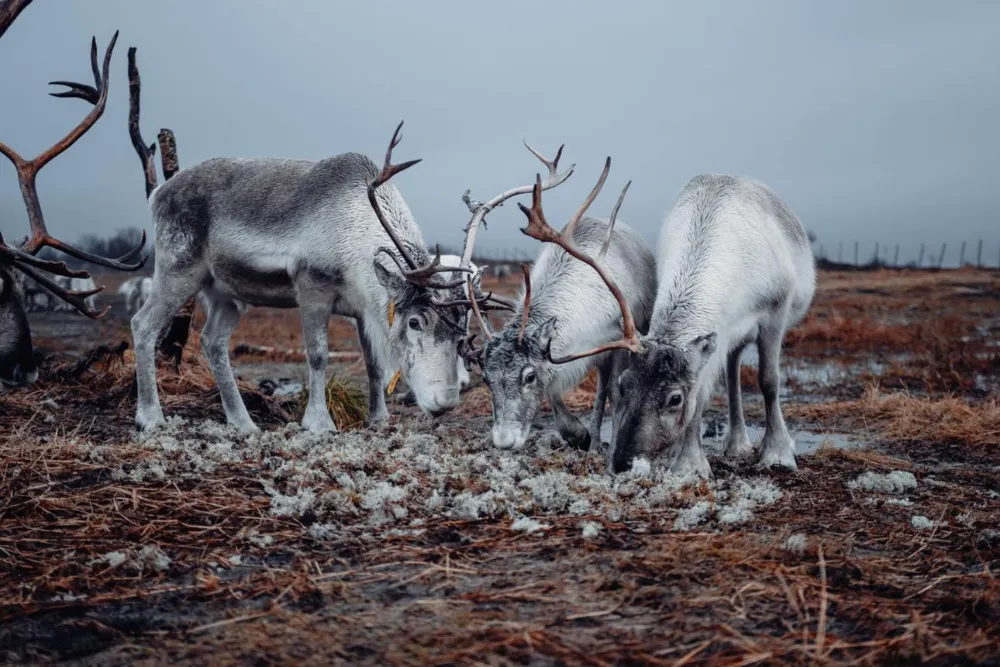
Reindeer feed on tundra vegetation, including lichens. Researchers are investigating whether ultraviolet-sensitive vision improves the contrast of certain foods against snow.
Frequently Asked Questions
Why do reindeer eyes change color?
The reflective tapetum lucidum behind the retina changes its microscopic structure seasonally, shifting from a mostly golden reflection in summer to deep blue in winter.
What color are reindeer eyes in summer?
The reflective layer is usually golden or gold-turquoise during summer.
What color are reindeer eyes in winter?
The tapetum lucidum becomes predominantly deep blue in Arctic winter conditions.
Do reindeer eyes really turn blue?
Yes, but the documented change involves an internal reflective layer rather than the entire visible eye or iris.
What is the tapetum lucidum?
It is a reflective tissue behind the retina that redirects incoming light back toward photoreceptors, helping many animals see in dim conditions.
How does the reindeer tapetum change color?
Changes in collagen-fiber spacing alter the wavelengths reflected by the tissue. Seasonal changes in fluid content and pressure are thought to contribute.
Do reindeer eyes glow blue?
The eyes can reflect blue light under suitable conditions, but they do not generate their own blue illumination.
Can reindeer see in the dark?
They have strong adaptations for dim light, although they still require some available light to see.
Do reindeer have better night vision in winter?
Research found greater retinal light sensitivity in winter eyes, potentially at the cost of reduced visual acuity.
Can reindeer see ultraviolet light?
Yes. Studies have shown that some ultraviolet light passes through their ocular tissues and produces retinal responses.
Does ultraviolet vision help reindeer find lichens?
It might help them identify some UV-absorbing lichens against snow, but direct behavioral confirmation of this foraging advantage is still limited.
Do reindeer see better than humans?
Reindeer possess adaptations for Arctic darkness and ultraviolet-sensitive vision, but visual ability cannot be ranked universally across every task.
Are reindeer eyes naturally blue in photographs?
Not necessarily. Many ordinary photographs show dark-looking eyes because the tapetum's reflective color is visible only under suitable viewing and lighting conditions.
Do caribou eyes change color too?
The seasonal change has been documented in Arctic reindeer. More research is needed to establish its precise expression across different Rangifer populations.
Do other deer change their eye color every winter?
A comparable gold-to-blue seasonal tapetum change has not been widely documented among other deer species.
Is the color change caused by blue eye pigment?
No. It is mainly associated with structural color produced by the organization of collagen fibers in the reflective layer.
Does climate change stop reindeer eyes from changing color?
There is currently insufficient evidence to claim that climate change has directly eliminated this particular optical adaptation.
The Bottom Line
Reindeer eyes change their reflective color from gold in summer to deep blue in winter because the microscopic structure of the tapetum lucidum changes.
The winter arrangement reflects and scatters light differently, increasing the retina's sensitivity under extremely dim Arctic conditions.
Research suggests that changes in collagen-fiber spacing and the amount of fluid within the reflective tissue are important to this process.
Reindeer also have unusual sensitivity to ultraviolet wavelengths, which may help them detect certain objects, predators, or food sources against snowy backgrounds.
However, the eyes do not literally become bright blue on the outside, and some proposed ecological advantages still require direct behavioral confirmation.
This remarkable adaptation demonstrates how animal vision can evolve to meet the demands of an environment with extreme seasonal changes in daylight.
Sources & Further Reading
Stokkan et al. (2013) — Shifting Mirrors: Adaptive Changes in Retinal Reflections to Winter Darkness in Arctic Reindeer. Proceedings of the Royal Society B. Original demonstration of seasonal gold-to-blue reflection, collagen spacing changes, and retinal sensitivity.
Fosbury and Jeffery (2022) — Reindeer Eyes Seasonally Adapt to Ozone-Blue Arctic Twilight by Tuning a Photonic Tapetum Lucidum. Proceedings of the Royal Society B. Optical model and experiments involving collagen structure and fluid redistribution.
Hogg et al. (2011) — Arctic Reindeer Extend Their Visual Range into the Ultraviolet. Journal of Experimental Biology. Experimental evidence of ultraviolet transmission and retinal responses.
Dominy, Hobaiter and Harris (2023) — Reindeer and the Quest for Scottish Enlichenment. i-Perception. Original measurements of lichen ultraviolet reflectance and discussion of possible feeding benefits.
Natural History Museum, London — Colour in the Collections: Reindeer Eye. Accessible scientific explanation of the tapetum and seasonal color change.
University College London (2022) — How Reindeer Eyes Transform in Winter to Give Them Twilight Vision. Researcher explanation of the optical mechanism and Arctic light environment.
University of St Andrews (2023) — Reindeer and the Quest for Scottish Enlichenment. University research summary explaining the lichen hypothesis and ultraviolet-sensitive vision.