Indoor cats often live longer, safer lives—but they also face a different set of nutrition challenges. With fewer daily calories burned, it’s easy for weight to creep up. Grooming can lead to more hairballs. And urinary issues can show up quietly until they become urgent. The “best” indoor cat food isn’t one magic brand—it’s a diet plan that supports healthy body condition, smooth digestion, and good hydration habits.
This guide explains what to look for in indoor cat food for weight control, hairball management, and urinary health, plus practical feeding tips and the red flags that mean you should contact your veterinarian.
1. What Makes Indoor Cats Different Nutritionally?
Many indoor cats move less, snack more, and spend more time sleeping. That changes the nutrition priorities:
Calories matter more: fewer calories are needed to maintain a healthy weight.
Protein quality matters: you want enough protein to support muscle while controlling calories.
Hydration is often lower: many cats naturally drink less, which can affect urinary health.
Enrichment affects appetite: boredom can look like “hunger” and lead to overeating.
Indoor-cat reality: Most “indoor” formulas are essentially calorie-controlled foods with added fiber. That can be helpful—but only if portions are accurate.
2. Weight Control: What to Look for (And What to Avoid)
2.1 Signs Your Indoor Cat Might Need a Weight-Focused Diet
Ribs are hard to feel under a layer of fat
Loss of a visible waist when viewed from above
Low energy, less jumping, or getting winded easily
Portion creep and frequent begging
2.2 What “Good Weight Control” Cat Food Usually Includes
High-quality protein as a main focus: helps maintain muscle while reducing calories.
Moderate fiber: can improve satiety and stool quality.
Reasonable calorie density: fewer calories per cup/can makes portioning easier.
Clear feeding guidance: so you can measure accurately.
2.3 Common Mistakes That Sabotage Weight Control
Free-feeding dry food: easy to overeat without noticing.
Treat overload: treats can quietly add significant calories.
“Indoor” label without portion control: even indoor formulas cause weight gain if portions are too large.
2.4 Practical Feeding Strategy for Indoor Weight Control
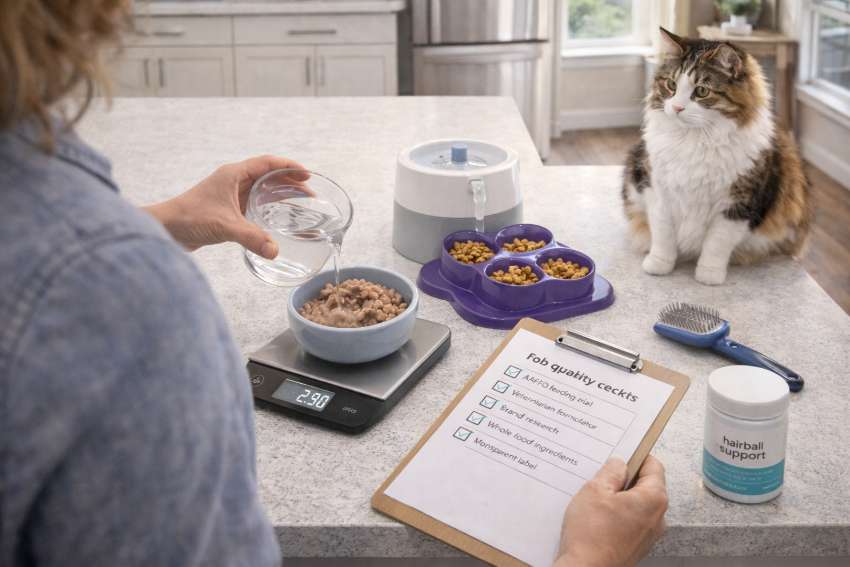
Use a kitchen scale or measuring cup for consistent portions
Feed 2–4 smaller meals per day (or use an automatic feeder for dry)
Use puzzle feeders to slow eating and increase activity
Build “treat calories” into the daily total
3. Hairballs: What Helps (And What Doesn’t)
Hairballs happen when swallowed fur accumulates in the stomach. Some cats rarely have them; others cough up hairballs frequently—especially long-haired cats or cats that groom due to stress or skin irritation.
3.1 When Hairballs Are “Normal” vs a Problem
Occasional hairball: can be normal for many cats.
Frequent hairballs: may signal excessive shedding, overgrooming, or GI motility issues.
Coughing/gagging with no hairball produced: can also be asthma or respiratory disease—don’t assume it’s hairballs.
3.2 What Hairball-Focused Cat Food Typically Does
Added fiber: helps move hair through the digestive tract rather than forming a clump.
Digestibility support: gentler formulas can reduce vomiting triggered by stomach irritation.
3.3 The Most Effective Hairball Prevention (Often Not the Food)
Regular brushing: reduces how much fur your cat swallows.
Address skin issues: allergies, fleas, or dermatitis can increase grooming dramatically.
Stress reduction: enrichment, predictable routine, and safe spaces can reduce overgrooming.
Practical note: Hairball foods can help, but they work best when paired with brushing and hydration.
4. Urinary Health: The Indoor Cat Priority Many Owners Miss
Urinary problems are common in indoor cats, especially if they drink little, eat mostly dry food, or experience stress. Urinary issues can range from mild irritation to painful emergencies.
4.1 What “Urinary Health” Food Usually Aims to Do
Promote hydration: wet food naturally increases water intake.
Support healthy urine concentration: more moisture usually means more dilute urine.
Manage mineral balance and urine pH: to reduce risk of certain crystals in susceptible cats.
4.2 The Most Effective Urinary Health Tool: More Water
If your indoor cat has no medical restrictions, hydration is usually the number-one lifestyle lever:
Feed more wet food (even partial wet can help)
Use a water fountain and refresh water daily
Offer multiple water stations away from the litter box
Try different bowl shapes (some cats dislike deep bowls)
4.3 Litter Box and Stress Matter for Urinary Health
Stress and litter box issues can contribute to urinary inflammation. Indoor cats are especially vulnerable to routine changes and territory stress.
Keep litter boxes clean and easy to access
Provide enough boxes (a common guideline is one per cat plus one extra, if space allows)
Reduce conflict in multi-cat homes with separate resources (food, water, litter, resting spaces)
5. The Best “Indoor Cat Food” Approach: Wet vs Dry vs Mixed
Instead of looking for the perfect bag, think in a plan that supports weight, hairballs, and urinary health.
5.1 Wet Food (Often Best for Urinary Support)
Pros: higher moisture, often supports urinary health and satiety.
Cons: can cost more; needs portion control and freshness management.
5.2 Dry Food (Convenient, But Easy to Overfeed)
Pros: easy storage, easy to use with automatic feeders, often budget-friendly.
Cons: lower moisture; indoor cats may gain weight faster if free-fed.
5.3 Mixed Feeding (Often the Most Practical for Indoor Cats)
Many owners do well with a mixed plan:
Wet food for one or two meals to boost hydration
Measured dry food for convenience and puzzle feeders
Key rule: count total daily calories across wet + dry + treats.
6. What to Look for on the Label (Simple, Non-Technical Checklist)
You don’t need to be a nutrition expert. Use a checklist that focuses on outcomes and safety.
Complete and balanced for your cat’s life stage (adult vs kitten vs senior)
Protein-focused formula that supports lean muscle
Moderate fiber (especially if hairballs or hunger are issues)
Clear feeding directions with calories listed (helps you portion accurately)
Urinary support claim only if your cat truly needs it (and ideally with vet guidance if there’s history)
Practical warning: If your cat has had urinary crystals, blockages, or recurrent urinary signs, ask your vet before choosing a “urinary” diet on your own. Some cats benefit from veterinary therapeutic diets rather than over-the-counter options.
7. A Simple Indoor Cat Feeding Plan (Weight + Hairball + Urinary)
If your cat is generally healthy but indoor, this is a practical starting plan:
Base diet: a quality adult cat food with moderate calories and good protein
Hydration upgrade: add at least one wet meal daily (or mix water into wet food)
Hairball management: brush 3–5 times per week (daily for long-haired cats)
Portion control: measure food and track weight monthly
Enrichment: 5–10 minutes of play twice daily + puzzle feeding
8. When to See a Vet (Don’t “Food Trial” These Symptoms)
Indoor cats can hide illness. Contact your vet if you notice:
Urinary red flags: straining to urinate, frequent tiny urinations, crying in the litter box, blood in urine, peeing outside the box
Emergency sign (especially male cats): repeated trips to the litter box with little/no urine output
Frequent vomiting: more than occasional hairballs, or gagging without producing anything
Weight loss or big appetite change: could indicate metabolic or GI disease
Persistent constipation or diarrhea
Overgrooming with bald patches
Important: A blocked male cat is a true emergency. If your cat is straining and not producing urine, seek urgent care immediately.
Final Thoughts: The Best Indoor Cat Diet Is a Plan, Not a Product
The best cat food for indoor cats supports three priorities: healthy weight, smooth digestion (including fewer hairballs), and strong urinary health through hydration. For many cats, a mixed feeding approach (measured dry + daily wet) plus regular brushing and daily play is the most effective, realistic strategy.
Your action step: start by measuring portions and adding a hydration boost (wet food and a water fountain), then track your cat’s weight and litter box habits monthly. If urinary signs appear, don’t wait—call your vet early.