When you have babies, toddlers, or young kids in the house, “cute” isn’t the same as “family-friendly.” The best family dog is usually the one with a steady temperament, high tolerance for normal kid chaos, and an exercise level your family can realistically meet. Breed can help predict tendencies, but it never replaces individual personality, early socialization, and good supervision.
This real-life guide explains what “good with kids” truly means, which breeds often fit families with young children, what challenges to expect, and how to choose a dog your household can enjoy safely for years. You’ll also learn when to involve a trainer, and when a dog might not be a good match right now.
1. What “Good With Young Kids” Actually Means
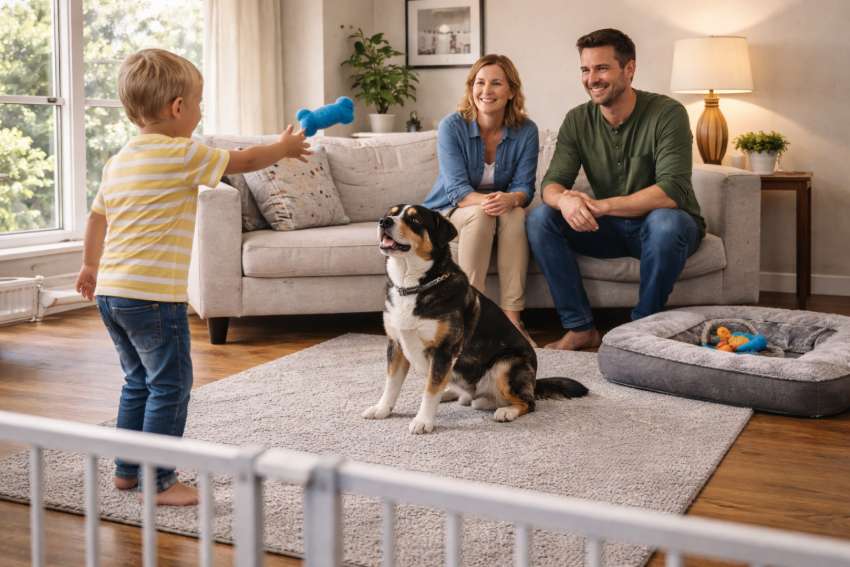
Family-friendly temperament isn’t about a dog letting a child climb on them (that’s unsafe). It’s about predictable, low-risk behavior in a busy home.
Stable, predictable reactions: not easily startled, not quick to snap, recovers quickly from surprises.
Tolerant handling: can cope with accidental bumps (with training and boundaries), not easily defensive.
Low to moderate guarding: less likely to guard food, toys, or spaces.
Moderate energy with an “off switch”: can play, then settle calmly indoors.
Enjoys people: generally social and affectionate without being frantic.
Important: No dog is “kid-proof.” Safe family dog ownership always includes active supervision, child training (gentle rules), and dog training (calm behavior around kids).
2. The Biggest Mistake: Picking a Breed Instead of a Lifestyle Match
Many family dog problems aren’t “bad dogs”—they’re mismatched expectations. A high-energy breed without daily exercise often turns into jumping, mouthing, barking, and chaos. A sensitive breed in a loud home can become fearful or reactive.
Ask These “Reality” Questions First
How many minutes per day can we truly spend on walks, play, and training?
Do we want a dog that’s happy with neighborhood walks, or one that needs intense running?
How much shedding and grooming can we handle weekly?
How much noise and mess can we tolerate (barking, drool, muddy paws)?
Will the dog be alone for long stretches? Who handles potty breaks?
Do we have time for puppy training, or do we need an adult dog?
Family tip: For many households with young children, an adult dog with a known temperament is easier than a puppy.
3. Best Dog Breeds for Families with Young Children (Real-Life Temperament Notes)
Below are breeds that often do well in family settings. “Often” matters—individual dogs can vary. For families, prioritize a dog that is calm, social, and comfortable being handled appropriately.
3.1 Labrador Retriever
Why families love them: Labs are typically friendly, people-oriented, and playful. Many have excellent “bounce-back” after surprises.
Kid-fit strengths: outgoing, tolerant, enjoys play, usually not overly sensitive.
Real-life challenge: young Labs can be very mouthy and bouncy; toddlers may get knocked over.
Best for: families who can provide daily exercise and basic training.
3.2 Golden Retriever
Why families love them: Goldens are often gentle, affectionate, and eager to please, with a social, cooperative nature.
Kid-fit strengths: soft-mouthed play style, affectionate, patient with calm handling.
Real-life challenge: shedding is significant; some young Goldens are exuberant and need training.
Best for: families who want a social dog and can handle grooming and daily exercise.
3.3 Cavalier King Charles Spaniel
Why families love them: typically sweet, people-focused, and content with moderate exercise, making them easier in busy homes.
Kid-fit strengths: gentle, cuddly, often less intense than many larger breeds.
Real-life challenge: small dogs can be more fragile; toddlers must learn gentle handling.
Best for: families with calmer kids or strong supervision and “gentle hands” training.
3.4 Beagle
Why families love them: cheerful, social dogs that often enjoy kids and playtime.
Kid-fit strengths: friendly, playful, usually enjoys being part of the group.
Real-life challenge: scent hounds can be stubborn and vocal; recall training can be tough.
Best for: families who can commit to training and manage barking/escape risk.
3.5 Poodle (Standard or Miniature)
Why families love them: intelligent, trainable, and often more “hypoallergenic-feeling” in shedding compared to many breeds.
Kid-fit strengths: highly trainable, can learn calm greetings and polite behavior quickly.
Real-life challenge: grooming needs are high; can be sensitive if socialization is lacking.
Best for: families who want a smart dog and will maintain grooming and training.
3.6 Boxer
Why families love them: affectionate “clown” personality, often very bonded to family, with playful energy.
Kid-fit strengths: loyal, fun, often tolerant and people-loving.
Real-life challenge: can be very bouncy; needs training to avoid knocking over small kids.
Best for: active families who enjoy play and consistent training.
3.7 Bernese Mountain Dog
Why families love them: often calm, gentle, and affectionate with a generally easygoing style.
Kid-fit strengths: steady temperament, often patient and relaxed indoors.
Real-life challenge: very large; even a gentle dog can accidentally bump a toddler hard.
Best for: families with space and strong management for large-dog handling.
3.8 Bichon Frise
Why families love them: generally friendly, social, and suited for smaller homes with moderate exercise needs.
Kid-fit strengths: cheerful and affectionate; often enjoys family activity.
Real-life challenge: grooming is frequent; can develop separation issues if always around people.
Best for: families who want a smaller dog and can commit to grooming and alone-time training.
3.9 Mixed-Breed Dogs (Often the Best “Real-Life” Choice)
Why families love them: many mixed-breed adult dogs have stable temperaments and are adaptable to family life. If you adopt an adult dog from a reputable rescue, you may get a clearer picture of personality than with a puppy.
Kid-fit strengths: potential for calmer, known temperament; often resilient and social.
Real-life challenge: past history can matter; choose a dog with child-safe evaluation and a transparent rescue.
Best for: families who want temperament-first selection rather than breed-first selection.
4. Breeds and Traits That Can Be Harder with Young Children (Not “Bad,” Just Higher Management)
This section isn’t about labeling dogs as unsafe. It’s about honest lifestyle fit. Some traits are tougher with toddlers:
Very high energy and intensity: can lead to nipping, herding behavior, or nonstop motion without enough exercise and training.
Strong guarding instincts: may guard food, toys, or spaces—risky around kids who drop snacks or grab items.
Very sensitive or fearful temperaments: can struggle with sudden noises, unpredictable movement, and frequent visitors.
Strong prey drive: can be challenging in homes with small pets or chaotic movement.
Important: You can absolutely have a successful family dog with these traits—just plan for more training, more management, and stronger supervision.
5. Puppy vs Adult Dog: Which Is Better for Young Kids?
5.1 Puppies (Pros and Cons)
Pros: you shape training early, can socialize carefully, bonds strongly with family.
Cons: biting/mouthing, accidents, sleep disruption, huge training demands, higher supervision needs with toddlers.
5.2 Adult Dogs (Pros and Cons)
Pros: calmer energy, known temperament, often already house-trained, easier with consistent routines.
Cons: may have existing habits; needs slow introductions and decompression time.
Family-friendly recommendation: If you have very young children, an adult dog (2+ years) with a proven, stable temperament is often the smoothest path.
6. The “Family Temperament Checklist” (Use This When Meeting a Dog)
Whether you’re adopting or buying, use this checklist. You’re looking for calm curiosity and easy recovery.
Body language: relaxed posture, soft eyes, loose wag, not stiff or frozen.
Approach style: comes over gently rather than charging and jumping.
Touch tolerance: accepts gentle handling without flinching or whipping around.
Startle recovery: if something drops, does the dog recover quickly?
Food/toy behavior: shows no intense guarding or snapping behavior.
Energy match: can settle after a few minutes, not constant “go-go-go.”
Red flag moment: if you see stiff posture, hard staring, growling, or repeated snapping, pause and consult a qualified professional before proceeding.
7. How to Make Any Dog Safer Around Young Children (Practical Steps)
Even the best breed needs training and structure. These steps are high-impact for safety and harmony:
7.1 Teach the Dog “Kid-Proof Skills”
Calm greetings: sit for hello, no jumping.
Leave it / drop it: reduces conflict over toys and food.
Go to mat: a safe settle spot when kids are loud or guests arrive.
Handling practice: gentle touch + treat pairing for ears, paws, collar, brushing.
7.2 Teach Kids “Dog-Safe Rules” (Simple, Repeatable)
No hugging or climbing: many dogs tolerate it until they don’t.
No bothering the dog while eating or sleeping: reduces bite risk.
One toy at a time: reduce chaos and grabbing.
Gentle hands: touch the shoulder or chest, not the face.
7.3 Use Management Tools (They Prevent Mistakes)
Baby gates and playpens: create safe separation during busy moments.
Crate or quiet zone: gives the dog a place to decompress.
Leash indoors at first: helps guide behavior without grabbing the collar.
8. When to Call a Professional Trainer or Behaviorist
Don’t wait until you’re scared. Get help early if you notice:
Growling, snapping, or showing teeth around kids
Resource guarding (food, toys, couch, bed)
Fearful reactions to child movement/noise
Chasing, herding, or nipping kids repeatedly
Severe separation anxiety that increases household stress
Safety first: If there’s any bite or near-bite incident, separate dog and child immediately and consult a qualified professional promptly. Management is not failure—it’s responsibility.
9. When to Involve a Vet
Sometimes behavior shifts aren’t “training issues.” Pain or medical problems can make a previously tolerant dog irritable or reactive.
Contact your vet if you notice:
Sudden aggression or irritability that’s out of character
Reluctance to be touched, picked up, or handled
Limping, stiffness, or changes in mobility
Changes in appetite, sleep patterns, or bathroom habits
Practical note: Treating pain can make training dramatically easier and safer.
Final Thoughts: Choose Temperament First, Then Breed
The “best” family dog breed is the one that matches your household’s pace, space, and daily routine—and has the temperament to handle kid life calmly. Labs and Goldens are popular for good reasons, but many families find their perfect match in a calm adult mixed-breed dog with a proven track record around children.
Your action step: decide your non-negotiables (energy level, size, grooming needs), meet dogs with the temperament checklist in hand, and plan for early training and management tools. With the right match and good habits, a dog can become one of the most meaningful parts of your child’s childhood.