Many owners only start thinking seriously about pet insurance when their dog or cat is already a “senior” – maybe 8, 10 or even 12+ years old. At that point, it’s natural to wonder: “Is it too late? Will any company even cover my pet? And is it still worth the price?”
The honest answer is: it depends. Pet insurance for older dogs and cats can still provide real financial protection, but there are more exclusions, higher premiums and more fine print to read carefully.
This guide will help you:
Understand how insurers view age and “pre-existing conditions”
See what types of coverage matter most for senior pets
Compare accident-only vs comprehensive options for older animals
Decide when insurance still makes sense and when a savings fund might be better
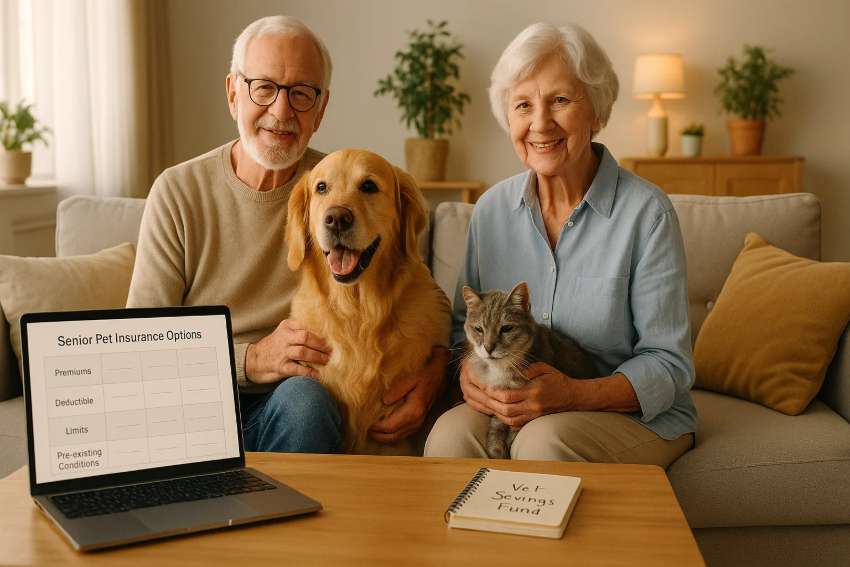
1. How Pet Insurers Think About Age
From the insurer’s point of view, older pets are more likely to get sick and more likely to need expensive tests and treatments. That’s why:
Premiums usually increase with age.
Some companies have a maximum age for new sign-ups (for example: no new policies after 8–10 years old).
There may be more exclusions for certain age-related conditions.
However, many insurers still:
Allow new older pets to join, just with higher premiums.
Continue to cover pets for life, as long as the policy is kept active and premiums are paid on time.
The key is to look at policies in detail rather than assuming “they won’t cover old pets anyway”. You might be surprised – there are often still options.
2. The Big Issue: Pre-Existing Conditions
For older pets, the main obstacle is not just age. It’s pre-existing conditions.
2.1 What counts as a pre-existing condition?
Most insurers define a pre-existing condition as:
Any illness or injury that showed signs or symptoms before your policy started, or
Any problem that appeared during the policy’s waiting period.
This can include:
Chronic kidney disease
Heart disease or heart murmurs
Arthritis or cruciate ligament issues
Ongoing skin allergies, ear infections
Previous cancers or masses
These conditions are usually excluded from coverage going forward, or subject to special rules. That means insurance is really protecting you mostly from new problems that appear after the policy starts.
2.2 Why this matters more for seniors
By the time a dog or cat is older, many already have:
Some level of dental disease
Mild arthritis or stiffness
Recurring skin or ear problems
Age-related organ changes
These may all be excluded – so you must read the policy and any medical history notes carefully to understand what is and isn’t covered for your individual pet.
3. What Coverage Matters Most for Older Pets?
For senior dogs and cats, the highest costs usually come from illness and diagnostics, not from dramatic accidents.
3.1 High-value areas of coverage
Diagnostics: blood tests, urine tests, X-rays, ultrasound, CT/MRI, biopsies.
Chronic disease management: repeated check-ups, monitoring, specialist consultations.
Medications: long-term drugs for arthritis, heart disease, epilepsy, thyroid disease, etc.
Hospitalization and emergency care: for sudden crises like pancreatitis, pneumonia, acute kidney failure.
Cancer treatment: surgery, chemotherapy or other options, if you would consider them.
When comparing policies for seniors, focus less on “extras” and more on how they handle serious illnesses over time.
3.2 Features to look for
Lifetime cover for conditions: the policy continues to cover a condition year after year, as long as you keep the policy.
Reasonable annual or per-condition limits: enough to cover a typical serious illness, not tiny amounts.
Medication coverage: some plans have separate limits for long-term medications.
Diagnostic test coverage: make sure expensive tests are included, not excluded.
4. Accident-Only vs Comprehensive for Seniors
4.1 Accident-only for older pets
Accident-only plans for seniors:
Are usually cheaper per month than comprehensive plans.
Cover emergencies such as falls, car accidents, bites and swallowed objects.
Do not cover age-related illnesses, cancer, arthritis, kidney disease, etc.
For older pets, most big vet bills are actually illness-related, not accident-related. So accident-only may offer limited value unless your main worry is trauma (for example, a roaming outdoor cat).
4.2 Comprehensive plans for older pets
Comprehensive accident + illness plans:
Cost more per month, especially for seniors.
May exclude existing diseases, but can cover new illnesses that appear after the start date.
Offer more meaningful protection if your pet develops a new serious condition at 10, 12 or even older.
For many owners, comprehensive coverage for an older pet is about protecting against one or two big, new diagnoses that could otherwise be financially overwhelming.
5. When Insurance for Older Pets Can Still Be Worth It
Insurance for a senior pet can still make sense if:
Your pet is older but does not yet have many diagnosed conditions.
You can afford the monthly premium, but would struggle to pay a sudden $2,000–$5,000 vet bill.
The policy clearly covers:
New cancers
New organ diseases
New orthopedic injuries
Diagnostics and medications related to those conditions
There is no unrealistic annual limit (for example, only a few hundred dollars per year).
Think of it this way: if your older dog suddenly needed:
Emergency hospitalization for pancreatitis, or
Surgery for an intestinal blockage, or
Ongoing treatment for newly diagnosed heart disease
Would the policy pay enough to significantly reduce your out-of-pocket cost? If yes, it may be worth the premiums.
6. When Insurance Might Not Be the Best Choice
On the other hand, insurance for a senior pet might not be cost-effective if:
Your pet already has multiple chronic illnesses that will be excluded.
Policies in your region have very high premiums for seniors with low annual limits.
You have enough savings to comfortably handle even large vet bills.
You prefer to set aside money in a dedicated “pet health savings account” each month instead of paying insurance premiums.
In these cases, you might:
Skip insurance and focus on budgeting and regular preventive care.
Look into payment plans, credit options or discount programs some clinics offer.
7. How to Compare Policies Specifically for Seniors
When you’re comparing plans for an older dog or cat, go beyond the marketing headlines and ask:
Maximum age for new enrollment: Is my pet still eligible to start a new policy?
Pre-existing condition rules: How do they define pre-existing? Do they ever re-cover conditions after a symptom-free period?
Chronic condition coverage: Are conditions covered for life once they start, or only for a year or two?
Annual and per-condition limits: Are the limits high enough for real-world illnesses?
Medication and specialist coverage: Are these included or restricted?
Premium increases: How much do prices typically rise as pets get older?
Ask insurers for sample claim scenarios: “If my 11-year-old dog is diagnosed with heart disease, what would be covered and what would I pay?” Real examples help more than abstract numbers.
8. Combining Insurance with a Savings Plan
One practical approach for senior pets is a hybrid strategy:
Choose a policy with a higher deductible and slightly lower premium.
At the same time, put some extra money each month into a separate savings account for vet costs.
The insurance helps prevent complete financial disaster from a major illness or emergency, while your savings account helps cover:
Routine check-ups and bloodwork
Dental care
Deductibles and co-pays
This can be more realistic than trying to buy the highest possible coverage level for an older pet.
9. Talk to Your Vet: Realistic Costs for Senior Care
Before deciding, ask your vet:
“What kinds of serious health problems do you typically see in dogs/cats of my pet’s age and breed?”
“Roughly how much do those problems cost to diagnose and treat in this clinic?”
“If my pet needed major treatment in the next 2–3 years, what price range should I be ready for?”
Hearing real numbers for your area (not just online guesses) can make the decision much clearer. You may realize:
Insurance is a valuable safety net, or
You prefer to rely on savings and careful budgeting.
10. Final Thoughts: Is Pet Insurance for Seniors “Worth It”?
There is no one-size-fits-all answer. For some older dogs and cats, pet insurance still provides crucial protection that allows owners to say “yes” to life-saving care. For others, especially with many existing illnesses or very high premiums, a dedicated savings plan might be more sensible.
The key is to:
Be honest about your finances and risk tolerance.
Read policy wording carefully, especially exclusions and limits.
Focus on coverage for new serious illnesses, not small routine costs.
If you decide to insure your senior pet, think of it as buying options and peace of mind: the option to choose better care if something big happens, without money being the only deciding factor in a very emotional moment.