Potty training a puppy is never “effort-free”, but doing it in a small apartment in New York, London, Berlin or Paris adds extra challenges. No backyard. Long elevator rides. Busy streets. Maybe even cold, rain or snow. The good news? With a clear plan and a realistic schedule, apartment potty training absolutely works.
This guide gives you a step-by-step plan that fits modern city life. You’ll learn:
How often a young puppy actually needs to go
What setup works best in an apartment (crate, playpen, pads, balcony, outside)
A simple daily schedule you can follow even if you work from home
How to handle nights, accidents and “stubborn” puppies
1. How Often Do Puppies Need to Go?
Very young puppies have tiny bladders and almost no control. As a rough guide:
8–10 weeks old: every 1–2 hours when awake
10–16 weeks old: every 2–3 hours when awake
4–6 months old: every 3–4 hours (some can hold longer)
Puppies almost always need to go:
Right after waking up (day or night)
Right after eating or drinking
Right after play or excitement
Every time you let them out of a crate or playpen
If you live on the 10th floor or in a building with slow elevators, you must plan around this. That’s where good setup and a realistic choice between indoor vs outdoor potty goals come in.
2. Decide: Outside Only, Indoor Pads, or a Mixed Approach?
In an ideal world, all puppies would go straight outside to grass. In real life, some apartment owners:
Live many floors up with long elevator waits
Have busy streets with traffic and noise that scare tiny pups
Face very harsh winters or summer heat
So you have three basic strategies:
2.1 Outside-only training
You always take your puppy outside to pee and poop.
Best if:
You have fast access to a safe outdoor spot (courtyard, quiet street corner).
You or another adult are home often during the day.
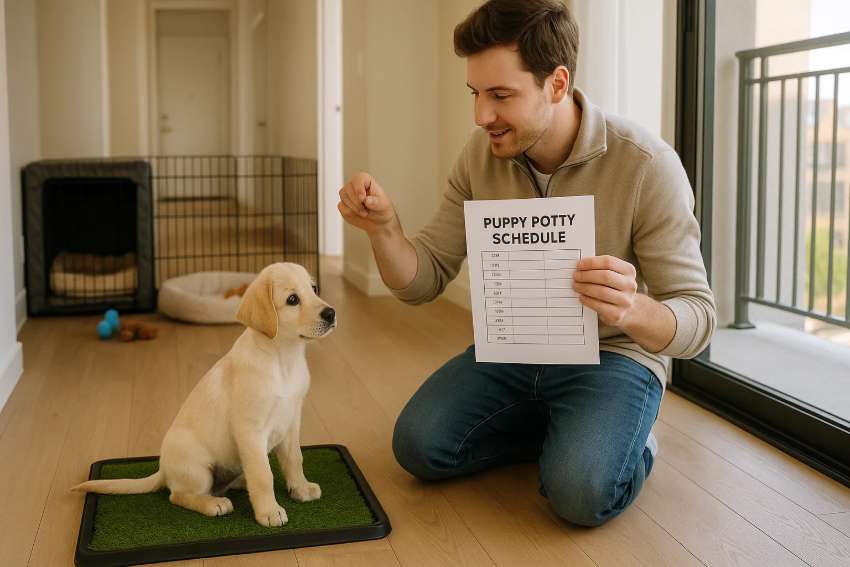
2.2 Indoor potty spot (pee pads, real or fake grass)
You teach your puppy to use:
Disposable pee pads
Washable pads
Indoor grass trays or balcony potty boxes
Best if:
Getting outside is very slow or difficult.
Weather is extreme for much of the year.
2.3 Mixed approach (start indoors, move to outside later)
Puppy first learns to use a pad or grass mat in one fixed spot.
Over time, you move that spot closer to the door and then fully transition to outdoors.
There is no “one correct” choice. Pick what you can realistically do every day. Consistency matters more than the specific method.
3. Set Up Your Apartment: Crate, Playpen and Potty Zone
A good layout makes potty training much easier.
3.1 Crate (sleeping and resting zone)
A crate should be just big enough for your puppy to stand, turn around and lie down comfortably – not so big that they can pee in one corner and sleep in another.
Use it for:
Night-time sleep
Short rest periods during the day
Dogs naturally avoid soiling their sleeping area, which encourages holding it until you take them out.
3.2 Playpen or “safe zone”
Attach a playpen to the crate or use baby gates to block off a small area.
In this area, you can place:
Bed or crate
Water bowl
Chew toys
Indoor potty spot (if you’re using pads or grass)
3.3 Fixed potty spot
If training outdoors: choose one specific corner of the courtyard or sidewalk strip as your “toilet zone”.
If training indoors: choose one specific corner for pads/grass trays and never move it randomly.
Puppies learn faster when there is clear structure: sleep here, play here, toilet there.
4. Step-by-Step Daily Schedule (First 2–3 Weeks)
Here is a simple example for an 8–12 week old puppy in an apartment. Adjust times to your life, but keep the order consistent.
Morning
Puppy wakes up in crate → go straight to potty spot.
Carry your puppy if needed, especially in hallways and elevators, to avoid accidents.
Stay at the potty spot for up to 5–10 minutes.
Say a simple cue like “go potty” in a calm voice.
When they finish, praise warmly and give a small treat within 1–2 seconds.
Go back inside for:
Breakfast
5–10 minutes of calm play or cuddles
Take puppy to potty spot again 5–15 minutes after eating.
Daytime (repeat cycle)
Every 1–2 hours:
Take puppy from crate/playpen → directly to potty spot.
Give them a chance (up to 5–10 minutes).
Praise and treat if they go.
Always take them:
After naps
After play sessions
Before and after training
Evening and night
Last meal at least 2–3 hours before bedtime if possible.
Multiple potty trips in the evening (after dinner, after play, before bed).
Overnight, most young puppies need at least one night-time potty break (set an alarm every ~3–4 hours at first).
Yes, it’s tiring. But this intense phase doesn’t last forever. In a few weeks, many puppies can sleep longer and hold it longer.
5. How to Reward Good Potty Habits
Positive reinforcement is the fastest way to teach your puppy what you want.
Use a special treat that they only get for peeing/pooping in the right spot.
Give the treat immediately after they finish, not when you’re back inside.
Use a consistent verbal cue like “go potty” or “toilet time” only when they are in the correct spot.
Stay calm and boring on the walk until they go – then you can make the rest of the walk fun.
Many puppies quickly learn that “toilet first = treats and fun after”.
6. Handling Accidents (Without Ruining Training)
Even with a perfect schedule, accidents will happen. How you react is crucial.
6.1 If you catch your puppy in the act
Say a neutral interrupt like “ah-ah” or “oops” – no shouting.
Gently pick them up and bring them to the potty spot.
If they finish there, praise and treat as usual.
6.2 If you find a “surprise” after the fact
Do not scold, rub their nose in it, or punish.
Your puppy won’t connect the punishment to the accident – they just learn that you are scary around pee/poop.
Quietly clean it up with an enzymatic cleaner so no smell remains (smell attracts repeat accidents).
After any accident, ask yourself:
Did I miss a scheduled potty trip?
Was the gap too long for this puppy’s age?
Did I give too much freedom too quickly (whole apartment instead of small area)?
Then adjust the routine instead of blaming the puppy.
7. Crate Time, Freedom and “Earning” More Space
In an apartment, letting your puppy roam everywhere too soon almost guarantees hidden accidents. Instead:
Start with:
Crate or bed area
Small playpen or gated zone
Give short periods of supervised freedom in the wider apartment only after they’ve just gone potty.
If you’re busy (work call, shower, cooking), put them back in the playpen or crate – this prevents “silent accidents”.
Think of freedom as something they earn with consistent good habits, not something they start with immediately.
8. Special Apartment Challenges (Elevators, Busy Streets, Bad Weather)
8.1 Elevators and stairwells
If possible, carry very young puppies in common areas to reduce the chance of accidents on the way out.
Bring a small cleaning spray and paper towels in a bag if your building requires you to clean up immediately.
8.2 Busy or scary streets
Choose the quietest possible corner for your potty spot – a side street, courtyard or patch of grass away from heavy traffic.
If your puppy is too scared to go outside at first, you may temporarily rely more on indoor pads and gradually build confidence outdoors.
8.3 Extreme weather
Short, focused trips to the potty spot in heatwaves or freezing conditions.
Use a coat or sweater for small or short-haired puppies in winter.
If it’s truly unsafe outside (ice storms, extreme heat), indoor potty options are your backup plan.
9. Common Problems and How to Fix Them
9.1 Puppy pees again right after coming back inside
Maybe they were too distracted outside to fully empty.
Solution: stay outside a bit longer, walk in a quieter area, or give them 5 extra minutes at the potty spot.
When you come inside, keep them on-leash and supervised for 10–15 minutes to prevent “second pee” accidents.
9.2 Puppy only uses pee pads and refuses to go outdoors
Gradually move the pad closer to the door over days/weeks.
Then place a pad just outside the door (if allowed) or in a carrier that you take outside.
Eventually, reduce pad size or switch to grass mat outdoors, then remove it once they reliably use the ground.
9.3 “Stubborn” puppy with many accidents
In most cases, the puppy is not stubborn – the plan is just too ambitious.
Go back to basics:
More frequent potty trips
Smaller freedom area
Better supervision (leash indoors or tether to you)
10. How Long Does Potty Training Take in an Apartment?
Every puppy is different, but as a rough outline:
First 1–2 weeks: many accidents, heavy supervision, very frequent potty breaks.
Weeks 3–6: fewer accidents, puppy starts to “get it” if you’re consistent.
By 4–6 months: most puppies are largely reliable during the day, with occasional mistakes.
Night-time control often takes longer, and small breeds may take longer than large breeds. Apartment living adds some logistics, but the basic learning process is the same: predict, prevent, reward in the right place.
Stay patient, keep your routine, and remember: every correct pee in the right spot is a small deposit in your future of living with a fully house-trained city dog who can share your apartment without stress.