Chewing is a completely normal dog behavior – puppies explore the world with their mouths, and many adult dogs enjoy chewing for relaxation. But when your dog destroys shoes, furniture, remote controls, door frames or walls, it stops being “normal” and becomes a serious problem, especially in apartments and rented homes in the US and Europe.
The goal of this guide is not to stop all chewing (that would be unfair and unrealistic), but to:
Understand why dogs chew
Tell the difference between normal chewing and problem chewing
Use management to protect your home and your dog
Teach your dog what is okay to chew and what is not
Know when destructive chewing might be a sign of stress, anxiety or a medical issue
1. Why Dogs Chew (Puppies vs Adult Dogs)
1.1 Puppies: teething and exploration
Puppies start teething around 3–4 months of age, and it can last until about 6–7 months.
Chewing helps relieve gum discomfort and loosen baby teeth.
Puppies also use their mouths to explore textures, shapes and tastes – like human babies with their hands.
So for puppies, chewing is not just normal – it’s essential. The problem is that they don’t automatically know the difference between a chew toy and your expensive shoes.
1.2 Adult dogs: stress relief, boredom and habit
Many adult dogs chew to relax and self-soothe. It can be a natural “stress reliever”.
Dogs left alone for long periods without enough mental or physical exercise often chew out of boredom.
If chewing “worked” for them as puppies (relieved stress, felt good), they may keep the habit into adulthood.
Some adult dogs also chew due to anxiety – for example, dogs with separation anxiety may destroy doors, crates or window frames trying to escape or cope with panic.
2. Normal Chewing vs Problem Chewing
Not all chewing is equal. It helps to separate:
Healthy chewing: on appropriate items (toys, long-lasting chews) during relaxed times.
Problem chewing: on dangerous or valuable items, repeated in the same areas, or clearly linked to stress.
2.1 Signs it’s “just” normal puppy chewing
Puppy chews random objects left within easy reach (shoes, socks, phone cables).
Most damage happens when they are unsupervised.
Puppy happily chews on dog toys and bones when offered.
In these cases, the main problem is usually too much freedom and not enough management, not a serious behaviour issue.
2.2 Signs of more serious problem chewing
Dog focuses on doors, window frames or walls, especially near exits.
Chewing happens mainly when the dog is alone or when you’re getting ready to leave.
Dog ignores or rarely uses appropriate chew items.
Chewing is intense and repetitive, leading to broken teeth, bleeding gums or ingestion of non-food items.
These patterns can signal anxiety, frustration or medical issues, not just a playful habit.
3. First Priority: Safety for Your Dog and Your Home
Before training, make sure your dog cannot easily hurt themselves.
3.1 Dangerous items to protect
Electrical cords and chargers
Batteries, remote controls and electronic devices
Medications, cosmetics and cleaning products
Children’s toys with small parts
Hard objects that can break teeth (some stones, metal, very hard bones)
Use cord covers, cable management boxes, baby gates and closed doors to keep these out of reach – especially for puppies.
3.2 Veterinary check if needed
See your vet if:
Your dog chews or eats non-food items (rocks, fabric, plastic – possible pica).
They break teeth or show signs of mouth pain.
Chewing suddenly increases or changes in an adult dog with no obvious reason.
4. Management: “Puppy-Proof” and “Dog-Proof” Your Space
Management means shaping the environment so your dog can’t easily make bad choices, especially when unsupervised.
4.1 For puppies and young dogs
Use a playpen or gated area rather than giving full free access to the whole home.
Keep valuable items out of reach:
Shoes in closets
Wires behind furniture or covered
Laundry in hampers with lids
Offer several safe chew toys in their area at all times.
4.2 For adult dogs
If your dog chews in certain problem zones (like one corner of the sofa), block access when you’re not there:
Use baby gates, pens, or close doors.
Consider crate training if done humanely and your dog is comfortable in a crate.
Rotate toys so they feel “new” and interesting; boredom makes chewing more likely.
Management is not cheating; it’s like toddler-proofing a home. You are setting your dog up for success instead of waiting to correct failure.
5. Choosing the Right Chew Toys (What to Offer Instead)
Dogs need things they are allowed to chew. A “no chewing at all” rule is unrealistic and unfair.
5.1 Types of safe chews and enrichment
Rubber toys: sturdy, hollow toys that can be stuffed with food (kibble, wet food, peanut butter without xylitol).
Nylon or composite chews: designed specifically for dogs, in appropriate size and hardness.
Rope toys: supervised only, as they can fray and be swallowed.
Edible chews: dental chews, natural chews appropriate for your dog’s size and chewing style (ask your vet for recommendations).
Food puzzle toys: slow-feeding bowls, treat-dispensing balls.
5.2 Match the chew to your dog
Power chewers: need extra-tough rubber or composite toys to avoid shredding and swallowing pieces.
Gentle chewers: may prefer softer rubber, rope, or plush toys.
Puppies: need slightly softer textures that are gentle on growing teeth and gums.
Always supervise your dog with new chews at first and remove anything that is breaking into large, sharp or easily swallowed pieces.
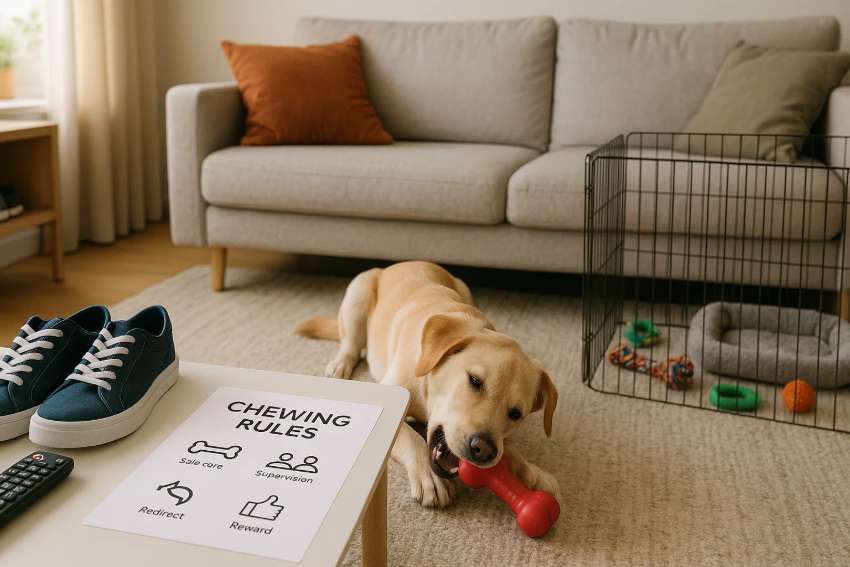
6. The Core Training Strategy: Interrupt, Redirect, Reward
Training your dog to chew appropriate items instead of your furniture follows a simple pattern:
Interrupt gently when they start chewing something they shouldn’t.
Redirect them to an appropriate chew toy.
Reward them for chewing the correct item.
6.1 How to interrupt without scaring your dog
Use a calm, neutral word like “uh-uh” or “oops”.
Avoid shouting, hitting or yanking – fear doesn’t teach good choices, it just damages trust.
Walk over, gently remove the forbidden item if safe, and immediately offer an allowed chew.
6.2 Make the right choice very rewarding
When your dog takes the appropriate chew toy, praise warmly (“good chew!”) and sometimes add a tiny treat into or on the toy.
Spend a minute interacting – hold the toy, play a short tug game, or sit with them while they start chewing.
Over time, your dog learns that chewing their toys = attention and good things, while chewing furniture leads to a boring interruption and removal.
7. Special Case: Chewing When Left Alone
If your dog mainly chews door frames, crates, or walls when alone, the issue may be more than boredom.
7.1 Boredom and lack of enrichment
Ask yourself:
Does my dog get enough daily exercise (appropriate for age and health)?
Do they get mental stimulation (training, sniff walks, food puzzles)?
Before leaving, give:
A walk with sniffing time, not just a quick toilet trip.
A stuffed Kong or long-lasting chew reserved only for alone-time.
7.2 Anxiety-based chewing (possible separation anxiety)
Signs include:
Chewing doors, window frames or crates near exits.
Whining, howling or barking when you leave.
Other signs of distress: pacing, drooling, accidents indoors.
If you suspect separation anxiety, simple “chew toy solutions” are usually not enough – you need a structured alone-time training plan and possibly help from a vet or behaviourist.
8. What Doesn’t Work (and Can Make Things Worse)
Some common “quick fixes” backfire or cause new problems.
Rubbing their nose in the damage or scolding after the fact
Dogs cannot connect your anger with something they did hours or even minutes ago.
They may act “guilty”, but that’s actually a fear response to your tone and body language, not real understanding.
Hitting, yelling or using harsh collars
These can increase anxiety, which may lead to more chewing or new behaviour problems.
Leaving tempting items everywhere and expecting a puppy or young dog to “just know better”
This is like leaving a plate of cookies on the floor in front of a toddler and blaming the toddler.
Using bitter sprays as the only solution
They sometimes help in specific spots, but many dogs simply move on to the next chewable item.
Without training and management, sprays are rarely a complete fix.
9. A Sample Daily Plan for a Chewy Puppy (or Young Dog)
Here’s an example routine you can adapt to your own schedule:
Morning:
Toilet walk + short play or sniffing walk
Breakfast in a puzzle feeder or stuffed toy
Supervised free time in one room; if puppy tries to chew furniture, interrupt → redirect → reward
Short nap in crate or playpen with a safe chew
Midday:
Toilet break + 10–20 minutes of mental work (basic training, nose games)
Rotate chew toys so there is “something new” to explore
Afternoon/evening:
Walk appropriate for age and breed
Calm indoor time with you; supervised free time in the living area
Short training session focused on cues like “leave it” and “drop it”
Before bed:
Last toilet break
A brief chew session to help them relax, then sleep in crate/bed
Management + routine + clear rules about what is okay to chew = fewer surprises and less damage.
10. When to Get Professional Help
Consider talking to your vet or a qualified trainer/behaviourist if:
Your dog’s chewing is intense and focused on walls, doors or crates.
They injure themselves (broken teeth, bleeding gums, swallowed objects).
Chewing is clearly linked to being alone and comes with other anxiety signs.
You’ve tried basic management and redirection for several weeks with no improvement.
A professional can:
Help you identify whether the chewing is driven by teething, boredom, anxiety or compulsive behaviour.
Design a custom training and management plan for your home and lifestyle.
Work with your vet if medication or additional diagnostics are needed in severe cases.
11. Final Thoughts: Chewing Is Normal – Your Job Is to Guide It
Chewing itself is not the enemy. For puppies, it’s part of growing up. For adult dogs, it’s a natural way to relax and relieve stress. The real goal is to channel that chewing into safe, appropriate outlets and protect both your home and your dog.
With:
Smart management and “dog-proofing”
Plenty of legal chew options
Calm, consistent interrupt–redirect–reward training
Extra support if anxiety is involved
…most destructive chewers can become dogs who enjoy their toys instead of your furniture. Over time, you’ll start to notice that when your dog feels like chewing, they walk over to their toy basket instead of your shoe rack – and that’s when you know your hard work is paying off.