You step out of your apartment in New York, London, Berlin or Paris for a relaxing walk… and then it happens. Another dog appears, or a jogger, or a cyclist – and your dog explodes at the end of the leash. Barking, lunging, growling, pulling like crazy. Neighbors stare. You feel embarrassed, frustrated and maybe even scared.
This is called leash reactivity. It’s incredibly common in city dogs in the US and Europe, and it doesn’t mean your dog is “bad” or that you’re a bad owner. It does mean your dog needs help to feel and behave differently on walks.
In this guide, you’ll learn:
What leash reactivity really is (and what it isn’t)
Why dogs lunge and bark on leash even if they’re friendly off leash
Simple management strategies to make walks safer right away
A step-by-step training plan to change your dog’s emotional response
When to call a professional trainer or behaviourist
Note: This is general information only. Always ask your vet if sudden behaviour changes appear or if you’re worried about safety.
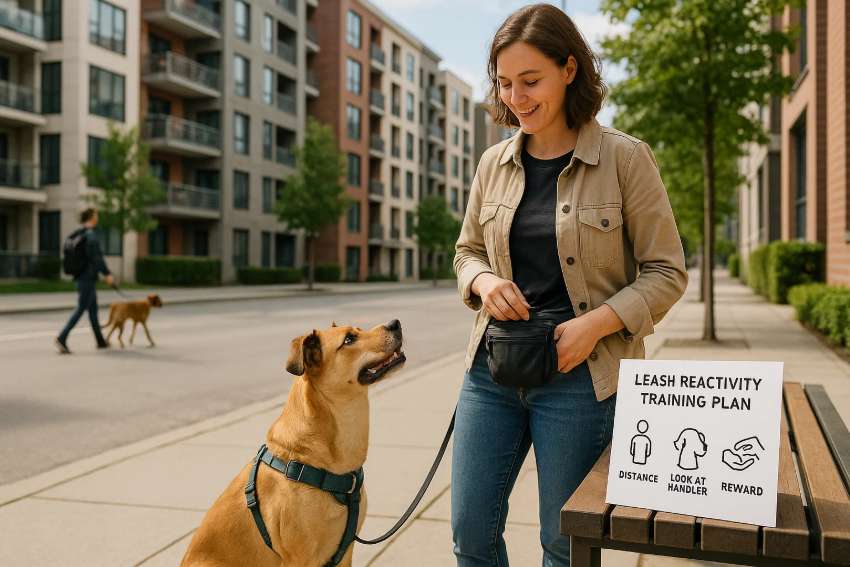
1. What Is Leash Reactivity?
Leash reactivity is when a dog has an over-the-top reaction to certain triggers while on leash, such as:
Other dogs
People (neighbors, joggers, kids, cyclists)
Cars, scooters, skateboards
Typical behaviours include:
Barking, growling, whining
Lunging, pulling toward the trigger
Spinning, jumping, hitting the end of the leash
Ignoring food and cues because they’re “over threshold”
Important: leash reactivity is often driven by fear, frustration or excitement – not “dominance” or a desire to be “the boss”. Your dog is struggling emotionally, not plotting to embarrass you.
2. Why Dogs React on Leash (Even If They’re Friendly Off Leash)
Many owners say: “But he’s fine at the dog park! He only goes crazy when he’s on leash.” There are several reasons for this:
2.1 Limited choice and movement
On leash, dogs cannot move away from something that worries them.
They also can’t approach in their normal, curved, sniffing way – they’re often pulled straight in.
This can make them feel trapped and frustrated.
2.2 Tension travels down the leash
When you see a trigger, you may tighten the leash and hold your breath.
Your dog feels this tension and thinks: “Uh oh, something is wrong!”
Leash pressure around the neck or chest can add to the feeling of being trapped.
2.3 Past bad experiences
Perhaps another dog rushed them on a sidewalk.
Maybe people have grabbed their head, squealed, or leaned over them.
One or two scary encounters can teach dogs that “dogs/people on walks = danger”.
2.4 Under-socialization or genetics
Some dogs didn’t meet enough calm, polite dogs and people during their sensitive puppy period.
Others are simply more sensitive or suspicious by nature.
The key idea: your dog’s reaction is emotional. To change the behaviour, we must change how they feel about their triggers and give them a new, safer way to respond.
3. Safety and Management: Make Walks Easier Right Now
Training will take time. In the meantime, management can lower the number of “explosions” and protect everyone’s safety.
3.1 Choose quieter routes and times
Walk in quieter streets or parks where you can maintain distance from other dogs and people.
Go at off-peak times if possible (early morning, later evening) to avoid rush-hour crowds.
3.2 Use the right equipment
A well-fitted front-clip harness can:
Give you more control
Reduce strain on the dog’s neck
A standard 1.8–2 metre (6–7 ft) leash is usually better than a retractable leash, which can be dangerous and hard to manage.
3.3 Avoid tight, crowded spaces when you can
Avoid narrow hallways, tight building entrances or busy doorways if your dog struggles in them.
If you must pass a trigger in a tight spot:
Step off to the side as far as possible.
Ask your dog to “sit” and feed a stream of treats as the trigger passes.
3.4 Advocate for your dog
Politely ask other owners not to let their off-leash dog rush yours (“Sorry, my dog needs space”).
Step between your dog and pushy humans who want to grab or hug them without asking.
Management is not “giving up” – it’s protecting your dog’s emotions and avoiding extra practice of the reactive behaviour while you work on training.
4. Training Strategy: Change the Emotional Response
The core of leash reactivity training is:
Desensitization: exposing your dog to triggers at a distance where they can stay calm.
Counter-conditioning: pairing those triggers with good things (usually food) so they start to feel positive instead of scary.
You’re teaching them a new story: “When I see a dog/person/bike, I look at my human and good things happen. I don’t need to freak out.”
5. Step-by-Step Training Plan (“Look at That” Game)
Here’s a simple version you can start with for dog–dog reactivity (it also works for people, bikes, etc.).
Step 1: Find your dog’s “calm distance”
Go to an area where you can see other dogs at a distance, like a park edge or wide street.
Notice at what distance your dog:
Can see the other dog
Is still able to take treats and respond to simple cues (like their name)
That is your starting distance. If they are already barking and lunging, you are too close – move farther away.
Step 2: Mark and reward calm looking
When your dog looks at the other dog (their trigger), calmly say “yes” (or use a clicker).
As soon as they turn their head back toward you, give them a small treat.
Repeat every time they look at the trigger calmly.
You are teaching: “See dog → look at human → get reward.” Over time, many dogs will begin to automatically check in with you when they see a trigger.
Step 3: Gradually reduce distance
When your dog can reliably look at the trigger and then back at you at one distance, take a step or two closer (over multiple sessions, not all at once).
If your dog starts barking or lunging:
Do not punish.
Simply move away to a distance where they can succeed again.
Step 4: Add a cue like “Look at me”
Once your dog is offering check-ins, you can add a cue.
Say “look at me” right before you expect them to glance back at you, then reward.
Eventually, when you see a trigger, you can proactively say “look at me” to get their attention before they escalate.
6. Skills That Support Reactivity Training
6.1 U-turns (“Let’s go!”)
A well-practiced U-turn can save you when a trigger suddenly appears too close.
Practice in quiet areas first:
Walk forward, then say “let’s go!” in a happy voice and quickly turn 180°.
Reward your dog for turning with you and moving in the new direction.
Make it a fun, fast movement so your dog enjoys following you.
Later, when a dog suddenly appears in a narrow hallway, you can say “let’s go!” and smoothly turn your dog away before they explode.
6.2 “Find it” scatter game
This teaches your dog to lower their head and sniff for food – a calming activity.
Say “find it!” and gently scatter a few treats on the ground.
Let your dog sniff them out.
Practice in quiet areas first; then use it when a mild trigger passes at a safe distance.
6.3 Relaxation at home
Dogs who are constantly “on” often react more strongly outdoors. Teach:
Settle on a mat with chews or stuffed Kongs.
Short relaxation sessions (you sit calmly, dog lies beside you and gets the occasional treat for being quiet).
A dog who can relax at home has a better baseline for staying calmer outside.
7. What Not to Do (Things That Often Make Reactivity Worse)
Yelling or jerking the leash:
Your dog becomes more stressed and may associate pain or fear with other dogs and people.
Using punishment collars (shock, prong, harsh choke chains):
They may suppress barking temporarily but increase fear or aggression over time.
Flooding: deliberately walking your dog right through groups of dogs/people hoping they will “get used to it”.
This often overwhelms them and can make the problem worse.
Forcing greetings: making your reactive dog “say hi” to every dog or person.
Many reactive dogs actually prefer more space, not more interaction.
Instead, focus on distance, safety and small wins. You want your dog to feel safe, not punished.
8. Adjusting Expectations: Progress, Not Perfection
Reactivity training takes time, especially in busy US and European cities with constant triggers. Realistic progress looks like:
Fewer out-of-control episodes.
Shorter barking/lunging bursts before your dog can respond to you.
Your dog choosing to look at you when they see a trigger.
Being able to walk a bit closer to other dogs or people than before, without meltdown.
Your dog may never love crowded sidewalks full of other dogs – and that’s okay. The goal is a dog who can cope, not a dog who wants to be best friends with every stranger.
9. When to Call a Professional
It’s smart to get help from a qualified trainer or behaviourist if:
Your dog has bitten or seriously tried to bite another dog or person.
You feel unsafe walking your dog.
Your dog is so aroused that they won’t take food at any distance from triggers.
You’ve tried to work on it for several weeks with no improvement.
Look for professionals who:
Use positive reinforcement (reward-based methods).
Understand fear and anxiety, not just “obedience”.
Are comfortable working in real-life city environments.
In some severe cases, your vet may also suggest temporary medication to lower anxiety so training can be effective. This is not “cheating” – it’s a medical tool to help your dog learn.
10. Final Thoughts: You and Your Dog Are a Team
Living with a leash-reactive dog can feel lonely and embarrassing, especially in crowded cities. But you’re not alone, and your dog is not “broken”. They’re overwhelmed.
By combining:
Better management (routes, equipment, distance)
Reward-based training to change emotions
Realistic expectations and patience
…you can help your dog feel safer and behave more calmly on walks. Every time your dog sees a trigger and chooses to look at you instead of exploding, that’s a huge win.
One day, you may notice you’ve just walked past another dog with only a tiny head turn or a quiet “woof” – and then kept going. In that moment, you’ll see just how far you and your dog have come as a team.