If you live in a place with real winters or very hot summers, climate isn’t just a background detail – it should be part of your dog breed decision. Some dogs were developed to run in deep snow all day. Others come from hot, dry regions and are much more comfortable in the sun than in a blizzard.
But no dog is “weather-proof”. A Husky can still get heatstroke in summer, and a short-haired dog can still get dangerously cold on icy pavements. This guide will help you:
Understand how a dog’s body shape and coat affect temperature tolerance
Learn which breeds typically handle cold weather better
Learn which breeds and types cope better with heat
Know the signs your dog is too cold or too hot
Choose a breed that matches your local climate and lifestyle
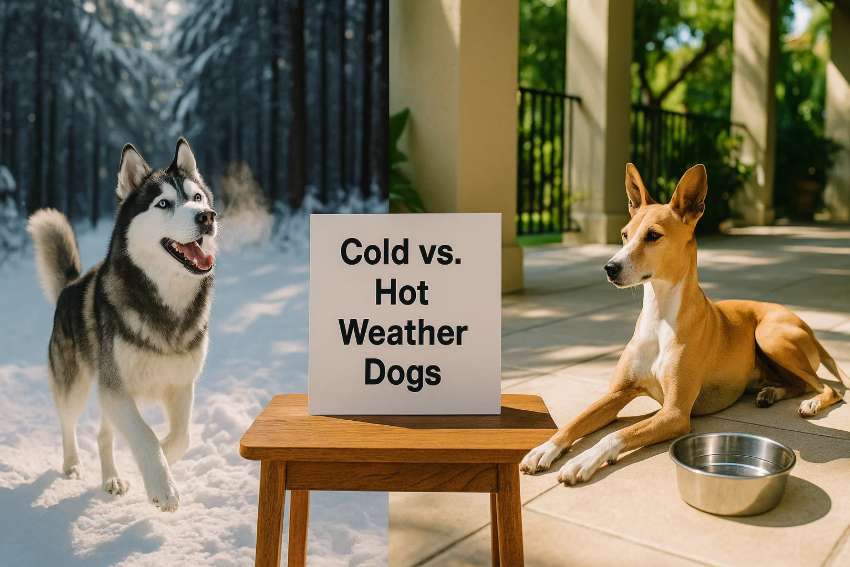
1. How Dog Bodies Handle Temperature
A dog’s comfort in cold or heat depends on several factors:
Coat type: double coat vs single coat, hair length, density and texture
Body size and shape: lean vs stocky, long legs vs short legs
Nose and airway structure: long-nosed vs short-nosed (brachycephalic) breeds
Colour: dark coats absorb more sun; very pale skin can burn
Age and health: puppies, seniors and sick dogs are less tolerant of extremes
General patterns:
Thick double coats insulate against cold but can trap heat in hot weather.
Short, thin coats shed heat quickly but don’t protect well from wind, rain and snow.
Brachycephalic (flat-faced) breeds struggle more to cool themselves in heat.
Very small dogs lose heat faster; very large, stocky dogs hold heat longer.
2. Signs Your Dog Is Too Cold or Too Hot
2.1 Signs your dog is too cold
Shivering or trembling
Hunched posture, tucked tail
Lifting paws off the ground, refusing to walk
Whining, trying to turn back home
Very cold ears or paws to the touch
2.2 Signs your dog is overheating
Heavy panting and drooling
Bright red tongue and gums
Lethargy, unsteady walking, collapse
Vomiting or diarrhoea
Refusing to move or trying to lie down in shade
If your dog shows serious signs of heatstroke (collapse, confusion, very fast breathing), it’s an emergency. Cool them safely and contact a vet immediately.
3. Cold-Weather Champions: Breeds Built for Snow and Ice
Cold-weather breeds come from regions with long winters and deep snow. They usually have:
Thick double coats
Good insulating undercoat
Strong bodies designed for work in cold conditions
3.1 Siberian Husky
Bred to pull sleds over long distances in harsh Arctic conditions.
Dense double coat, fluffy tail they can wrap around their nose when resting.
Usually very cold-tolerant, love winter hikes and snow play.
Important: they still overheat easily in hot weather and need careful summer management.
3.2 Alaskan Malamute
Heavier, more powerful sled dog than the Husky.
Huge double coat, strong build and big paws for snow.
Often happiest in colder climates with plenty of outdoor activity.
3.3 Samoyed
Originated in Siberia for herding reindeer and pulling sleds.
Thick, fluffy white coat that insulates in freezing temperatures.
Coat can help reflect sunlight, but they still get hot in warm weather.
3.4 Other cold-tolerant breeds
Newfoundland: large, water-resistant coat; historically used for cold-water work.
Bernese Mountain Dog: developed in the Swiss Alps; thick coat and sturdy frame.
Saint Bernard: another Alpine breed, historically used for mountain rescue.
Spitz-type breeds: e.g. Norwegian Elkhound, Akita, Keeshond, with dense coats and curled tails.
These dogs often enjoy cold climates in the US and Europe, but they still need protection from icy roads, extreme wind chill and chemical de-icers on pavements (which can irritate paws).
4. Dogs That Cope Better with Heat
No dog “loves” extreme heat. But some breeds handle warm climates better than heavy-coated, cold-bred dogs. Traits that help in hot weather:
Short, thin coat
Lean body with long legs (more surface area to lose heat)
Longer muzzle (better air flow for panting)
4.1 Sighthounds (Greyhound, Whippet, Saluki, etc.)
Very lean bodies and short coats shed heat quickly.
Often tolerate warm weather better than heavy-coated breeds, as long as there is shade and water.
Still need protection from hot pavement and extreme midday sun.
4.2 Basenji
Short coat and origin in Central Africa.
Compact, athletic body suited for warmer climates.
Still needs shade, water and cool indoor spaces during high heat.
4.3 Many short-coated companion and working breeds
With sensible management, many short-haired breeds can live comfortably in warmer climates, for example:
Beagle
Doberman Pinscher (with care in both heat and cold)
Boxer (heat-sensitive, but short coat helps; avoid serious exertion in hot weather)
Short-haired mixed breeds with lean builds
These dogs still need breaks from the sun, plenty of water and cool indoor areas. Short coat ≠ “heatproof”.
5. Breeds That Struggle Most in Heat
Some dogs are at especially high risk in hot weather, no matter where you live:
5.1 Brachycephalic (flat-faced) breeds
Examples: French Bulldog, English Bulldog, Pug, Boston Terrier, some Shih Tzus and Pekingese.
Short noses and crowded airways make it harder to pant efficiently.
Much higher risk of heatstroke, even in moderate temperatures and gentle exercise.
5.2 Heavy-coated cold-weather breeds in hot climates
Huskies, Malamutes, Samoyeds, Newfoundlands, Bernese Mountain Dogs and similar breeds.
Their thick coats trap heat; high humidity makes cooling even harder.
Need serious management: cool indoor spaces, careful exercise timing and good coat care.
If you live in a very hot region, it’s kinder to avoid these types unless you have strong air conditioning, access to cool exercise times and a clear management plan.
6. Breeds That Sit in the Middle (Adaptable with Good Management)
Many popular breeds can adapt to a wide range of climates as long as owners manage them correctly. Examples:
Labrador Retriever: double coat; enjoys cold but can overheat in strong summer heat if pushed too hard.
Golden Retriever: similar to Labs; great in chilly weather, need careful summer management.
Short-haired herding and working breeds: e.g. some collies and shepherds, if not heavily coated.
Mixed-breed dogs: many have “middle-ground” coats and can do well in various climates.
For these dogs, owner behaviour (walk times, shade, clothing, paw protection) matters more than breed label alone.
7. Living in a Hot Climate with a Cold-Weather Breed (and Vice Versa)
Sometimes you already share your life with a dog who isn’t ideally matched to your climate. Or you move from one region to another. You can still keep them comfortable, but you must plan carefully.
7.1 Keeping cold-weather dogs safe in heat
Exercise early in the morning or late in the evening, never in midday sun.
Provide strong shade, cool indoor areas and plenty of fresh water.
Use fans or air conditioning where possible.
Keep the coat healthy – regular brushing removes dead undercoat and helps air flow (but don’t shave double coats completely; you can damage the coat and skin).
7.2 Keeping short-coated dogs safe in cold
Use dog coats or sweaters in cold, wet or windy weather.
Limit time outside in freezing temperatures.
Protect paws from ice, salt and chemical de-icers (booties or paw balm).
Provide warm bedding away from drafts.
With the right gear and routines, many dogs can live comfortably outside their “original” climate – but you can’t ignore their natural limitations.
8. Indoor Climate, Housing and Lifestyle Matter Too
Don’t just think about outdoor weather. Consider:
Do you have reliable heating in winter and cooling in summer?
Can your dog choose cooler or warmer spots in your home (tile floor vs bed, sunny vs shaded room)?
Are you away all day with the dog stuck in a hot or cold environment?
Do you live in a small flat with limited outdoor space, or a house with a yard?
A Husky in a hot but fully air-conditioned apartment with early-morning walks can sometimes be more comfortable than a short-coated dog in a cold, unheated house in winter.
9. How to Choose a Climate-Smart Breed (or Mix)
When choosing your next dog, use these questions as a climate checklist:
What are the coldest winters and hottest summers like where I live?
Do I love winter sports and long snowy hikes, or do I mostly stay inside?
Do I have air conditioning for heatwaves, or good heating for deep cold?
Am I willing to buy coats, boots, cooling mats or other gear for my dog?
Is this breed known to struggle in my type of climate (flat-faced, ultra-heavy coats, etc.)?
Then look for:
Breeds naturally closer to your preferred outdoor temperature range.
Dogs whose coat and body type fit your environment.
Individuals (especially mixed breeds) whose behaviour and comfort level you can observe in real weather.
10. Final Thoughts: Climate Matters, but Management Matters More
“Cold-weather breed” or “heat-tolerant breed” are helpful labels, but they’re not magic shields. The best climate match happens when you:
Understand your local weather and how extreme it can get,
Choose a breed or mix whose coat and body make sense for your region, and
Adjust your daily routine, walk times and home environment to keep your dog comfortable all year.
A Husky can live happily in a warm city with early walks, shade and air conditioning. A Whippet can be perfectly content in a snowy town with warm coats and short winter walks. Climate-smart dog ownership isn’t about chasing a “perfect” breed – it’s about combining the right dog, the right environment and the right care, season after season.