Many dogs can relax when their owners leave for work or errands. They might nap, chew a toy and greet you calmly when you come home. Dogs with separation anxiety are different. For them, being left alone feels like a real crisis – they panic, vocalize, destroy things or even hurt themselves.
Separation anxiety is one of the most common behaviour problems vets and trainers see in the US and Europe, especially in city dogs who spend time alone in apartments. The good news: with patience and a structured plan, most dogs can improve a lot.
This guide explains:
What separation anxiety really is (and what it isn’t)
Common causes and risk factors
Clear signs your dog may be struggling when you’re gone
Step-by-step home treatment strategies
When to call a vet or certified behaviour professional
Note: This article is general information only. Always discuss behaviour changes with your veterinarian.
1. What Is Separation Anxiety in Dogs?
Separation anxiety is an intense fear or distress that happens when a dog is separated from their main attachment figure (usually you). It’s not “stubbornness” or “revenge” – it’s a panic response.
Key points:
It usually happens within minutes of you leaving.
Dogs are often completely normal when you’re home.
The behaviour is driven by anxiety and fear, not anger.
Separation anxiety can range from mild (whining and pacing) to severe (destroying doors, howling for hours, self-injury trying to escape).
2. Common Causes and Risk Factors
Any dog can develop separation anxiety, but some situations make it more likely:
2.1 Changes in routine
Owner starts working outside the home after months of being home (for example, after remote work or holidays).
Big schedule changes: new job, school hours, moving to nights or shifts.
2.2 Changes in home or family
Moving to a new home or apartment.
Family members moving out (children leaving for university, divorce, etc.).
Loss of a human or animal companion.
2.3 Early life experiences
Puppies who were never taught to spend short, calm periods alone.
Dogs adopted from shelters or rescues who have experienced instability or abandonment.
2.4 Genetics and personality
Some dogs are simply more sensitive and “clingy” by nature.
Breeds developed for close human work (herding, companion breeds) may be more prone in modern apartment life.
Often, separation anxiety is triggered by a combination of these factors rather than a single cause.
3. Signs Your Dog May Have Separation Anxiety
Many owners only see the “after” – scratched doors, complaints from neighbours, or a dog that seems exhausted when they come home. Watch for:
3.1 Behaviour during your absence
Howling, barking or whining for long periods (often reported by neighbours, or visible on a pet camera).
Scratching at doors, chewing door frames, window sills or crate bars.
Pacing or running in repetitive patterns.
Escape attempts (from rooms, crates, or even through windows).
3.2 Behaviour when you’re getting ready to leave
Dog becomes restless when you pick up keys, put on a coat, or grab your bag.
Following you from room to room, panting or whining.
Trying to block the door or cling to you as you walk out.
3.3 Signs that are easy to misinterpret
Indoor urination or defecation during your absence, despite being house-trained.
Chewing furniture or objects close to exits, like door frames.
Dogs that greet you in an over-the-top way – crying, jumping, frantically licking – as if they’re “relieved you came back alive”.
If your dog only destroys things when you’re gone, and mostly near doors or windows, anxiety is more likely than simple boredom.
4. Rule Out Medical Issues First
Before you assume it’s separation anxiety, your vet should rule out:
Urinary or digestive problems causing accidents in the house.
Pain that makes your dog restless, vocal or unable to settle.
Age-related issues (for example, cognitive dysfunction in older dogs).
Sometimes a combination happens: an older dog with pain and cognitive decline may be more anxious when alone than they used to be. A vet exam is an important first step.
5. Core Treatment Idea: Change the Emotional State, Not Just the Behaviour
Yelling, punishing or using shock collars will not fix separation anxiety. They may make your dog even more frightened. Effective treatment focuses on:
Gradual desensitization: teaching your dog that being alone is safe by increasing the time away in tiny steps.
Counter-conditioning: pairing alone-time with good things (food, relaxation) so it feels less scary.
Think of it as teaching your dog: “When my person leaves, nothing terrible happens – I can cope, and good things still appear.”
6. Step-by-Step Home Plan: Building Calm Alone-Time
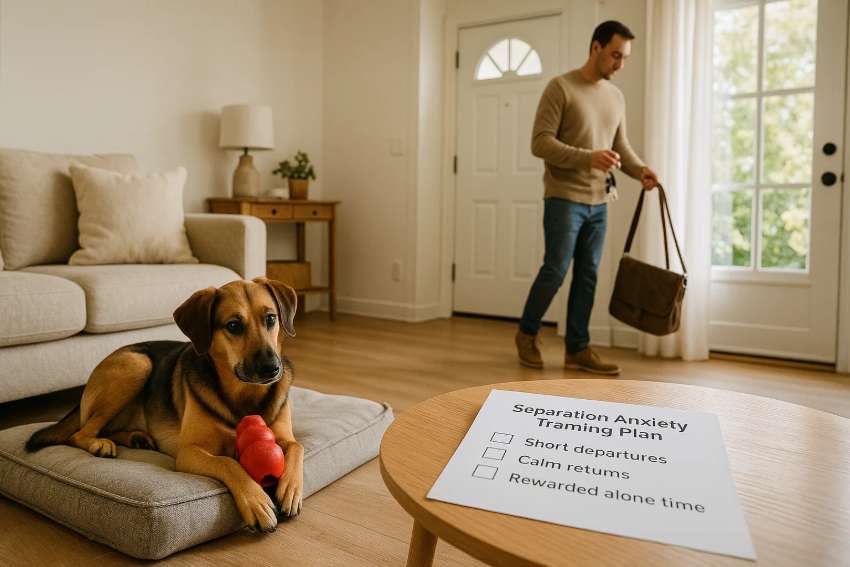
The exact plan depends on how severe your dog’s anxiety is. For mild to moderate cases, you can start with these steps. For severe cases (self-injury, extreme panic), work with a vet and certified behaviour professional.
6.1 Create a “relaxation zone”
Choose a safe, quiet area – a room, gated zone or crate (only if your dog is already crate-comfortable).
Add:
A comfortable bed or mat
Chew toys and food puzzles
Water bowl
Background sound (radio, white noise or TV at a low volume)
Your goal: this space becomes a predictable, safe “chill area”, not a punishment spot.
6.2 Teach calm with you still in the home
Spend short sessions where your dog is on their bed/mat with a chew or stuffed Kong while you read, work or watch TV nearby.
Reward calm behaviour (relaxed body, lying down) with quiet praise or small treats delivered to the bed.
Practice brief moments where you stand up, walk around, go into another room for a few seconds, then calmly return.
The idea is to break the link between “human moves → panic”. Movement should become boring.
6.3 Practice micro “departures”
Once your dog can relax when you move around the home, start:
Putting on your shoes and coat, then taking them off again.
Picking up keys, bag, or laptop, then putting them down.
At first, do these “departure cues” but don’t actually leave. You want to show your dog that these signals are no big deal.
If your dog gets anxious when you pick up keys, that’s where you start – until those keys no longer predict panic.
6.4 Very short real departures (seconds, not hours)
Give your dog a special high-value chew or stuffed Kong in their relaxation zone.
Say a neutral phrase like “I’ll be back” in a calm voice.
Step out of the door for just a few seconds (for example, 5–10 seconds).
Come back in before your dog starts to panic, and act casual – no huge greetings.
Repeat and gradually increase the time away. The key is to stay under your dog’s “panic threshold”. If they start barking, scratching or crying, you went too fast.
6.5 Slowly build up duration
Increase absence time in small jumps:
10 seconds → 30 seconds → 1 minute → 3 minutes → 5 minutes → 8 minutes → 10 minutes, etc.
Mix easier and harder repetitions so it’s not always more difficult.
Use a camera or baby monitor if possible to watch your dog’s reaction.
Many dogs with mild separation issues can progress to 30–60 minutes over weeks of regular practice. Severe cases may go much slower and need professional help.
7. Supportive Strategies That Can Help
7.1 Physical and mental exercise
A tired brain and body cope better with being alone.
Provide:
Daily walks appropriate for your dog’s age and health
Short training sessions (sit, down, tricks)
Food puzzle toys and sniffing games
Avoid over-exercising puppies or dogs with joint issues – ask your vet what’s appropriate.
7.2 Calming aids
Pheromone diffusers or collars designed to help dogs relax.
Calming music, white noise or low TV/radio volume to block external sounds.
Vet-approved calming supplements for mild anxiety (discuss with your vet first).
7.3 Dog walkers, daycare or pet sitters
For some dogs, breaking up long workdays with a midday walk helps.
Some dogs enjoy doggy daycare; others find it overwhelming – watch your dog’s individual reaction.
Pet sitters or neighbours can help in the short term while you work on training.
8. What Not to Do (Common Mistakes)
Don’t punish your dog for destruction or accidents you find after coming home.
They won’t understand why you’re angry.
They may only learn that your arrival is unpredictable and scary.
Don’t use punishment-based devices (shock collars, citronella collars) for barking due to panic.
They punish the symptom, not the fear.
Anxious dogs often get worse when frightened or hurt.
Don’t jump from zero to eight hours alone with no training.
Even well-adjusted puppies need a gradual build-up.
Don’t rely ONLY on gadgets (TV, calming foods, new toys) without changing your training routine.
9. When to Involve a Vet or Behaviour Specialist
You should seek professional help if:
Your dog injures themselves trying to escape (broken teeth, bleeding paws, raw nose).
They are so distressed that they won’t eat high-value food when alone.
They show signs of anxiety even when you move from room to room.
Home training attempts for several weeks show no improvement or things get worse.
A vet can:
Check for underlying health issues.
Discuss medication options to reduce severe anxiety, especially in serious cases.
A certified behaviourist or positive-reinforcement trainer with experience in separation issues can:
Build a customized step-by-step plan for your specific dog.
Help you read your dog’s body language and adjust pace properly.
10. Realistic Expectations: Progress, Not Perfection
Separation anxiety rarely disappears overnight. Progress often looks like:
Fewer destructive episodes.
Dog settling faster after you leave.
Longer periods of calm alone-time before any signs of stress.
Your goal isn’t necessarily to create a dog who loves being alone for 8 hours, but to create a dog who can cope calmly with realistic alone-time in your lifestyle.
With patience, structure and, if needed, professional support, most dogs can learn that:
“When my person leaves, I know what to expect. I can rest, chew a toy and wait calmly. They always come back.”