Barking is normal dog communication—but barking at every neighbor, delivery driver, or passing dog can quickly become stressful (and in apartments, it can become a real problem). The key is to figure out why your dog is barking—alerting, fear, frustration, territorial behavior, or boredom—then use training that changes your dog’s emotional response and teaches an alternative behavior.
This guide gives you a practical, step-by-step plan to reduce barking at neighbors, delivery people, and other dogs, including what to do in the moment, how to set up your home, and when it’s time to involve a trainer or veterinarian.
1. Why Dogs Bark at Neighbors, Delivery Drivers, and Other Dogs
Most “reactive barking” falls into a few common categories. Your training strategy will be more effective once you identify the main driver.
Alert/Watchdog barking: “Something is here!” Often triggered by door knocks, footsteps, elevators, and hallway sounds.
Territorial barking: “This is my space!” Often stronger at windows, balconies, fences, and doorways.
Fear-based barking: “Go away!” Often includes backing up, tucked tail, lip licking, or stiff posture.
Frustration/reactivity: “I want to go meet that dog/person!” Often happens on leash when access is blocked.
Habit + reinforcement: Barking worked before (the person left), so the dog repeats it.
Important: The goal is not to “punish barking.” It’s to change the pattern—reduce triggers, lower arousal, and teach what to do instead.
2. First Fix: Reduce Trigger Access (So Your Dog Can Learn)
If your dog barks all day at hallway noises or every dog outside the window, training will be slower. You need fewer “practice reps” of barking.
2.1 Window and Balcony Management
Use frosted window film or keep blinds partially closed at peak trigger times
Move furniture so your dog can’t post up at the window all day
Create a “quiet zone” away from the front window with a bed and chews
2.2 Door and Hallway Noise Management
Use a white-noise machine or fan to reduce sudden sound spikes
Add a draft stopper or door seal to reduce hallway noise
For apartments: place a rug or mat near the door to muffle footsteps
2.3 Outdoor Management on Walks
Choose quieter routes during peak hours
Cross the street early to avoid close passes
Use distance as your friend while you train
3. What to Do in the Moment (Without Making Barking Worse)
In the moment, your job is to interrupt the barking cycle and help your dog settle—without escalating fear.
Stay calm and move your dog away: calmly guide to a quieter spot (treat trail if needed).
Use a simple cue: “this way,” “come,” or “bed.” Keep it consistent.
Reward quiet: the second your dog pauses barking, mark and reward.
Avoid yelling: to many dogs, it sounds like you’re barking too, and it adds arousal.
Avoid punishment-based tools: they can suppress signals without fixing the underlying emotion.
Key concept: You can’t teach new skills when your dog is fully over threshold. Create distance, then reward calm behavior.
4. Step-by-Step Training Plan for Door Barking (Neighbors and Delivery Drivers)
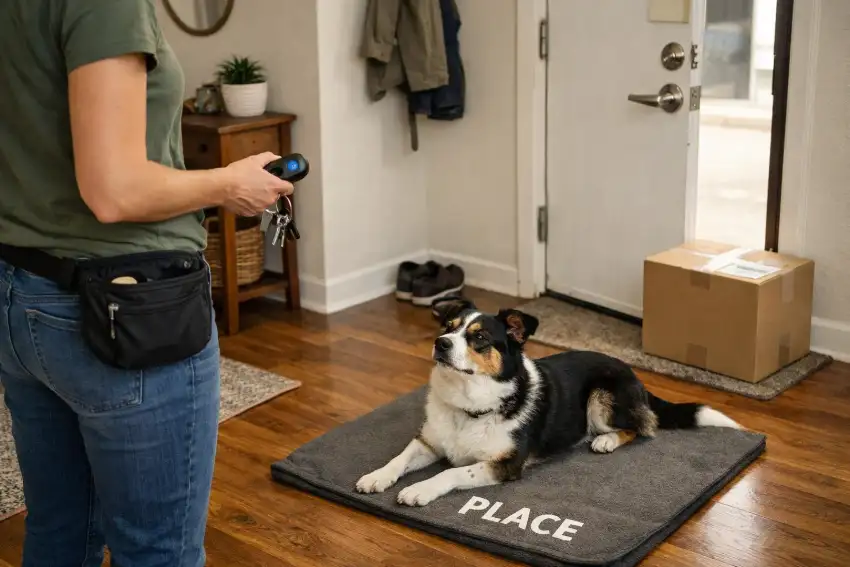
Door barking is usually a mix of alerting + excitement + habit. The most effective plan teaches a predictable routine: sound → go to place → get rewarded.
4.1 Teach “Go to Place” (When Nothing Is Happening)
Pick a bed or mat 6–12 feet from the door
Lure your dog onto it, reward, release
Add a cue: “bed” or “place”
Build duration: reward calm staying on the mat
4.2 Add Fake Door Triggers (Training Sessions)
Do very quiet knocks or hallway sounds (phone audio, friend tapping door lightly)
Immediately cue “place” and reward heavily
Gradually increase realism: louder knock, doorbell, voices
Practice short sessions daily
4.3 Add the Real Delivery Scenario (Controlled)
Have a friend act as the “delivery driver”
Dog goes to place, gets continuous small treats
Keep the door interaction short and boring
Pro tip: If your dog barks at the sound itself, don’t wait for barking to start. Reward the moment your dog hears the sound and looks at you calmly.
5. Training Plan for Window Barking (Neighbors, Dogs, and Street Noise)
Window barking is often territorial and self-rewarding: the dog barks, the “intruder” eventually leaves.
5.1 Teach a “Check and Return” Pattern
Let your dog look briefly, then call them back (“come” or “this way”)
Reward on a mat away from the window
Over time, your dog learns: “I notice something, then I disengage.”
5.2 Use “Look at That” Training (Great for Dogs and People Triggers)
This is a controlled exercise that changes emotion: trigger appears → treat happens.
From a distance where your dog can stay calm, let them notice the trigger
Immediately reward (before barking)
Repeat until your dog starts looking at the trigger then back to you
Why it works: it turns “uh-oh” into “good things happen,” and it teaches disengagement.
6. Training Plan for Leash Barking at Other Dogs
On-leash barking is often frustration or fear. The most effective approach uses distance, pattern games, and reinforcement of calm engagement.
6.1 Find Your Dog’s “Threshold Distance”
At what distance can your dog notice another dog and still take treats?
Start training outside that distance (farther away).
6.2 Teach a Reliable “U-Turn” and “Let’s Go” Cue
Practice at home first: cue “let’s go” and move away, reward when they follow
Use it outdoors before your dog explodes into barking
6.3 Reward Calm Behaviors You Want More Of
Looking at you
Sniffing the ground calmly
Walking with a loose leash
Choosing to move away from the other dog
6.4 Avoid the “Tight Leash Trap”
A tight leash can increase frustration and make barking worse. Aim for a relaxed leash and use distance instead of pulling.
7. Daily Routine Changes That Reduce Barking Overall
Many barking problems improve when a dog’s overall stress and boredom are reduced.
More sniff walks: sniffing lowers arousal for many dogs.
Short training sessions: 5–10 minutes daily builds focus.
Enrichment at home: puzzle feeders, food toys, scatter feeding.
Calm rest time: teach your dog to settle instead of pacing for stimulation.
8. Common Mistakes That Keep Barking Going
Only reacting after barking starts: try to reward calm before the barking.
Inconsistent rules: sometimes allowing window guarding, sometimes not.
Trying to “socialize” by forcing greetings: can worsen fear and reactivity.
Using punishment or shock tools: can increase fear and aggression risk.
Expecting quick results: barking is self-rewarding and takes practice to change.
9. When to Get Professional Help
Consider a certified trainer or behavior professional if:
Barking is paired with lunging, snapping, or attempts to bite
Your dog cannot take treats around triggers (always over threshold)
Neighbors are complaining or it’s risking housing issues
You’ve tried consistent training for a few weeks with little progress
Talk to your veterinarian if barking suddenly started in an older pet, or if it’s paired with pain signs (limping, restlessness at night), cognitive changes, or increased anxiety. Medical issues can increase irritability and reactivity.
Final Thoughts: Teach Your Dog What to Do Instead of Barking
To stop barking at neighbors, delivery drivers, and other dogs, focus on three steps: reduce trigger access so your dog stops rehearsing the behavior, reward calm behaviors before barking starts, and train predictable routines like “go to place” and “look then disengage.” With consistent practice and smart management, most dogs become noticeably quieter and more relaxed over time.
Your action step: pick one situation (door, window, or leash) and train it daily for 10 minutes. Small daily reps are more powerful than one long session on the weekend.