Bringing home a new cat or dog is exciting, but for your current pets it can feel like an invasion of their territory. Rushing introductions is one of the most common reasons new adoptions fail in the US and Europe – fights break out, someone gets stressed, and the new pet is sent back.
The good news: with a slow, structured plan, most dogs and cats can learn to live together peacefully, and many even become close friends. This guide walks you through:
How to prepare your home before the new pet arrives
Step-by-step introductions for dog–dog, cat–cat and dog–cat households
How to read body language and stop problems early
Common mistakes that cause fights and how to avoid them
Note: this is general information. Always prioritize safety and ask your vet or a qualified trainer/behaviourist for help in difficult cases.
1. Before the New Pet Comes Home: Set Up for Success
Safe introductions start before you walk in the door with the new animal.
1.1 Vet checks and health safety
Make sure the new pet has had:
A basic health exam
Core vaccinations appropriate for their age
Flea, tick and worm prevention
If adopting from a shelter or rescue, ask what tests and treatments they’ve already done.
Keep new pets separate from existing pets for a short period if there are any health concerns (especially with cats and kittens).
1.2 Prepare safe zones for each animal
For cats:
Litter box
Food and water
Hiding spots and elevated perches
Bed and toys
Give each cat a separate “base camp” room with:
Use baby gates or closed doors to maintain separation at first.
For dogs:
Have crates, baby gates or playpens ready to create distance and structure.
Set up separate feeding areas to avoid food-guarding issues.
1.3 Gather your tools
Leashes and well-fitted harnesses or collars
High-value treats for both new and resident pets
Blankets/towels you can use to swap scents between animals
Feliway-style pheromone diffusers for cats or calming aids for dogs, if recommended by your vet
Think of this phase as designing a house with safe “borders” so nobody feels trapped or invaded.
2. General Rules for All Introductions
Whether you’re introducing dog–dog, cat–cat or dog–cat, some principles are universal:
Go slower than you think you need to. Rushing is the #1 mistake.
Use barriers: doors, baby gates, leashes and crates to control contact.
Supervise closely until you’re sure everyone can handle each other calmly.
Separate food, beds, litter boxes and high-value toys at the beginning.
Reward calm behaviour near the other animal with treats and praise.
Never force interaction by holding one animal still so the other can sniff.
Your job is to make every step feel as predictable, safe and low-stress as possible.
3. Step-by-Step: Introducing a New Dog to Your Resident Dog
3.1 First meeting: neutral territory (if possible)
Dogs often do better meeting for the first time outside the home, so your resident dog doesn’t feel a stranger walked straight into their territory.
Have both dogs on loose leashes with separate handlers.
Start by walking parallel at a comfortable distance where both dogs can:
See each other
Still remain relatively calm and able to take treats
Gradually allow them to close the distance if their body language stays relaxed (soft eyes, loose tails and bodies).
Let them sniff briefly, then call them away for treats and a break.
Repeat several short “sniff and walk away” sessions. Don’t aim for instant best friends; aim for polite, low-drama interactions.
3.2 Entering the home
Let the resident dog enter the home first to feel secure, then bring the new dog in on-leash.
Remove high-value items (bones, favourite toys, food bowls) from shared areas for the first days.
Use baby gates or leashes to:
Allow them in the same room but with space to move away.
Supervise all interactions closely.
3.3 First few days
Keep interactions short and positive, then separate them for rest.
Feed them in separate areas to prevent food guarding.
Give each dog one-on-one time with you for walks, training and cuddles.
Over time, if both dogs remain relaxed, you can gradually:
Drop the leashes indoors (while still supervising).
Remove gates for part of the day.
Allow unsupervised time together only when you are confident in their behaviour.
4. Step-by-Step: Introducing a New Cat to Your Resident Cat
Cats are often more territorial than dogs, and many introductions fail because people try to put cats together too quickly.
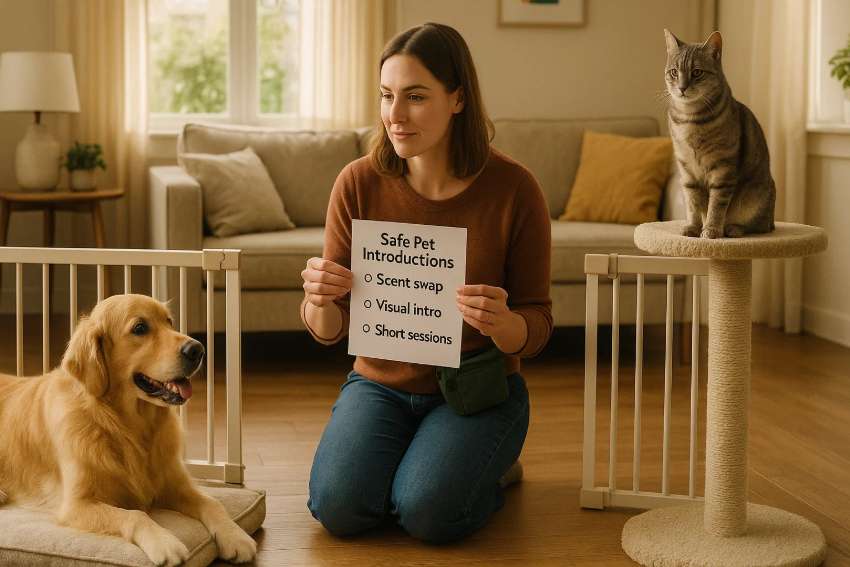
4.1 Phase 1: Complete separation with scent swapping
Keep the new cat in a separate “base camp” room with door closed.
Feed both cats on opposite sides of the door so they associate each other’s scent with something good (food).
Swap bedding or blankets between the cats every day so they get used to each other’s smell.
Use a toy (like a wand toy) to play with both cats separately to help them burn off stress.
4.2 Phase 2: Visual introductions through barriers
Use a baby gate, doorstop (to open the door a crack), or screen so they can see but not reach each other.
Offer treats or wet food while they look at each other from a distance.
If either cat hisses, growls or puffs up:
Gently close the barrier and try again later at a greater distance or shorter duration.
4.3 Phase 3: Short, supervised time in the same room
When both cats can calmly see each other through a barrier multiple times:
Allow them in the same room for very short sessions.
Provide vertical escape routes (cat trees, shelves) so they can avoid each other.
Keep plenty of toys and treats available to distract and reward calm behaviour.
If tension rises (hissing, fixed stares, chasing), calmly separate them and go back one step in the process.
4.4 Litter boxes and resources
Follow the rule: number of cats + 1 = number of litter boxes (for example, 2 cats → at least 3 boxes).
Spread boxes, beds and feeding stations around the home so one cat can’t “control” everything.
Patient, stepwise introductions can take days to weeks – or longer for very sensitive cats – but they dramatically reduce the risk of long-term conflict.
5. Step-by-Step: Introducing a Dog and a Cat
Many dogs and cats can live happily together, but safety comes first – especially for the cat.
5.1 Assess your dog’s prey drive and history
Has your dog lived with cats peacefully before?
Do they chase cats, squirrels or small animals obsessively?
Can they respond to basic cues (“sit”, “stay”, “leave it”) even when excited?
Strong prey drive or a history of chasing cats means you should go very slowly and strongly consider working with a professional trainer from the start.
5.2 Phase 1: Separate spaces and scent swapping
Give the cat a secure, dog-free room with litter box, food, water and high perches.
Let the dog sniff under the door; reward calm behaviour with treats.
Swap bedding or rub a cloth on each animal’s cheeks and let the other smell it.
5.3 Phase 2: Visual introductions with barriers and leash
Keep the dog on a leash, and the cat behind a baby gate or screen at first.
Let the dog see the cat from a distance where they can still:
Take treats
Respond to “sit” or “look at me”
Reward the dog heavily for any calm behaviour: sitting, lying down, glancing at the cat and then back at you.
Never allow the dog to rush the barrier or stare intensely at the cat without interruption.
5.4 Phase 3: Shared space with safety options
When the dog can calmly watch the cat, allow them in the same room with:
Dog on leash
Cat able to jump to high places or leave the room through a gate/crack
Keep sessions short and positive, rewarding the dog for calm, non-chasing behaviour.
If the dog fixates, lunges or the cat becomes very scared (hissing, hiding), shorten the session and increase distance next time.
Only when you’re confident that the dog will not chase and the cat has safe escape routes should you begin allowing brief, supervised off-leash interactions. Unsupervised time together comes later, sometimes weeks or months later.
6. Reading Body Language: Green, Yellow and Red Flags
6.1 “Green light” signals (relatively relaxed)
Dogs:
Soft eyes and face, loose tail, normal breathing
Brief sniffing then looking away
Play bows or gentle, bouncy movements (if the other pet is comfortable too)
Cats:
Tail held loosely (not puffed), ears forward or slightly sideways
Curious sniffing, slow blinking
Choosing to remain in the room rather than fleeing
6.2 “Yellow light” signals (caution, slow down)
Staring without blinking
Stiff body, tail held high and rigid
Growling, low-level hissing, lip lifting
At this stage, increase distance, distract with treats or toys, and maybe shorten the session.
6.3 “Red light” signals (stop immediately)
Dogs:
Snapping, lunging, pinning the other animal
Chasing that does not stop when called
Cats:
Fully puffed tail and body, intense hissing, swatting
Full-speed escape attempts, hiding and not returning
In red-light situations, calmly separate animals without shouting or hitting, give them time to decompress, and rewind several steps in your introduction plan. If red-light moments repeat, seek professional help.
7. Common Mistakes That Cause Fights
Throwing them together on day one: no barriers, no gradual steps, just “figure it out”.
Ignoring resource guarding: letting animals share food bowls, favourite beds or toys before trust is built.
Forcing interactions: holding one animal still so the other can sniff, ignoring signs they want space.
Leaving them alone together too soon: unsupervised time before you’re sure they’re safe together.
Punishing early warning signs: scolding growls or hisses can teach animals to skip warnings and go straight to biting next time.
Instead, treat early warning signs as useful feedback that you need to slow down and adjust your plan.
8. When to Get Professional Help
Call your vet or a qualified trainer/behaviourist if:
There has already been a serious fight or injury.
One animal is so fearful they stop eating, grooming or using the litter box.
There is intense chasing that you cannot interrupt with your voice.
You feel unsafe trying to separate them.
A professional can:
Assess whether the match is realistic and safe.
Design a custom step-by-step introduction plan.
Work with your vet if medication is needed to reduce severe anxiety.
9. Long-Term Peace: Maintaining Harmony After the Honeymoon
Even after the initial introduction period, keep things peaceful by:
Maintaining multiple safe zones for each animal.
Feeding separately if there is any tension around food.
Giving each pet individual attention and playtime so no one feels left out.
Watching for subtle changes – a previously friendly cat that starts hiding, a dog that suddenly guards the couch – and addressing them early.
With time, patience and structure, many households go from “uh-oh, this is tense” to “I can’t imagine life without both of them”. Your job is to be the calm, predictable leader who makes sure everyone feels safe as they learn to share their home.