2026’s top-rated calming gadgets compared (what helps, what doesn’t, and how to use them)
As an animal scientist, I’ll translate the hype into biology: separation anxiety is a panic-style response to being left alone, not “bad behavior.” The most effective treatment still looks like systematic desensitization + counterconditioning (gradually teaching “alone time = safe”), with management and—when needed—medication.
Calming gadgets can help, but mainly as support tools to (1) reduce arousal, (2) increase predictability, and (3) help you deliver training at the right moment. They rarely “solve” true separation anxiety by themselves.
1) Why “post-remote work pets” are struggling in 2026
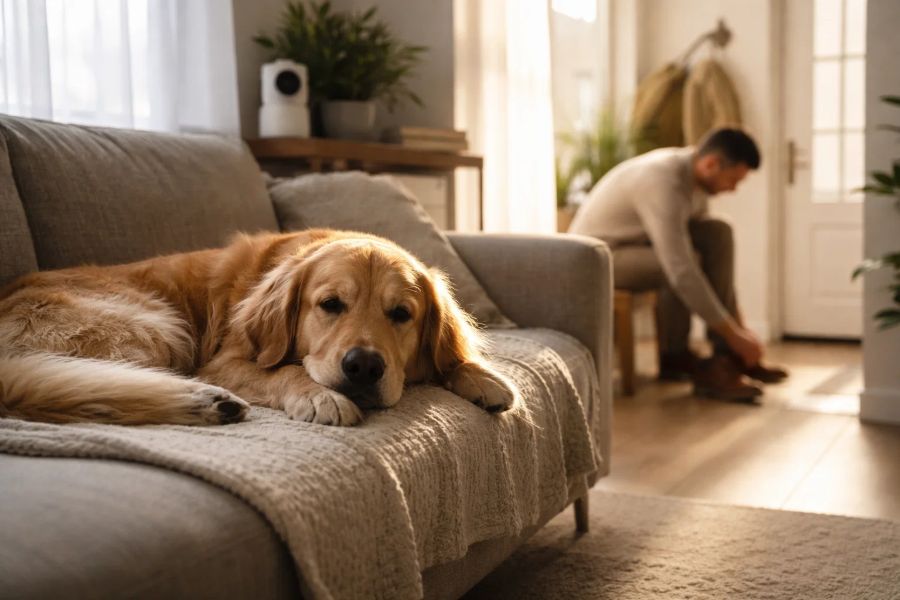
During remote-work years, many pets had near-constant human presence. When routines shift back toward office time, dogs—especially those with limited “alone-time practice”—can show increased separation-related behaviors (vocalizing, destruction, toileting, escape attempts). Veterinary organizations and clinical outlets have been warning about this pattern since the pandemic era.
2) First: make sure it’s actually separation anxiety
Many owners call it “separation anxiety,” but the treatment differs depending on the cause:
Separation anxiety / isolation distress: panic when alone (or away from a specific person).
Barrier frustration: calm when alone, frantic only at doors/windows/crates.
Boredom/under-enrichment: mischief because nothing else is happening.
Medical issues: pain, GI disease, urinary issues can mimic stress behaviors.
A modern clinical approach usually combines: management + training plan + tools + (sometimes) meds.
Practical diagnostic step: record 2–3 typical departures on video. A pet camera is not just a gadget—it’s your best “field observation” tool.
3) What actually treats separation anxiety (evidence-based core)
The backbone protocol
Stop rehearsals of panic (management). If your dog melts down after 10 minutes, don’t keep doing 2-hour absences while training. Use sitters/daycare/family, or “micro-absences” while you train.
Systematic desensitization + counterconditioning. Increase alone time in tiny steps that stay below panic threshold. Evidence reviews describe success with owner-implemented protocols.
Reward-based methods only. Punishment increases fear and can worsen anxiety; veterinary behavior guidelines emphasize reward-based training for welfare and effectiveness.
Medication when appropriate. For moderate–severe cases, vets may add medication to lower panic enough for learning to occur (the “learning window” concept).
Where gadgets fit: they support steps (1)–(3). They’re not the backbone.

4) 2026’s top calming gadget categories (what they do biologically)
A) AI pet cameras + treat dispensers (Furbo / Petcube)
Best for: monitoring, interrupting early escalation, and supporting training in mild to moderate cases.
What they do: give you real-time info + two-way audio + treat delivery. Tech reviewers continue to rate pet cameras as useful, but note many “smart” features require subscriptions.
Reality check: there’s little high-quality clinical evidence that treat cameras alone “fix” separation anxiety. Used poorly, they can accidentally reinforce barking (“bark → treat”).
How to use correctly
Use the camera mainly to confirm calm and spot early stress signals.
Deliver treats only during calm/settled behavior (lying down, quiet, relaxed posture).
Avoid using two-way audio if it increases arousal.
B) Remote reward training devices (PetSafe Teach & Treat)
Best for: structured training sessions where you reinforce calm behaviors from another room or brief out-the-door reps.
Why it helps: it enables precise reinforcement timing during desensitization steps, aligning with reward-based protocols.
C) Pheromone diffusers (Adaptil for dogs, Feliway for cats)
Best for: mild baseline calming, multi-pet households, or as part of a multimodal plan.
Evidence is mixed. A major systematic review found insufficient evidence for pheromones for many claimed outcomes in cats, and the broader evidence base is variable.
For dog-appeasing pheromone (DAP), a critically appraised review notes the evidence in older dogs is weak/uncertain, but it’s unlikely to cause harm and can be tried as an adjunct.
There are controlled studies showing benefits in certain contexts (e.g., hospitalized or stress settings), but “home-alone separation anxiety” is not guaranteed to respond.
Use tips
Place diffusers near the pet’s core resting area.
Give it 1–2 weeks to judge effects (don’t expect instant results).
D) Pressure wraps (ThunderShirt)
Best for: dogs with generalized anxiety traits, noise sensitivity, or mild separation distress—again, as an add-on.
Controlled research exists on pressure wraps in dogs diagnosed with anxiety disorders, measuring heart rate and behavior changes.
Interpretation: effects can be modest and individual; some dogs love them, some don’t.
Use tips
Fit matters: too loose = no pressure; too tight = discomfort.
Pair with relaxation training, not as a standalone.
E) Heartbeat comfort toys (Snuggle Puppy style)
Best for: puppies/new adoptees, crate training, and sleep-onset calming.
Biology: mimics social-contact cues (heartbeat warmth), which can reduce arousal in some animals. This is more “comfort enrichment” than true separation anxiety therapy.
F) Calming music / sound enrichment (iCalmDog + white noise)
Best for: reducing baseline stress during alone time, especially in noise-exposed environments.
Kennel studies show music can influence stress markers like heart rate variability and cortisol and change behavior (more resting/less standing).
At home, it’s not a cure—but it can make training easier by lowering overall arousal.
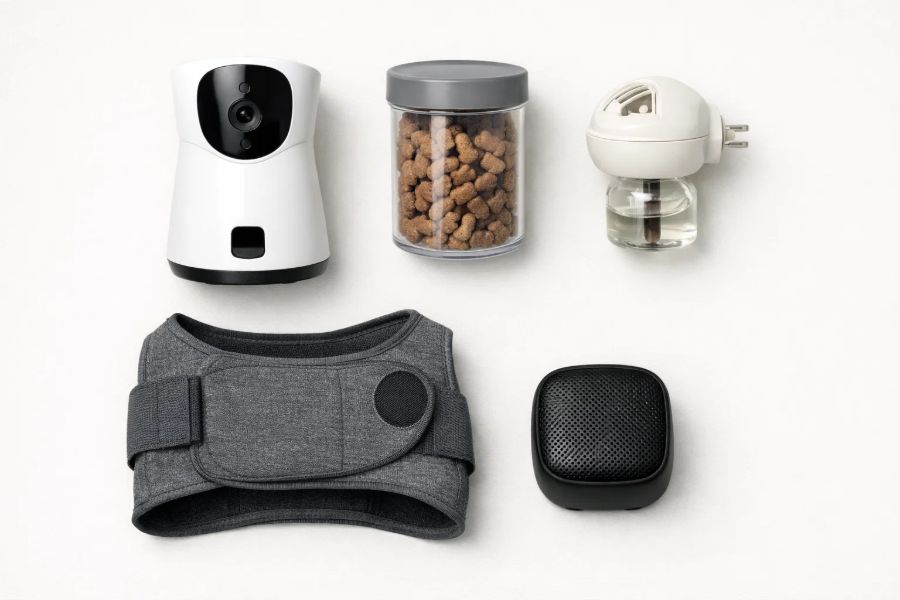
5) Comparison table: 2026 top-rated calming gadgets (and when they’re actually worth it)
| Gadget type | Examples | Helps most with | Evidence strength (practical) | Biggest “gotcha” |
|---|---|---|---|---|
| AI camera + treat dispenser | Furbo, Petcube | Monitoring, catching early escalation, rewarding calm | Moderate for monitoring, low–moderate for treatment (tool, not therapy) | Can reinforce barking/panic if treats are mistimed |
| Remote reward trainer | PetSafe Teach & Treat | Structured desensitization reps | Moderate (supports proven training) | Requires training plan; not “set and forget” |
| Dog pheromone diffuser | Adaptil | Mild calming adjunct | Mixed/uncertain, low risk | Benefits may be subtle; doesn’t replace training |
| Cat pheromone diffuser | Feliway | Stress-related behaviors in cats; household tension | Mixed/condition-dependent | Not all cats respond; don’t oversell it |
| Pressure wrap | ThunderShirt | Generalized anxiety traits, some mild separation distress | Mixed but has controlled studies | Fit/comfort; some dogs dislike it |
| Heartbeat comfort toy | Snuggle Puppy | Sleep and settling, puppies | Low (comfort aid) | Won’t fix true panic alone |
| Calming music / sound enrichment | iCalmDog + speakers/white noise | Baseline arousal reduction | Moderate (stress marker changes in studies) | Habituation—rotate playlists/genres |
| “Gadget-only plan” | Any single product | — | Low | Most common reason owners fail |
6) A simple 2026 “treatment stack” that works in real homes
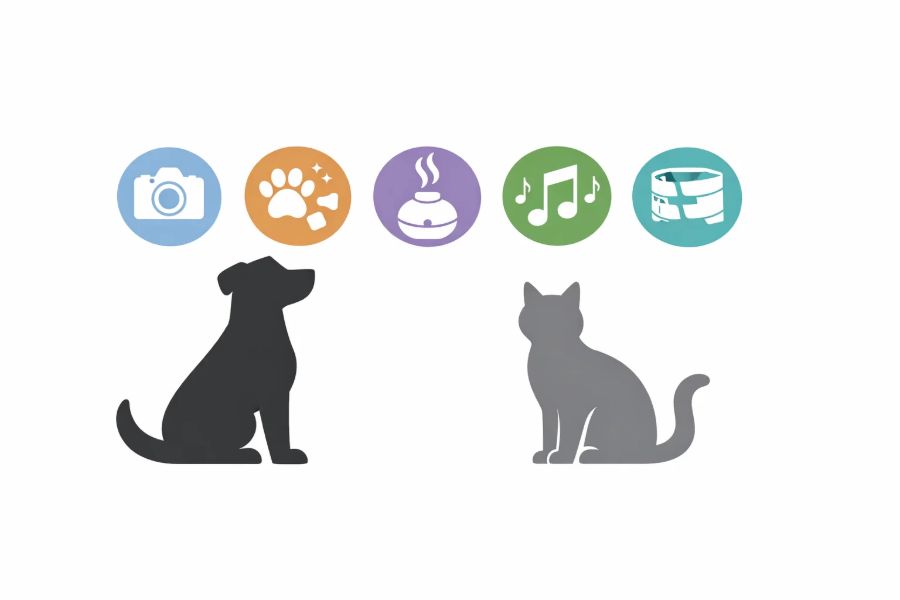
If you want a practical plan that doesn’t rely on one magic device:
Camera first (assessment). Identify the time-to-panic and stress signals.
Management bridge. Prevent repeated panic episodes while training.
Training core. Short, repeatable reps: step out → return before panic → reward calm.
Add one calming layer (choose ONE): pheromone OR pressure wrap OR calming audio.
Vet involvement if: self-injury risk, severe destruction, nonstop vocalizing, elimination, or no progress after 2–4 weeks of consistent training.
References (cited)
Today’s Veterinary Practice. “Algorithmic Approach: Separation Anxiety in Dogs” (2025) — multimodal plan including management, DS/CC, tools, and medication.
Sargisson RJ. “Canine separation anxiety: strategies for treatment…” (review; DS/CC evidence).
American Veterinary Society of Animal Behavior (AVSAB). Position statements emphasizing reward-based training methods.
Frank D. et al. JAVMA (2010). Systematic review on pheromone therapy (mixed/insufficient evidence across claims).
Wong CF. et al. Veterinary Evidence (2021). Critically appraised topic: dog-appeasing pheromone evidence remains weak in many anxiety contexts.
Kim YM. et al. (2010). Controlled study suggesting DAP decreased several separation/stress behaviors in hospitalized dogs.
King C. et al. Journal of Veterinary Behavior (2014). Pressure wrap (ThunderShirt) effects on heart rate/behavior in dogs with anxiety disorders.
Mathis S. et al. (2024). Review/discussion of compression wraps and anxiolytic mechanisms.
Bowman A. et al. (2015) + Lindig AM. et al. (2020). Studies/review on music exposure altering behavior and physiological stress markers in dogs.
WIRED (Jan 2026). “Best pet cameras” (consumer testing; subscription notes).
AVMA (2023) + Pandemic puppy cohort (2024). Discussion of pandemic-related behavior patterns and separation-related behaviors.