A quick “woof!” when someone passes your door is normal. But if your dog explodes into non-stop barking every time neighbors walk in the hallway, delivery drivers ring the bell, or another dog passes the window, life in a US or European apartment can get stressful very fast – for you, your dog and your neighbors.
The goal of this guide is to help you:
Understand why your dog barks at people and dogs near your home
Reduce triggers using simple management changes
Teach your dog calmer reactions with step-by-step training
Know what not to do (yelling, punishment, harsh tools)
Recognize when it’s time to involve a trainer or behaviourist
1. Why Dogs Bark at Neighbors, Delivery Drivers and Other Dogs
Barking isn’t “bad” by itself – it’s how dogs communicate. The problem is when and how much they bark.
1.1 Common reasons behind the barking
Alert / watchdog barking: “Someone is near our territory!”
Fear or insecurity: “I don’t feel safe with that person/dog so close.”
Frustration: wanting to reach or chase someone they see but can’t get to (through a window, door, or leash).
Learned habit: every time your dog barks, the person eventually leaves – so in your dog’s mind, barking “works”.
1.2 Is it normal alerting or a behaviour problem?
Normal: one or two barks when someone passes, then your dog settles quickly.
Problem: long barking fits, lunging at the door/window, not able to calm down, barking at every tiny noise or movement.
We can’t and shouldn’t remove barking completely, but we can reduce the intensity and frequency and give your dog a better way to handle these triggers.
2. Management First: Make Barking Less Likely
Training is important, but the fastest relief often comes from management – changing the environment so your dog has fewer reasons to explode in the first place.
2.1 Reduce visual triggers
Use frosted window film or curtains on street-facing windows where your dog stands and barks at passers-by.
Move furniture so your dog has less access to window “guard posts”.
Use baby gates to keep your dog away from the front door area when you’re not training.
2.2 Reduce sound triggers
Use white noise, a fan, or low-volume music to dampen hallway sounds.
Place a thick rug, draft stopper or towel near the door gap to reduce noise from the corridor.
2.3 Meet basic needs
Many “barky” dogs are also:
Under-exercised (physically and mentally)
Bored and looking for a job
Daily walks, sniffing time, training games and food puzzles give your dog healthier ways to use their energy.
Management doesn’t fix the underlying emotion, but it lowers the “background pressure”, so your training works better and life at home feels calmer right away.
3. Teaching a Calmer Response to People and Dogs Outside
We don’t just want your dog to shut up; we want them to feel less worried or frustrated when they see or hear neighbors, delivery drivers and other dogs.
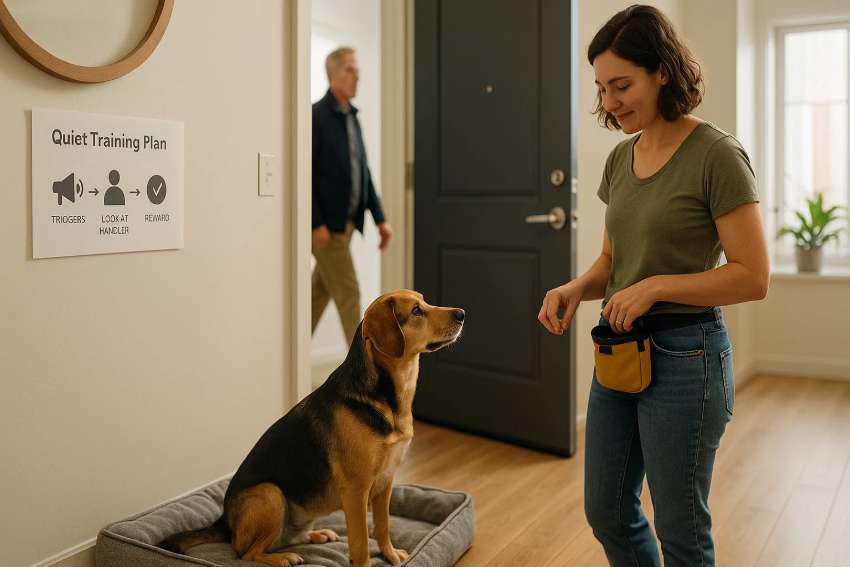
3.1 The basic pattern: “See trigger → look at you → get reward”
You’ll teach your dog that when they notice a trigger (person/dog), they should:
Look at the trigger briefly.
Then turn back to you for a treat or praise.
This is sometimes called the “look-at-that” game:
Trigger appears → you calmly say “yes” (or click, if you use a clicker) the moment your dog looks at the trigger.
Dog turns to you → you give a small treat.
Repeat until your dog automatically checks in with you when they see a trigger.
Over time, your dog learns: “People and dogs near our door/window mean I look back at my person and get something good.”
3.2 Start at a distance where your dog is still calm
For window barking:
Begin a few steps back from the window so your dog can see but isn’t right up against the glass.
For barking at dogs outside:
Start across the street or at a distance where your dog notices the other dog but is not yet barking or lunging.
If your dog is already “over the edge” (barking, lunging, ignoring treats), move farther away and try again at an easier level.
4. Specific Situations and Training Steps
4.1 Barking at neighbors in the hallway
Goal: When someone walks past or you open the door, your dog looks to you and stays relatively calm instead of rushing, barking and scratching.
Pre-training:
Teach your dog to go to a “mat” or “place” a few steps away from the door (bed or mat on the floor).
Practice: say “place”, dog goes to mat → reward with a treat on the mat. Repeat daily until this is easy.
Door sounds practice:
Knock softly on your own door or have someone ring the bell.
Immediately say “place” and guide your dog to the mat; reward heavily for staying there (multiple small treats).
At first, you don’t open the door at all – just reward staying calm on the mat.
Opening the door:
Once your dog can stay on the mat with door sounds, start cracking the door open while they remain on the mat.
Feed them a stream of treats while the door is open; close the door before they get too excited.
Real-life guests or neighbors:
Ask a friend to help by knocking/ringing, then calmly stepping in while your dog is on the mat.
Keep greetings low-key; treat your dog for quiet behaviour.
Over time, the pattern becomes: door noise → go to mat → food and calm → boring, predictable greeting.
4.2 Barking at delivery drivers
Delivery drivers and mail carriers often move quickly and leave again, which can be extra exciting or scary.
Keep a small jar of treats near the door.
When the intercom or doorbell rings:
Say your mat cue (“place”) and reward your dog for going there.
If possible, toss treats toward your dog while you accept the package.
Ask friendly regular drivers (if safe and appropriate) to:
Ignore your dog completely (no excitable greetings).
Let you hand your dog a treat after the package exchange, so the dog associates deliveries with calm, positive experiences.
4.3 Barking at dogs on walks (leash reactivity)
For dogs that bark and lunge at other dogs when on leash, use a similar “look-at-that” game outdoors.
Start at a distance where your dog can see the other dog but is not yet reacting.
When your dog looks at the other dog, calmly mark (“yes”) and feed a small treat.
If your dog starts to escalate, increase distance by stepping sideways or turning away.
Practice many short sessions rather than forcing long, stressful walks in crowded areas.
It’s often helpful to:
Walk at quieter times of day or in less crowded streets while you build skills.
Use a front-clip harness and standard leash for control, never a retractable leash.
5. Teaching a “Quiet” Cue (The Right Way)
Many people yell “quiet!” over and over, but the dog has no idea what it means. Instead, you need to:
Wait for even one second of silence after barking.
Say “quiet” once in a calm voice.
Immediately reward with a treat or calm praise.
Repeat: bark, short silence → “quiet” → reward. Over time, your dog learns that “quiet” predicts good things if they stop barking.
Important:
Don’t say “quiet” while they are fully barking; they can’t listen in that state.
Don’t reward if they’re still barking – wait for that tiny pause first.
6. Tools That Help (and Ones to Avoid)
6.1 Helpful tools
Front-clip harness: better control on walks, reduces pulling and lunging.
Treat pouch: makes it easy to reward calm behaviour quickly.
Baby gates and crates: safely manage hallway access and window “guard posts”.
Frosted film, curtains, white noise: cut down on visual and sound triggers.
6.2 Tools to avoid
Shock or prong collars, citronella or “anti-bark” collars:
They punish the barking but don’t address the fear or frustration underneath.
They can make anxious dogs more fearful and can damage your relationship.
For most family dogs, positive reinforcement-based training plus smart management is more effective and kinder in the long term.
7. Common Mistakes That Make Barking Worse
Yelling at your dog: they may think you are barking too, or simply become more anxious.
Letting them rehearse barking all day: the more they practice, the stronger the habit becomes.
Inconsistent rules: sometimes allowing them to go wild at the window, sometimes punishing them.
Too much freedom too soon: letting them patrol the entire apartment unsupervised near windows and doors while you’re home.
Instead, think: prevent, then teach. Prevent full-blown barking with management, then teach calmer behaviour in small, achievable steps.
8. When to Get Help From a Professional
It’s time to involve a vet or certified dog behaviour professional if:
Your dog cannot calm down at all when people or dogs pass.
They injure themselves scratching at doors or windows.
Barking is causing serious neighbor complaints or risk of eviction.
You’ve tried basic training for several weeks with no improvement.
A professional can:
Evaluate whether fear, frustration or other emotions are driving the barking.
Create a step-by-step plan tailored specifically to your dog and your building.
Work with your vet if medication is needed for severe anxiety.
9. Realistic Expectations: Better, Not Perfect
In a busy city, some barking is normal. Your aim is not a “silent robot dog”, but a dog who:
Can see or hear neighbors without exploding every time.
Responds to your cues and can settle more quickly.
Feels safer and less stressed by everyday sounds and sights.
With consistent management and training, many owners notice:
Fewer and shorter barking episodes.
Dogs that choose to look at their owner instead of the window.
A calmer home that’s easier to share with neighbors, delivery drivers and city life in general.
Step by step, you’re teaching your dog a new story: “When people and dogs pass by, I don’t have to shout at them. I can stay calm, look to my person, and everything is okay.”