Weasels and ferrets look similar because both belong to the mustelid family, but they are not the same animal. A weasel is usually a wild, slender predator with a long body, short legs, and strong hunting instincts. A ferret is a domesticated form of polecat, bred for life around humans. Ferrets are usually larger, calmer, more social, and commonly kept as pets, while weasels are wild animals.
Weasel vs Ferret Quick Answer
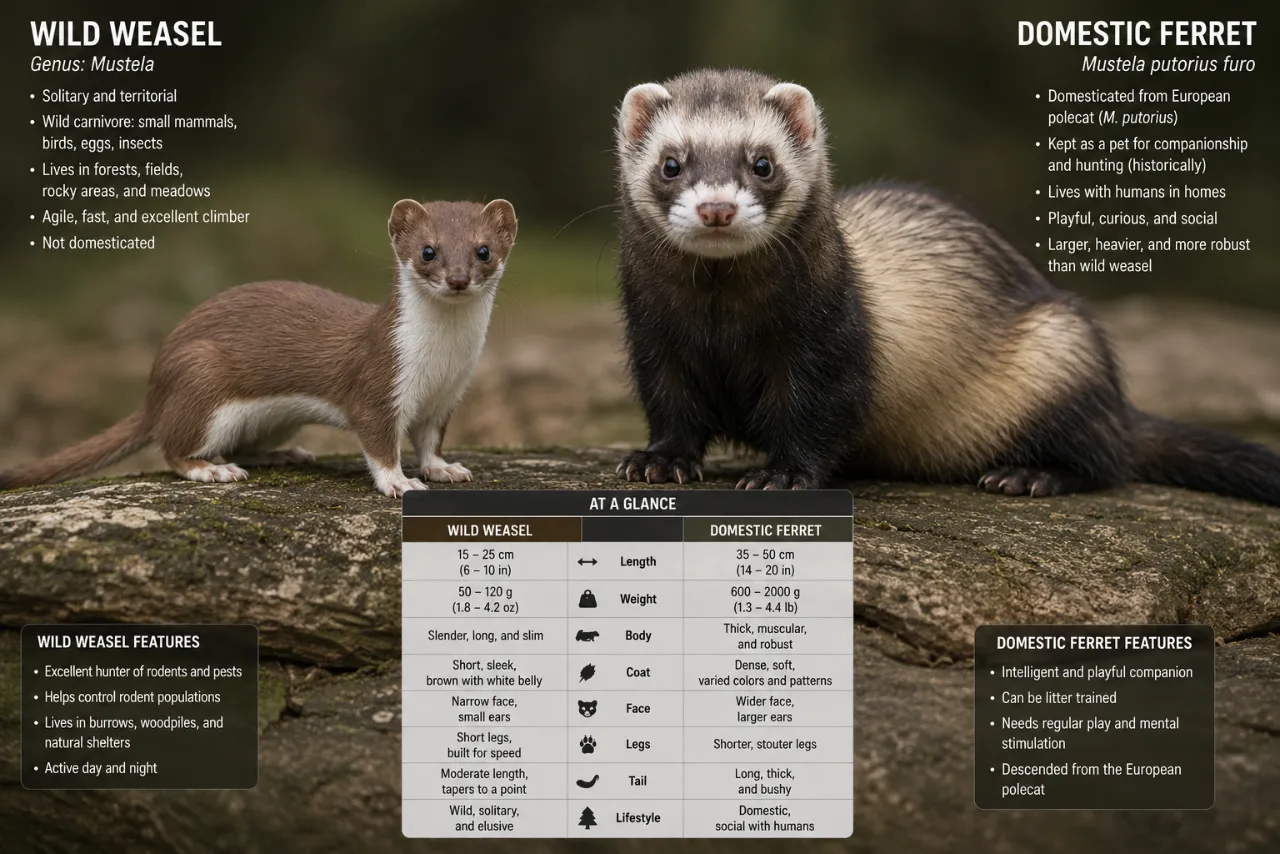
The biggest difference is domestication. Ferrets are domesticated mustelids, usually descended from the European polecat, and have been bred for companionship, hunting assistance, and human handling. Weasels are wild mustelids that live independently in nature and hunt small animals. Weasels are generally smaller, faster, more intense, and less suitable for handling, while ferrets are larger, more social, and better adapted to living with people.
Weasel vs Ferret Summary Table
| Feature | Weasel | Ferret |
|---|---|---|
| Animal group | Wild mustelids in the genus Mustela and related groups | Domesticated mustelid, closely related to the European polecat |
| Domestication | Wild animal | Domesticated animal |
| Typical size | Usually smaller and slimmer | Usually larger and heavier |
| Body shape | Very long, narrow, and flexible | Long-bodied but thicker and more rounded |
| Temperament | Alert, fast, solitary, highly predatory | Curious, playful, social, often tolerant of handling |
| Habitat | Fields, forests, farms, grasslands, wetlands, and tundra depending on species | Lives with humans; domestic ferrets do not naturally form wild populations in most places |
| Diet | Small mammals, birds, eggs, insects, reptiles, and other prey | Carnivorous diet provided by owners; needs animal-based protein and fat |
| Social behavior | Mostly solitary | Often social and playful with other ferrets |
| Pet suitability | Not suitable as a pet | Common pet in many countries, though laws vary |
| Quick identification clue | Smaller, sharper-looking, more wild and intense | Larger, softer-bodied, often handled by humans or seen as a pet |
What Is a Weasel?
A weasel is a small carnivorous mammal in the mustelid family, the same broader family that includes ferrets, stoats, minks, martens, badgers, otters, and wolverines. The word “weasel” can refer to several species, including the least weasel, short-tailed weasel, long-tailed weasel, and other close relatives.
Weasels are famous for their slim bodies, short legs, quick movements, and fierce hunting ability. Their shape allows them to enter burrows, tunnels, grass clumps, and tight spaces while chasing rodents and other prey. Although small, a weasel is a serious predator for its size. It may hunt mice, voles, rats, rabbits, birds, eggs, lizards, frogs, and insects depending on species and habitat.
What Is a Ferret?
A ferret is a domesticated mustelid, usually considered a domesticated form of the European polecat. Ferrets have lived with humans for a very long time and were historically used to hunt rabbits by entering burrows and flushing prey out. Today, many ferrets are kept as pets because they are curious, playful, intelligent, and social.
Domestic ferrets have long bodies, short legs, pointed faces, rounded ears, and soft fur. They often sleep for many hours a day but become highly energetic when awake. A healthy ferret may explore, wrestle, tunnel under blankets, steal small objects, and perform playful hopping movements sometimes called a “weasel war dance.”
Are Weasels and Ferrets Related?
Yes. Weasels and ferrets are closely related because both belong to the mustelid family. They share many features: long flexible bodies, sharp teeth, carnivorous diets, strong scent glands, and quick movements. However, related does not mean identical.
A ferret is domesticated and adapted to human care. A weasel is wild and adapted to survival in nature. The difference is similar to the difference between a domestic dog and a wild fox: they may share family traits, but their behavior, handling needs, and relationship with humans are very different.
Quick Visual Difference
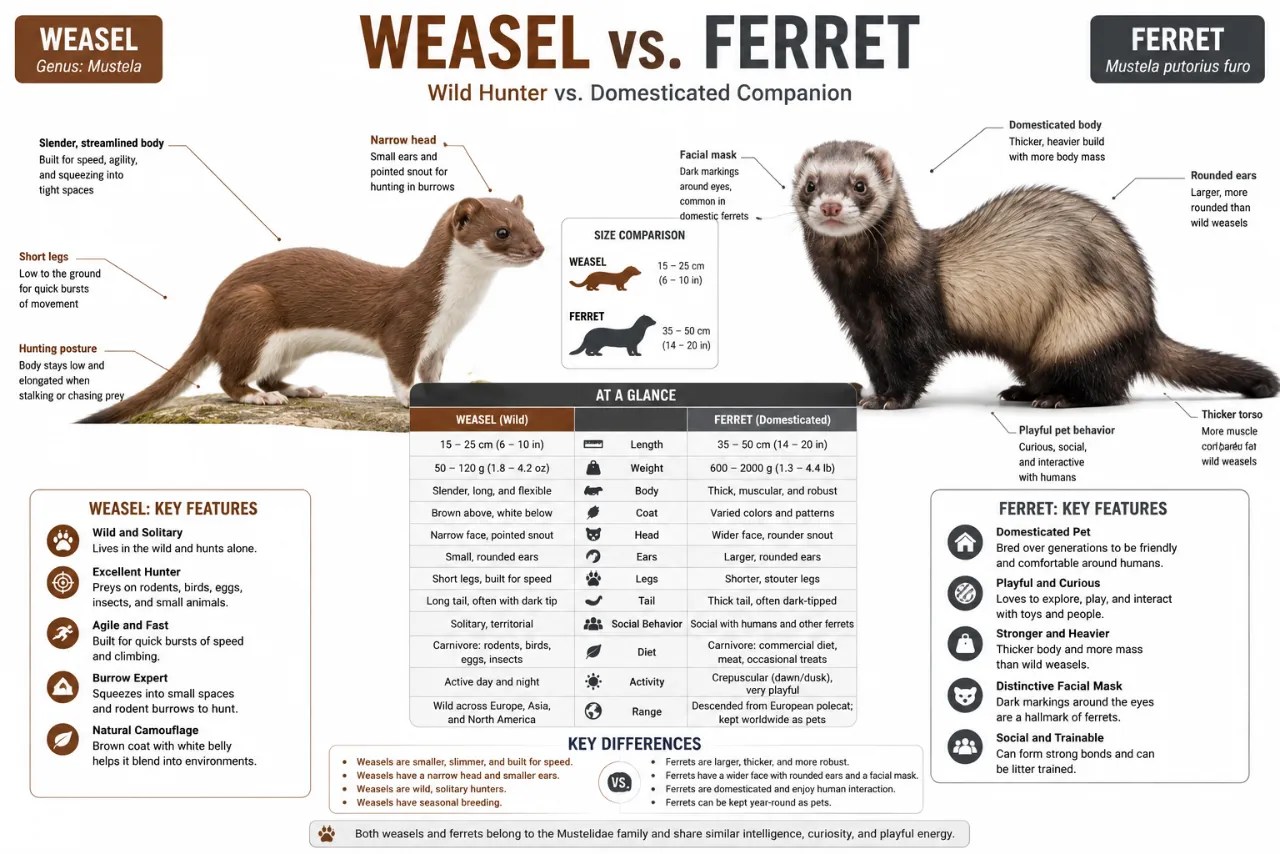
The easiest visual difference is body size and build. A weasel usually looks slimmer, smaller, sharper, and more stretched out. A ferret usually looks larger, thicker, and softer in body shape. Ferrets also often appear in domestic color patterns such as sable, albino, champagne, cinnamon, silver, black sable, or marked patterns.
Weasel: very slim body, small head, short legs, wild alert posture.
Ferret: longer pet-like body, thicker torso, rounded appearance, often handled by people.
Weasel: usually seen outdoors in wild or rural habitats.
Ferret: usually seen indoors, in cages, with owners, or in pet-care settings.
Size Comparison
Weasels are usually smaller than ferrets, but size depends on species. The least weasel is one of the smallest carnivorous mammals in the world. Long-tailed weasels and stoats are larger, but they are still usually slimmer and lighter than domestic ferrets.
Ferrets are generally longer and heavier than most weasels. Their bodies are still narrow compared with cats or rabbits, but they are thicker and more robust than many wild weasels. Pet ferrets can vary in size depending on sex, genetics, diet, and whether they are neutered.
In simple terms: weasels are usually smaller and more needle-like, while ferrets are usually larger and more tube-shaped.
Body Shape and Appearance
A weasel has an extremely elongated body that helps it chase prey into burrows and tunnels. Its head is small, its neck is long, and its legs are very short. This body plan is perfect for hunting rodents in narrow spaces.
A ferret also has a long body and short legs, but it tends to look more rounded and domesticated. Its face may look softer, its body heavier, and its movements more playful than a wild weasel’s. Ferrets also come in a wider range of domestic coat colors and markings.
Some weasels change color seasonally. For example, stoats in cold regions may turn white in winter, with a black tail tip. Domestic ferrets do not normally show this kind of seasonal camouflage change.
Face, Ears, and Tail
Weasels often have a narrow face, bright eyes, small rounded ears, and a long tail depending on species. Some species have a distinct black tip on the tail, especially stoats. Their facial expression often looks intense because they are alert predators that must avoid larger predators while hunting.
Ferrets have a more pet-like face, with rounded ears and a longer muzzle. Many ferrets have a dark mask across the face, especially sable-colored individuals. Their tail is usually thick and furry compared with the delicate tail of some smaller weasels.
If the animal has a dark facial mask, a thick body, and is interacting comfortably with people, it is probably a ferret, not a wild weasel.
Behavior and Temperament
Weasels are wild predators. They are quick, alert, defensive, and highly energetic. A wild weasel does not behave like a pet and should not be handled. Even a small weasel can bite hard if captured or frightened. Its instincts are focused on hunting, escaping predators, defending itself, and reproducing.
Ferrets are domesticated and usually much more tolerant of humans. A well-socialized ferret can be playful, affectionate, mischievous, and interactive. Ferrets enjoy exploring, hiding, tunneling, wrestling, and playing with toys. However, they still have predatory instincts and may nip, steal objects, or chase small animals.
The key difference is that a weasel is a wild survival specialist, while a ferret is a domesticated companion animal.
Diet and Hunting Style
Weasels are carnivores with fast metabolisms. Many species must eat frequently because their small bodies burn energy quickly. They are skilled hunters of rodents and other small animals. Their long bodies allow them to follow prey into burrows, where many other predators cannot reach.
Ferrets are also carnivores, but domestic ferrets depend on humans for food. They need a diet high in animal protein and fat, with very limited plant material. Their digestive systems are short and not designed for large amounts of fiber or carbohydrate-rich foods.
A weasel hunts to survive. A ferret eats a managed carnivorous diet provided by its owner.
Habitat and Range
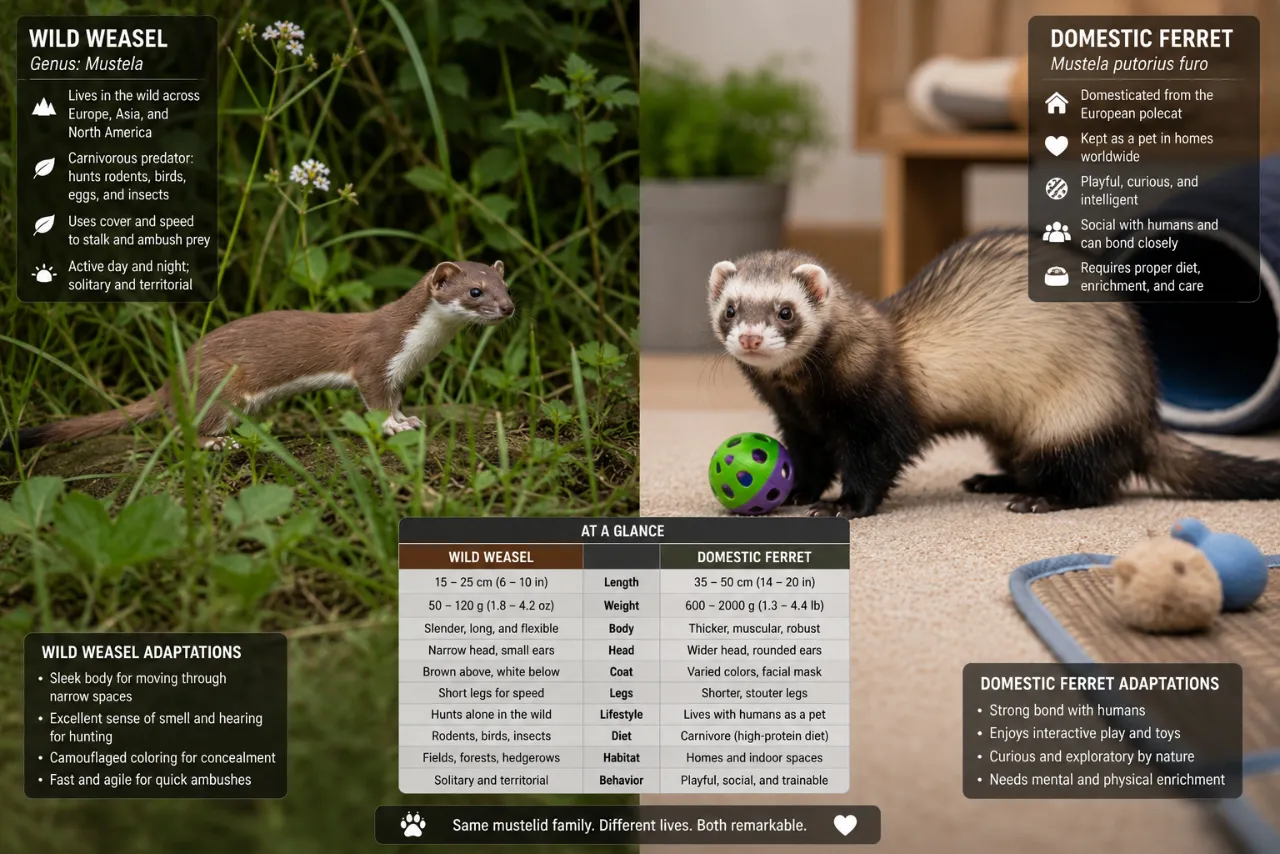
Weasels live in many habitats depending on species. They may be found in fields, farms, forests, grasslands, wetlands, mountains, hedgerows, tundra, and areas with abundant small prey. Their small size allows them to use hidden pathways through vegetation, burrows, and rock piles.
Domestic ferrets usually live in human homes or controlled outdoor enclosures. They are not naturally wild animals in the same way as weasels. In some places, escaped or released ferrets may not survive well because they lack the survival skills of wild mustelids. In other regions, ferret-like relatives or feral mustelids can create ecological problems, especially where native wildlife is vulnerable.
Social Life
Most weasels are solitary. They may maintain territories and usually come together mainly for mating. A weasel’s solitary lifestyle fits its role as a small predator that hunts scattered prey.
Ferrets are often more social. Many pet ferrets enjoy living with other compatible ferrets and may play, sleep, and wrestle together. They can form strong bonds with humans and other ferrets, although introductions should be handled carefully.
This social difference is one reason ferrets can be pets and weasels cannot. Domestication has made ferrets more tolerant of close contact.
Can You Keep a Weasel as a Pet?
A weasel should not be kept as a pet. Wild weasels are not domesticated, and they have strong hunting and defensive instincts. They need specialized natural conditions, live prey or appropriate wild diets, and freedom to behave normally. Capturing or keeping one may also be illegal depending on location.
Even if raised young, a weasel is not the same as a ferret. It may remain nervous, aggressive, difficult to handle, and unsuitable for household life. The ethical choice is to leave wild weasels in the wild and contact a licensed wildlife rehabilitator if an injured or orphaned animal is found.
Are Ferrets Good Pets?
Ferrets can be excellent pets for the right owner, but they are not low-maintenance animals. They need daily interaction, safe play areas, a proper carnivorous diet, veterinary care, enrichment, and careful supervision. They can squeeze into small spaces, chew unsafe objects, and get into trouble quickly.
Ferrets also have a natural musky odor, even when healthy and clean. Many are descented or neutered in countries where that is common, but they still have a distinctive smell. They may not be legal everywhere, so potential owners should check local laws before getting one.
A ferret is much more suitable as a pet than a weasel, but it still requires serious responsibility.
Do Weasels and Ferrets Smell?
Yes. Both weasels and ferrets have scent glands, as do many mustelids. Scent is used in communication, territory marking, defense, and social signaling. Wild weasels may release strong-smelling secretions when threatened.
Ferrets naturally have a musky odor. Good cleaning, proper diet, healthy skin, and regular bedding changes can reduce odor, but they will not make a ferret smell like a scent-free animal. Over-bathing can actually make odor worse by irritating the skin and encouraging more oil production.
Weasel vs Ferret vs Stoat
People often confuse weasels, ferrets, and stoats. A stoat is a wild mustelid closely related to weasels. In many regions, the stoat is also called the short-tailed weasel. Stoats are usually larger than least weasels and often have a black tip on the tail. In cold climates, they may turn white in winter; this white winter coat is called ermine.
A ferret is different because it is domesticated. If the animal is living as a pet, has a thicker body, and shows domestic color patterns, it is probably a ferret. If it is a small wild predator with a slender body and no human association, it is more likely a weasel or stoat.
How to Identify One in a Photo
When looking at a photo, use several clues together:
Look at the setting: indoors or with humans usually suggests ferret; wild grassland or forest suggests weasel.
Look at body thickness: very thin and sharp-bodied suggests weasel; thicker and softer-bodied suggests ferret.
Look at color pattern: domestic masks, albino coloring, or unusual pet colors often suggest ferret.
Look at the tail: a black-tipped tail may suggest stoat rather than ferret.
Look at behavior: playful handling suggests ferret; alert wild posture suggests weasel.
Common Misidentifications
Many people use “weasel” as a general word for any long, skinny mustelid. This can create confusion because ferrets, stoats, minks, polecats, and martens may all look somewhat weasel-like. The correct identification depends on size, habitat, color, tail shape, behavior, and location.
Another common mistake is assuming that a ferret is simply a tame weasel. That is not accurate. Ferrets are domesticated animals with a long history of living with humans. A wild weasel is a separate kind of animal with a much stronger wild temperament.
Which Is More Dangerous?
A weasel is more dangerous to handle because it is wild, fast, and likely to bite if captured. Its small size does not make it harmless. Weasels are predators with sharp teeth and strong defensive reactions.
A domestic ferret is usually safer around humans when properly socialized, but it can still bite, especially if frightened, poorly handled, or not trained. Ferrets should also be kept away from very small pets such as hamsters, mice, birds, and young rabbits because their predatory instincts can be strong.
Neither animal should be treated like a toy. Weasels should be left alone, and ferrets should be handled responsibly.
Ecological Role
Weasels are important small predators. They help control rodent populations and influence the behavior of small mammals, birds, reptiles, and insects. Because they are small, they are also prey for hawks, owls, foxes, coyotes, snakes, and larger carnivores.
Ferrets, as domesticated animals, do not play the same natural ecological role in most places. Pet ferrets depend on human care. However, related wild mustelids and feral populations can have major ecological effects in sensitive ecosystems, especially on islands or in places where ground-nesting birds evolved without mammalian predators.
Final Comparison
Weasels and ferrets are similar because both are long-bodied carnivorous mustelids, but their lives are very different. The weasel is a small wild predator built for speed, stealth, and hunting in tight spaces. The ferret is a domesticated mustelid bred to live and work with humans.
If the animal is wild, very slender, intensely alert, and found outdoors, it is more likely a weasel. If it is larger, more social, domesticated, and kept around people, it is probably a ferret. The simplest answer is: all ferrets are mustelids, but they are not the same as wild weasels.
Related Animal Comparisons
Ferret vs Stoat
Weasel vs Stoat
Mink vs Ferret
Otter vs Weasel
Badger vs Wolverine
Polecat vs Ferret
FAQs About Weasel vs Ferret
Is a ferret the same as a weasel?
No. Ferrets and weasels are related mustelids, but they are not the same animal. Ferrets are domesticated and closely related to polecats, while weasels are wild predators.
Are ferrets domesticated weasels?
Not exactly. Ferrets are domesticated mustelids, but they are usually considered domesticated forms of the European polecat, not domesticated versions of the small wild weasels people commonly see outdoors.
Which is bigger, a weasel or a ferret?
Ferrets are usually larger and heavier than most weasels. Weasels tend to be slimmer, lighter, and more sharply built for hunting small prey in burrows and dense vegetation.
Can a weasel be kept as a pet?
No, a weasel is not a suitable pet. It is a wild animal with strong predatory and defensive instincts. Keeping one may also be illegal depending on local wildlife laws.
Are ferrets good pets?
Ferrets can be good pets for experienced and responsible owners. They need daily play, safe housing, a proper carnivorous diet, veterinary care, and careful supervision.
Do weasels and ferrets bite?
Yes. A wild weasel may bite strongly if handled or threatened. A ferret can also bite, especially if frightened, poorly socialized, or handled roughly, but many pet ferrets can be trained and handled safely.
Do ferrets smell like weasels?
Ferrets have a natural musky odor because they are mustelids with scent glands. Wild weasels can also produce strong smells, especially when stressed or threatened.
How can I tell a weasel from a ferret?
Look at size, setting, and behavior. A small, very slender, wild animal outdoors is more likely a weasel. A larger, thicker, domesticated animal interacting with people is more likely a ferret.