Just two decades ago, the Iberian lynx seemed close to disappearing forever. Fewer than 100 animals remained in the wild in 2002, and the species survived mainly in two last strongholds: Doñana-Aljarafe and Andújar-Cardeña in Sierra Morena. Today, the picture is dramatically different. According to the latest official census, the Iberian Peninsula held 2,401 wild Iberian lynxes in 2024, including 2,047 in Spain and 354 in Portugal, a 19% increase over the previous year.
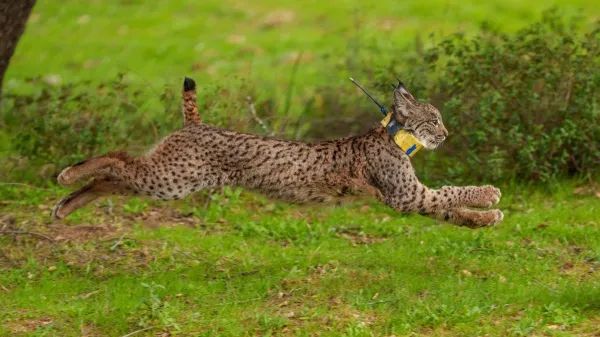
What makes this recovery remarkable is not only the rise in numbers, but also the change in geography. The Iberian lynx no longer depends exclusively on its historic refuges. Stable breeding populations and settlement areas now extend across a much broader network of territories in Andalusia, Castilla-La Mancha, Extremadura, Murcia, and Portugal, and the official 2024 update says the species is now reproducing in 17 different geographic areas.
A New Map for the Iberian Lynx
For many years, Doñana and Sierra Morena were the species’ final sanctuary. The 2024 census still recognizes Doñana-Aljarafe and Andújar-Cardeña as the remnant populations that survived the collapse, but the modern Iberian lynx map is now far more complex. Established or expanding nuclei include Guarrizas, Guadalmellato, Matachel, Vale do Guadiana, Campo de Montiel, Montes de Toledo, Valdecañas, Ortiga, Sierra Arana, Lorca, Campos de Hellín, and several “stepping-stone” areas created to improve connectivity between populations.
This expansion is especially important because the census can no longer be understood as a story of isolated pockets. The technical report notes that some subpopulations now stretch across more than one autonomous community, making simple regional counting less meaningful than before. In practical terms, the Iberian lynx is increasingly functioning as a connected metapopulation rather than as a few disconnected fragments.
From Near Extinction to a European Conservation Success
The Iberian lynx recovery is now considered one of Europe’s most important wildlife comeback stories. Conservation programs supported through the EU LIFE framework combined captive breeding, carefully planned reintroductions, rabbit and habitat management, road-safety measures, and long-term monitoring. In 2024, the species was officially reclassified by the IUCN from Endangered to Vulnerable, a major milestone that reflects how far the recovery has come while also confirming that important risks remain.
Official figures show just how dramatic the turnaround has been. The 2024 census recorded 1,557 adults or subadults, 470 breeding females, and 844 cubs born during the year. Since 2011, 403 captive-bred lynxes have been reintroduced into suitable release areas, and the recovery program continues to reinforce existing populations while opening new territories.
One reason this program has been so effective is that it has gone far beyond simply releasing animals into the wild. LIFE LynxConnect was designed to create a genetically and demographically functional metapopulation by connecting population nuclei, improving rabbit habitat, reducing non-natural mortality, and managing the species on a genetic basis. That approach transformed the effort from emergency rescue into a long-term recovery strategy.
Why Connectivity Matters More Than Raw Numbers
For a species that once survived in only two isolated strongholds, increasing the headcount is not enough. Genetic exchange between populations is essential if the Iberian lynx is to remain healthy over the long term. That is why conservationists have invested so heavily in corridors, stepping-stone areas, and coordinated releases across Spain and Portugal.
A 2023 study by the Doñana Biological Station of the Spanish National Research Council warned that the lynx population was still not genetically viable in the long term. The researchers estimated that around 1,100 reproductive females and at least eight new subpopulations would be needed to secure long-term genetic viability. That study was based on earlier census levels, but it remains an important reminder that today’s success is only part of the journey. Even with 470 breeding females recorded in 2024, the species has not yet reached the demographic and genetic safety margin researchers would ideally like to see.
The official LIFE recovery framework is also ambitious. Favourable conservation status has been linked to reaching 750 reproductive or mature females by 2040. The current census shows that the lynx is moving toward that benchmark, but it has not reached it yet.
The Challenges Are Not Over
The Iberian lynx is no longer hanging by a thread, but it is still vulnerable. The same official 2024 update that celebrated the population increase also reported 214 detected lynx deaths during the year, including 162 caused by road collisions. That makes roads, transport infrastructure, and habitat fragmentation some of the most urgent issues for the next phase of conservation.
Other risks remain as well. Conservation authorities and researchers continue to highlight rabbit declines, disease, poaching, and other forms of non-natural mortality as threats that could slow or reverse the recovery if management weakens. Continued public funding, habitat restoration, and cooperation from landowners, farmers, hunters, and local communities are still essential to keep the species moving toward long-term stability.
A New Bastion Across the Peninsula
The most important change is that the Iberian lynx no longer depends on a single refuge. Doñana and Sierra Morena remain symbolically and biologically important, but the species’ real strength now lies in a wider peninsula-scale network of old strongholds, reintroduction nuclei, natural settlement areas, and emerging connections between them.
Twenty years ago, the story of the Iberian lynx looked almost finished. Today, the species is reclaiming landscapes across Spain and Portugal through science, planning, genetic management, habitat restoration, and long-term social cooperation. Its comeback is already one of Europe’s great conservation successes. The next challenge is making sure that this expanding network becomes fully self-sustaining for generations to come.
Bibliography
Ministry for Ecological Transition and the Demographic Challenge (MITECO). Available at: https://www.miteco.gob.es
LIFE LynxConnect Project. Available at: https://www.lynxconnect.eu
European Commission – LIFE Programme. Available at: https://cinea.ec.europa.eu/life_en
Institute for Nature Conservation and Forests (Portugal). Available at: https://www.icnf.pt