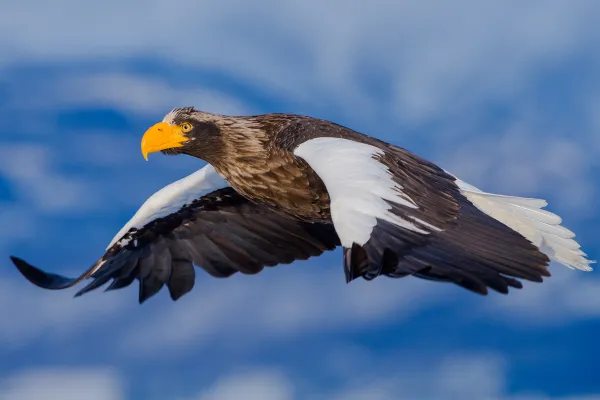
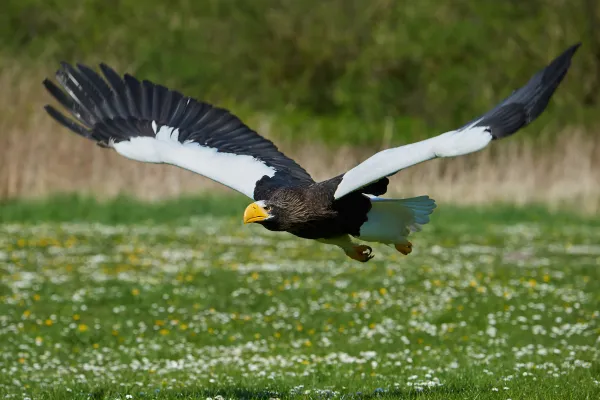
The Steller’s sea eagle (also called the giant sea eagle) is one of the most powerful birds of prey on Earth. It belongs to the sea-eagle group (Haliaeetus), which are closely related to eagles and other raptors, but are especially adapted to hunting around coasts, large rivers, and icy seas. This species is famous for its massive orange-yellow bill, broad wings, and striking white shoulders and tail.
Quick Facts
Scientific name: Haliaeetus pelagicus
Common names: Steller’s sea eagle, giant sea eagle
Body length: about 85–105 cm
Wingspan: about 1.9–2.5 m (very broad wings)
Weight: about 4.9–9.5 kg (females usually heavier)
Conservation: Vulnerable (global decline concerns)
Note: Some articles mistakenly write “85–105 meters tall.” The correct measurement is centimeters (body length), not meters.
Identification and Physical Characteristics
1) Size and build (why it’s called “giant”)
Steller’s sea eagles are among the heaviest eagles and one of the largest raptors by bulk. Their wings are not only long but also wide, giving them strong lift and control over windy coasts and river valleys.
2) Plumage pattern (easy field marks)
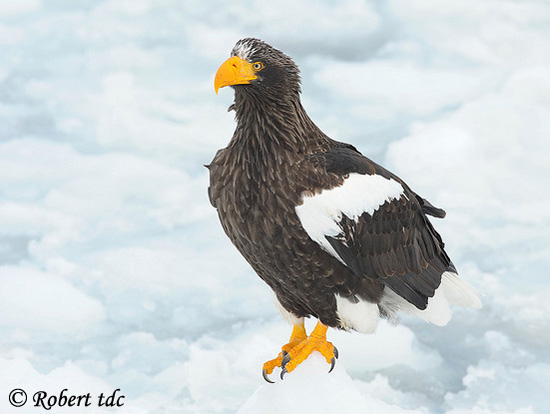
Adults are dramatic and high-contrast:
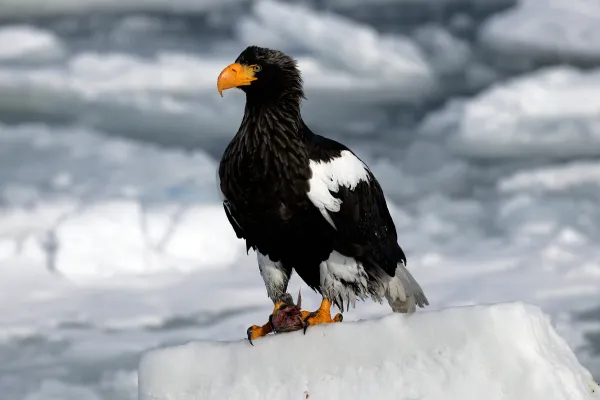
Dark brown to blackish body
Bright white shoulders (“epaulettes”)
White tail
Often paler feathering on the legs/upper thighs can look like “feathered trousers.”
Juveniles are generally darker and less sharply patterned, gaining the crisp adult look over several years.
3) Bill, feet, and talons
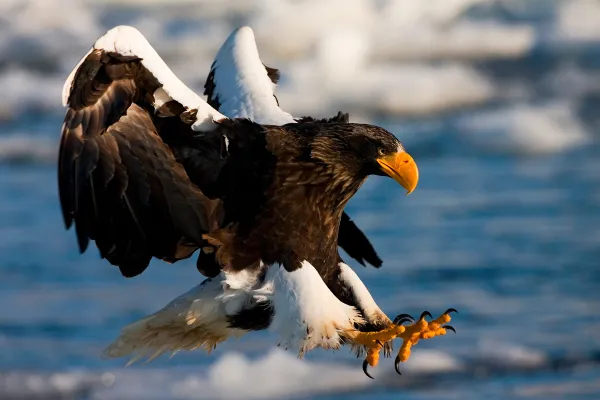
Huge, deep bill: bright orange-yellow, built for tearing fish and carrion
Feet and talons: powerful, with black claws for gripping slippery prey
4) Why their legs look different from “bird-catching” raptors
Sea eagles often grab prey from water or shore. Compared with raptors that snatch birds in flight, sea eagles tend to have strong gripping feet and a build suited for heavier prey and scavenging opportunities along coasts and rivers.
Where Does the Steller’s Sea Eagle Live?
Breeding range
Breeding is concentrated in far eastern Russia, including:
Kamchatka Peninsula
Coastal areas around the Sea of Okhotsk
The lower Amur River
Shantar Islands
Northern Sakhalin and nearby areas
Winter range and movements
Many birds move south or to areas with open water and food in winter, commonly reaching:
Japan (especially Hokkaido)
parts of Korea
China (some wintering or wandering records)
They are strongly tied to water bodies because fish and waterbirds dominate the diet.
Habitat
Steller’s sea eagles prefer:
Rocky coasts, sea cliffs, and islands
Large rivers with mature forest edges for nesting
Lakes and estuaries
Winter feeding sites that include sea-ice edges, river mouths, and coastal flats where carrion and fish concentrate
Diet and Hunting Style
Main food: fish (especially salmonids)
Their core diet is fish, including salmon and trout. In many regions, they heavily exploit seasonal pulses—such as post-spawning salmon carcasses in autumn, which provide abundant high-energy food with less risk than chasing live fish.
Broad prey list (opportunistic apex scavenger-predator)
Beyond fish, they may take:
Crabs, squid, and other marine animals
Mammals or carrion (including deer carcasses in harsh winters in some areas; occasionally seals or other large prey is reported in field notes)
How they hunt
Common strategies include:
Perch-and-wait: watching from trees or rocks, then diving to seize prey
Low patrol flights over shallow water where visibility is better
Scavenging: feeding on dead fish and carcasses when available
Kleptoparasitism: stealing prey from other birds (including other eagles)
Large winter gatherings can happen at rich feeding sites; some reports describe very large aggregations when food is extremely concentrated.
Reproduction and Life Cycle
Courtship and nesting
Courtship begins in late winter; pairs perform flights and calls over nest areas.
Nests are massive platforms of sticks, built:
high in large trees near rivers/coasts, or
on rocky outcrops/cliffs
These nests can be reused and enlarged year after year, becoming extremely large.
Eggs and chick development
Egg-laying often peaks in spring (commonly April–May depending on region).
Typical clutch: 1–3 eggs (often 2 in many summaries), but usually only one chick successfully fledges in many nests due to competition, food variability, or disturbance.
Incubation is often described around ~40 days, and fledging commonly occurs by late summer (August–September in many breeding areas).
Maturity
Young birds take several years to gain full adult plumage and breeding maturity (often around 4–5+ years in many raptors), during which they may roam widely.
Threats and Conservation
The Steller’s sea eagle is listed as Vulnerable, with concerns tied to habitat and food systems across its range.
Major threats commonly discussed include:
1) Habitat disruption near coasts and rivers
Industrial development (including projects that alter river systems and coastal zones) can reduce nesting and feeding quality, especially where disturbance or pollution affects fish runs.
2) Overfishing and reduced prey availability
Where fish stocks decline, eagles may rely more on carrion and human-associated food sources, increasing risk from toxins and conflict.
3) Lead poisoning
A serious, well-documented issue for many large eagles: they may ingest lead fragments when feeding on carcasses shot with lead ammunition, which can cause fatal poisoning.
4) Nest vulnerability and predation
Eggs and chicks can be taken by predators (which varies by region and nesting site), and nests are sensitive to disturbance during breeding.
Interesting Facts
Highly social for an eagle: compared with many solitary eagles, Steller’s sea eagles often gather in groups at rich food sources in winter.
A cold-region giant: their huge size fits the common ecological pattern that larger bodies conserve heat better in cold climates (often discussed as Bergmann-like patterns in animals).
Strong pair bonds: many pairs are effectively long-term partners and reuse the same nesting territories.
FAQ
Is it an “eagle” or a “sea eagle”?
It’s a sea eagle (Haliaeetus). In everyday language people call it an eagle, but biologically it’s part of a sea-eagle lineage adapted to aquatic prey and coastal habitats.
Do they only eat fish?
Fish are the main food, but they are opportunistic and also take birds, marine animals, and carrion—especially in winter.
Where is the best place to see them in winter?
One of the most famous wintering areas is northern Japan (Hokkaido), where birds gather near open water and feeding sites.