Quick answer: Animals that survive extreme cold use several different strategies, including thick fur or feathers, blubber, compact body shapes, heat-saving circulation, hibernation, snow shelter, and even controlled freezing. Polar bears, Arctic foxes, emperor penguins, musk oxen, reindeer, seals, whales, snow leopards, and Arctic ground squirrels are all adapted to subzero environments. Some species, such as wood frogs and Antarctic icefish, survive cold in ways that are very different from warm-blooded mammals and birds.
Cold-adapted animals survive with a mix of insulation, body shape, physiology, and behavior.
Summary Table: Animals That Survive Extreme Cold
| Animal | Main Cold Habitat | Key Cold-Weather Adaptation | Main Survival Strategy |
|---|---|---|---|
| Emperor penguin | Antarctica | Dense feathers and body fat | Huddling and heat conservation |
| Arctic fox | Arctic tundra | Dense fur and compact body | Insulation and shelter |
| Polar bear | Arctic sea ice | Body fat, dense fur, large body | Insulation and energy storage |
| Musk ox | Arctic tundra | Long guard hairs and qiviut | Heavy insulation |
| Reindeer / caribou | Arctic and subarctic regions | Insulating coat and adapted hooves | Migration and winter foraging |
| Arctic hare | High Arctic tundra | Thick coat and short ears | Heat conservation and shelter |
| Arctic ground squirrel | Arctic and subarctic land | Deep hibernation | Extreme metabolic slowdown |
| Ringed seal | Arctic sea ice | Blubber and ice-breathing behavior | Snow lairs and breathing holes |
| Weddell seal | Antarctic sea ice | Blubber and diving physiology | Life around ice-covered water |
| Walrus | Arctic seas | Thick blubber and large body | Marine insulation |
| Beluga whale | Arctic and subarctic seas | Thick blubber and dorsal ridge | Cold-water insulation |
| Antarctic krill | Southern Ocean | Cold-adapted physiology | Seasonal energy conservation |
| Antarctic icefish | Southern Ocean | Antifreeze glycoproteins | Preventing dangerous ice growth |
| Wood frog | Subarctic forests | Freeze tolerance and glucose protection | Controlled seasonal freezing |
| Snow leopard | High Asian mountains | Thick fur and wide paws | Alpine insulation and movement |
| Wolverine | Northern mountains and tundra | Dense fur and snow-adapted lifestyle | Cold-climate travel and food caching |
| Canada lynx | Boreal forest | Large furry paws | Efficient movement over deep snow |
| Rock ptarmigan | Arctic and alpine tundra | Feathered feet and seasonal plumage | Insulation and camouflage |
| Snowy owl | Arctic tundra | Heavy feathering | Insulation while remaining active |
| Yak | High-altitude Central Asia | Dense coat and high-altitude physiology | Cold and low-oxygen adaptation |
How Do Animals Survive Extreme Cold?
There is no single cold-survival mechanism. Different animals solve the same problem in different ways.
Many mammals rely on dense fur or blubber to slow heat loss. Birds use feathers that trap insulating air. Some species reduce heat loss through compact body shapes, small extremities, or specialized blood flow in the legs and feet.
Behavior matters just as much. Emperor penguins huddle. Reindeer migrate. Ringed seals use snow-covered lairs. Arctic ground squirrels hibernate. Wolverines use persistent snow for denning and can cache food in cold environments.
A few ectotherms use completely different strategies. Wood frogs can tolerate extensive freezing during winter, while Antarctic fish use specialized proteins that help them function in seawater close to its freezing point.
Animals That Survive Extreme Cold
Emperor Penguin
Emperor penguins are among the most famous animals associated with extreme Antarctic cold. Unlike most birds, they breed during the Antarctic winter, when darkness, wind, and low temperatures create especially demanding conditions.
Their survival depends on dense plumage, body fat, heat-saving circulation, and group behavior. Males incubating eggs form large huddles, and individuals gradually move through different parts of the group so that no bird remains continuously exposed on the cold outer edge.
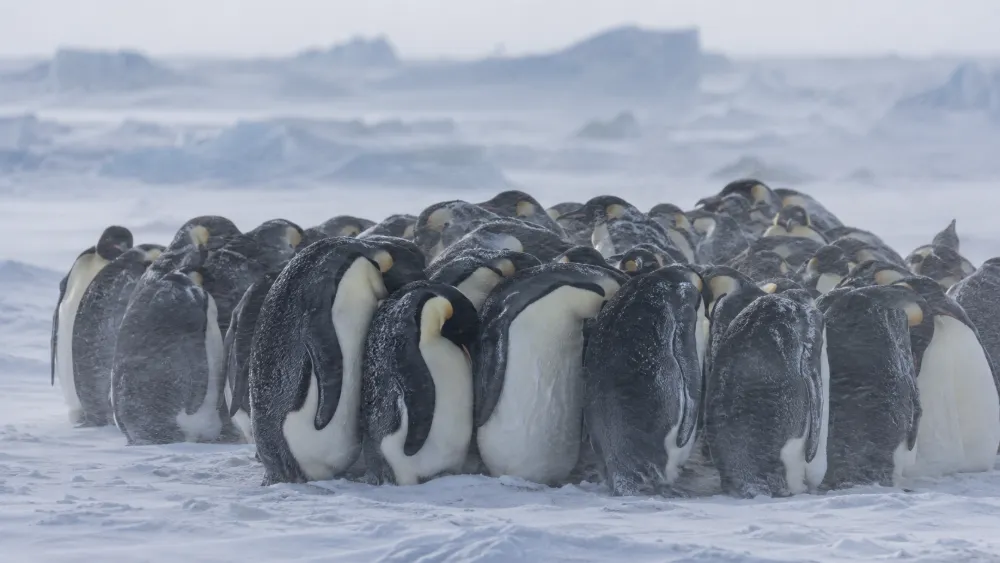
Emperor penguins reduce heat loss by combining insulation with tightly coordinated huddling behavior.
Arctic Fox
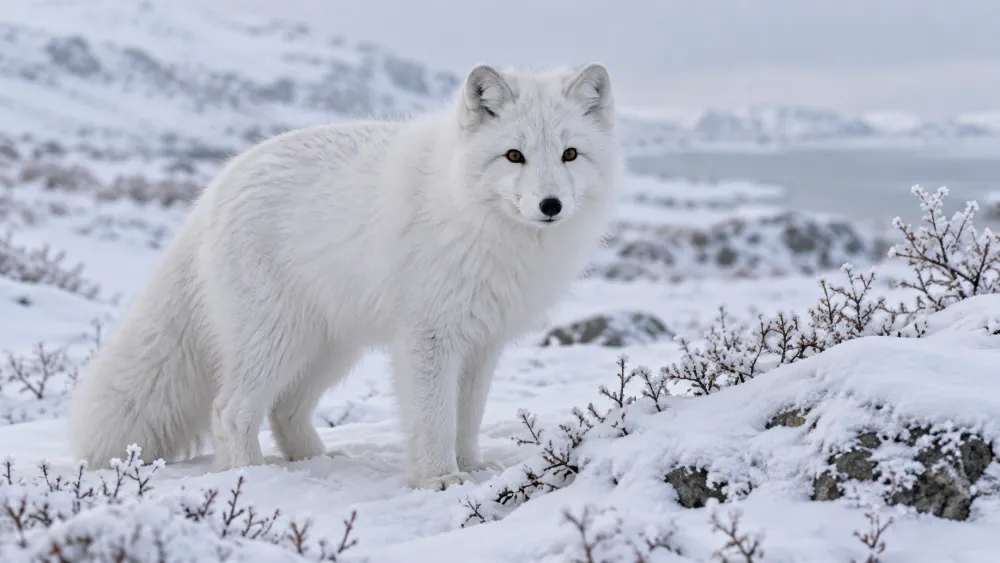
The Arctic fox is built for life on open tundra. Its dense coat covers the body and the soles of the feet, while its short muzzle and relatively small ears reduce exposed surface area.
Many Arctic foxes also change coat color seasonally, becoming white in winter and darker in summer. The color change is mainly camouflage, while the heavy winter coat provides the insulation needed for life on snow and ice.
Polar Bear
Polar bears are marine mammals that depend heavily on Arctic sea ice for hunting seals. Their large bodies lose heat more slowly than smaller bodies, and thick body fat plus dense fur provide powerful insulation.
Their broad paws help with walking over snow and swimming through icy water. However, being highly adapted to cold does not make polar bears independent of their environment. Their hunting success remains strongly connected to the availability of sea ice.
Musk Ox
Musk oxen survive Arctic winters beneath one of the most effective coats among large mammals. Long outer hairs protect a soft undercoat known as qiviut, which traps warm air close to the body.
They do not escape winter by hibernating. Instead, they remain active, move deliberately, and feed on available tundra vegetation. Conserving energy is important because winter food can be difficult to reach and relatively low in quality.
Reindeer and Caribou
Reindeer and caribou live across Arctic and subarctic regions. Their coats contain hollow guard hairs that improve insulation, and their hooves are well suited to snow, frozen ground, and seasonal changes in terrain.
Many populations migrate long distances to track food and seasonal habitat. In winter, they may dig through snow to reach lichens and other vegetation.
For another example of animals that combine harsh-environment survival with sustained movement, see Animals With the Best Endurance.
Arctic Hare
Arctic hares remain active through winter rather than hibernating. Thick fur, a compact body, and relatively short ears help reduce heat loss in open tundra environments.
Their pale winter coat also provides camouflage. They may use depressions in snow or natural shelter to reduce exposure to wind while feeding on woody plants and other vegetation that remains available.
Arctic Ground Squirrel
The Arctic ground squirrel uses one of the most dramatic mammalian winter strategies: prolonged hibernation. During hibernation, metabolism and body temperature fall sharply, greatly reducing the amount of stored energy required to survive the winter.
This strategy allows the squirrel to avoid months of surface conditions when temperatures are severe and food is scarce. It is a very different solution from the active winter lifestyle of an Arctic fox or reindeer.
Ringed Seal
Ringed seals are strongly associated with Arctic ice. Their blubber insulates them in cold water, while strong claws on the front flippers help them maintain breathing holes through sea ice.
Females also use snow-covered lairs above the ice for giving birth and nursing. These lairs provide shelter for pups during a vulnerable stage of life.
Weddell Seal
Weddell seals live around Antarctic sea ice and are among the southernmost-breeding mammals. A thick blubber layer helps reduce heat loss in frigid seawater.
They are also exceptional divers. Their ability to use breathing holes and move beneath sea ice allows them to exploit an environment that is inaccessible to many other marine mammals.
Walrus
Walruses survive Arctic waters with a thick blubber layer and a very large body. Large body size gives them a relatively low surface-area-to-volume ratio, which helps reduce heat loss.
They regularly move between cold water and sea ice while feeding mainly on bottom-dwelling invertebrates such as clams.
Beluga Whale
Belugas are well suited to cold northern seas. A substantial blubber layer provides insulation and stores energy.
Instead of a tall dorsal fin, a beluga has a low dorsal ridge. This body shape is useful when swimming beneath ice and also leaves less exposed tissue projecting from the back.
Antarctic Krill
Antarctic krill are small crustaceans, but they are central to Southern Ocean food webs. Penguins, seals, whales, fish, and seabirds all depend on them directly or indirectly.
Krill remain active in extremely cold water and adjust their feeding, growth, and energy use with the seasons. Their ability to survive winter is especially important because food availability changes dramatically as sea ice expands and retreats.
Antarctic Icefish
Many Antarctic notothenioid fish possess antifreeze glycoproteins that limit the growth of ice crystals in their body fluids. These proteins are one of the clearest examples of biochemical adaptation to permanently cold seawater.
Some Antarctic icefish are also unusual because they lack hemoglobin, but that trait should not be confused with their antifreeze system. Cold adaptation in these fish involves several physiological features rather than one single mechanism.
Wood Frog
The wood frog is one of the most remarkable cold-tolerant amphibians. In northern parts of its range, it spends winter beneath leaf litter rather than escaping below the frost line.
During freezing, ice can form around tissues while high concentrations of glucose and other cryoprotective compounds help protect cells from damage. Breathing and heartbeat can stop during the frozen state, then resume when the frog thaws in spring.
This makes the wood frog an especially useful reminder that “cold-blooded” does not mean an animal is unable to survive freezing weather. For more examples of ectotherms, see 35 Cold-Blooded Animals.
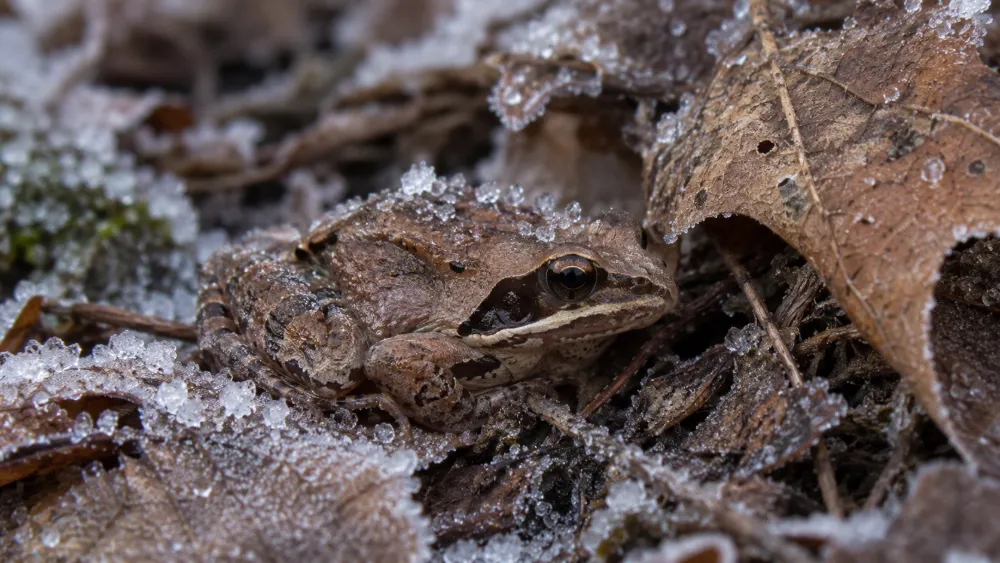
Wood frogs survive winter with a rare freeze-tolerance strategy that protects their cells while much of the body freezes.
Snow Leopard
Snow leopards live in cold, high mountains across Central and South Asia. Their dense coat, wide paws, compact ears, and long tail are all useful in steep, snowy habitats.
The tail helps with balance while climbing and can also be wrapped around the body while the animal rests. Wide paws spread weight over snow and improve movement on loose surfaces.
Wolverine
Wolverines are closely associated with cold northern and mountain environments. They travel across large territories and are well adapted to snow.
Persistent spring snow is especially important for reproductive denning in some populations. Cold conditions can also help preserve cached food, which wolverines may return to later.
Canada Lynx
The Canada lynx is a specialist of snowy boreal forests. Its exceptionally large furry paws spread its weight over soft snow, allowing it to move efficiently while pursuing snowshoe hares.
This does not mean the lynx is immune to winter stress. Its success is closely tied to suitable forest habitat and to populations of its main prey.
Rock Ptarmigan
The rock ptarmigan is found in Arctic and alpine environments. It grows heavily feathered feet that provide both insulation and extra surface area when walking over snow.
Seasonal plumage also provides camouflage: mostly white in winter and mottled brown or gray during snow-free months.
Snowy Owl
Snowy owls are heavily feathered birds of Arctic tundra. Feathers cover much of the body, including the legs and feet, helping reduce heat loss while the owl remains active in winter conditions.
Their movements vary with prey availability, especially populations of lemmings and other small mammals.
Yak
Wild and domestic yaks are strongly associated with the cold, high-altitude environments of the Tibetan Plateau and surrounding regions. Their long outer hair and dense undercoat provide insulation against cold wind.
They are also adapted to low-oxygen conditions at high elevation. Cold tolerance and altitude tolerance work together, allowing yaks to live where many large domestic animals would struggle.
Which Animal Can Survive the Coldest Conditions?
There is no scientifically useful single ranking for the “coldest animal” because species experience cold in very different ways. An emperor penguin remains active through Antarctic winter, a wood frog survives by freezing, an Arctic ground squirrel hibernates, and an Antarctic fish lives permanently in seawater near its freezing point.
The better question is which adaptation is being compared: active cold endurance, freezing tolerance, marine cold tolerance, hibernation, or winter survival on land.
Warm-Blooded and Cold-Blooded Animals Use Different Strategies
Most birds and mammals are endotherms, meaning they generate much of their body heat internally. That allows species such as emperor penguins, polar bears, Arctic foxes, and musk oxen to remain active when the surrounding environment is far colder than their bodies.
You can read more about this distinction in 20 Endothermic Animals.
Ectotherms rely more heavily on environmental heat, but that does not make them simple or fragile. Wood frogs use biochemical freeze tolerance, and Antarctic fish use molecular adaptations that allow them to function in extremely cold water.
Why Tundra and Polar Habitats Are So Difficult
Cold alone is only part of the challenge. Animals in polar and tundra ecosystems may also face long winter darkness, high winds, ice-covered food, deep snow, seasonal prey shortages, and short breeding seasons.
That is why successful species usually combine multiple adaptations rather than relying on one feature. A thick coat may conserve heat, but an animal still needs food, shelter, mobility, and a way to reproduce successfully.
For a broader look at this ecosystem, see What Animals Live in the Tundra?.
Are Cold-Adapted Animals Threatened by Climate Change?
Many cold-adapted species depend not just on low temperature but on specific forms of snow, sea ice, frozen ground, or seasonal timing. Changes in these conditions can alter access to prey, breeding sites, shelter, and migration routes.
Sea-ice specialists such as polar bears and ringed seals are especially dependent on frozen marine habitat. On land, changing snow conditions can affect animals such as reindeer, wolverines, and Arctic herbivores.
The effects are not identical for every species. Some animals can shift their range or behavior, while highly specialized species may have fewer options when their habitat changes rapidly.
Final Takeaway
Animals survive extreme cold in many different ways. Emperor penguins huddle, Arctic foxes rely on dense fur, polar bears and marine mammals use fat and large body size, Arctic ground squirrels hibernate, and wood frogs tolerate freezing itself.
The most important lesson is that there is no single “cold adaptation.” Extreme-cold survival is the result of anatomy, physiology, behavior, and ecology working together.
FAQs
What animals can survive extreme cold?
Examples include emperor penguins, Arctic foxes, polar bears, musk oxen, reindeer, Arctic hares, Arctic ground squirrels, ringed seals, walruses, beluga whales, snow leopards, wolverines, Canada lynx, wood frogs, and Antarctic fish.
What animal survives the coldest temperature?
There is no single scientifically accepted winner because different animals survive different kinds of cold. Emperor penguins remain active through severe Antarctic winter, while wood frogs survive seasonal freezing and Antarctic fish live in seawater near its freezing point.
How do Arctic animals stay warm?
Common strategies include thick fur, blubber, dense feathers, compact bodies, reduced heat loss from extremities, huddling, snow shelter, migration, and hibernation.
Can cold-blooded animals survive freezing weather?
Yes, some can. Wood frogs are a famous example because they can tolerate extensive body freezing during winter. Many other ectotherms avoid freezing by burrowing, entering water, producing cryoprotective compounds, or becoming dormant.
How do emperor penguins survive Antarctic winter?
They rely on dense feathers, body fat, heat-saving circulation, and huddling. Males also protect their eggs on their feet beneath a brood pouch during the winter breeding season.
How do polar bears stay warm?
Polar bears retain heat through a combination of large body size, dense fur, body fat, and behavior. Their broad paws also help them move across snow, ice, and cold water.
Why do some Arctic animals have small ears?
Smaller ears expose less surface area to cold air and can reduce heat loss. Arctic foxes are a classic example of this compact-body pattern.
Do all animals in cold places hibernate?
No. Arctic ground squirrels hibernate, but polar bears, Arctic foxes, reindeer, snowy owls, musk oxen, and many marine mammals remain active through much or all of winter.