A zoologist’s field-guide to “who rules” when two apex mammals share the same forest
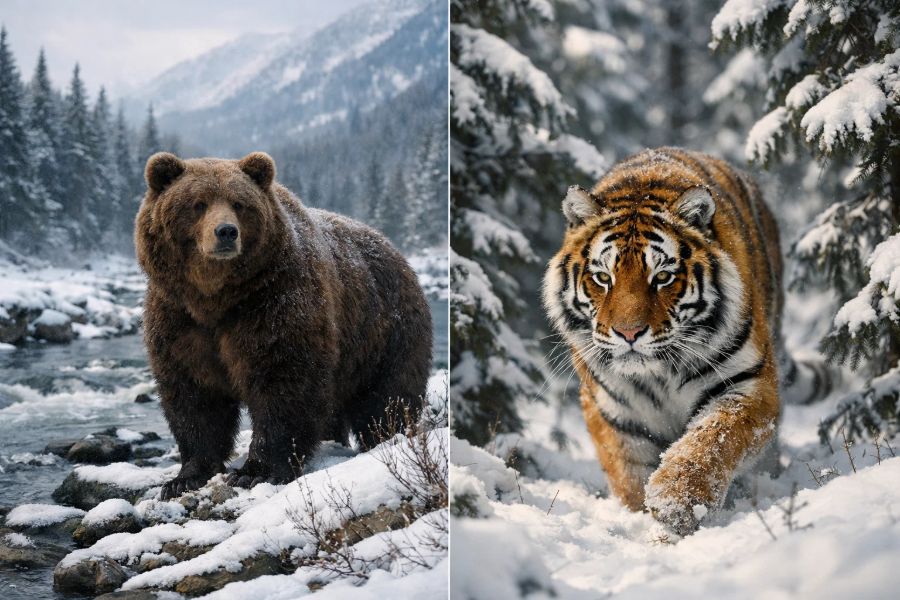
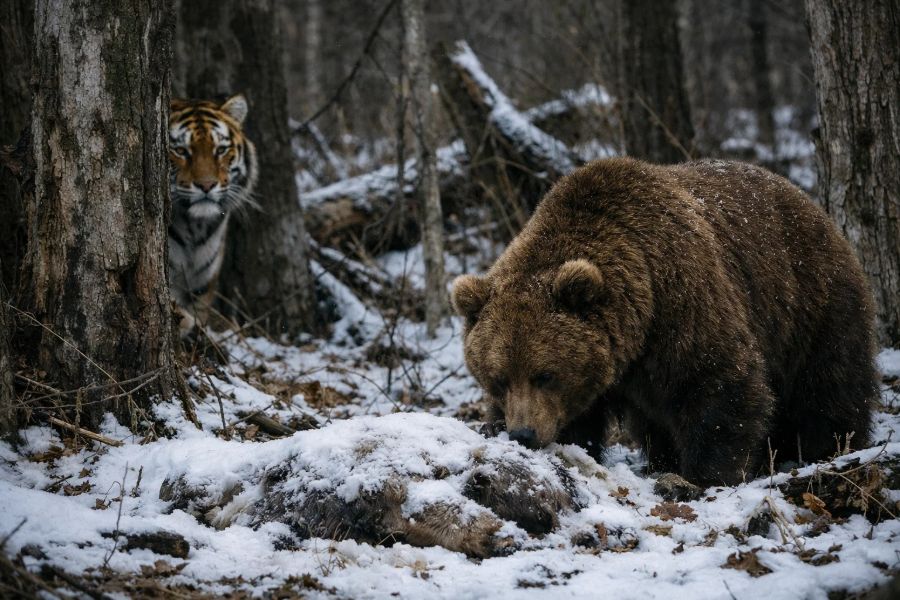
“Brown bear vs Siberian tiger” sounds like a heavyweight title fight, but in real ecology it’s closer to a negotiation between two top-tier strategies:
the tiger (Panthera tigris altaica) as a stealthy, specialized carnivore built for ambush and precision killing, and
the brown bear (Ursus arctos; in the Russian Far East often the Ussuri/Amur brown bear type) as a massive, omnivorous powerhouse that can switch between foraging, scavenging, and predation.
They overlap most famously in parts of the Russian Far East (Sikhote-Alin region and surrounding landscapes), where researchers have documented complex interactions ranging from avoidance and scavenging to occasional lethal encounters.
1) Who are the contenders?
Siberian (Amur) tiger — the largest tiger subspecies
Smithsonian’s National Zoo notes the Amur tiger is the largest tiger subspecies, with males up to ~300 kg and up to ~3 m (10 ft) in length (nose to tail).
Across tigers generally, San Diego Zoo gives a broad weight range of ~75–325 kg (sex and population dependent).
Brown bear — the most widely distributed bear species
The IUCN “Amazing Species” summary highlights brown bears as the world’s most widely distributed bear, with diets that can shift dramatically by season and region (plants, insects, fish, ungulates, etc.) and long winter dormancy in many populations.
Britannica emphasizes how variable brown bear size is; some coastal subspecies can be enormous (e.g., Kodiak), showing the species’ capacity for extreme body mass.
2) Body design: why size alone doesn’t decide “dominance”
Tigers and brown bears are dangerous for different mechanical reasons:
Tiger advantage: high-performance predation toolkit—stealth, explosive acceleration, and a killing bite optimized for suffocation (neck/throat) once it gets position.
Bear advantage: mass + strength + endurance in grappling—thick limbs, heavy skull, and powerful forequarters that are extremely hard for a cat to control once contact becomes a wrestling match.
Table 1 — Fast comparison (ecology + anatomy)
| Trait | Brown bear (Ursus arctos) | Siberian/Amur tiger (Panthera tigris altaica) |
|---|---|---|
| Core diet strategy | Omnivore-flexible (plants + animals; can scavenge or hunt) | Obligate carnivore (specialized predator) |
| Social system | Mostly solitary (except mothers with cubs; seasonal congregations) | Mostly solitary (except mothers with cubs) |
| “Winning” style | Outmuscle and outlast in close contact | Avoid damage, control positioning, end fast |
| Typical adult mass (broadly) | Highly variable by region; Eurasian forms often ~135–250 kg, with very large individuals reported in some areas | Amur males can reach up to ~300 kg; females smaller |
| Primary risk in a clash | A fast ambush that lands perfectly | Being grabbed and forced into a prolonged grapple |
3) Where the conflict actually happens: the “carcass economy”
Most tiger–bear drama is not a sudden duel in an open clearing. It often happens around food concentration points, especially:
Tiger kills (fresh carcasses)
Winter and early spring when energetic pressure is high
Denning zones where bears are vulnerable (or defensive)
A long-term study in and around the Sikhote-Alin Nature Reserve (1992–2013) documented how bears fit into tiger ecology and vice versa. The researchers logged 763 tiger kills and analyzed 430 tiger scat samples, emphasizing that bear–tiger relationships are real, measurable, and multi-directional.
One striking detail from that published summary: bears represented ~2.2% of identified tiger kills, while bear remains appeared in ~8.4% of tiger scats, implying that direct predation is relatively uncommon but bear-derived food (including scavenging) is not negligible.
4) Who kills whom? A careful, evidence-based answer
Tigers can kill bears — but usually under specific conditions
Tigers are capable of killing bears, especially when:
the bear is young, weakened, or surprised,
the tiger has ambush advantage (ideal positioning), or
the bear is an Asiatic black bear rather than a large brown bear (black bears are typically smaller and more arboreal).
The Sikhote-Alin long-term work explicitly treats bears as a component of tiger diet and examines bear den sites in relation to tiger attack risk.
Bears can kill tigers — especially in close, messy fights or defensive contexts
A large brown bear’s strength and mass make it extremely dangerous at close range. In real ecosystems, the “bear wins” pathway often looks like:
bear detects tiger early → tiger loses stealth advantage, or
tiger is forced into a prolonged grapple → bear’s strength becomes decisive.
The same long-term research frames the relationship as a two-way competitive system, not a one-way predation story.
5) The most realistic “kingmaker” factors (what decides outcomes)
Instead of “lion vs tiger” style myth-making, wildlife biologists focus on decision variables:
Table 2 — Encounter scenarios and what usually matters most
| Scenario | Most important factor | More likely “advantage” (not a guarantee) |
|---|---|---|
| Tiger meets adult brown bear at a carcass | Detection distance + willingness to risk injury | Often bear if it commits; tiger may yield to avoid damage |
| Tiger ambushes bear (subadult or surprised) | First-contact positioning and bite placement | Often tiger if ambush is perfect |
| Bear encounters tiger while guarding cubs | Defensive aggression + risk tolerance | Often bear (high motivation) |
| Winter scarcity, both hungry | Energy pressure increases risk-taking | Outcomes become more volatile; avoidance breaks down |
| Dense forest vs open terrain | Cover favors stealth; open space favors early detection | Forest: tiger more likely to control distance |
The key ecological rule: tigers are optimized to minimize injury (a crippled tiger often starves), while bears can sometimes afford more injury risk because they can scavenge and eat a wider menu.
6) “Who is the true boss?” Ecology gives two different answers
If “boss” means direct dominance in a face-to-face dispute:
A large adult brown bear frequently has the practical advantage in a prolonged confrontation—especially if it sees the tiger coming.
If “boss” means predatory control over large prey:
The Amur tiger is the more specialized killing machine, designed to bring down large ungulates efficiently.
So the honest scientific conclusion is: there is no single ruler. These two apex mammals dominate different parts of the same ecosystem’s “power map.”
7) Conservation context (why this comparison matters beyond hype)
The tiger is listed as Endangered on the IUCN Red List and has lost the majority of its historic range.
Brown bears, in contrast, are broadly distributed and often more resilient as a species due to ecological flexibility.
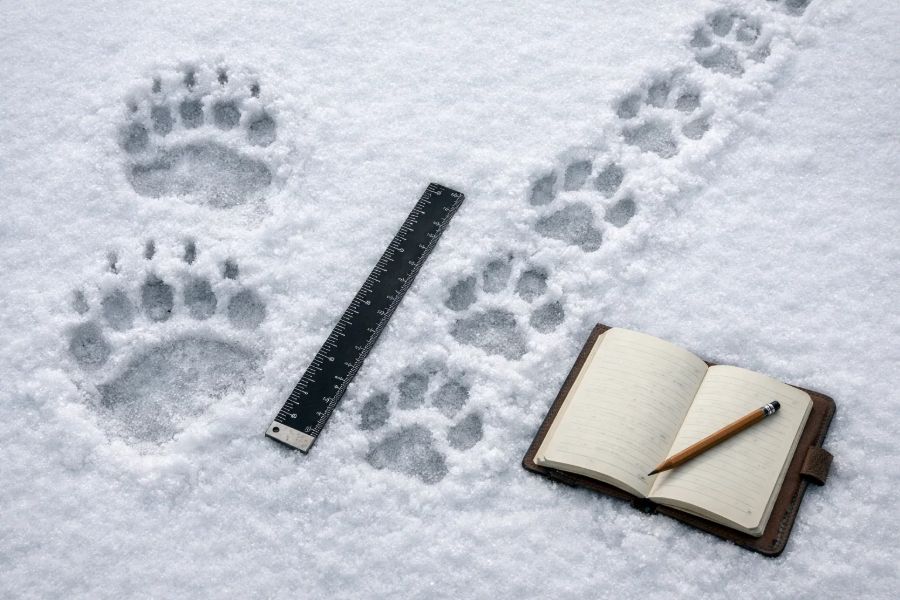
In the Russian Far East, tiger monitoring frequently uses standardized winter track surveys and related field methods—showing that “tiger vs bear” isn’t just storytelling; it sits inside active conservation science.
References (cited)
Seryodkin, I.V. (2018). Interspecific Relationships between the Amur Tiger (Panthera tigris altaica) and Brown (Ursus arctos) and Asiatic Black (Ursus thibetanus) Bears. Bio Bulletin (journal page).
Summary details (kills/scat/marking/den sites; % kills and scat) from accessible full-text repost/host.
Smithsonian’s National Zoo. “Tiger” (Amur tiger size up to ~300 kg; length up to ~3 m).
San Diego Zoo Animals & Plants. “Tiger” (general tiger size ranges).
IUCN Red List (Amazing Species PDF). “Brown Bear (Ursus arctos)” (distribution, diet flexibility).
Encyclopaedia Britannica. “Brown bear” (size variability; very large subspecies examples).
Encyclopaedia Britannica. “Eurasian brown bear” (typical size ranges; notes on very large Siberian forms).
Conserve Wild Cats. “Track Survey of the Amur Tiger” (survey method and results example from a regional unit).