At first glance, Polar Bear vs Elephant Seal sounds like a perfect “who’s the ocean boss?” matchup. But biology starts with geography:
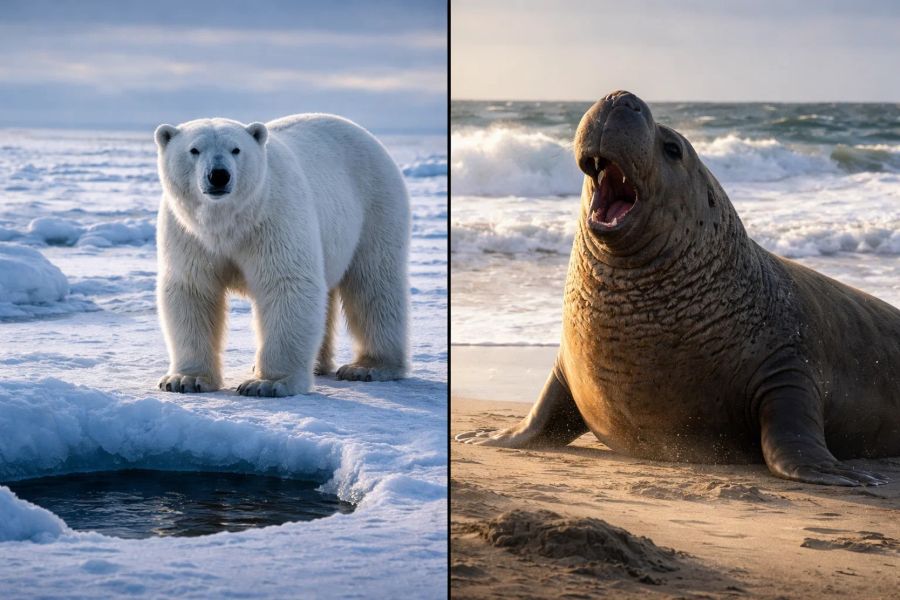
Polar bears (Ursus maritimus) are Arctic sea-ice hunters, built to stalk seals from the ice.
Elephant seals (Mirounga spp.) are deep-diving pinnipeds—with northern elephant seals in the eastern North Pacific and southern elephant seals around sub-Antarctic/Antarctic waters.
That means a true “face-off” is extremely unlikely in the wild. Still, comparing them is scientifically useful because it reveals two different apex strategies:
ice-platform ambush (polar bear) vs open-ocean deep-dive foraging (elephant seal).
1) Meet the contenders: what they are and what they’re optimized to do
Polar bear: a seal specialist powered by fat
Polar bears are highly carnivorous and strongly adapted to hunting seals—especially ringed seals, with bearded seals also important prey.
Their “engine” is sea-ice access: the ice is the platform that makes their hunting efficient.
Elephant seal: a champion diver built for the deep
Elephant seals are pinnipeds (true seals) with extreme sexual dimorphism and elite diving physiology.
Northern elephant seal males can weigh nearly ~4,400 lb (~2,000 kg) per NOAA.
Southern elephant seal males commonly weigh ~2,200–4,000 kg, per Antarctic & Southern Ocean Coalition.
They spend most of their lives at sea, foraging on fish and squid at depth, and coming ashore mainly to breed and molt.
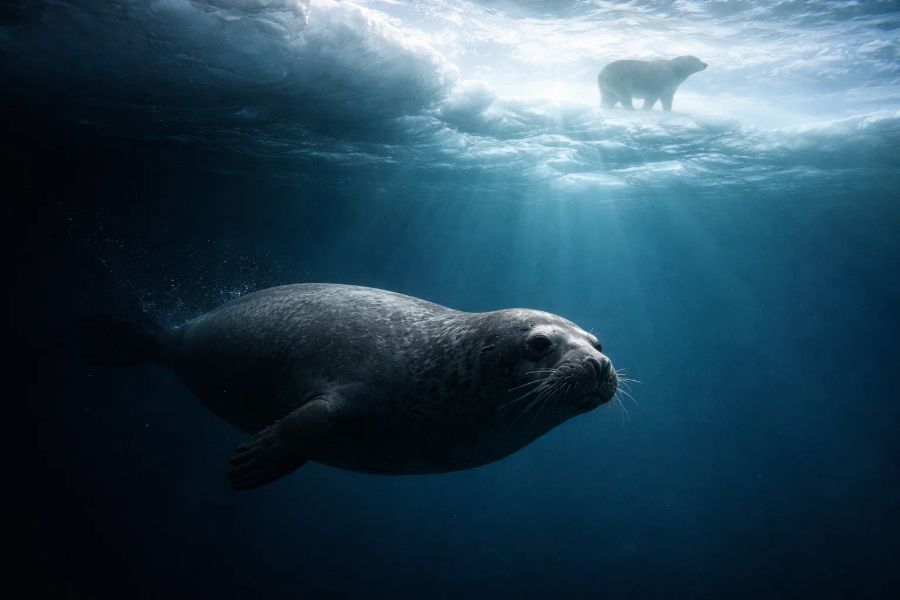
2) How each one gets food: the hunting problem they evolved to solve
Polar bear hunting: patience + precision on ice
Polar bears commonly hunt by:
still-hunting at seal breathing holes, and
stalking hauled-out seals on the ice.
These are high-stakes attempts: a miss costs energy, and the bear often needs to rest after failed hunts.
The payoff is huge because seals provide the high-fat calories polar bears rely on.
Elephant seal feeding: repeated deep dives, long foraging trips
Northern elephant seals are famous for prolonged, continuous deep diving, with research documenting dives that can exceed 1,000 m and a deepest estimate around 1,250 m in classic work.
They also perform specialized behaviors like “drift dives” linked to rest and buoyancy changes.
In short: elephant seals “win” by out-diving and out-lasting, not by fighting.
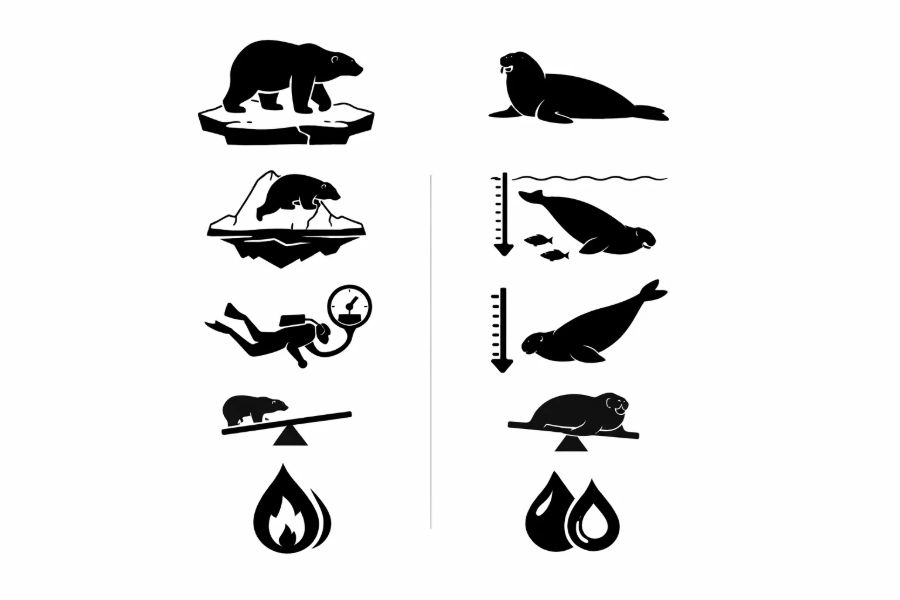
3) Size, muscle, and “weapons”: who’s built for what kind of conflict?
Polar bear’s toolkit
Large body mass (adult males commonly cited ~350–590 kg; females ~150–295 kg)
Powerful forelimbs, claws, and bite optimized for subduing seals on/near ice
Strong swimming ability; recorded dives include depths up to ~13.9 m in one study of aquatic behavior.
Elephant seal’s toolkit
Enormous mass advantage in adult males (especially southern elephant seals)
Thick blubber + toughened skin on neck/chest in adult males (a “shield” for male-male combat) noted in northern elephant seals.
In water: extreme diving performance and efficient swimming for open-ocean life
Elephant seals aren’t “designed” to fight polar bears—but their mass and water advantage can make them formidable if the context is right.
4) The key biology: “Who wins?” depends on the arena
Because these animals are optimized for different environments, the honest scientific answer is context, not crown.
Table: Polar bear vs elephant seal—scenario outcomes (biomechanics + ecology)
| Scenario | What matters most | Likely advantage | Why |
|---|---|---|---|
| On sea ice / land (short distance) | Traction, grappling, ability to bite and control head/neck | Polar bear | Bears are built to overpower seals at the ice edge; elephant seals are awkward on land despite size. |
| Shallow water (edge habitat) | Who can keep control while partly buoyant | Uncertain / high risk | Bears can swim and strike, but seals maneuver better in water; outcome depends on size, surprise, and stamina. |
| Open water (deep) | Swimming efficiency, breath-hold, maneuvering | Elephant seal | Elephant seals are elite divers; polar bears are not adapted to deep-water pursuit. |
| Adult male southern elephant seal vs polar bear | Raw mass difference | Seal on paper, bear on ice | Southern bulls can outweigh a polar bear several-fold, but the bear’s best “arena” is still ice/land. |
| Typical real life | Overlap probability | No contest | They mostly don’t co-occur; “vs” is mostly hypothetical. |
5) Conservation and why the comparison matters in 2026
Polar bears are listed as Vulnerable on the IUCN Red List, largely because sea-ice loss threatens their hunting platform and energetic balance.
Elephant seals—especially northern elephant seals—are widely cited as a major conservation recovery story after 19th-century overhunting, and are not presently endangered per U.S. National Park Service.
So the real “dominance” story isn’t about fighting—it’s about which species’ habitat is disappearing faster, and what that means for survival and ecosystem roles.
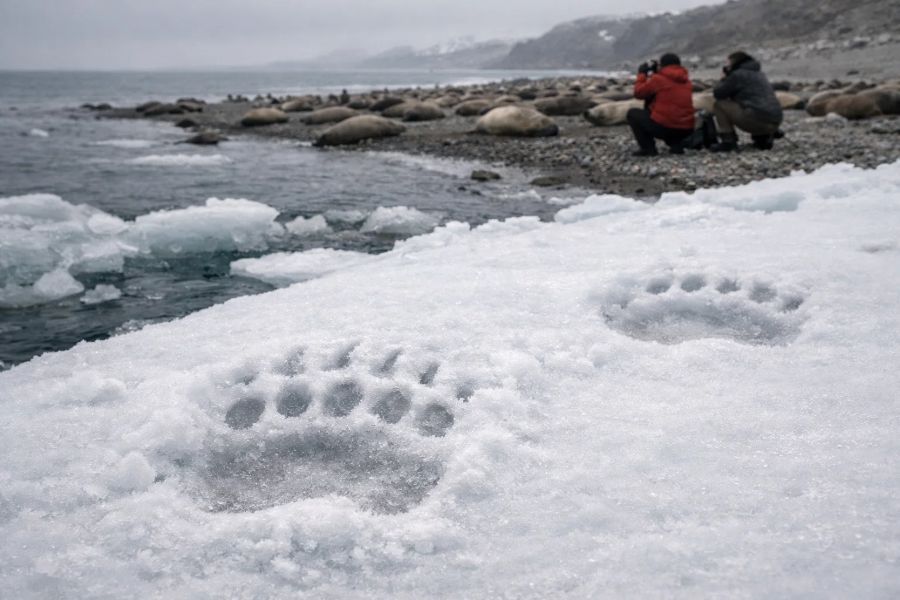
Summary: who is the “boss”?
On ice, the polar bear is the specialist apex predator.
In the deep ocean, elephant seals are unmatched in their niche.
In nature, they rarely meet, so the real comparison is about adaptations, not a duel.
References (cited)
IUCN Red List. Polar Bear (Ursus maritimus) assessment PDF (Vulnerable).
IUCN SSC Polar Bear Specialist Group report noting Vulnerable listing and review context.
Polar Bears International — Diet & prey; dependence on seals and limits of switching to land foods.
Bear Biology Association — Polar bear diet mainly ringed and bearded seals.
Animal Diversity Web — Polar bear prey list (ringed, bearded, harp, etc.).
Polar Bears International — adult weight ranges (males and females).
NOAA Fisheries — Northern elephant seal size (males nearly 4,400 lb; females up to ~1,300 lb) and species overview.
Antarctic & Southern Ocean Coalition — Southern elephant seal average size/weight and status notes.
Le Boeuf, B. J. et al. (1989). Prolonged deep diving in northern elephant seals; dives exceeding 1,000 m and deepest estimate ~1,250 m.
Mitani, Y. et al. (2009). Drift dives and three-dimensional resting behavior in northern elephant seals.
Togunov, R. R. et al. (2022). Review of polar bear foraging strategies (still-hunting vs stalking).
Lone, K. et al. (2018). Aquatic behavior of polar bears; dive depths up to ~13.9 m recorded.
U.S. National Park Service — Northern elephant seals not presently endangered; historical overhunting and recovery context.