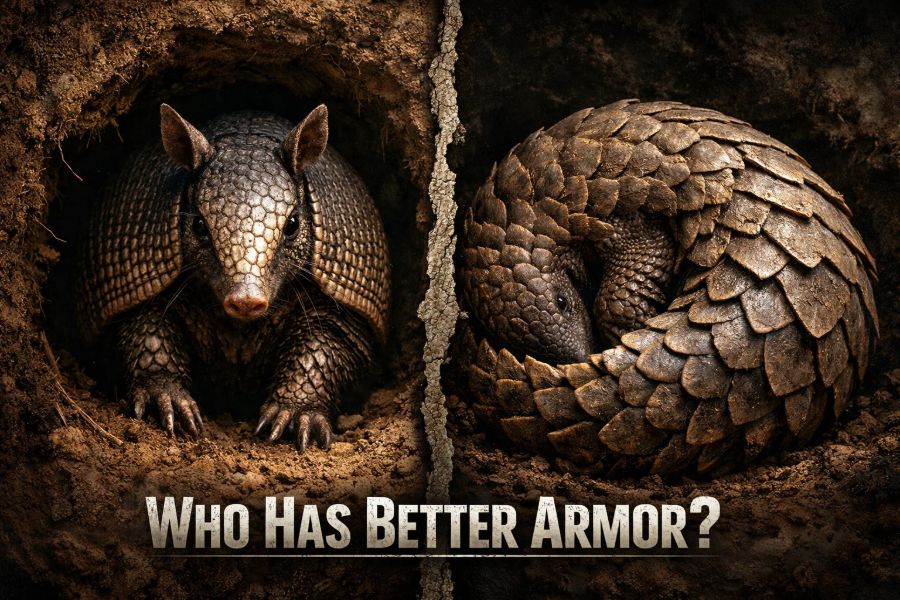
At first glance, armadillos and pangolins look like close relatives: both are small-to-medium mammals, both eat ants or termites, and both wear body armor. But zoologically, they are not close relatives at all. Armadillos belong to the xenarthran lineage of the Americas, while pangolins belong to the order Pholidota and live in Asia and Africa. Their superficial similarity is a classic case of convergent evolution: two unrelated groups evolving similar protective solutions because they face similar ecological problems.

So if we ask, “Who wins the defense battle: armadillo or pangolin?”, the most scientific answer is not a simple one. It depends on what kind of defense we mean. Are we comparing armor strength, ability to roll into a sealed ball, burrowing escape, or resistance to different predators? Under that broader view, pangolins are usually better at passive armor defense, while many armadillos are better at escape-through-digging and wedge defense. The result is less “one winner” than “two very different defensive systems.”
Quick comparison table
| Category | Armadillo | Pangolin | Likely edge |
|---|---|---|---|
| Armor material | Bony plates (osteoderms) covered with keratin | Large overlapping keratin scales | Different strengths |
| Can roll into a tight ball | Only some species, especially three-banded armadillos | Many species can curl into a tight ball | Pangolin |
| Best escape strategy | Digging, burrow retreat, wedging into tunnels | Curling, tail lashing, some digging | Depends on situation |
| Main defensive weak point | Soft underside in many species | Vulnerable if unrolled or handled by humans | Slight edge to pangolin in passive defense |
| Burrowing ability | Often excellent | Strong in some species, but less universally the main defense | Armadillo |
| Protection against natural predators | Good, but often incomplete unless species can fully roll | Very strong when tightly curled | Pangolin |
| Protection against humans | Poor | Poor | Neither |
This comparison is intentionally broad because “armadillo” and “pangolin” each include multiple species with different body plans and behaviors.
First, they are not built from the same kind of armor
Armadillo armor is made of bony plates called osteoderms embedded in the skin and covered by keratin. National Geographic describes armadillo shells as bony plates with a keratin layer, while Animal Diversity Web notes that the armadillo skeleton and limbs are strongly modified for both armor support and digging. In other words, an armadillo is wearing something like a flexible bony shield built into the body.
Pangolin armor is different. Pangolins are the only mammals covered largely in scales, and those scales are made of keratin, the same structural protein found in hair and nails. Britannica and Animal Diversity Web both note that pangolins curl into a ball when threatened, using those scales as protective armor over the vulnerable underside. So while the two animals may look similar at a distance, their armor is not constructed the same way.
Pangolins are the better “ball defense” specialists
If the contest is “Which animal is better at turning itself into an armored ball?”, pangolins usually win. Britannica explicitly notes that the very name “pangolin” refers to the habit of rolling up when threatened, and Animal Diversity Web says pangolins curl into a ball to protect their scaleless underside, while also lashing with their sharp-edged tails and sometimes releasing foul-smelling secretions. This is a highly specialized passive defense system: do not fight face-to-face, just become a nearly inaccessible package of scales.
Armadillos are more limited here than many people assume. Britannica notes that three-banded armadillos can roll into a solid ball, but most armadillos do not form a fully sealed sphere. Smithsonian’s National Zoo likewise states that the La Plata three-banded armadillo is the only armadillo that can curl into a complete ball. So the popular image of “all armadillos rolling up” is inaccurate.
That means pangolins win this specific category not because armadillos are weak, but because pangolins made rolling defense their central design, whereas most armadillos did not.
Armadillos are usually better diggers and tunnel defenders
Where armadillos often gain the edge is burrowing escape. Animal Diversity Web notes that armadillo forelimbs and skeletons are strongly modified for digging, and the toes bear heavy curved claws that aid in digging and defense. The nine-banded armadillo account adds that they excavate burrows that can be 1–5 meters long and use multiple burrows for nesting, shelter, and other purposes.
Britannica also states that when threatened, many armadillos retreat to burrows or pull in their feet so their armor presses against the ground. Some species even wedge themselves in so firmly that they become extremely difficult to pull out. This is a very different defensive philosophy from the pangolin’s ball defense. Instead of becoming a sealed object in the open, the armadillo often becomes an anchored armored plug inside a tunnel.
Pangolins can dig well too, especially ground-dwelling species, but the web-accessible sources here emphasize rolling and scale armor more consistently than burrow-wedging as their core defense. So if the question is “Who is better at defensive retreat underground?”, the answer often leans toward armadillos.

Which armor is actually tougher?
This is the hardest part to answer cleanly, because there is no universal head-to-head mechanical test between “armadillo shell” and “pangolin scales” in the way people imagine. Still, the biology suggests different strengths.
Armadillo armor contains bone plus keratin, which gives it structural rigidity and body support. Pangolin armor is made of large, overlapping keratin scales that act like a layered protective coat. Smithsonian notes that pangolin scales likely evolved as armor against predators, while National Geographic emphasizes the tough osteoderm-and-keratin structure of armadillo shells. The armadillo’s system may be more integrated into the body; the pangolin’s may be better at creating a flexible external barrier when curled.
In practical terms, the pangolin’s defense often appears more effective when stationary and fully curled, while the armadillo’s armor often works best combined with digging, bracing, or movement into cover. That is an inference from their documented defense behaviors rather than a direct lab comparison.
Against natural predators, the pangolin often looks more “predator-proof”
Against a leopard, big cat, or canid, a tightly curled pangolin can be extremely difficult to open. Animal Diversity Web notes that pangolins protect their soft underside by curling into a ball and can swing their sharp-scaled tails. This creates a compact defensive package with relatively few openings. That is why pangolins are often described as exceptionally well protected from natural predators.
Most armadillos are less absolute in this way. Since most species cannot form a perfect sealed ball, they often still rely on escape, shelter, or posture. Britannica notes that only three-banded armadillos can truly form a solid ball, while many others defend themselves by retreating into burrows or pressing their armor down toward the ground. This is good defense, but it is usually less “closed” than pangolin defense.
So if the opponent is a natural predator encountering the animal in the open, the pangolin often has the stronger passive defensive posture.
Against humans, neither strategy works well enough
This is where the story becomes tragic. Pangolin armor is highly effective against many natural predators, but it is catastrophically poor against humans. The IUCN SSC Pangolin Specialist Group states that all eight pangolin species face severe pressure from overexploitation, and WWF notes that all eight IUCN-recognized species are protected under law but continue to be heavily trafficked. Their instinct to curl into a ball may actually make them easier for poachers to pick up.
Armadillos are not in the same global trafficking crisis, but armor does not make them invulnerable either. National Geographic notes clearly that armadillos are not bulletproof, despite myths, and their shell is a biological shield, not an invincible suit. So against humans, neither animal can be called a true defense champion.

So who wins the defense battle?
A zoologist’s verdict would be:
If the question is “Who has the better passive armor defense in the open?” the pangolin usually wins.
It is more specialized for curling into a tight, hard-to-open ball covered in scales.
If the question is “Who has the better escape-and-fortify defense?” many armadillos win.
Their digging ability, burrow use, and tunnel bracing are excellent defensive tools.
If the question is “Who is absolutely safer overall?” neither is unbeatable.
Both evolved impressive defenses against natural predators, but both remain vulnerable to human threats. Pangolins in particular are now among the world’s most threatened mammals.
Final conclusion
So the most scientifically honest conclusion is not “armadillo beats pangolin” or “pangolin beats armadillo.” It is this:
The pangolin is the better armored ball. The armadillo is the better armored digger.
Pangolins excel at becoming a sealed defensive object. Armadillos often excel at getting underground, wedging in, and turning the landscape into part of their armor. They represent two elegant but very different solutions to the same problem: how a small mammal survives in a world full of predators.
References
Britannica. Armadillo — armor, burrow defense, and three-banded rolling behavior.
Smithsonian’s National Zoo. La Plata three-banded armadillo — only armadillo that can curl into a complete ball.
Animal Diversity Web. Dasypodidae — armadillo digging morphology and defensive claws.
Animal Diversity Web. Dasypus novemcinctus — burrow structure and digging behavior.
National Geographic. Animal armor — armadillo osteoderms and keratin covering.
Britannica. Pangolin — curling into a ball, eight species, armored mammal overview.
Animal Diversity Web. Pholidota — pangolin scales, ball defense, tail lashing, and anal gland secretion.
Smithsonian. The Genetics of the Pangolin — pangolin scales as armor against predators.
IUCN SSC Pangolin Specialist Group. The 8 Species — current conservation status across pangolins.
WWF. Pangolin — all eight IUCN-recognized pangolin species protected but still heavily trafficked.