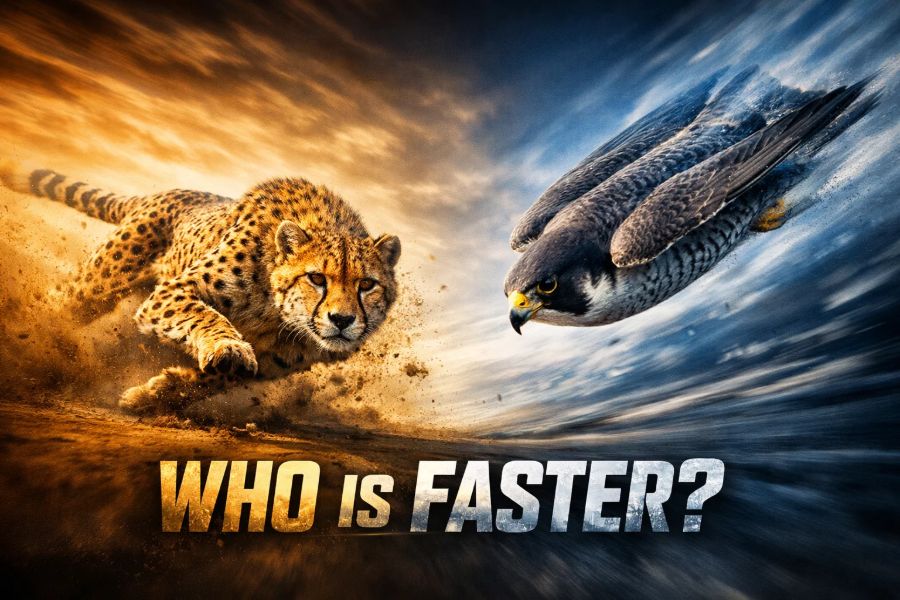
When people ask whether the cheetah or the peregrine falcon is faster, they are usually mixing together two very different kinds of speed. A cheetah is a terrestrial sprinter, while a peregrine falcon is an aerial hunter whose greatest speed comes during a steep hunting dive called a stoop. That means this is not a clean head-to-head race unless we first decide what kind of movement we are comparing: running speed on land, powered or level flight, or gravity-assisted diving speed.
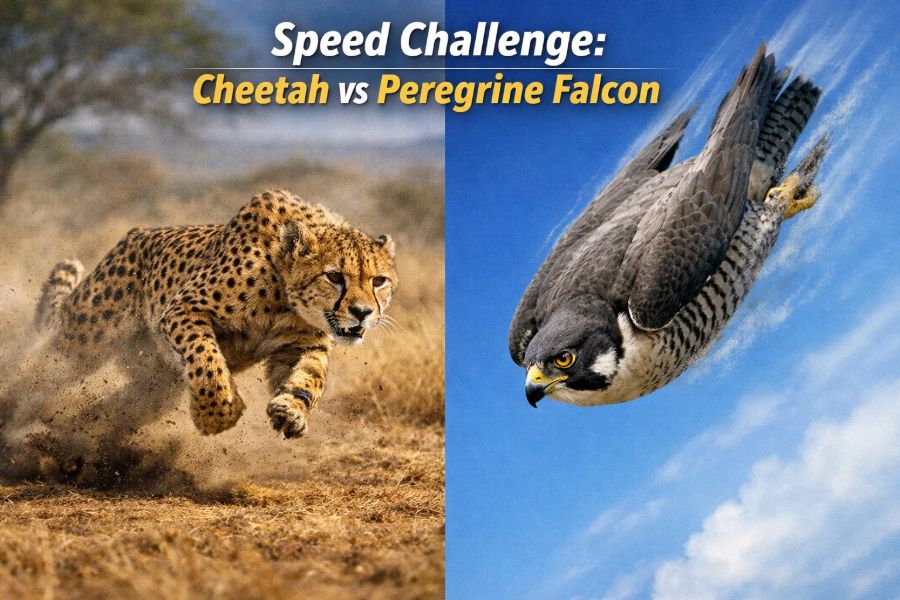
The most scientifically accurate short answer is this: the peregrine falcon is faster overall, because its stoop speed far exceeds anything a cheetah can do on land. But the cheetah is still the faster runner, and remains the fastest land animal alive. So the real verdict depends on the category: cheetah wins on land; peregrine wins in the sky; peregrine wins overall if all forms of speed are counted.
Why this comparison is trickier than it looks
A zoologist would separate “speed” into at least four categories: top speed, acceleration, maneuverability, and how long that speed can be sustained. A cheetah can explode from low speed to near top speed in seconds, but only for a short burst. A peregrine falcon can achieve extraordinary velocity in a stoop, but that is not the same as sustained level flight. So saying “the peregrine is faster” is true only if we are counting its diving attack, not just ordinary horizontal movement.
This distinction matters because many popular comparisons unfairly compare a cheetah’s running speed with a peregrine’s diving speed. That is like comparing a sprinter on a track with a skier descending a mountain. Both are meaningful measurements, but they do not describe the same kind of locomotion.
Quick comparison table
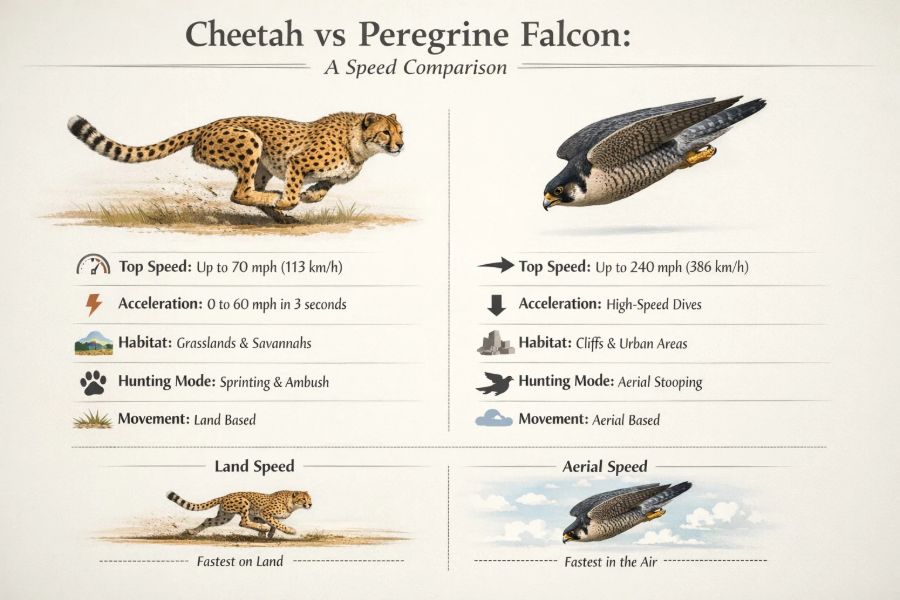
| Category | Cheetah | Peregrine Falcon | Winner |
|---|---|---|---|
| Highest reliably recorded land/running speed | about 29 m/s = 104 km/h = 65 mph | not applicable | Cheetah |
| Commonly cited maximum/upper-end popular speed | up to 114 km/h = 71 mph | over 322 km/h = 200+ mph in stoop | Peregrine falcon |
| Famous directly recorded extreme | Sarah the cheetah reached 61 mph in a 100 m run | peregrines have been directly recorded at about 242 mph in dives | Peregrine falcon |
| Best acceleration in a hunt | extremely rapid, up to 7.5 m/s² in wild hunts | very high during dives, but in a different movement mode | Different categories |
| Best sustained sprint | only a short burst, usually seconds | dive also short; ordinary flight slower than stoop | Neither is built for long endurance at top speed |
| Fastest in its own ecological niche | fastest land animal | fastest animal overall in hunting dive | Both, in different ways |
These numbers mix rigorous field studies with widely cited reference summaries, so the “winner” depends on which standard is being used.
The cheetah: the supreme land sprinter
The cheetah (Acinonyx jubatus) is still the best-supported champion of land speed. A classic timed study reported a cheetah running at 29 m/s, equivalent to 104 km/h or about 65 mph, and described this as the highest reliably recorded running speed for any animal. Britannica, using a more popular summary figure, states that cheetahs can reach 114 km/h (71 mph), which is the number most readers know.
What makes cheetahs extraordinary is not just their top speed, but how they get there. Research on wild hunting cheetahs found speeds up to 18.94 m/s during hunts and accelerations up to 7.5 m/s², showing that real hunting success depends heavily on acceleration, turning ability, and pace control, not just reaching a headline maximum. In other words, cheetahs are not simply “fast in a straight line”; they are highly tuned pursuit predators built for explosive, agile chases.
A famous captive record adds another useful data point. In 2012, the cheetah Sarah ran 100 meters in 5.95 seconds and reached a top speed of about 61 mph, demonstrating how astonishing cheetah sprint performance can be under timed conditions. That said, the most rigorous scientific literature still treats about 104 km/h as the highest reliably measured running speed for the species.
The peregrine falcon: the speed king of the sky
The peregrine falcon (Falco peregrinus) is widely recognized as the fastest animal on Earth because of its hunting stoop. Britannica states that peregrines exceed 185 mph in dive flight, while Smithsonian reports that they have been clocked at up to 242 mph during hunting dives. Live Science also summarizes Guinness-style figures of over 200 mph (322 km/h).
This is not ordinary flapping flight. The stoop is a specialized attack maneuver in which the falcon climbs, folds its wings into an aerodynamic shape, and dives steeply toward prey. During that dive, gravity, streamlining, wing control, and body design combine to produce speeds no running animal can approach. That is why the peregrine is not just the fastest bird, but the fastest animal overall in the most widely accepted sense.
Why the peregrine’s speed should not be dismissed as “just falling”
Some people argue that the peregrine “doesn’t count” because it is diving downhill through the air. Biologically, that objection misses the point. The stoop is not uncontrolled falling; it is a highly specialized predatory behavior that requires fine aerodynamic control, body stability, and precise aim at extraordinary speed. Smithsonian explicitly describes peregrines climbing high, diving abruptly, and using that velocity to strike prey.
In other words, the peregrine is not accidentally fast. It is evolved to be fast in exactly the ecological situation that matters most to its survival: the kill dive. From a zoological perspective, that absolutely counts as real speed.
Straight-line speed vs hunting reality
A second important distinction is that maximum speed is not always the most useful speed. Wild cheetahs do not spend most hunts running at their absolute top speed. Studies on hunting cheetahs found that they often balance pace with turning performance, because prey animals dodge and twist. Too much speed can actually reduce control.
The same is true for peregrines. Their highest speed appears during the final attack phase, not during normal cruising flight. So for both species, the record number is impressive, but their real hunting success depends on combining speed with control, timing, and precision. This is an important reminder that the “fastest” animal is not necessarily the most efficient mover in every context.
Acceleration: the cheetah’s hidden advantage
Although the peregrine wins the overall speed contest, the cheetah deserves special respect for acceleration. Popular descriptions often note that cheetahs can go from near standstill to very high speed in only a few seconds, and scientific work on wild individuals confirms extremely strong acceleration during hunts. That explosive launch is one reason cheetahs succeed against fleet-footed antelope in open habitats.
This matters because a race is not decided only by top speed. Over a very short distance on level ground, the cheetah’s rapid acceleration makes it one of the most formidable vertebrate athletes alive. The peregrine, by contrast, needs altitude and space to build to its greatest numbers.
So who is actually faster?
If the question is “Who is faster in the most absolute sense?”, the answer is the peregrine falcon. Its documented stoop speeds of 200+ mph, with direct recordings around 242 mph, are far above even the fastest cheetah measurements.
If the question is “Who is faster on land?”, the answer is the cheetah, which remains the fastest land animal, with a highest reliable running speed around 104 km/h and popular maximum figures up to 114 km/h.
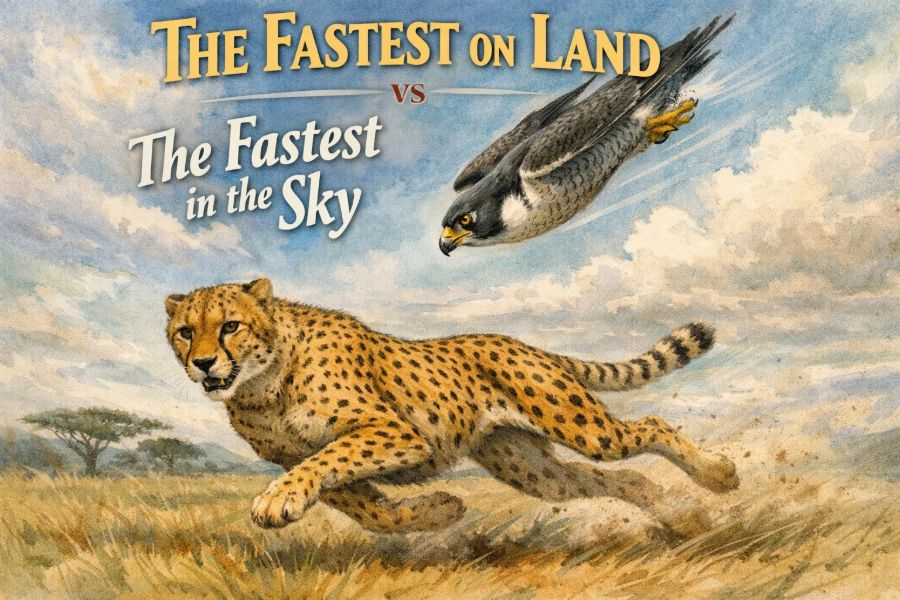
If the question is “Who is the more impressive athlete within its own environment?”, then both are champions. The cheetah is the supreme land sprinter; the peregrine is the supreme aerial diver. Zoologically, they are not rivals so much as masterpieces of speed built for different worlds.
Final verdict
A zoologist’s verdict would be:
On land: the cheetah is faster.
In the air: the peregrine falcon is much faster.
Overall: the peregrine falcon is the faster animal.
So the cleanest headline answer is: the peregrine falcon beats the cheetah in total top speed, but the cheetah remains the king of running speed on land.
References
Hudson, P. E. et al. 2012. High speed galloping in the cheetah (Acinonyx jubatus). Journal of Experimental Biology. PubMed summary.
Sharp, N. C. C. 1997. Timed running speed of a cheetah (Acinonyx jubatus). Summary reporting 29 m/s (104 km/h) as the highest reliably recorded running speed.
Wilson, J. W. et al. 2013. Cheetahs, Acinonyx jubatus, balance turn capacity with pace when chasing prey. Wild hunting speeds up to 18.94 m/s and acceleration up to 7.5 m/s².
Britannica. How Fast Are Cheetahs? Popular reference value of 114 km/h (71 mph).
Smithsonian Magazine / Smithsonian Channel. How the Fastest Animal on Earth Attacks Its Prey. Peregrine dive speed up to 242 mph.
Smithsonian Air & Space. Falling with the Falcon. Directly recorded peregrine stoop speed of 242 mph.
Britannica. The Fastest Animals on Earth. Peregrine falcon as the fastest animal, with dive speeds over 185 mph.
Wired / National Geographic-linked coverage of Sarah the cheetah’s 5.95-second 100 m run and top speed of 61 mph.