At first glance, Giant Otter vs Caiman sounds like a simple matchup between a mammal and a crocodilian. In reality, it is more complicated. A giant otter (Pteronura brasiliensis) is the largest living otter, an endangered, highly social freshwater carnivore that hunts mainly fish in family groups. A caiman is not one exact animal, but a group of South American crocodilians that includes smaller species such as the spectacled and yacaré caimans, as well as the much larger black caiman (Melanosuchus niger). That distinction matters, because a giant otter facing a subadult yacaré caiman is a very different biological scenario from a giant otter confronting a huge adult black caiman.
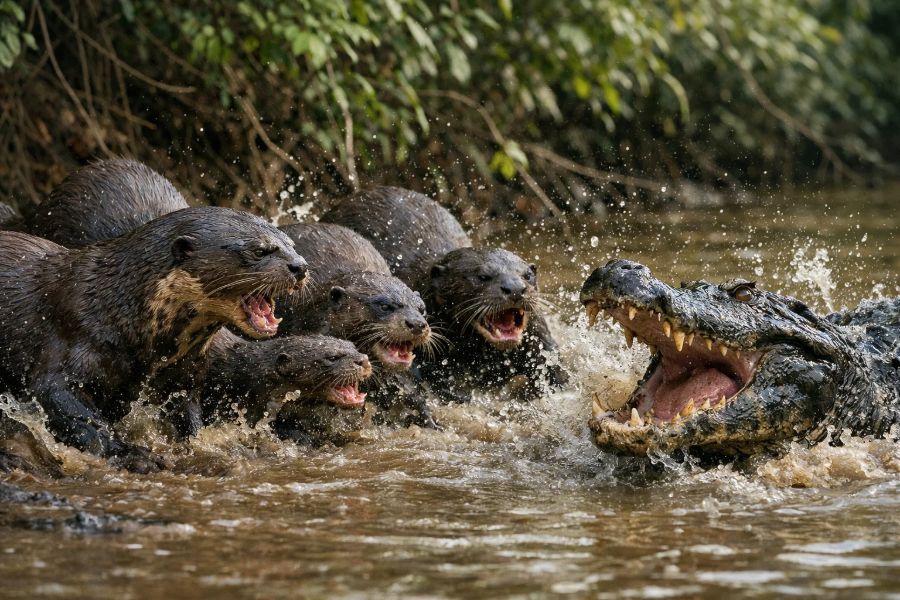
The most scientifically defensible conclusion is this: giant otters usually have the edge over small caimans, especially when otters are hunting or defending territory as a group, but large adult black caimans are among the few freshwater predators capable of seriously threatening giant otters. In other words, the answer depends heavily on caiman species, size, water conditions, and whether the otters are alone or acting as a coordinated family group.
Quick Comparison Table
| Feature | Giant Otter | Caiman | Why It Matters |
|---|---|---|---|
| Scientific identity | Pteronura brasiliensis | Several species; often yacaré, spectacled, or black caiman | “Caiman” is a category, not one fixed opponent |
| Typical adult size | Up to about 1.7 m long; commonly 23–32 kg in adults | Small and medium caimans are far lighter than a black caiman; adult male black caimans often exceed 4–5 m | Size range among caimans changes the matchup completely |
| Social system | Highly social family groups, often 3–8 or more | Mostly solitary or loosely aggregated crocodilians | Otters gain a major advantage from teamwork |
| Main weapons | Bite, agility, speed in water, group harassment, coordination | Powerful jaws, armor, ambush, sheer mass | Otters win with mobility and teamwork; caimans win with size and bite force |
| Main diet | Primarily fish; occasionally small caimans and snakes | Fish and many vertebrates; larger black caimans take much larger prey | Both compete in the same freshwater food web |
| Best combat setting | Shallow water, group defense, fast repeated attacks | Ambush, deeper water, large-body dominance | Habitat and depth matter a lot |
| Likely edge | Against juveniles and smaller caimans | Against very large adult black caimans | Scale is the key variable |
Size and ecology summarized from the Otter Specialist Group, Mammalian Species, Animal Diversity Web, and crocodilian sources.
Meet the Giant Otter
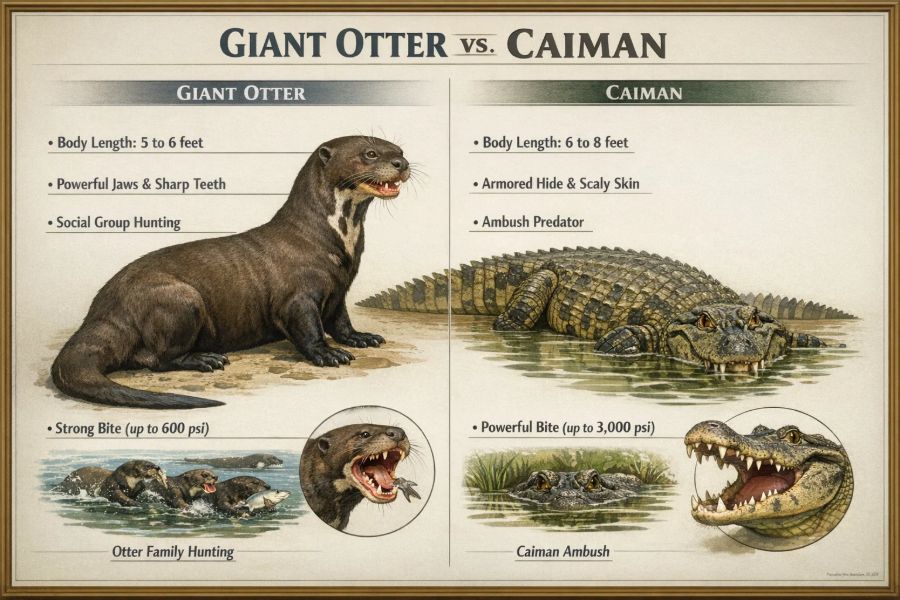
The giant otter is the largest extant otter species and can reach roughly 170 cm in length, with adults commonly reported around 23–32 kg. Unlike most mustelids, it is strongly social, living in cohesive family groups centered on a breeding pair and their offspring. These groups sleep, travel, hunt, and defend territory together.
Its diet is mainly fish, but giant otters are not strict fish-only specialists. Animal Diversity Web notes that when fish are scarce they may also take crustaceans, snakes, and small caimans, and other sources note occasional feeding on juvenile black caiman and other reptilian prey.
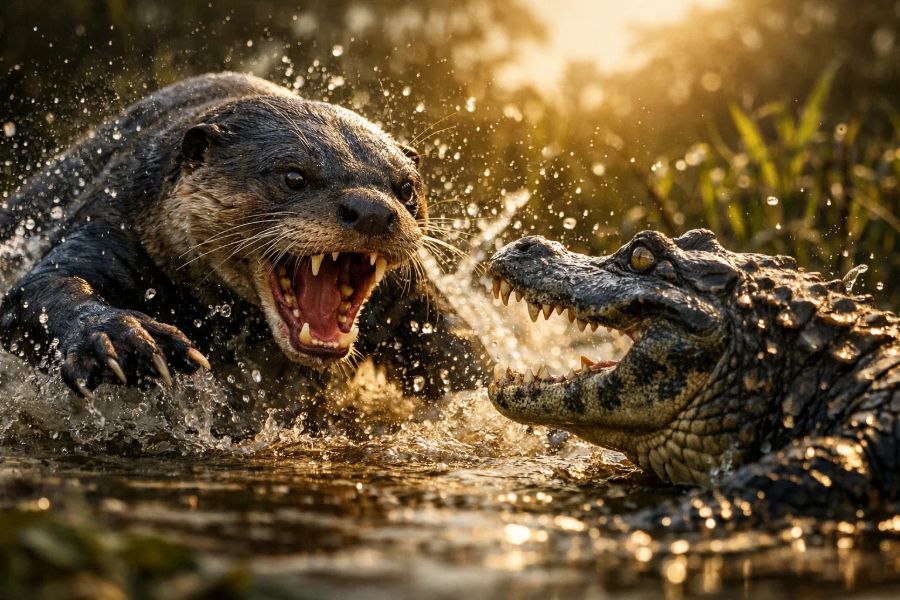
Meet the Caimans
“Caiman” covers several crocodilian species, and that matters more here than in many other animal comparisons. Small and medium caimans can be vulnerable to giant otters, especially as juveniles or subadults. But the black caiman is a very different animal: it is the largest member of Alligatoridae, with adult males commonly surpassing 4–5 meters, and it is one of the top aquatic predators of Amazonian freshwater systems.
That means a giant otter is not facing one standard “caiman power level.” Against a smaller caiman, the otter may be the more agile and proactive predator. Against a giant black caiman, the otter is dealing with a heavily armored ambush predator that can outweigh it many times over.
Size and Strength: Why the Matchup Changes So Much
If this were a straight comparison of individual body size, a giant otter looks formidable among mustelids, but it is still nowhere near the scale of a large adult black caiman. A giant otter at about 23–32 kg is impressive for a semiaquatic mammal; a mature black caiman can be several meters long and massively heavier.
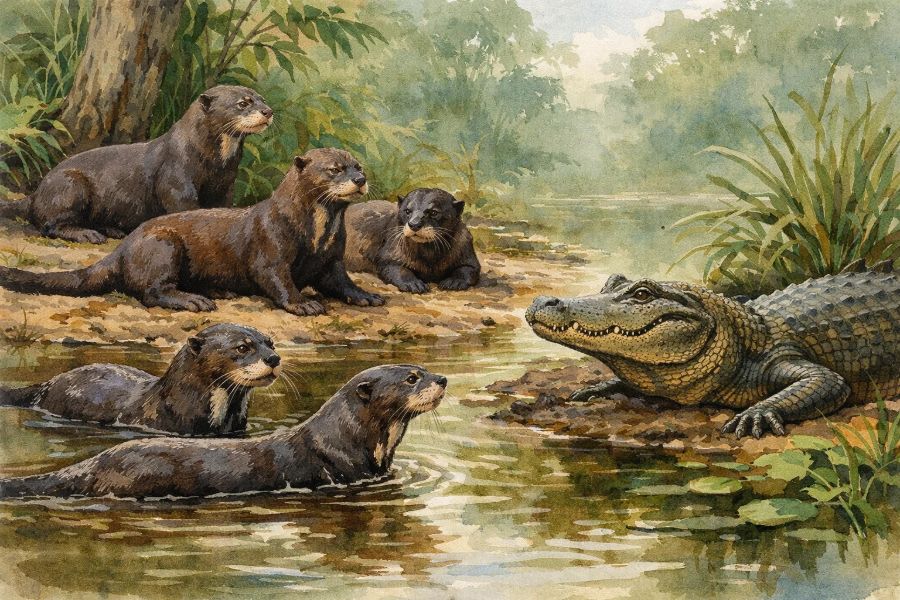
But body size is only part of the story. Giant otters are unusually dangerous because they are not built to fight as isolated individuals. Their sociality changes the balance. A caiman may dominate one otter physically, but a group of alert giant otters can harass, surround, bite repeatedly, and force a predator to defend itself from multiple directions at once. This is one reason the question is better framed as otter family vs caiman than as a simple one-on-one duel.
Weapons and Fighting Style
A giant otter’s advantages are speed, coordination, repeated biting, and confidence in shallow water. It is a visually oriented hunter that can pursue prey quickly and make sharp turns through water. When defending cubs or territory, the group can escalate rapidly into mobbing behavior.
A caiman’s advantages are armor, bite force, ambush, and mass. It does not need to match the otter’s agility. It only needs to seize effectively once, especially if the encounter happens in a position where the otter cannot attack from several angles or cannot retreat into group support. This is especially true for a large black caiman.
What Do Real Records Suggest?
Published evidence shows that giant otters do eat caimans, but usually not giant adults. A Pantanal report documented giant otters preying on subadult yacaré caimans, describing it as the first recorded caiman predation for that region and suggesting it may be linked to local food limitation. The same report did not describe coordinated hunting of giant adults; it described individuals capturing subadult caimans.
Other sources also note that giant otters may occasionally take young black caimans or other juvenile caimans. A PLOS ONE paper on giant otter social behavior states that giant otters in Manu National Park occasionally eat juvenile black caiman, and a broader species account repeats that giant otters may take caimans under some conditions, especially in marginal habitats or drought conditions.
At the same time, the literature also indicates that large black caimans are potential threats to giant otters. An IUCN Otter Specialist Group Bulletin article noted that, apart from an earlier report of black caimans attacking giant otters, direct published evidence of other predators attacking giant otters was scarce. That does not mean large caimans are harmless to otters; it means attacks are relatively difficult to document in the field.
Teamwork: The Giant Otter’s Biggest Advantage
The giant otter’s greatest edge is not its bite alone, but its social system. Group living is one of the most distinctive features of the species. Family members cooperate in rearing young, territorial defense, and vigilance. That makes a big difference when a dangerous reptile enters otter territory.
In practical terms, this means a caiman facing a giant otter group may not be “fighting one mammal.” It may be facing several highly vocal, highly mobile attackers. Even a large caiman can be pressured when a group attacks its flanks, tail, and head region in quick succession. This is an inference from giant otter social ecology, but it is also consistent with widely filmed and reported territorial defense events.
So Who Has the Edge?
If the scenario is a giant otter or otter group versus a juvenile or subadult caiman, the otters are often favored. Published reports of caiman predation by giant otters, along with dietary records of small caimans, support that conclusion.
If the scenario is a giant otter group confronting a medium-sized caiman, the answer becomes more conditional. Otters may be able to drive it off, especially in shallow water or during active defense of cubs or den sites, but the danger remains real.
If the scenario is a lone giant otter versus a very large adult black caiman, the caiman is the more convincing favorite. Its mass, armored body, and ambush power are simply too great. Even the broader giant otter literature treats black caimans as one of the major large predators and competitors in the same freshwater system.
So the most accurate zoological verdict is this: giant otters dominate smaller caimans and can collectively harass or repel larger ones, but giant adult black caimans remain among the few freshwater reptiles with a credible advantage over an individual otter.
Competition Matters as Much as Combat
This is not only a predator-versus-prey story. Giant otters and caimans also overlap as top freshwater carnivores competing for fish and space. San Diego Zoo researchers explicitly describe giant otters and black caimans as two of the top carnivores in Amazon freshwater systems. Some conservation and coexistence work with fishers likewise treats both as major fish competitors in certain regions.
That matters because many encounters may not end in death. They may end in avoidance, intimidation, territorial defense, or short bursts of aggression. In ecology, forcing a rival to leave can matter just as much as killing it.
Conservation Context
The giant otter is currently listed as Endangered by the IUCN Red List. It was heavily reduced by the fur trade and still faces habitat loss, disturbance, and conflict with fisheries.
The black caiman, by contrast, has recovered strongly in parts of its range and is now treated as Least Concern in current IUCN status-change materials, though older assessments listed it under a conservation-dependent category and ongoing habitat and hunting pressures still matter.
Final Verdict
A zoologist’s answer to Giant Otter vs Caiman is not “otter always wins” or “caiman always wins.” It is this:
Against small caimans, giant otters often win. Against medium caimans, group behavior can shift the balance. Against very large adult black caimans, the caiman remains the more dangerous individual opponent.
So the real key is not just species identity, but scale and social context. A giant otter is formidable. A giant otter family is more formidable still. But a huge black caiman is one of the few freshwater reptiles in South America that can still make even a giant otter group think carefully.
References
IUCN Red List. Pteronura brasiliensis. Current status: Endangered.
Otter Specialist Group. Giant Otter (Pteronura brasiliensis). Size, social groups, and general ecology.
Noonan, P. et al. 2017. Pteronura brasiliensis (Carnivora: Mustelidae). Mammalian Species. Size, weight, and ecology.
Animal Diversity Web. Pteronura brasiliensis. Diet including small caimans.
Thorbjarnarson, J. 2010. Black Caiman Melanosuchus niger. Crocodile Specialist Group action plan chapter. Large size and conservation background.
IUCN Red List status-change table, 2025–2. Melanosuchus niger updated to Least Concern.
Ribas et al. 2012. Giant otters feeding on caiman: evidence for an expanded trophic niche of recovering populations. First Pantanal record of giant otter predation on caimans.
Davenport et al. 2010. Aid to a Declining Matriarch in the Giant Otter (Pteronura brasiliensis). Notes occasional consumption of juvenile black caiman and cooperative family behavior.
Weber Rosas et al. 2008. Predation or scavenging of giant otter cubs by lizards. Includes discussion of black caimans attacking giant otters and the scarcity of direct predation records.
San Diego Zoo Wildlife Alliance. Powerful Predators of Amazonia. Giant otter and black caiman as top freshwater carnivores.