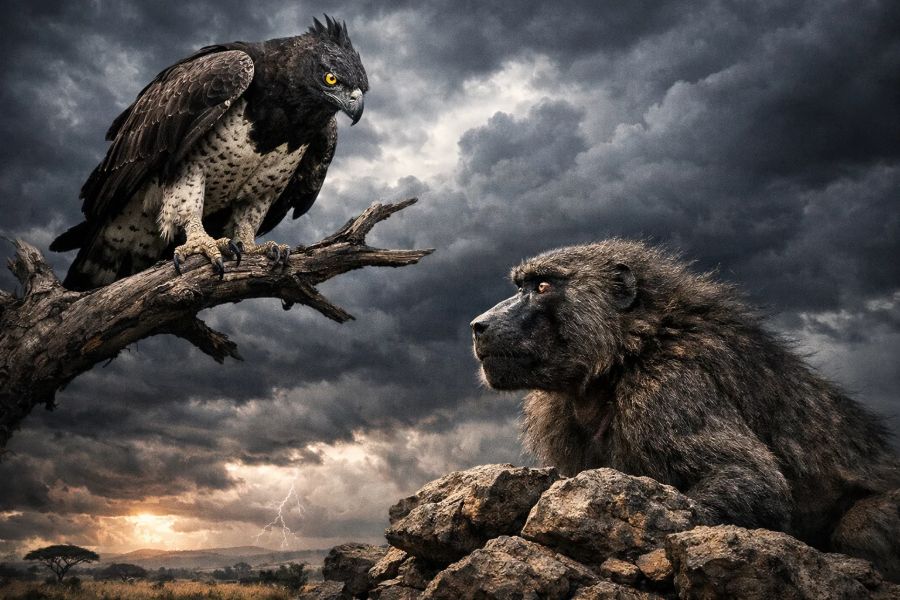
A zoologist would treat “Martial Eagle vs Baboon” as a highly asymmetrical matchup. The martial eagle (Polemaetus bellicosus) is one of Africa’s largest eagles, a powerful aerial predator that usually targets medium-sized mammals, birds, and reptiles. A baboon is a large, social Old World monkey in the genus Papio, often living in troops with vigilant adults, especially males, that can mob or drive off predators. The key scientific point is that this is not usually a fair fight between two similarly matched adults. In nature, the realistic question is whether a martial eagle can prey on a young or small baboon, and under what conditions adult baboons can repel it.
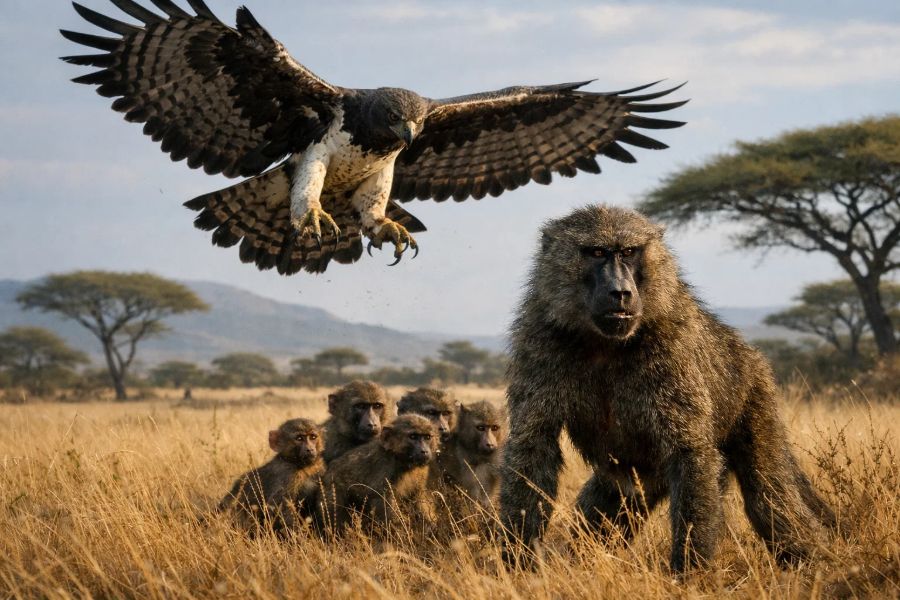
The short answer is this: a martial eagle can prey on baboons, but mostly at the vulnerable end of the age spectrum. Against an infant or small juvenile baboon, the eagle can be a real threat. Against a healthy adult baboon, especially in a troop, the balance shifts strongly toward the baboon side because of body mass, social defense, and the risk the eagle takes by attacking on the ground. That makes this matchup less about “who wins” in the abstract and more about age, size, surprise, and troop response.
Quick Comparison Table
| Feature | Martial Eagle | Baboon | Why It Matters |
|---|---|---|---|
| Scientific identity | Polemaetus bellicosus | Papio spp. | “Baboon” covers several large monkey species |
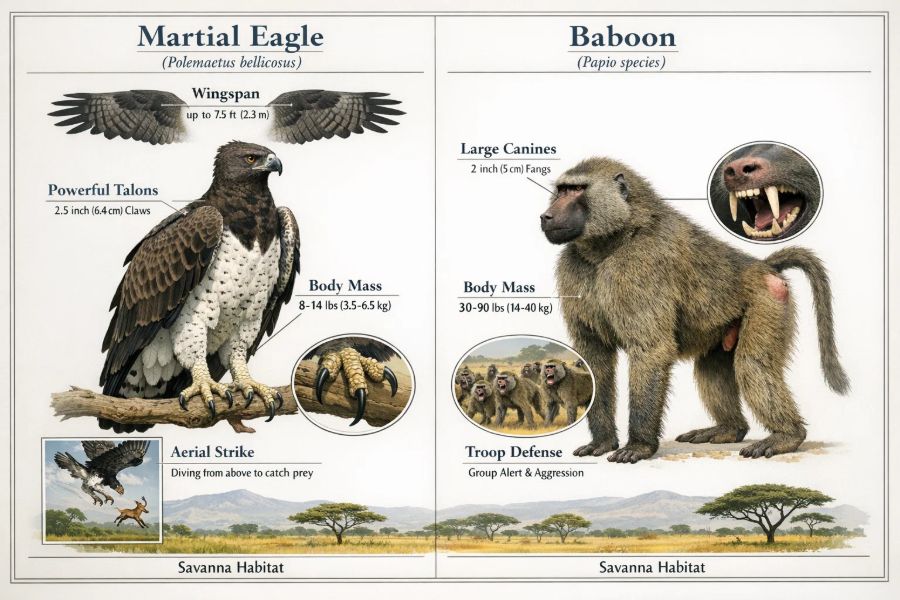
| Typical adult size | 3.1–6.2 kg; 78–96 cm long; wingspan 188–260 cm | Males of different baboon species average about 33–82 lb (15–37 kg) | Adult baboons are usually far heavier |
| Main weapons | Talons, hooked bill, surprise stoop, aerial reach | Canines, strong arms, troop defense, intimidation | Eagle wins by speed and grip; baboon wins by mass and social backup |
| Hunting style | High soar, dive attack, seize-and-kill | Ground foraging, vigilance, alarm calling, mobbing | Surprise is critical for the eagle |
| Best target class | Small to medium mammals, birds, reptiles; some primates | Infants and juveniles most vulnerable | Age class decides the realism of the matchup |
| Best combat setting | Open approach, isolated target, quick snatch | Grouped adults, cover, counterattack opportunity | Context matters more than raw ferocity |
| Likely overall edge | Against isolated young baboons | Against adult baboons, especially in troops | This is not one fixed outcome |
These values come from Animal Diversity Web, The Peregrine Fund, and National Geographic.
Meet the Martial Eagle
The martial eagle is among Africa’s largest and most powerful eagles. Authoritative summaries place it at 78–96 cm in length, 3.1–6.2 kg in mass, and a wingspan of roughly 1.9–2.6 m. It hunts mainly by soaring high and then attacking in a controlled dive, using long legs and large talons to strike prey. Its normal prey is usually in the 1–5 kg range, though it can kill animals much heavier than that under favorable conditions.
Animal Diversity Web also notes that martial eagles take a broad range of prey and, to a lesser extent, have hunted vervet monkeys and baboons, especially olive baboons (Papio anubis). The same source says they have been seen killing and eating prey up to 35 kg, which shows that the species is capable of tackling animals larger than itself, at least occasionally. That does not mean such prey is routine or low-risk. It means the martial eagle is unusually powerful for a bird of prey.
Meet the Baboon
Baboons are among the largest monkeys in the world. National Geographic notes that males of different baboon species average roughly 33–82 pounds and that baboons spend much of their time on the ground, often in open or semi-open habitats. That terrestrial lifestyle makes them more exposed to large aerial predators than strictly forest-canopy primates, but it also means they often live in large, watchful groups.
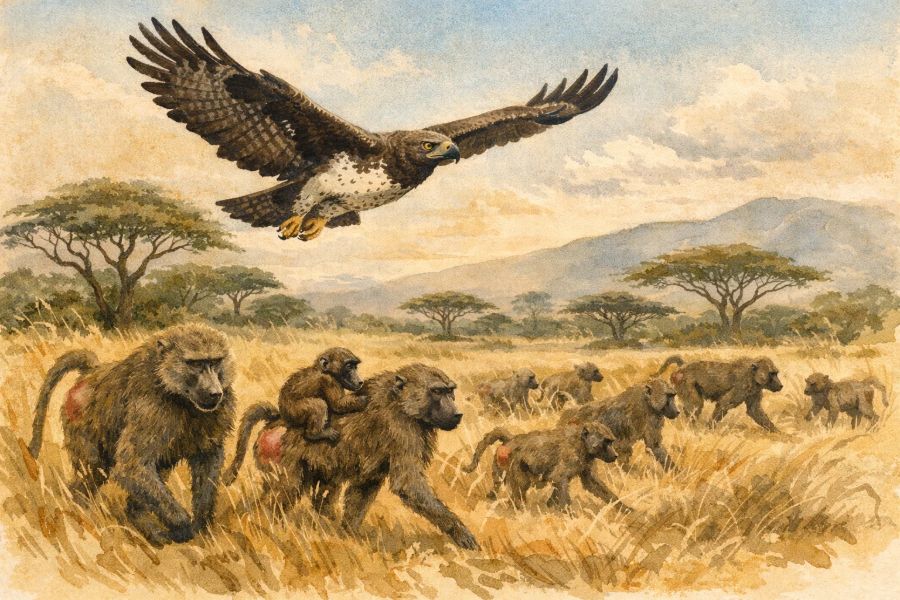
This sociality is a huge part of the story. Baboons do not usually face danger alone. A troop can contain many females, young, and multiple adult males, and when alarm spreads, the vulnerable individuals often move to cover while large males confront the threat. That matters because an eagle attacking one infant may suddenly face several aggressive primates only seconds later.
Size: The Baboon’s Advantage, the Eagle’s Problem
In direct body mass, an adult baboon is usually much larger than a martial eagle. Even large female eagles rarely exceed about 6 kg, while adult male baboons in several species are many times heavier. So if the matchup is imagined as adult martial eagle vs adult baboon, the baboon’s size advantage is enormous.
That is why the eagle’s strategy cannot be brute-force wrestling with a mature primate. It must rely on surprise, speed, and vulnerable targets. In other words, martial eagles are dangerous to baboons not because they dominate adult baboons physically, but because they can exploit moments when a small individual is exposed before adults can respond. This is an inference strongly supported by the size gap and by observed baboon anti-raptor behavior.
Weapons: Talons and Impact vs Teeth and Troop Defense
The martial eagle’s main weapon is its feet. Large raptors kill primarily with talons, not with the beak alone. A stooping eagle can hit prey with force, grip it, and begin disabling it quickly. Its bill then helps tear flesh once the prey is subdued. This system works best when the target is small enough to be controlled rapidly.
Baboons, by contrast, defend themselves with size, canine teeth, strong forelimbs, and social behavior. The real danger to an eagle is not that a baboon is a specialized predator of birds, but that a troop can turn one strike into a chaotic counterattack. Adult males in particular can threaten, chase, and possibly injure an eagle if it stays too long near the ground.
What the Evidence Suggests About Baboons as Eagle Prey
The most direct evidence from the sources here is that martial eagles do include baboons, especially olive baboons, among their lesser prey items. But the same source also makes clear that the martial eagle’s core prey tends to be medium-sized animals, usually much smaller than adult male baboons. That strongly suggests baboons are not routine adult prey and are more likely taken when small, young, or unusually vulnerable.
There is also useful comparative evidence from another African eagle. A peer-reviewed study of olive baboons reacting to crowned eagles found that all infants and juveniles rushed for cover and that adult males climbed toward the eagle, threatened it, and chased it away. The authors concluded that large eagles pose a threat at least to juvenile baboons. This study is about crowned eagles, not martial eagles, so it is not direct proof of martial-eagle kills. But it is highly relevant because it shows how baboon troops respond to large aerial raptors and how vulnerability is concentrated in the young.
So Can a Martial Eagle Kill a Baboon?
Yes, but the scientifically careful answer is “sometimes, and mainly when the baboon is young or isolated.” Animal Diversity Web specifically lists baboons among martial eagle prey, which confirms that the interaction is biologically real. However, when that source is read together with baboon body-size data, the likely pattern is clear: infants, juveniles, and perhaps small subadults are realistic targets; full-sized adults are not typical prey.
This fits basic raptor ecology. Large eagles often push above their own body mass when prey is vulnerable, but there is a steep risk curve. An eagle that attacks an adult baboon on the ground is not just attacking a heavy animal; it may be attacking a heavy animal whose troop is seconds away. That makes adult baboons a much less attractive target than smaller primates, hares, hyraxes, or juvenile mammals.
The Role of Troop Defense
Troop behavior is probably the baboon’s single biggest advantage. In the crowned-eagle study, adult male baboons led the response, including threatening displays and active chasing. That is exactly the kind of behavior that can make a large eagle abandon an attack. The eagle’s opportunity window is very short: grab fast, kill fast, or leave.
So the more exposed a young baboon is, the better the eagle’s odds. The closer that young baboon is to vigilant adults, the worse the eagle’s odds. This is why “martial eagle vs baboon” is really a question of predation opportunity rather than a duel between equal fighters.
What Would Happen in a Direct Adult-vs-Adult Clash?
If the thought experiment is one martial eagle versus one healthy adult baboon, the adult baboon is the more convincing favorite. It is much heavier, heavily muscled, armed with large canines, and far too big for the eagle to carry. Even if the eagle struck successfully, it would need to keep contact with a dangerous primate at close range. That is not the kind of prey situation large eagles prefer.
If the thought experiment is martial eagle versus baboon infant, the equation flips. A young baboon falls much more squarely into the eagle’s realistic prey window, especially if caught separated, distracted, or without immediate adult intervention.
Conservation Context
The martial eagle is currently listed as Endangered by BirdLife and The Peregrine Fund. Its decline is linked to persecution, habitat change, and other human pressures. Baboons, by contrast, are generally widespread and often locally common, although population trends vary by species and landscape. So from a conservation perspective, the more urgent story is not whether baboons can defeat eagles, but whether Africa can retain enough intact habitat for large raptors to persist at all.
Final Verdict
A zoologist’s verdict would be:
Martial eagles can prey on baboons, but mostly at the vulnerable end of the age range.
Adult baboons, especially within a troop, are usually too large and too socially defended to be normal targets.
So the most accurate conclusion is not “eagle beats baboon” or “baboon beats eagle.” It is this: the martial eagle is a serious predator of small baboons, while adult baboons—especially males in a troop—are a dangerous problem the eagle usually cannot treat as ordinary prey.
References
Animal Diversity Web. Polemaetus bellicosus account. Size, hunting style, prey range, and mention of baboons in the diet.
The Peregrine Fund. Martial eagle species profile. Body length, wingspan, weight, and current status.
National Geographic. Baboons fact page. General baboon body size and ecology.
Paciência et al. 2020. Olive baboons’ response towards crowned eagles at Lake Manyara National Park. Evidence that large eagles threaten juvenile baboons and that adult males drive them off.
BirdLife International Data Zone. Martial eagle factsheet. Current global conservation status.