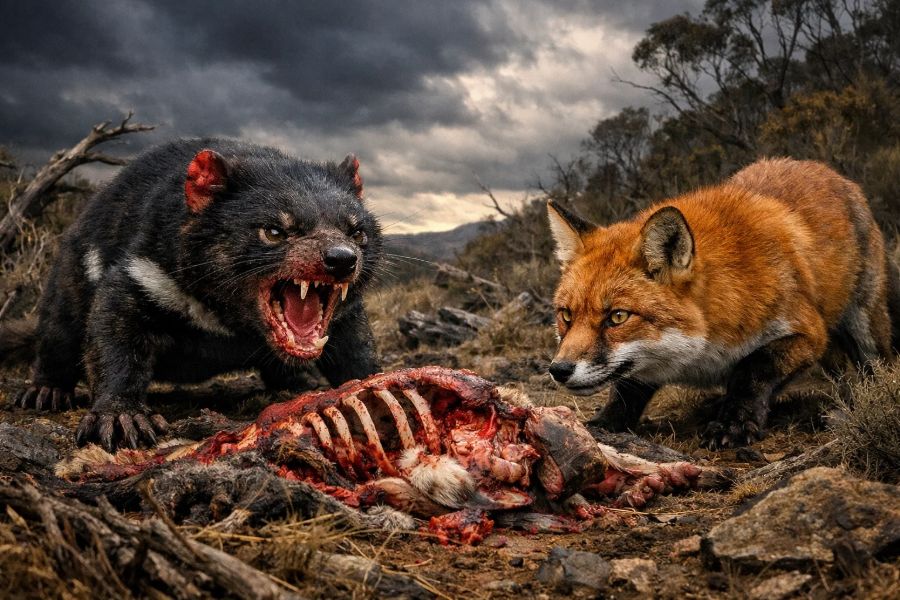
At first glance, Tasmanian Devil vs Fox sounds like a simple contest between a notoriously fierce scavenger and a clever small predator. Zoologically, though, it is a comparison between two very different carnivore designs: the Tasmanian devil (Sarcophilus harrisii), a stocky marsupial scavenger-predator with one of the most powerful bites relative to body size among living mammalian carnivores, and the red fox (Vulpes vulpes), a lighter, longer-legged placental canid built for mobility, opportunism, and flexible hunting.

The short scientific answer is that in a direct, close-range fight, the Tasmanian devil would usually have the edge, mainly because it is generally heavier, much more robustly built, and equipped for brutal biting and carcass disputes. The red fox, however, has advantages in caution, speed, agility, and tactical avoidance. In nature, that means a fox’s best strategy is not to wrestle with a devil, but to avoid the sort of close confrontation where the devil is strongest.
Quick Comparison Table
| Feature | Tasmanian Devil | Red Fox | Why It Matters |
|---|---|---|---|
| Scientific name | Sarcophilus harrisii | Vulpes vulpes | Clarifies the species being compared |
| Animal type | Marsupial carnivore | Placental canid | Different evolutionary toolkits |
| Typical adult size | Commonly larger and more compact; often around 6–8 kg, with larger males heavier | Most adults about 5–7 kg, though large individuals may approach 14 kg | Devil often has the sturdier body; fox may match it only at the upper end |
| Main weapons | Crushing bite, strong jaws, stocky build, intimidation | Speed, agility, sharp bite, evasiveness | Devil wins by contact; fox wins by not being caught |
| Typical feeding style | Heavy scavenging plus opportunistic hunting | Opportunistic hunting and scavenging | Both are flexible carnivores |
| Best combat range | Very close | Mid-range avoidance, quick dart-in/dart-out | Range strongly affects the outcome |
| Likely winner in a direct fight | Usually favored | Dangerous but less favored | Build and bite matter most at close quarters |
This summary is based on Britannica, Animal Diversity Web, San Diego Zoo, and Tasmanian sources.
Meet the Contenders
The Tasmanian devil is the world’s largest surviving carnivorous marsupial. It is endemic to Tasmania and is famous for its loud feeding disputes, huge head, powerful neck, and ability to consume bones, fur, and tissue from carcasses. Authoritative sources describe devils as mainly scavengers, though they also take live prey opportunistically.
The red fox is the largest species of true fox and one of the most adaptable carnivores on Earth. Britannica and Animal Diversity Web describe it as a lightly built but highly versatile predator-scavenger that can live in habitats ranging from tundra to farmland and urban edges. Foxes are typically solitary hunters, relying on alertness, stealth, and speed rather than raw power.
Size and Build: The Devil’s Biggest Advantage
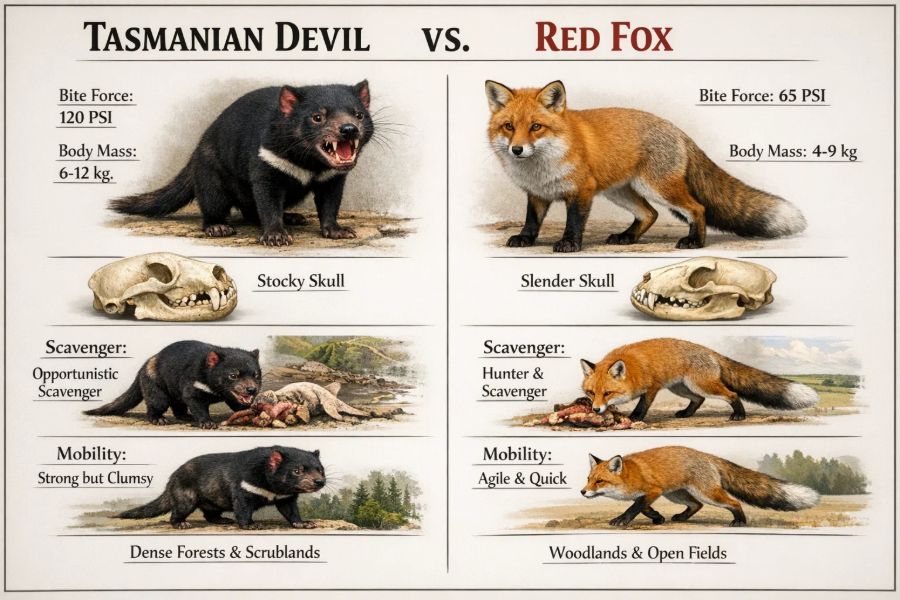
A red fox usually weighs about 5–7 kg, though some large individuals can reach around 14 kg. By contrast, Tasmanian devils are typically in a similar or somewhat higher size bracket, but with a much more compact, heavily muscled frame and a disproportionately large head. In practical terms, the fox is built like a runner and pouncer; the devil is built like a short, dense grappler.
That distinction matters more than raw weight alone. Even when body masses overlap, the devil’s body plan is much better suited to close-range impact, biting, and resisting struggle. The fox has longer legs and better mobility, but if forced into a tight contest over a carcass or in a confined space, the devil’s sturdier build becomes a major advantage. This is an inference from comparative anatomy and feeding ecology.
Bite and Weaponry
The Tasmanian devil’s most famous weapon is its jaw. It is widely described as having the most powerful bite relative to body size of any living mammalian carnivore, and its jaws are adapted to tearing flesh and crushing bone. That makes sense for an animal that often feeds in aggressive groups around carcasses and may need to process tough remains quickly.
The red fox, by contrast, has the standard canid toolkit: a fast bite, quick reactions, and enough agility to seize smaller prey or dodge danger. Foxes are effective hunters of rodents, rabbits, birds, and other small animals, but they are not specialized bone-crushers, nor are they built for prolonged physical contests with stockier carnivores.
Feeding Ecology: Scavenger Tank vs Flexible Opportunist
Tasmanian devils are strongly associated with scavenging. Animal Diversity Web and National Geographic both note that devils commonly eat carrion and can consume nearly all parts of a carcass, including bones and fur. They also take live prey, but their reputation is tied above all to carcass use and aggressive feeding behavior.
Red foxes are also opportunists, but in a different way. They hunt live prey more routinely and have a famously broad diet that can include rodents, rabbits, birds, frogs, fruit, insects, and human-associated food. So while both animals scavenge, the devil is the more specialized carcass monopolizer, whereas the fox is the more flexible small-prey hunter.
What Would Happen in a Direct Fight?
If the scenario is a one-on-one close confrontation, especially around food, the Tasmanian devil is usually the better pick. Its bite, skull, neck strength, and tolerance for rough feeding disputes make it the more dangerous animal once body contact happens. A fox could inflict injury, but it would be fighting on the devil’s preferred terms.
If the fox has room to move, the picture changes. A fox is faster, more agile, and much more likely to rely on avoidance than commitment. So the fox’s real strength is not defeating a devil physically, but escaping a contest that does not favor it. Zoologically, that is often how “weaker” animals succeed: by refusing the wrong kind of fight.
The Tasmania Question
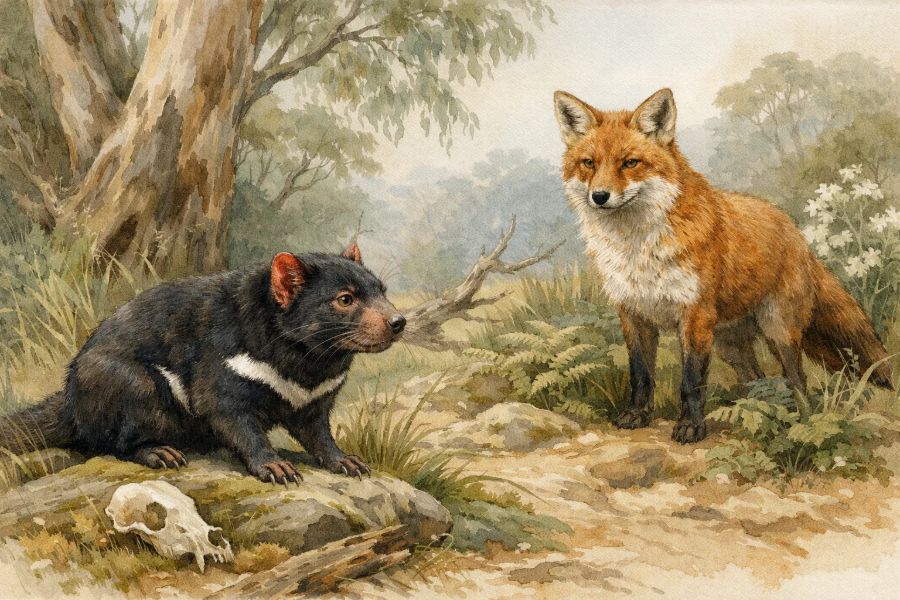
There is one important ecological complication: direct wild Tasmanian devil–red fox interactions are not especially well documented, partly because the fox situation in Tasmania has long been debated and heavily managed. Official Tasmanian government sources classify the European red fox as a declared pest, while other sources note years of controversy over how widespread foxes actually were on the island. That means this matchup is biologically plausible, but not nearly as well documented in the wild as many better-known predator rivalries.
Because of that, the most defensible answer comes from anatomy and ecology rather than from a large body of direct encounter records. Based on those lines of evidence, the devil should dominate close-range physical conflict, while the fox should rely on wariness, mobility, and avoidance.
Conservation Context
The Tasmanian devil is currently listed as Endangered and has suffered major declines because of Devil Facial Tumour Disease. Red foxes, by contrast, are globally widespread and successful, though in Tasmania they are treated as an invasive pest rather than a conservation target. So from a real-world biological perspective, the more important story is not a duel with foxes, but the devil’s recovery from disease and protection of its remaining populations.
Final Verdict
A zoologist’s verdict would be this: the Tasmanian devil is the more formidable close-combat animal, while the red fox is the more agile and evasive one. In a direct, committed fight, the devil usually has the advantage because it is built for violent biting and physical domination at very short range. The fox’s best edge lies in not letting the encounter become that kind of fight in the first place.
References
Encyclopaedia Britannica. Red fox species profile, including body size and general ecology.
Animal Diversity Web. Vulpes vulpes account, including size range and diet breadth.
Animal Diversity Web. Sarcophilus harrisii account, including scavenging ecology and diet.
National Geographic. Tasmanian devil facts page, including scavenging-focused behavior.
IUCN Red List search result for Tasmanian devil, indicating current conservation listing.
Tasmanian Government / Natural Resources and Environment Tasmania. European red foxes status page, describing foxes as a declared pest in Tasmania.
PestSmart. Fox eradication in Tasmania, summarizing the long-running debate and evidence history around fox presence.
PLOS ONE. The Red Fox Incursion into Tasmania, discussing inferred fox distribution and the uncertainty around establishment evidence.