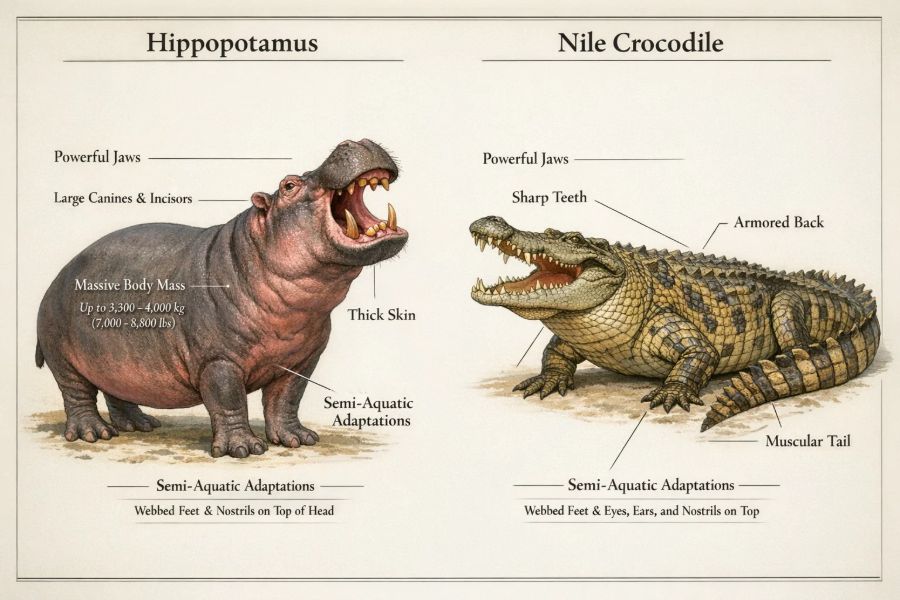
Few wildlife matchups are more dramatic than Hippo vs Crocodile. Both animals dominate African rivers, both are dangerous, and both spend much of their lives in or near water. But from a zoological perspective, this is not a simple “monster versus monster” fight. It is a comparison between two very different survival strategies: the common hippopotamus (Hippopotamus amphibius), a huge semi-aquatic megaherbivore armed with massive jaws and tusk-like teeth, and the Nile crocodile (Crocodylus niloticus), Africa’s largest crocodile and one of the continent’s top aquatic predators.
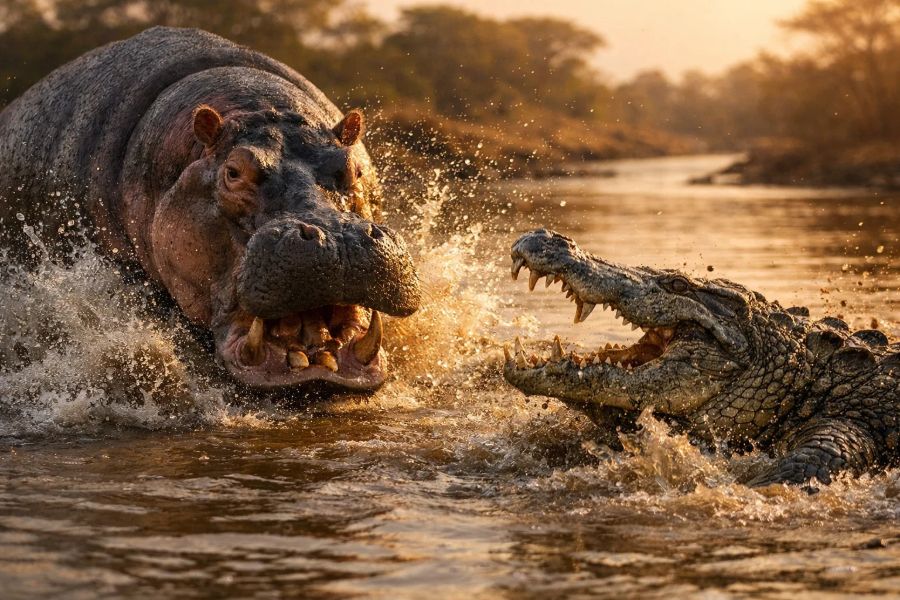
In most real-world encounters, a healthy adult hippo has the advantage in a direct confrontation because it is usually much heavier, carries enormous canines and incisors, and is itself one of the most aggressive large mammals in Africa. The Nile crocodile, however, remains extremely dangerous in water, especially to young hippos, weakened individuals, or animals caught off guard. So the scientifically honest answer is not that one always beats the other, but that adult hippos usually dominate adults, while crocodiles are far more threatening to calves and juveniles than to prime adults. This conclusion is an inference based on body size, weapon anatomy, and documented predator risk.
Quick Comparison Table
The figures below are compiled from San Diego Zoo, WWF, Britannica, and the crocodilian bite-force study by Erickson and colleagues.
| Feature | Common Hippo | Nile Crocodile | Why It Matters |
|---|---|---|---|
| Scientific name | Hippopotamus amphibius | Crocodylus niloticus | Clarifies the exact species being compared |
| Typical adult size | Males average about 3,500–9,920 lb (1,600–4,500 kg) | Average about 4–4.5 m and about 410 kg; exceptional individuals can exceed 6 m and 680 kg | Hippo usually has the mass advantage |
| Height / profile | Up to about 1.6 m at the shoulder, huge barrel-shaped body | Low, elongated, heavily armored reptile body | Crocodile is better built for ambush; hippo for blunt-force dominance |
| Main weapons | Massive jaws, long canines and incisors; canines up to 20 in (51 cm) | Powerful jaws, conical teeth, ambush bite | Hippo’s bite is a crushing-slashing weapon; crocodile’s is a gripping weapon |
| Lifestyle | Semi-aquatic herbivore; rests in water by day, grazes on land at night | Aquatic apex predator | They share habitat but fill very different ecological roles |
| Mobility in water | Moves by pushing off the bottom; very dense body | Expert swimmer, ambush hunter | Crocodile is more agile in open water; hippo is still highly effective in shallow river zones |
| Bite-force context | Extremely dangerous jaw weapon, especially in close combat | Crocodilians as a group generate the highest bite forces known among living animals | Both have terrifying mouths, but their bite styles differ |
| Main risk across age classes | Adults have few natural predators | Can take large prey, but risk rises sharply against giant adults | Juveniles are the more realistic crocodile targets |
| Conservation status | Vulnerable | Least Concern globally, though pressures vary locally | Both face human-driven pressures |
Meet the Contestants
The animal usually called a “hippo” in this matchup is the common hippopotamus, not the much smaller pygmy hippo. WWF notes that hippos can weigh up to 8,000 pounds, while San Diego Zoo gives male common hippos an even broader upper range of up to 9,920 pounds (4,500 kg). Britannica describes the hippo as a massively built animal with thick skin, a huge head, and a body plan made for dominating shallow freshwater habitats.
The crocodile in question is the Nile crocodile, the largest crocodile in Africa. Britannica describes it as a species of freshwater lakes, rivers, swamps, and brackish waters across much of sub-Saharan Africa and Madagascar. Average adults are commonly around 4 to 4.5 meters and about 410 kilograms, though exceptional individuals can be much larger. Britannica also describes the Nile crocodile as an apex predator capable of taking prey well above fish size.

Size and Strength: The Hippo’s Biggest Edge
In a head-to-head collision, the hippo’s greatest advantage is simple: mass. A large male hippo can outweigh an average Nile crocodile several times over. That matters because body mass affects momentum, resistance to injury, and the ability to control space in close quarters. A crocodile is long, muscular, and heavily armored, but its frame is still far lighter than that of a full-grown male hippo.
Hippos are also not passive grazers. San Diego Zoo describes them as among the most dangerous and aggressive of mammals, and notes that their canines and incisors grow continuously, with canines reaching 20 inches (51 cm). When agitated, they threaten with gaping displays, lunges, roaring, and charges. In a direct clash, this means a hippo is not just a large target—it is a large, aggressive animal equipped to smash and slash at very close range.
The Crocodile’s Strength: Ambush, Grip, and Aquatic Predation
What the crocodile lacks in bulk, it makes up for in predatory design. Nile crocodiles are specialized for stealth, sudden acceleration, and seizing prey with powerful jaws. Britannica identifies them as apex predators, and the PLOS ONE study by Erickson et al. showed that crocodilians as a group generate the highest bite forces and tooth pressures known for any living animals. That does not automatically mean a crocodile beats a hippo, but it does explain why crocodiles are such formidable river predators.
A crocodile’s bite is built mainly to grab, puncture, and hold, especially in water where leverage and drowning can finish the job. That is very different from a hippo’s fighting style. The crocodile wants a tactical attack window; the hippo can turn a confrontation into a violent close-range brawl. In practical terms, the crocodile is usually deadliest when it controls surprise and positioning, while the hippo is usually strongest when the fight becomes open and frontal. This is an inference from their anatomy and ecological roles.
Water Does Not Automatically Belong to the Crocodile
Many people assume that the crocodile must win in water. That is too simplistic. Hippos are highly adapted to aquatic life: San Diego Zoo notes that their eyes, ears, and nostrils sit high on the head, they can hold their breath for five minutes or longer, and they spend most of the day in water. Interestingly, hippos do not really swim or float in the usual sense; they move by pushing off the riverbed. In shallow rivers, channels, and pools, that still makes them extremely effective and surprisingly mobile.
So while the crocodile is the more elegant aquatic predator, the hippo is not fighting on foreign ground. Much of the habitat where these two species meet is exactly the sort of shallow, crowded, muddy freshwater environment in which hippos already live, rest, breed, and defend young. In those conditions, the crocodile’s agility matters, but so do the hippo’s size, territoriality, and familiarity with the same waterbody.
Adult Hippos vs Adult Crocodiles
For healthy adults, the matchup generally favors the hippo. San Diego Zoo states that a full-grown adult hippo “doesn’t have much in the way of natural predators,” whereas crocodiles are listed among the dangers faced while hippos are still growing up. WWF likewise notes that crocodiles are among the enemies hippos watch for while submerged. Together, these sources strongly suggest that crocodiles are a meaningful threat mostly to young or vulnerable hippos, not to prime adults in normal condition.
That does not mean crocodiles are harmless to adults. A very large Nile crocodile is a dangerous animal under any circumstances, and a hippo that is injured, sick, trapped, or a subadult could be at greater risk. But if the question is, “Which animal would usually win in a straightforward adult-versus-adult fight?” the balance of anatomy and natural-history evidence points to the adult hippo. That is an inference, but a well-supported one.
Calves and Juveniles: Where the Crocodile Becomes Far More Dangerous
The answer changes sharply when the hippo is young. San Diego Zoo explicitly lists crocodiles, lions, hyenas, and leopards as potential threats to growing hippos, and WWF notes that crocodiles are among the enemies hippos keep watch for in the water. In other words, crocodiles are not just neighbors; they are part of the real predation landscape for immature hippos.
This age-based difference is crucial. A crocodile that would hesitate to challenge a massive adult may readily exploit a calf or juvenile, especially if the youngster is separated, distracted, or entering deeper water. In many predator-prey systems, that is exactly how risk works: vulnerability is concentrated in the young, not evenly spread across all ages. The hippo-crocodile relationship fits that pattern well.
Do Hippos and Crocodiles Always Fight?
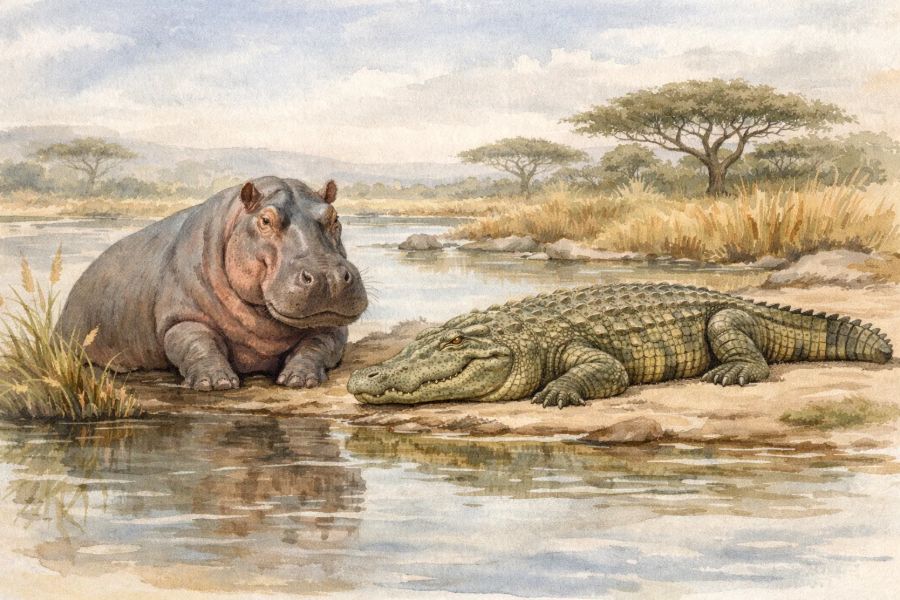
No. One of the most interesting zoological points is that coexistence is common. San Diego Zoo notes that in African rivers, even baby crocodiles have been seen sunning themselves on hippos. That detail captures an important truth: these animals often tolerate one another at close range, especially when neither is presenting a direct threat or opportunity.
That coexistence makes sense ecologically. Hippos are herbivores grazing mostly on grasses, while Nile crocodiles are carnivorous predators. They overlap in space, but not in basic diet. Conflict is therefore not constant. It tends to spike around vulnerable young, territorial stress, crowding, or sudden movement at close range. So the popular image of nonstop warfare is exaggerated; the real relationship is a mix of coexistence, caution, and occasional violence.
Conservation Context
The common hippopotamus is listed by WWF as Vulnerable, with an estimated population of roughly 115,000–130,000, and WWF identifies habitat loss as a major threat. For the Nile crocodile, search results tied to IUCN and San Diego Zoo library fact sheets identify the species as Least Concern globally, though local pressures and human conflict remain important in parts of its range.
Final Verdict
From a zoologist’s perspective, the most accurate conclusion is this: an adult hippo usually has the upper hand over an adult Nile crocodile, especially in a direct, visible confrontation. The hippo is bigger, massively armed, highly aggressive, and not an easy animal for even a giant crocodile to subdue.
The crocodile, however, is still the superior ambush predator and a very real threat to young hippos or compromised individuals. So the real answer is not “crocodile beats hippo” or “hippo beats crocodile” in every situation. It is this: adult hippos are usually the dominant force, while crocodiles are dangerous specialists that become far more successful when size, surprise, or age vulnerability shifts the odds in their favor.
References
Erickson, G. M., Lappin, A. K., Vliet, K. A., et al. 2012. Insights into the Ecology and Evolutionary Success of Crocodilians Revealed through Bite-Force and Tooth-Pressure Experimentation. PLOS ONE.
San Diego Zoo Wildlife Alliance. Hippo species page.
Encyclopaedia Britannica. Hippopotamus.
Encyclopaedia Britannica. Nile crocodile.
World Wildlife Fund. Hippopotamus species page.
IUCN / related indexed listings and San Diego Zoo Global fact-sheet search results for Crocodylus niloticus conservation status.