When people imagine a silverback gorilla vs leopard showdown, they usually picture brute strength against feline stealth. From a zoologist’s perspective, however, this is not a simple “fight card” matchup. A silverback is not a separate species, but a mature adult male gorilla, typically the dominant male of a troop. In real ecological terms, the most relevant comparison is usually a western lowland silverback gorilla versus an African leopard, because that is where overlap and documented leopard–gorilla interactions are best supported in the literature.
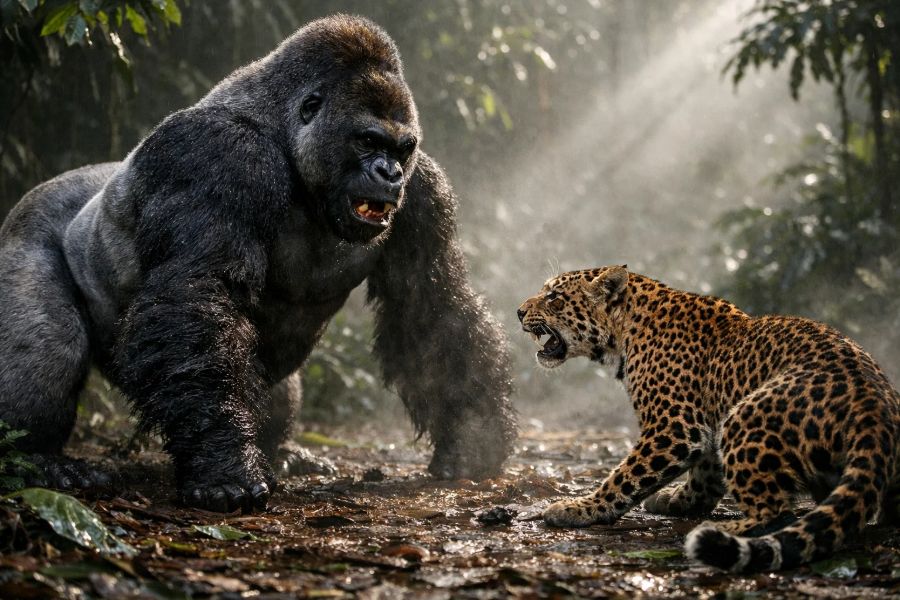
The short scientific answer is this: in a direct, face-to-face clash, a healthy adult silverback usually has the advantage because of its much greater strength, mass, reach, and social backing. The leopard’s advantage lies in stealth, surprise, sharp killing tools, and nocturnal predation, not in a fair frontal contest. Field evidence shows that leopards can prey on gorillas, but these interactions appear uncommon and are more plausibly directed at vulnerable individuals than at a fully alert, prime silverback in open confrontation.
Quick Comparison Table
| Feature | Silverback Gorilla | Leopard | Why It Matters |
|---|---|---|---|
| Identity in this matchup | Mature adult male gorilla, usually troop leader | Solitary big cat, Panthera pardus | “Silverback” is a role/stage, not a separate species |
| Most relevant overlap | Western lowland gorilla in Central African forests | African leopard in overlapping forest habitats | This is the biologically realistic comparison |
| Typical adult mass | Average about 136 kg, up to about 227 kg in western lowland males | Average about 50–90 kg | Gorilla usually has a major weight advantage |
| Size | Up to about 1.8 m tall standing; arm span about 2.4 m | Shoulder height about 60–70 cm; body length about 210 cm excluding tail | Gorilla dominates in reach and grappling space |
| Main weapons | Powerful arms, bite, large canines, blunt-force grappling | Claws, canine teeth, ambush bite, agility | Leopard is a killing specialist; gorilla is a power specialist |
| Sociality | Usually lives in troops led by a silverback | Usually solitary | Leopards hunt alone; silverbacks often defend a group |
| Typical combat style | Display, rush, bite, slam, grab | Ambush, latch on, throat/nape attack, retreat | Leopard wants surprise; gorilla wants to overpower |
| Likely winner in a frontal duel | Usually favored | Dangerous, but less favored | Depends heavily on whether surprise is lost |
Data compiled from Smithsonian’s National Zoo, Britannica, and the leopard–gorilla literature.
What Exactly Is a Silverback?
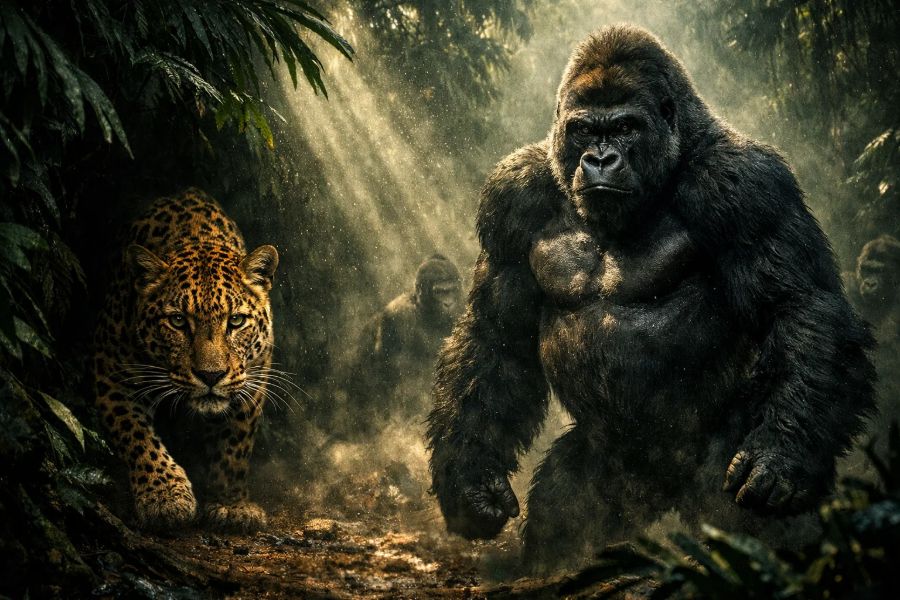
A silverback is an adult male gorilla with the characteristic silver hair across the back, and in gorilla social groups he is often the dominant male associated with several females and their offspring. Smithsonian notes that gorilla troops are typically organized around such a dominant male, and that mature males develop the classic silver “saddle” across the back. That matters here because the “silverback” being discussed is not just any gorilla, but the largest, strongest, and most socially important male in a group.
Size and Strength: The Gorilla’s Biggest Advantage
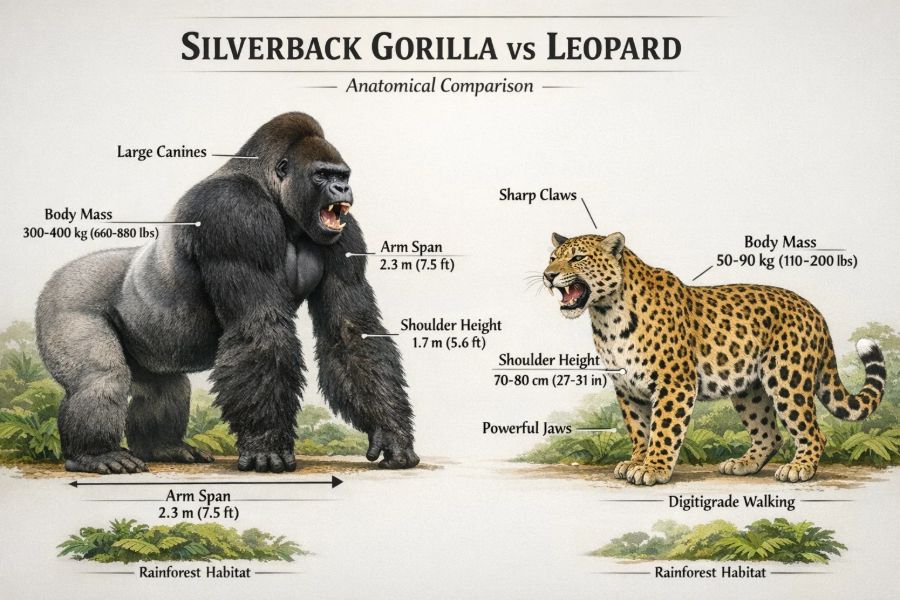
The western lowland gorilla is the smallest gorilla subspecies, yet even here adult males average about 300 pounds (136.1 kg) and may reach 500 pounds (226.8 kg), with standing height up to 6 feet (1.8 m) and an arm span of about 8 feet (2.4 m). Leopards, by contrast, average about 50 to 90 kg, with shoulder height around 60 to 70 cm. Even before discussing fighting style, that size gap is substantial.
That mass difference changes the entire geometry of a confrontation. A silverback is built like a mobile block of muscle, with long forelimbs, enormous shoulder girdle power, and a skull designed to anchor huge jaw muscles. A leopard is extremely powerful for its size, but it is still operating from a much lighter frame. In a straight collision where both animals know the other is there, the gorilla’s bulk and leverage are major advantages. That conclusion is an inference from comparative anatomy and size data, not a claim that every encounter ends the same way.
Weapons: Gorilla Power vs Leopard Precision
A leopard is a specialized predator. Britannica describes it as mainly nocturnal, solitary, highly agile, and capable of overpowering prey with stealth and sudden force. Its weapon system is classic big-cat design: sharp claws for grip, long canines for puncture and throat or nape bites, and explosive acceleration in a short ambush. Leopards also commonly store kills in trees, which reflects just how powerful they are relative to their size.
A silverback gorilla is not a predator, but that does not make it unarmed. Smithsonian notes the pronounced skull crests of adult males that anchor massive jaw muscles, and the gorilla’s overall build reflects tremendous upper-body strength. A silverback’s combat tools are different from a leopard’s: grabbing, slamming, biting, charging, and using sheer body control at close range. In other words, the leopard is optimized to kill prey efficiently; the silverback is optimized to dominate, intimidate, and physically overwhelm rivals or threats at close quarters.
Behavior Matters More Than Raw Strength
This is where popular “who would win?” discussions often go wrong. Leopards do not usually seek fair fights with dangerous adults if surprise can be avoided. Britannica notes that leopards generally prey on animals they can overpower and are mainly nocturnal hunters. A silverback, meanwhile, is not a solitary herbivore wandering defenselessly through the forest. He is often part of a troop and may act as a protector within that social system.
That makes the leopard’s best strategy very different from a cinematic duel. Its real advantages are concealment, timing, darkness, and target choice. The silverback’s best advantages are awareness, close-range power, and the ability to confront the cat before it secures a killing bite. So the true zoological question is not merely “Which animal is stronger?” but “Under what conditions does the encounter happen?”
What Does the Evidence from the Wild Actually Say?
There is documented scientific evidence that leopards can attack and consume gorillas. The 1995 paper by Fay and colleagues reported a leopard attack and consumption of gorillas in the Central African Republic, showing that leopard predation on gorillas is not a myth. Later review work on predator interactions with African great apes likewise identifies leopard predation as a threat to western gorillas.
At the same time, the published evidence does not support the idea that leopards routinely defeat healthy silverbacks in open combat. A 2024 study on lethal combats in wild western gorillas noted that leopard-inflicted wounds and deaths have often been proposed in western gorillas, and also pointed out that young and isolated individuals may be at higher risk for leopard attacks. That wording matters: it suggests risk is not evenly distributed across all gorillas, and that vulnerability rises when the target is smaller, separated, or otherwise exposed.
This fits broader leopard ecology. Leopards are generalist carnivores, but the classic prey base described in the leopard literature is usually smaller and medium-sized mammals rather than massively built adult apes. That does not mean a leopard cannot attack a gorilla; it means gorillas are not the sort of routine, low-risk prey that a leopard would prefer when easier options exist.
So Who Would Win?
If the scenario is a healthy adult silverback versus a leopard in a direct, fully aware confrontation, the silverback gorilla is usually the safer prediction. The gorilla is heavier, stronger in grappling range, harder to bring down quickly, and capable of inflicting serious damage if it gets hold of the cat. A leopard that loses surprise is suddenly facing a much larger opponent that is not easy to topple or suffocate. This is an inference, but it is the one most consistent with the anatomy and behavioral ecology of both animals.
If the scenario is an ambush in dense forest, at low light, against a smaller or isolated gorilla, the leopard’s odds improve sharply. That is the context in which leopard predation makes the most ecological sense. The leopard does not need to “outmuscle” the gorilla in a wrestling match; it needs to land a damaging bite before the target can counter effectively.
So the most accurate conclusion is not “gorilla always wins” or “leopard always wins.” It is this: the silverback dominates the frontal matchup, while the leopard dominates the ambush scenario. In the real forest, ambush conditions matter far more than fantasy duel rules.
The Bigger Ecological Story
There is also a conservation lesson here. Western gorillas are listed by IUCN as Critically Endangered, while leopards are listed as Vulnerable, and both species face far greater threats from habitat loss, hunting, and human pressure than from each other. The more meaningful scientific story is not a deathmatch, but how two iconic African mammals share shrinking forest systems while responding to different ecological pressures.
Conclusion
From a zoologist’s point of view, the silverback gorilla is the more formidable animal in a direct contest, because it brings greater mass, greater reach, and extraordinary close-range power. The leopard remains the more efficient killer, but only when it can use the advantages evolution gave it: stealth, timing, and a vulnerable opening. That is why the best answer is not “strength beats skill” or “predator beats herbivore,” but rather: silverbacks usually own the stand-up fight, while leopards are dangerous precisely because they try not to fight on those terms.
References
Fay, J. M., Carroll, R., Kerbis Peterhans, J. C., & Harris, D. 1995. Leopard attack on and consumption of gorillas in the Central African Republic. Journal of Human Evolution 29(1): 93–99.
Klailova, M., Casanova, C., Henschel, P., Lee, P., Pruetz, J. D., Todd, A., & Furuichi, T. 2013. Non-Human Predator Interactions with Wild Great Apes in Africa and the Use of Camera Traps to Study Their Dynamics. Folia Primatologica.
Potel, H. et al. 2024. Lethal combats in the forest among wild western gorillas. iScience.
Smithsonian’s National Zoo and Conservation Biology Institute. Western lowland gorilla species profile.
Smithsonian’s National Zoo and Conservation Biology Institute. Get to Know the Gorilla Troop Living at the Zoo.
Encyclopaedia Britannica. Leopard.
IUCN Red List search results for Gorilla gorilla and Panthera pardus.
Hayward, M. W. et al. 2006. Prey preferences of the leopard (Panthera pardus). Journal of Zoology.