At first glance, Honey Badger vs King Cobra looks like a classic mismatch: a relatively small mammal against the world’s longest venomous snake. But zoologically, this is really a contest between two very different survival strategies. The honey badger (Mellivora capensis) is a thick-skinned, powerfully built mustelid that digs, grapples, bites, and often attacks dangerous prey at close range. The king cobra (Ophiophagus hannah) is a highly specialized elapid with neurotoxic venom, great striking reach, and a body built for intimidation, precision bites, and control of distance.
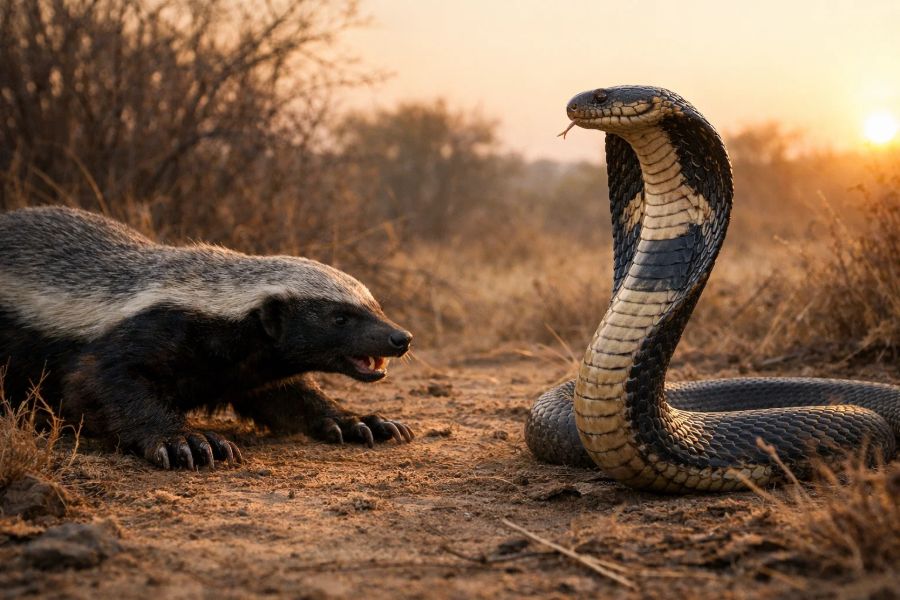
The scientifically careful answer is not “one always wins.” In a tight, chaotic, close-range encounter, the honey badger is often favored because of its thick and loose skin, strong claws, aggressive style, and real—though not absolute—resistance to some snake venoms. In a clean strike scenario, especially if the snake lands an effective bite early and can keep distance, the king cobra remains extremely dangerous. So the better conclusion is that the outcome depends on distance, bite placement, and how much venom is successfully delivered.
Quick Comparison Table
| Feature | Honey Badger | King Cobra | Why It Matters |
|---|---|---|---|
| Scientific name | Mellivora capensis | Ophiophagus hannah | Clarifies the species being compared |
| Animal type | Mustelid mammal | Elapid snake | Mammal vs venomous reptile means very different weapon systems |
| Typical size | Large terrestrial mustelid; body about 60–77 cm, tail 12–30 cm | Usually around 3–4 m; maximum reported around 5.5 m or more | Cobra has huge reach advantage; badger is compact and harder to control |
| Main weapons | Bite, claws, grappling, digging strength | Neurotoxic venom, long body, repeated striking ability | Badger wins by closing distance; cobra wins by landing a clean bite |
| Defensive traits | Thick, loose skin; some venom resistance | Hood display, elevation of front body, venom delivery | Both are hard to intimidate |
| Diet | Broad carnivorous diet including snakes | Mostly other snakes | Both are used to dangerous prey |
| Conservation status | Least Concern | Vulnerable | Both face human pressures, especially the cobra |
Data summarized from San Diego Zoo, Animal Diversity Web, Smithsonian, Reptile Database, and IUCN-linked records.
Meet the Contenders
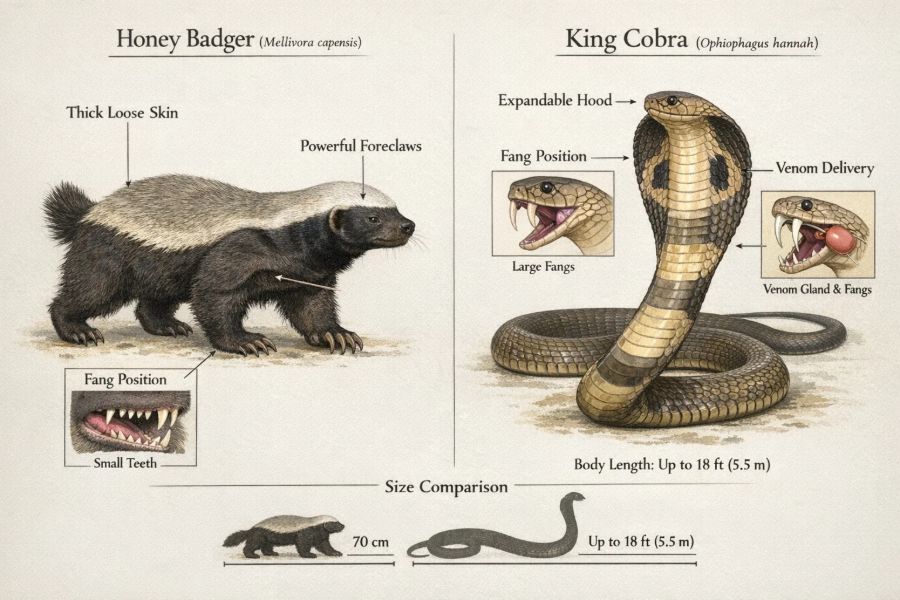
The honey badger is one of the most heavily built members of the weasel family and the largest terrestrial mustelid in Africa. It has a broad back, short powerful limbs, long foreclaws, and remarkably loose skin that allows it to twist and bite even when grabbed. San Diego Zoo and Animal Diversity Web both emphasize its tough skin and willingness to tackle risky prey, including venomous snakes.
The king cobra is the longest venomous snake in the world. Smithsonian notes that it mainly eats other snakes, including venomous species, while Reptile Database and other zoological references place its maximum length at about 5.5 meters. Unlike many animals casually called “cobras,” the king cobra belongs to its own genus, Ophiophagus, and is a specialized snake-eater rather than a generalist predator.
Size and Reach
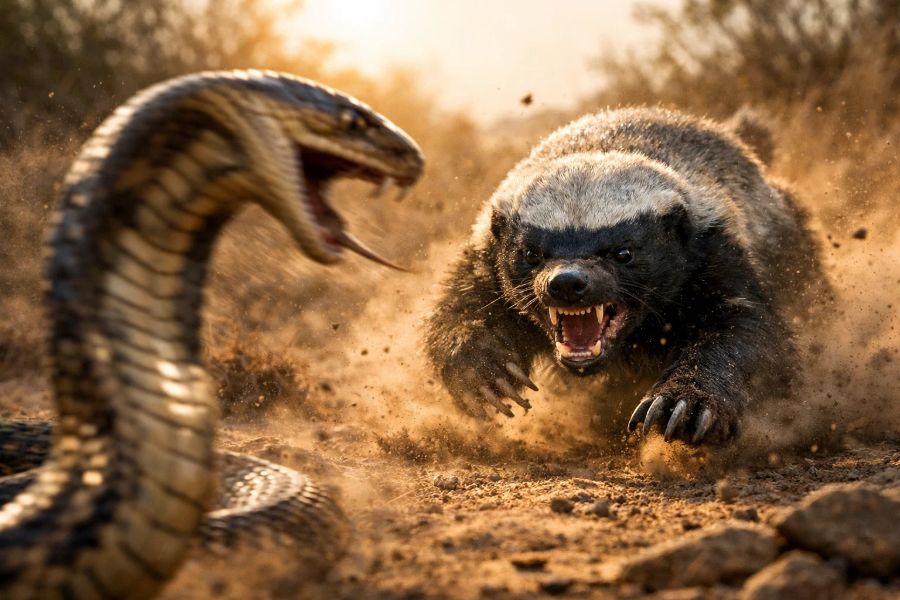
This matchup is interesting because the larger animal is not necessarily the heavier one. The king cobra is vastly longer, often around 3 to 4 meters, and can raise a substantial portion of its body off the ground when threatening or striking. That gives it major reach and distance-control advantages.
The honey badger, however, is built like a compact battering ram. Its short, muscular body and low center of gravity make it difficult for an opponent to topple or keep at bay once it gets in close. In practical terms, the cobra wants the encounter at striking distance, while the badger wants it at wrestling distance. That is the core biomechanical tension in this contest. This is an inference from their anatomy and behavior.
Weapons: Venom vs Toughness
The king cobra’s main weapon is neurotoxic venom. Like other elapids, it uses venom to interfere with neuromuscular function, and its long body lets it strike from farther away than most mammalian opponents can safely handle. Because king cobras specialize in eating other snakes, they are already adapted for precise, repeated biting and for controlling dangerous prey.
The honey badger’s weapon system is more physical. It bites hard, claws effectively, and can keep attacking while absorbing punishment that would stop many predators. San Diego Zoo notes that its skin is thick enough to withstand bee stings, porcupine quills, and even dog bites, while its loose fit lets the animal twist around inside an opponent’s grip.
Is the Honey Badger Really “Immune” to Venom?
This is where pop culture often goes too far. Honey badgers are not simply immune to all snake venom. A better description is that they have reduced susceptibility to some venom components and are unusually capable of surviving bites that might kill other mammals. San Diego Zoo and SDZ Wildlife Explorers say honey badgers seem resistant to snake venom and can survive bites from dangerous creatures, while Animal Diversity Web is more cautious and says their snake-eating habits suggest real adaptations, but not perfect invulnerability.
The strongest evidence comes from molecular studies. Drabeck and colleagues found that honey badgers have evolved changes in the muscular nicotinic acetylcholine receptor, a target of snake α-neurotoxins, reducing toxin binding. Later work also supported reduced susceptibility to α-neurotoxins in honey badgers and related evolutionary arms-race dynamics. That means the honey badger’s toughness is not just folklore; it has a real biochemical basis. But it still does not mean every bite is harmless or that all venom components are equally neutralized.
What Happens in a Real Encounter?
A king cobra usually tries to solve conflict by warning, posturing, and striking from range. It can elevate the front of the body, spread its hood, and attempt to keep an attacker outside safe distance. Against many mammals, that is enough. Against a honey badger, intimidation is less reliable because the badger is famous for pushing into close quarters against dangerous animals.
If the cobra lands an early bite to a vulnerable area and delivers a substantial venom dose, the snake’s odds improve sharply. If the badger survives the initial strike and closes distance, the balance shifts. Once the fight becomes a scramble of claws, jaws, and body contact, the king cobra is at a serious disadvantage because it is not built for prolonged close combat with a grappling mammal. That conclusion is an inference from their anatomy, feeding biology, and venom-resistance evidence.
Diet and Ecological Logic
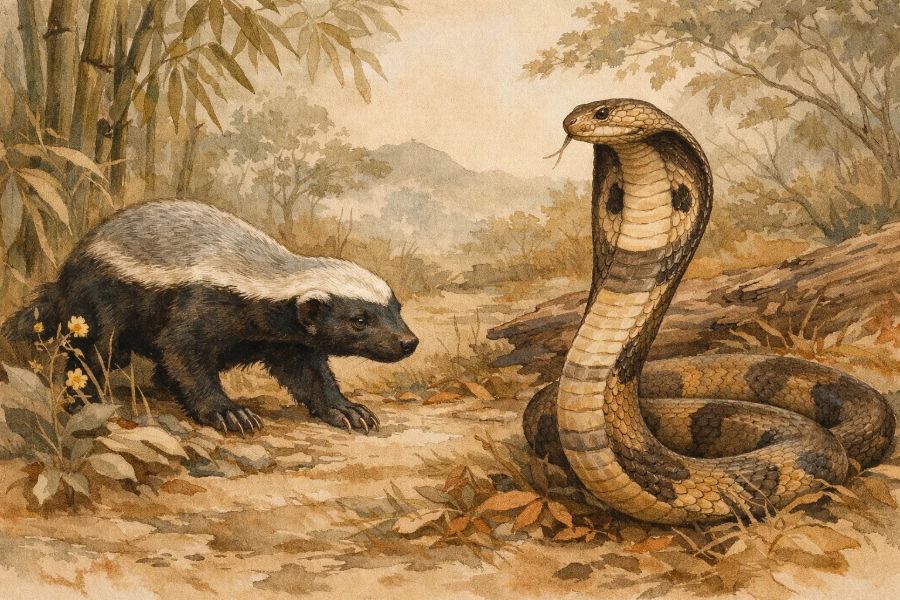
Both species are already adapted to high-risk prey. Honey badgers have one of the least specialized diets among mustelids and are known to eat snakes, among many other animals. King cobras, in contrast, are specialists that feed mainly on other snakes, including venomous ones. In other words, neither participant is encountering “danger” for the first time. This matchup is plausible because both species have evolved under selective pressure from risky prey and risky enemies.
That said, their natural ranges only overlap in parts of South and Southwest Asia, not across most of the honey badger’s African range. So this is a biologically plausible matchup only in the Asian portion of the honey badger’s distribution, not a universal everyday encounter.
So Who Has the Edge?
If the question is who is more dangerous at range, the king cobra has the edge. It is longer, can strike first, and can potentially end the fight before the badger gets a grip.
If the question is who is more likely to prevail once contact is made, the honey badger is usually the better pick. Its thick and loose skin, low body profile, claws, bite, and partial resistance to α-neurotoxic venom make it one of the worst possible mammalian opponents for a cobra.
So the most scientifically honest verdict is this: the king cobra wins with distance and a clean early envenomation; the honey badger wins if it survives the opening and turns the fight into close combat. Because honey badgers are unusually well equipped to survive that opening, I would cautiously give the overall edge to the honey badger, while stressing that this is not guaranteed and would depend heavily on strike placement and venom delivery.
Conservation Perspective
There is a more important ecological story than the showdown itself. The honey badger is listed as Least Concern, though local declines and conflict with people occur. The king cobra is listed as Vulnerable and is considered to be declining across its range. So from a conservation standpoint, the real priority is not who “wins,” but how both species survive habitat loss, persecution, and human pressure.
Conclusion
A zoologist would not describe Honey Badger vs King Cobra as brute courage against pure venom. It is more precise to say this is a clash between a distance-based neurotoxic specialist and a close-range, thick-skinned mammalian fighter with evolved toxin resistance. The snake is more dangerous before contact. The badger is more dangerous after contact. That is why the matchup is so compelling—and why the honey badger, despite its smaller size, is one of the few mammals that can make a king cobra’s greatest weapon less decisive than usual.
References
Drabeck, D. H. et al. 2015. Why the honey badger don’t care: Convergent evolution of venom-targeted nicotinic acetylcholine receptors in mammals that survive venomous snake bites. Toxicon.
Harris, R. J. et al. 2021. Electrostatic resistance to alpha-neurotoxins conferred by charge reversal of a conserved nicotinic acetylcholine receptor residue in the mammalian lineage.
San Diego Zoo Wildlife Alliance. Honey Badger (Ratel) species page.
San Diego Zoo Wildlife Explorers. Honey badger (ratel) profile.
Animal Diversity Web. Mellivora capensis account.
Smithsonian’s National Zoo. King cobra species page.
Reptile Database. Ophiophagus hannah account.
IUCN Red List materials for Mellivora capensis and Ophiophagus hannah.