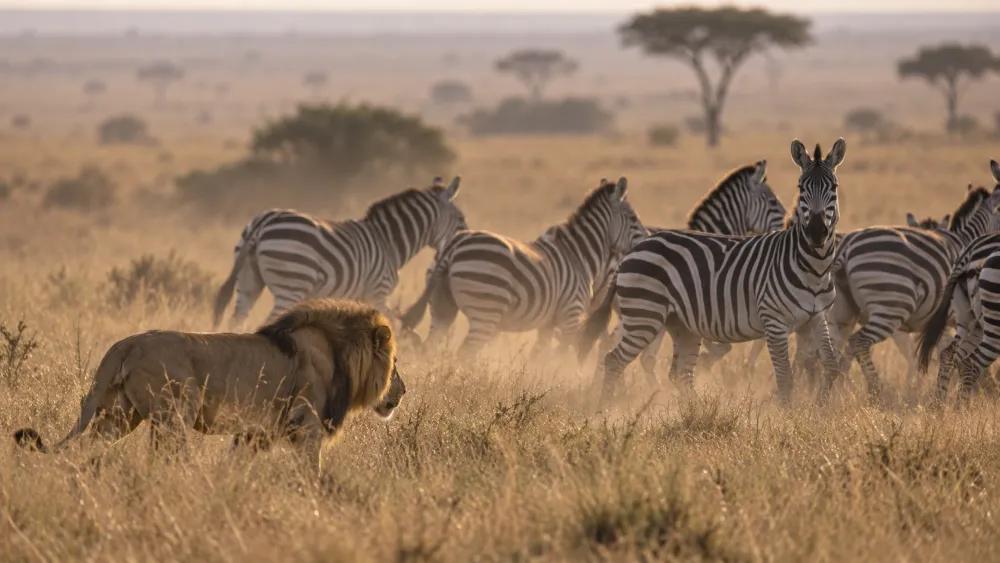
A zoologist would frame wolf pack vs cougar as a comparison between two very different predatory systems, not simply “dogs versus cat.” Gray wolves (Canis lupus) are highly social carnivores that often hunt and defend space as family-based packs, while cougars (Puma concolor) are solitary ambush predators that rely on stealth, cover, and explosive short-range attacks. In North America, these species overlap in several ecosystems, and the scientific literature shows that they do interact through competition, kill theft, spatial avoidance, and sometimes direct lethal conflict.
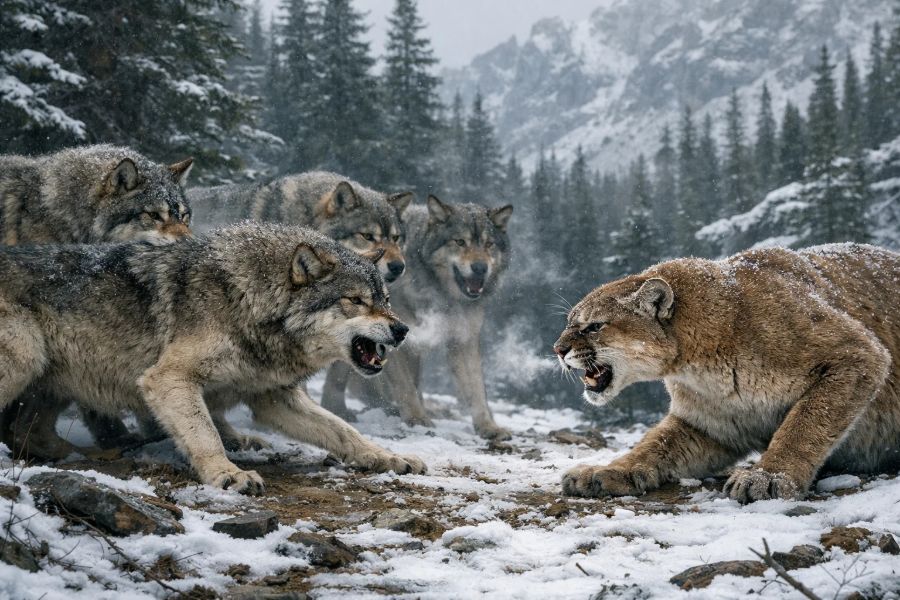
The most accurate short conclusion is this: a cougar is usually the more dangerous individual fighter, but a wolf pack usually has the advantage as a group. That is because the cougar is built to kill alone, whereas wolves gain their edge from numbers, coordination, harassment, and persistence. In nature, the more common outcome is not a dramatic duel, but wolves displacing cougars from kills, forcing cougars to shift habitat use, or occasionally killing them when group size and opportunity favor the pack.
Quick Comparison Table
| Feature | Wolf Pack | Cougar |
|---|---|---|
| Scientific identity | Gray wolf, Canis lupus | Cougar / mountain lion, Puma concolor |
| Social system | Social, pack-living family group | Solitary |
| Typical size | Packs often 5–9, though Yellowstone averages about 11.8 and packs can be larger | Adult males commonly about 36–120 kg; Yellowstone males about 145–170 lb |
| Main hunting style | Cooperative pursuit and harassment | Stealth ambush, short rush, grappling bite |
| Main strength | Numbers, endurance, group pressure | Surprise, agility, claws, precise killing bite |
| Main weakness | Individual wolves are smaller than a cougar | Alone against multiple attackers |
| Most likely real-world edge | Territorial pressure, kill theft, mobbing | One-on-one close combat, ambush efficiency |
These figures vary by region, prey base, and sex, but the pattern is consistent across authoritative sources.
Meet the Contenders
Gray wolves are among the best-known cooperative carnivores. Yellowstone National Park describes them as highly social animals living in packs, with pack size depending on prey and habitat; in Yellowstone, average pack size has recently been about 11.8 individuals, while Animal Diversity Web notes that many packs elsewhere are more often in the 5–9 range. This means “wolf pack” can describe anything from a small family group to a much more formidable large pack.
The cougar, by contrast, is a solitary cat. National Park Service pages and Animal Diversity Web both describe mountain lions as solitary, wide-ranging predators, with males larger than females. Adult male body mass can vary widely by region, but authoritative sources place males roughly from 36 to 120 kg, with Yellowstone males often around 145–170 lb. That makes a cougar larger than an individual wolf in many cases, but still badly outnumbered by a pack.
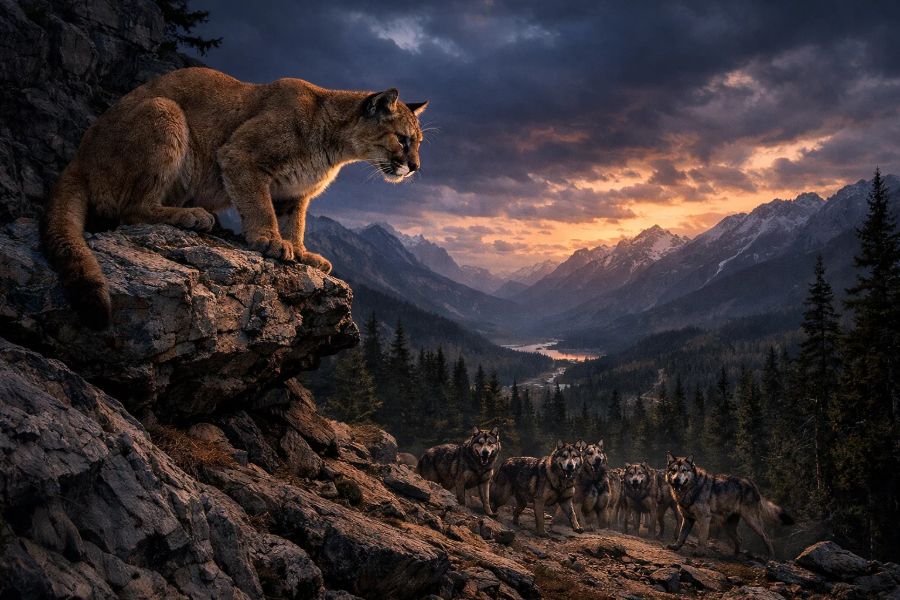
Size and Weaponry
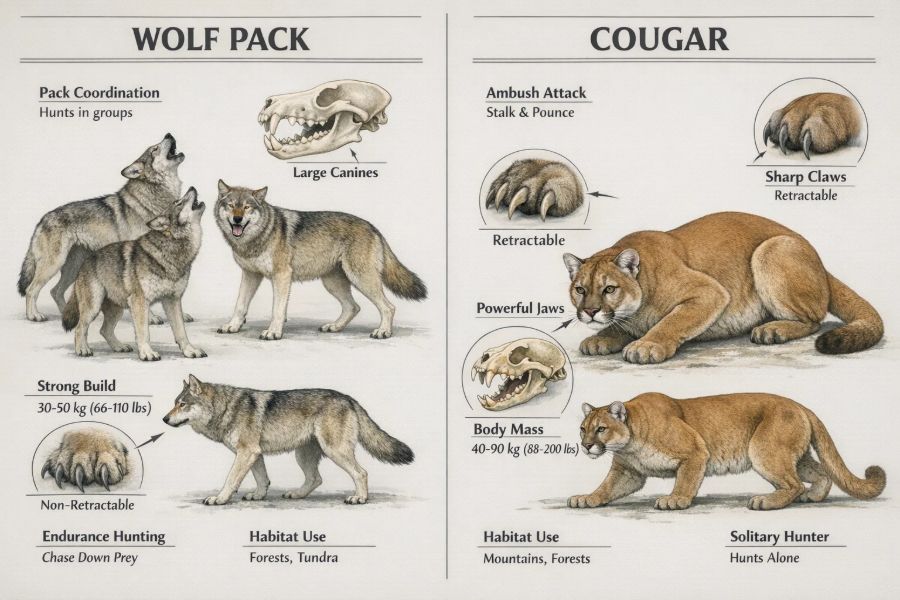
If this were reduced to a one-on-one fight, the cougar would usually be favored. It is heavier than a single wolf in many populations, has retractile claws, a powerful forequarter build, and the typical felid killing toolkit: seize, grapple, and bite efficiently at close range. Cougars are specialized ambush predators, not endurance chasers, and that matters because their anatomy is built for sudden violent control of prey.
An individual wolf is dangerous, but the wolf’s real weapon is the pack. Wolves use group pursuit, directional pressure, harassment, and repeated engagement to wear down prey or competitors. Yellowstone sources note that wolves hunt in packs and defend territory collectively, and their success depends not just on body size but also on coordination and the ability to recruit packmates into a conflict.
Hunting Style: Persistence vs Precision
Cougars and wolves solve the same ecological problem in opposite ways. Cougars depend on concealment, terrain, and a short burst of violence. They usually hunt alone, often using cover to approach closely before launching an ambush. Yellowstone material on cougars emphasizes their solitary behavior, while older Yellowstone Science summaries note that cougars often manipulate carcasses into concealment after the kill.
Wolves are coursing predators. They do not need the same element of surprise because they can pressure prey over distance and use multiple attackers. But even for wolves, bigger is not always better: Yellowstone research summaries note that packs of about four wolves were more successful than smaller packs in wolf-elk interactions, while larger pack size beyond that did not keep increasing hunting success in a simple linear way. So a pack’s value is real, but it is not magic.
What Happens When They Meet?
The most important scientific point is that wolf-cougar interactions are often about competition, not direct combat for its own sake. A classic study on interactions between cougars and gray wolves found that wolves displaced cougars from kill sites and scavenged cougar-killed prey; most wolf scavenging in that study involved elk killed by cougars. This means the wolf pack often wins economically even without needing to kill the cougar.
The same body of work and later Yellowstone research indicate that wolves can change cougar behavior at the landscape scale. As wolves recolonize an area, cougars may shift prey use, kill-site behavior, and habitat use to reduce risk. More recent Yellowstone analyses also found that the dynamics of interference competition depend partly on prey size, because larger prey are more likely to attract wolves and bears to cougar kills.
Can Wolves Kill Cougars?
Yes. The literature supports that wolves can kill cougars, especially when several wolves engage one cat or when a cougar is caught at a kill or in a poor escape position. That said, these events are not the dominant form of interaction; displacement and scavenging are more commonly emphasized in the studies than outright killing.
This distinction matters because internet discussions often jump straight to “who kills whom,” while ecologists care just as much about who loses food, who avoids whom, and who shifts space use. A cougar that repeatedly loses kills to wolves may suffer major energetic costs even if it survives every encounter. That is one reason wolf recovery can reshape cougar ecology without requiring frequent lethal battles.
Can a Cougar Beat Wolves?
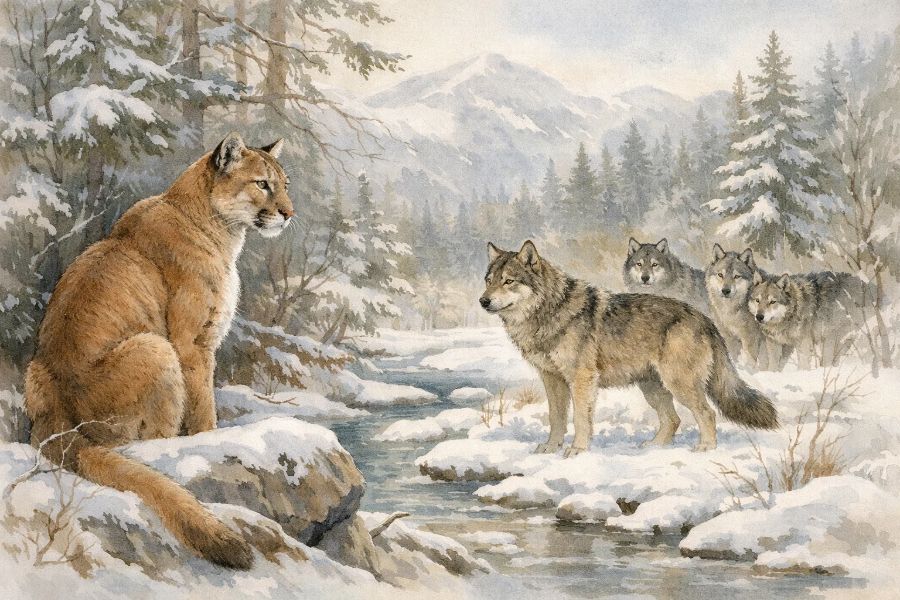
Against one wolf, a cougar would usually be a very serious opponent and likely the favorite in a close fight. Against two wolves, the outcome becomes much less predictable. Against a true pack, especially four or more committed adults, the cougar is usually at a major disadvantage unless it has an escape route such as steep terrain, dense cover, or a tree. This conclusion is partly an inference from anatomy and behavior, but it is strongly supported by the observed role of pack size in wolf success and the documented pattern of wolves displacing cougars.
In other words, the cougar is the superior individual combatant, while the wolves are the superior collective force. That is why the title “wolf pack vs cougar” already contains most of the answer: the key variable is not “wolf,” but “pack.”
Terrain Changes the Odds
Terrain can swing the balance. Cougars are especially dangerous in steep, broken, brushy terrain where they can ambush, disengage, or climb. Wolves are more effective where they can see, pursue, and keep pressure on a fleeing opponent. Yellowstone and other western systems contain both kinds of habitat, which helps explain why wolves do not simply erase cougars from shared landscapes. Instead, the result is coexistence shaped by risk and competition.
Trees and cliffs matter too. A cougar that reaches a defensible ledge or tree may survive an encounter that would be disastrous on open ground. That is not because the cougar suddenly becomes stronger, but because it can deny wolves the spatial advantage that pack hunting usually creates. This is an inference from their locomotion and observed habitat use.
So Who Has the Edge?
If the scenario is one healthy adult cougar versus one wolf, the cougar usually has the edge. If the scenario is a healthy adult cougar versus a real wolf pack, the pack usually has the edge. If the question is about what most often happens in the wild, the best answer is: wolves more often pressure, displace, and economically outcompete cougars than fight them in theatrical stand-up battles.
So the zoologically honest verdict is this: the cougar is the better solitary killer; the wolf pack is the stronger social weapon system. In ecology, teamwork often beats individual excellence.
References
Kortello, A. D., Hurd, T. E., & Murray, D. L. 2007. Interactions between cougars (Puma concolor) and gray wolves (Canis lupus) in Banff National Park, Alberta. Écoscience. Evidence that wolves displaced cougars from kills and scavenged cougar prey.
Elbroch, L. M., Lendrum, P. E., Allen, M. L., & Wittmer, H. U. Recolonizing wolves influence the realized niche of resident cougars. Study showing cougar behavior and prey use shift in response to wolf recovery.
Yellowstone National Park. Wolf Ecology. Current overview of wolf pack structure, sociality, and Yellowstone pack size.
Yellowstone National Park. Cougar. Overview of cougar size, solitary behavior, and ecology in Yellowstone.
Animal Diversity Web. Canis lupus and Puma concolor species accounts. General life history, social structure, and body-size ranges.
MacNulty, D. R. et al., summarized by Yellowstone National Park. Understanding the Limits to Wolf Hunting Ability. Evidence that hunting success improved up to about four wolves but did not increase indefinitely with larger packs.
Yellowstone long-term wolf-cougar-elk reporting and interference competition analyses. Recent project reports and analyses on scavenging, kill theft, and predator interactions.