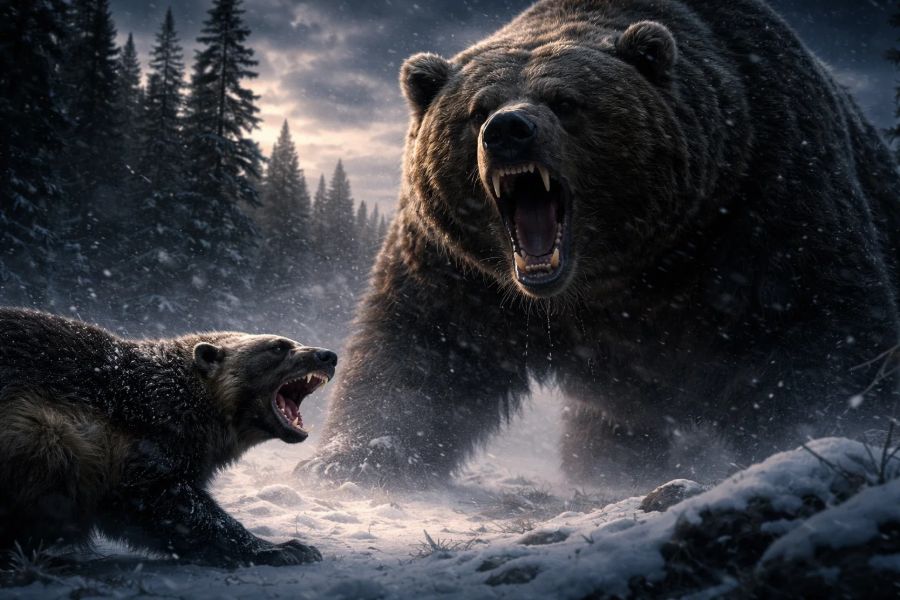
At first glance, Wolverine vs Grizzly Bear sounds like a classic battle of attitude versus mass. A wolverine (Gulo gulo) has an outsized reputation for toughness, while a grizzly bear is one of the most powerful land carnivores in North America. Zoologically, though, this is not a fair duel between equals. It is a comparison between a mid-sized mustelid built for bold scavenging, opportunistic predation, and close-quarters aggression and a massive brown bear built for physical dominance, excavation, omnivory, and carcass takeover.
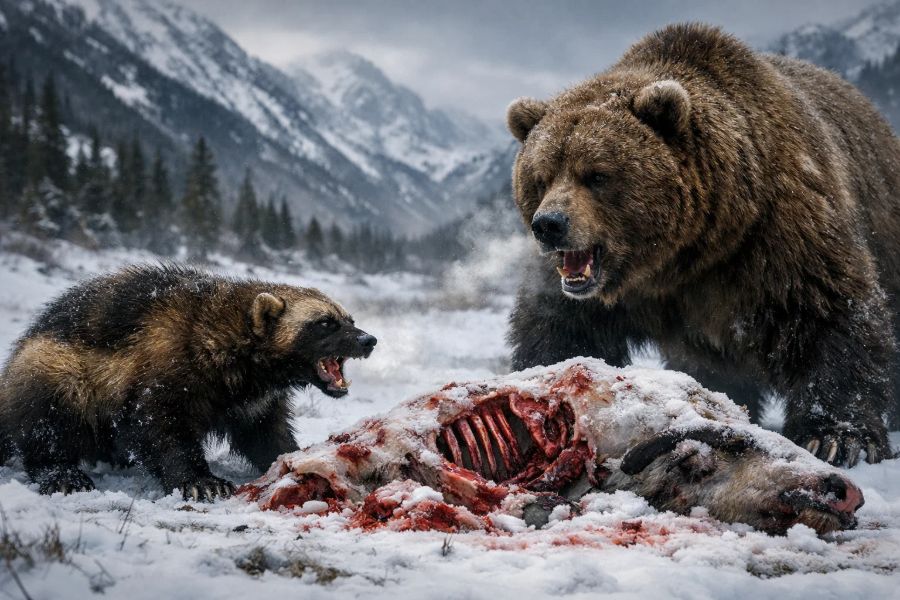
The short scientific answer is this: in a direct fight, the grizzly bear almost always has the advantage because it is vastly larger, stronger, and harder to injure seriously. The reason wolverines fascinate people is not that they routinely beat bears in combat, but that they can sometimes harass, resist, or briefly displace much larger animals at carcasses, especially when risk tolerance, surprise, snow conditions, or the bear’s motivation shift the interaction. In nature, the more important story is not who “wins a deathmatch,” but how these two carnivores compete over food.
Quick Comparison Table
| Feature | Wolverine | Grizzly Bear | Why It Matters |
|---|---|---|---|
| Scientific name | Gulo gulo | Ursus arctos horribilis | Clarifies the animals being compared |
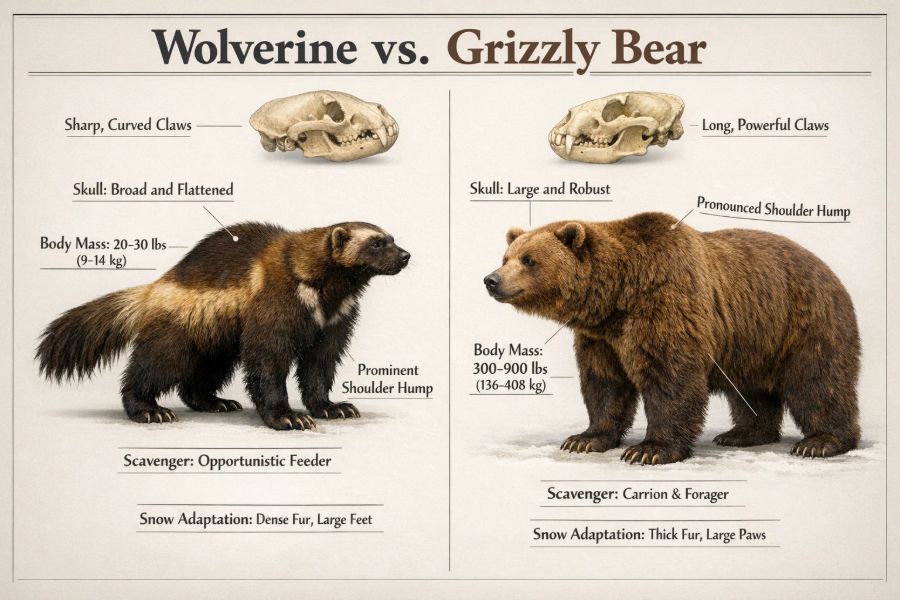
| Body size | Males commonly about 24–61 lb (10.9–27.5 kg); females about 15–41 lb (7–19 kg) | Adult males in the lower 48 average about 400–600 lb (200–300 kg); females about 250–350 lb (110–160 kg) | The bear has a huge mass advantage |
| Basic role | Mid-sized carnivore and scavenger | Large omnivore, dominant scavenger, occasional predator | Both use carrion, but one usually dominates access |
| Main weapons | Powerful jaws, claws, toughness, persistence | Massive strength, long claws, bite force, reach | Wolverines are dangerous for their size; grizzlies are dangerous full stop |
| Typical interaction | Bold scavenging, carcass use, opportunism | Takeover, displacement, dominance at food | Most encounters are about food, not formal fights |
| Best chance of “winning” | Bluffing, harassment, exploiting a low-motivation opponent | Almost any direct physical contest | Motivation matters, but size matters most |
Size data come from U.S. Fish & Wildlife Service and the U.S. Forest Service Fire Effects Information System for wolverines.
Meet the Contenders
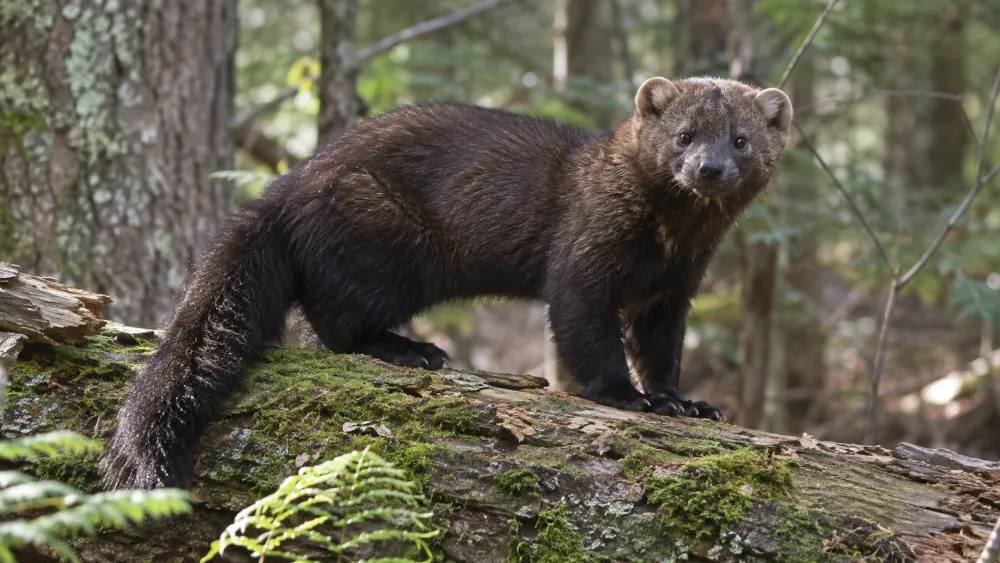
The wolverine is the largest land-dwelling member of the weasel family. Yellowstone National Park describes it as a mid-sized carnivore adapted to cold, snowy environments, and Animal Diversity Web notes that it is both a predator and a scavenger, often using kills made by larger carnivores such as wolves and bears. This already tells us something important: the wolverine’s ecological life often unfolds around the leftovers or opportunities created by larger predators.
The grizzly bear is a North American form of the brown bear. U.S. Fish & Wildlife Service describes grizzlies as generally larger and heavier than black bears, with adult males in the lower 48 averaging about 400 to 600 pounds. They are not pure predators; much of their diet is plant-based, but they are also extremely strong scavengers and can dominate carcasses used by other carnivores.
Size: The Bear’s Biggest Edge
If this comparison is reduced to raw body size, it becomes lopsided very quickly. A large male wolverine may weigh a few dozen pounds, while even an average adult male grizzly outweighs it many times over. This kind of size gap changes everything: momentum, striking reach, tolerance for injury, and the ability to simply shove the other animal aside.
That does not mean the wolverine is weak. The U.S. Forest Service summary notes that the skull and teeth of wolverines are unusually robust for a carnivore of their size, and that they can eat frozen meat and crush bones from large prey. But “impressive for its size” is not the same as “evenly matched with a grizzly.” In direct combat, the bear’s strength advantage is overwhelming.
Why Wolverines Seem So Formidable
Wolverines have an enormous reputation because they combine strength, persistence, and fearlessness in a compact body. National Geographic describes them as carnivores up to about 40 pounds, while Defenders of Wildlife gives somewhat broader ranges and notes their threatened status in the lower 48. More importantly, multiple sources describe them as animals that readily scavenge from larger predators and may tackle prey larger than themselves under the right conditions.
This is why people often assume a wolverine can “beat” a bear. What they are usually responding to is behavioral boldness, not consistent physical superiority. A wolverine may rush, threaten, vocalize, circle, and create enough nuisance or uncertainty to make a larger animal hesitate briefly. That is very different from reliably overpowering it. This distinction is an inference from their ecology and body size.
What Encounters Are Usually About: Food
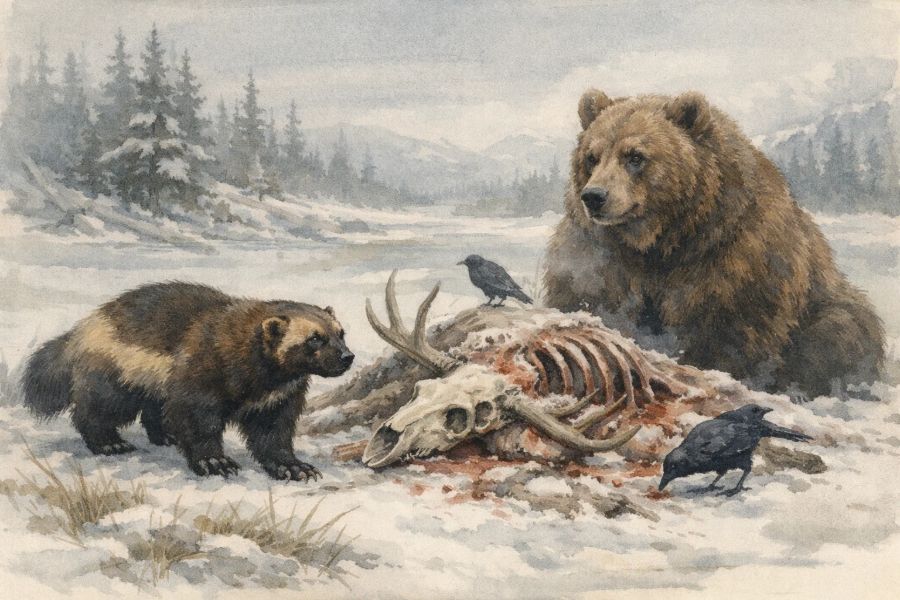
The most realistic wolverine-bear interaction is not a staged fight in an open field. It is a dispute over a carcass or food patch. Wolverines are well known scavengers, and research on carnivore communities repeatedly shows that larger dominant scavengers shape access to carcasses for smaller carnivores. In systems with bears, the bear is generally the dominant party. A 2021 study on energetic losses from kleptoparasitism showed how a dominant scavenger can strongly alter the foraging behavior of an apex predator; while that paper focused on other species, the principle applies broadly to carcass competition and helps frame why body size matters so much at food resources.
For wolverines specifically, Animal Diversity Web states that they use kills of larger predators such as bears and wolves. That means the wolverine often benefits from the presence of bigger carnivores. But benefit does not equal dominance. It usually means careful timing, opportunism, and risk assessment around animals that could kill it.
What the Broader Carnivore Literature Suggests
Direct published studies specifically on wolverine versus grizzly bear conflict are relatively sparse in the web-accessible sources I found. But the broader literature on carnivore competition is highly informative. Studies from Scandinavia show that wolverines heavily exploit carcasses produced by other carnivores, including wolves and lynx, and recent work found that wolves can facilitate wolverines by providing scavenging opportunities. These studies do not prove that wolverines dominate larger competitors; they reinforce the opposite picture: wolverines are outstanding at using food opportunities created within a hierarchy they do not top.
Research on wolves and brown bears also shows that large bears frequently use wolf kills and that most interactions are indirect, with bears functioning as dominant scavengers. Again, that is not a wolverine study, but it strongly supports a general rule of northern carnivore communities: brown bears tend to sit high in the dominance structure around carcasses. A wolverine entering that same system is even less likely to dominate physically.
So Can a Wolverine Ever Stand Up to a Grizzly?
Behaviorally, yes. Physically, only in a limited sense.
A wolverine may bluff, posture, charge, and even successfully pressure a low-motivation bear away from a food item for a moment. That sort of event is plausible because animals do not always escalate to maximum violence; sometimes a larger animal yields because the resource is not worth the risk or annoyance. This is one reason anecdotal reports of wolverines “driving off” bears exist in wildlife storytelling. But those cases should not be confused with evidence that wolverines are stronger combatants. That is an inference based on general animal conflict theory and the very large size gap here.
If the interaction becomes a serious fight and the bear commits fully, the balance shifts decisively. The grizzly’s forelimb strength, reach, claws, and sheer body mass would make it extraordinarily difficult for a wolverine to injure or restrain it meaningfully. The wolverine’s best strategy is therefore not to “beat” the bear, but to exploit timing, bluff, persistence, and the bear’s temporary lack of interest.
Snow, Terrain, and Risk
Wolverines are adapted to cold, snowy terrain, and that can matter. Yellowstone notes that they are strongly associated with cold, snowy environments, and their ecology is closely tied to high-elevation alpine and boreal habitat. In difficult snow conditions, a wolverine may move efficiently, locate carrion, and use terrain cleverly. But terrain advantage is not the same as becoming more powerful than a grizzly. It may improve access, escape, or timing; it does not erase the size difference.
This is another reason the matchup is often misunderstood. People tend to imagine a neutral arena. Nature does not work that way. A wolverine’s real talent is surviving and feeding in harsh systems where it can exploit weather, topography, carcasses, and other predators’ work. A grizzly’s real talent is dominating when it chooses to engage.
The Most Scientific Verdict
If the question is, “Who would win in a direct physical confrontation?”, the answer is the grizzly bear, overwhelmingly in most cases. The difference in mass and strength is simply too large.
If the question is, “Why do wolverines still seem formidable next to bears?”, the answer is that wolverines are unusually bold, tough, and efficient scavengers that can sometimes influence encounters through aggression and persistence, especially when the bigger animal is not strongly motivated. They are ecological opportunists with remarkable nerve, not equal-sized rivals to a grizzly.
So the best zoological conclusion is this: the grizzly bear is the true physical superior, while the wolverine is the master of making a much larger animal’s life temporarily inconvenient. That is impressive—but it is not the same as winning a serious fight.
Conservation Context
Globally, the wolverine is listed as Least Concern by the IUCN, though sources note concern and legal protection in parts of its southern range, including the lower 48 United States. The global brown bear is also listed as Least Concern by the IUCN, while grizzly populations in parts of the contiguous U.S. remain managed and protected under federal law.
References
U.S. Fish & Wildlife Service. Grizzly Bear (Ursus arctos horribilis). Size and physical characteristics for grizzlies in the lower 48.
U.S. Forest Service Fire Effects Information System. Gulo gulo. Wolverine body mass, skull robustness, and feeding ecology.
Yellowstone National Park. Wolverine. Habitat and ecological overview of wolverines in cold, snowy environments.
Animal Diversity Web. Gulo gulo. Wolverine scavenging ecology and use of kills made by larger predators.
IUCN Red List. Brown Bear (Ursus arctos). Global status listed as Least Concern.
Defenders of Wildlife. Wolverine. Lower-48 status context and body-size summary.
National Geographic. Wolverine. General size and life-history summary.
Nordli, K. et al. 2024. Carcass provisioning and intra-guild risk avoidance between wolves and wolverines. Shows how wolverines benefit from scavenging opportunities created by larger carnivores.
Mattisson, J. et al. 2011. Influence of intraguild interactions on resource use by wolverines and Eurasian lynx. Demonstrates heavy wolverine use of carcasses from larger carnivores.
Ordiz, A. et al. 2020 and Tallian, A. et al. 2022. Studies on bear–wolf interference and scavenging that help explain how large brown bears dominate carcass competition in northern carnivore systems.