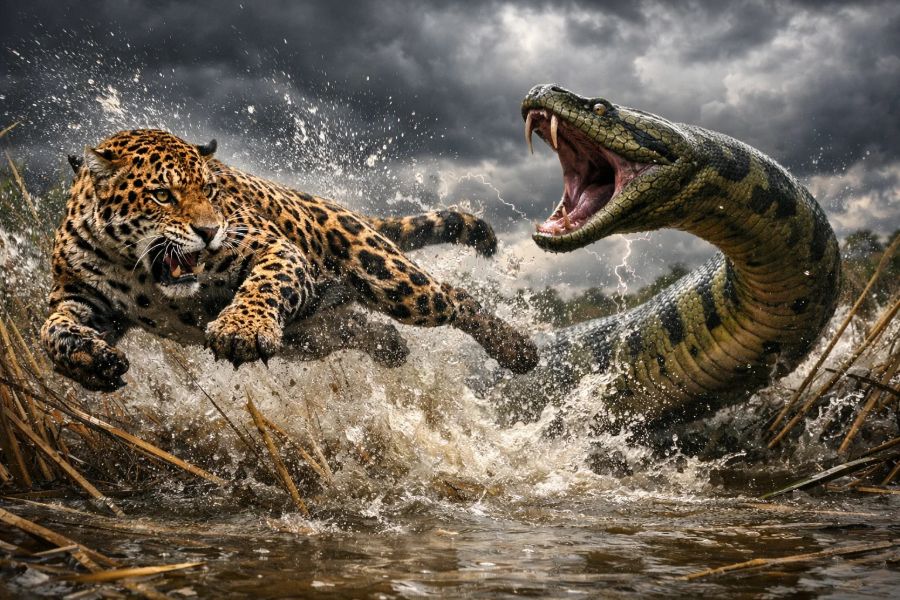
When people imagine Jaguar vs Green Anaconda, they usually picture a fast, muscular big cat against a giant constricting snake. From a zoologist’s perspective, though, this is not a simple “who wins” fantasy match. It is a comparison between two apex predators that overlap in parts of tropical South America, especially around rivers, swamps, marshes, flooded forest, and wetland edges. The jaguar (Panthera onca) is the largest cat in the Americas, while the green anaconda is a semiaquatic boa famous for being the world’s heaviest snake. Recent literature has also complicated anaconda taxonomy, with some sources now distinguishing northern and southern green anacondas; for clarity, this article uses green anaconda in the broad traditional sense while noting that taxonomic debate exists.
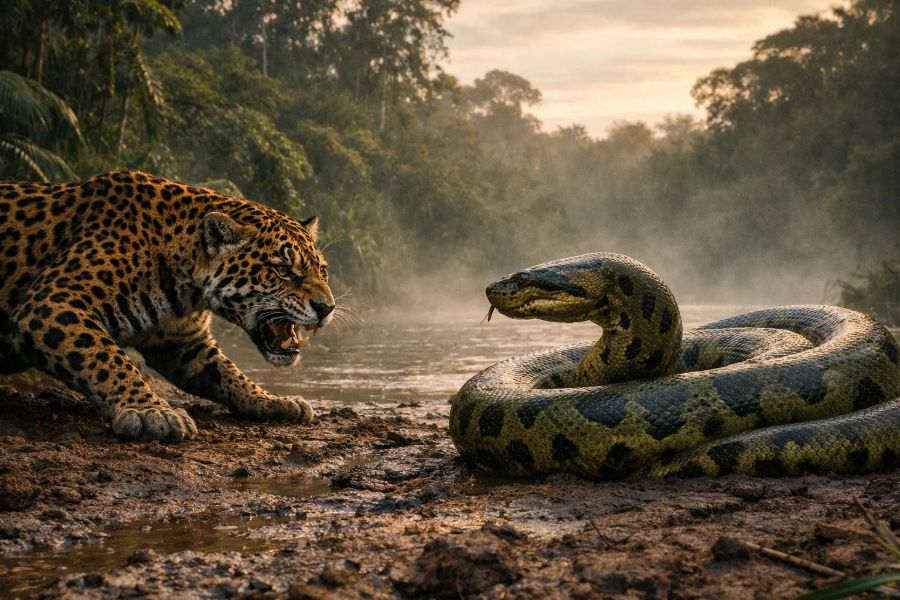
The most accurate scientific answer is that there is no single winner in every scenario. On firm ground, at the water’s edge, or in shallow water where the cat can move freely, the jaguar often has the practical edge because of its speed, control of distance, and unusually powerful skull-targeting bite. In deeper water, or if a very large female anaconda successfully seizes and coils the cat, the snake’s odds rise sharply. Importantly, there is published evidence of jaguars consuming anacondas, whereas the reverse is often mentioned in reputable reference works but is less well documented in the web-accessible primary literature I found.
Quick Comparison Table
| Feature | Jaguar | Green Anaconda | Why It Matters |
|---|---|---|---|
| Scientific name | Panthera onca | Traditionally Eunectes murinus in broad usage | Clarifies the animals being compared |
| Basic type | Large cat, ambush predator | Semiaquatic constrictor snake | Very different combat styles |
| Typical adult size | Usually about 68–136 kg; Pantanal males average about 100 kg | Average length about 5.5 m; giant females can reach about 9 m and 250 kg | The jaguar is compact and muscular; the biggest females can outweigh most jaguars |
| Main weapons | Crushing bite, thick canines, claws, explosive pounce | Constriction, powerful jaws for grip, aquatic ambush | One kills by bite and trauma; the other by restraint and suffocation |
| Habitat overlap | Forest, scrub, wetlands, river edges; strong swimmer | Swamps, marshes, slow streams, flooded grasslands | Encounters are most plausible near water |
| Best setting | Shoreline, shallow water, ambush from cover | Deep water, dense aquatic vegetation, close entanglement | Environment changes the odds |
| Evidence of predation | Published records show jaguars do eat anacondas | Reference sources note large anacondas can take jaguars | The documented evidence is not equally strong in both directions |
Table values compiled from zoological references and peer-reviewed studies.
Meet the Contenders
The jaguar is not just “a leopard of the Americas.” It is a heavily built pantherine cat with an unusually broad head, strong jaw musculature, and a hunting style adapted to dispatching dangerous prey quickly. Unlike many cats, jaguars are comfortable in and around water and readily hunt aquatic or semiaquatic prey such as fish, turtles, and caimans.
The green anaconda is not venomous. It is a massive constrictor built for stealth, leverage, and ambush in water. Its eyes and nostrils sit high on the head, allowing it to remain almost entirely submerged while waiting for prey. Females are much larger than males, and this sexual size difference matters a great deal in any realistic matchup, because a giant female is a very different opponent from a smaller male.
Size and Build
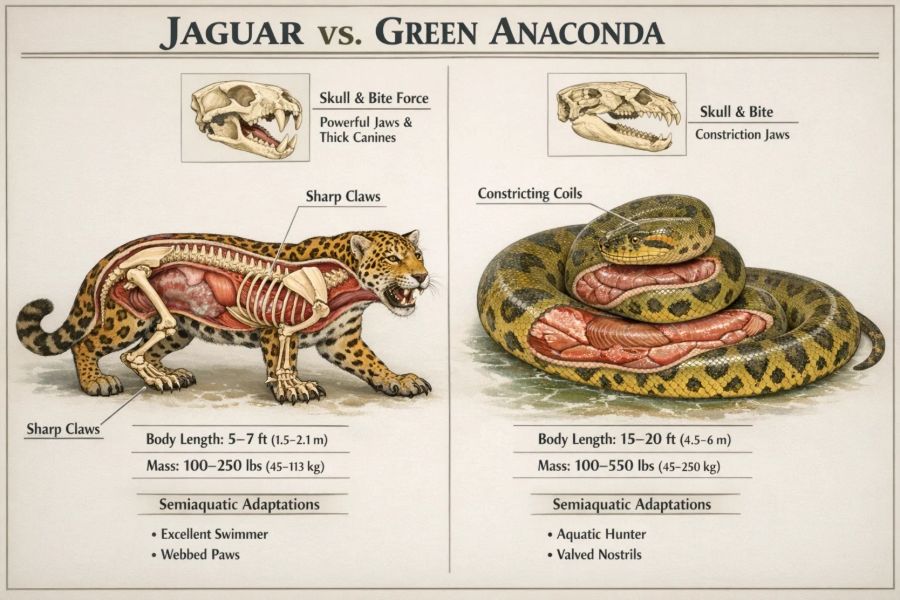
A typical jaguar usually weighs somewhere between 68 and 136 kilograms, with especially large Pantanal males averaging around 100 kilograms. That makes the species tremendously powerful for its size, but still much lighter than the largest female green anacondas.
Green anacondas average about 5.5 meters in length, and the largest recorded individuals can approach 9 meters and 250 kilograms. That does not mean every anaconda is a giant monster—most are smaller, and males are much smaller than females—but it does mean that the upper size range of adult females exceeds that of a jaguar by a wide margin in sheer mass and body length.
This is why the matchup is so context-dependent. A jaguar is shorter, more maneuverable, and optimized for fast violent contact. A large female anaconda is slower on land but can bring overwhelming body mass, leverage, and constriction power if the fight becomes a close entanglement rather than a hit-and-run attack.
Weapons and Killing Style
The jaguar’s biggest advantage is not just “bite force” in the popular sense, but how it uses its bite. A review in the Journal of Natural History notes that jaguars have unusual cranial and bite adaptations for tackling dangerous or armored prey, including thick canines, powerful head muscles, and a tendency to deliver a fatal bite to the braincase or nape. The same paper describes jaguars as having one of the strongest bites relative to body size in Carnivora. National Geographic likewise notes that jaguars use their jaws to pierce the skulls of prey such as turtles and caimans.
The green anaconda fights differently. It is a nonvenomous constrictor that seizes prey with the mouth, then wraps the body around it and squeezes until the animal asphyxiates. National Geographic also notes that green anacondas may drag prey underwater or suffocate it, and Smithsonian describes them as large nonvenomous constrictors capable of subduing very large animals.
So this is really a duel between precision trauma and immobilizing restraint. The jaguar wants to strike hard, fast, and in the right place. The anaconda wants to turn the encounter into a grappling problem the cat cannot escape. That difference is the core of the matchup.
Where the Fight Happens Matters More Than Most People Realize
Jaguars are unusually aquatic for big cats. National Geographic explicitly notes that they do not avoid water and are good swimmers, and field studies from wetland systems show that reptiles can form an important part of their prey base. In one Pantanal study, 24.4% of documented kills were caiman, showing that jaguars are not out of their element when attacking dangerous aquatic reptiles.
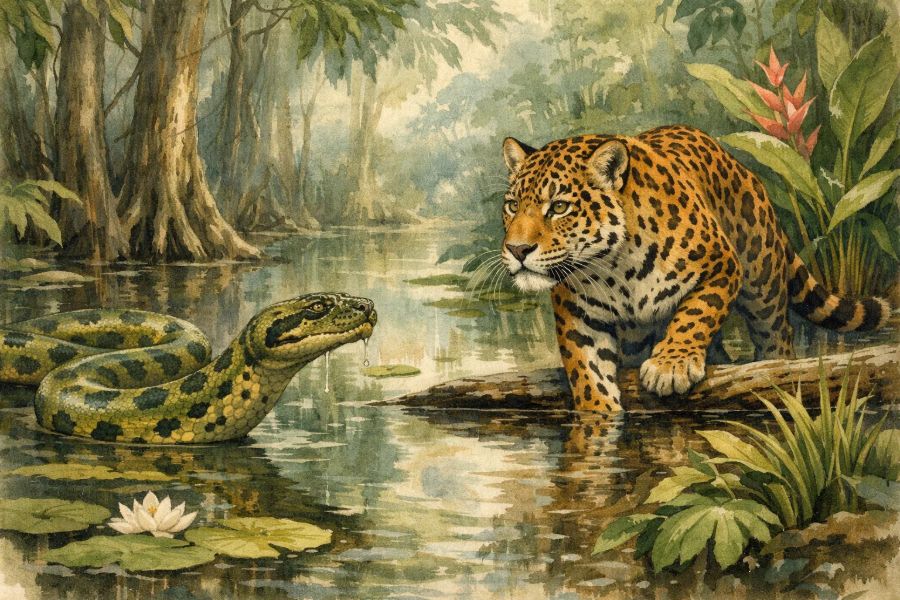
Green anacondas, however, are even more specialized for water. They inhabit swamps, marshes, slow-moving streams, flooded grasslands, and similar habitats, where their submerged ambush strategy works best. In deep water, a cat loses some of the stability and leverage it would normally use to control a target. That is exactly the sort of environment in which a large constrictor becomes most dangerous.
Because of this, “land fight” and “water fight” are not trivial distinctions. A jaguar on a riverbank is using one set of strengths. A jaguar chest-deep in dark water with a giant snake beneath it is in a very different contest.
What the Evidence Actually Shows
The best evidence that jaguars are serious reptile predators comes from multiple studies. In the southern Pantanal, GPS-based kill-site work found that caiman made up nearly a quarter of documented kills. In a broader review of jaguar diet across 19 studies, reptiles made up 12% of all prey items identified, and in five of those studies reptiles made up at least 20% of the reported diet. In one Amazonian flooded-forest site, reptiles were 54% of prey items consumed by jaguars.
That does not prove jaguars routinely hunt giant anacondas, but it does show they are well equipped—and behaviorally willing—to attack large reptilian prey when local conditions make it profitable. This matters because anacondas are not being compared here to a cat that specializes only in deer-sized mammals; they are being compared to a predator that already has a demonstrated ecological relationship with dangerous reptiles.
Direct evidence of jaguars consuming anacondas is scarce but real. A 2019 CATnews article reviewed jaguar–anaconda consumption events and reported a green anaconda consumed by a jaguar in Madre de Dios, Peru, along with an additional yellow-anaconda interaction. The same review noted dietary overlap between the two predators and emphasized how little is actually published about their behavioral encounters.
The reverse direction is also biologically plausible. National Geographic, Britannica, and Smithsonian all note that green anacondas can take very large prey, including jaguars. However, the strength of the evidence is not symmetrical: those references support the possibility, but the web-accessible primary literature I found was much thinner for documented anaconda-on-jaguar kills than for jaguar-on-anaconda consumption. In other words, the claim is credible, but the published case record is harder to trace in detail.
So, Who Has the Edge?
If the scenario is a jaguar encountering an average-sized anaconda on a bank, in reeds, or in shallow water, the jaguar is often the more convincing favorite. It is faster, more agile, has claws to control body position, and has a bite adapted for rapidly disabling dangerous prey with a head or nape attack. That conclusion also fits the fact that jaguars are demonstrably successful predators of large reptiles, including snakes.
If the scenario is a very large adult female green anaconda in deeper water, the picture changes. A giant female may outweigh the cat considerably, can strike from concealment, and only needs to convert the encounter into a secure wrap. Once a constrictor gets full body purchase, the fight becomes much less about speed and much more about whether the cat can break free before losing oxygen and control.
So the most zoologically honest conclusion is this: the jaguar probably has the broader all-around edge in open confrontations, but the green anaconda becomes extremely dangerous when size, water depth, and ambush positioning favor the snake. There is no fixed winner; the setting is half the answer.
Conservation Matters More Than the Matchup
The jaguar is listed by Panthera as Near Threatened, with a range-wide declining trend, and it has already disappeared from nearly half of its historic range. Green anacondas are generally listed as Least Concern, though recent taxonomic work suggests that splitting northern and southern forms could change how risk is interpreted for some populations. Both animals are also affected by habitat loss, wetland degradation, and human persecution.
References
Cavalcanti, S. M. C., & Gese, E. M. 2010. Kill rates and predation patterns of jaguars (Panthera onca) in the southern Pantanal, Brazil. Journal of Mammalogy 91(3): 722–736.
Da Silveira, R., Ramalho, E. E., Thorbjarnarson, J. B., & Magnusson, W. E. 2010. Depredation by Jaguars on Caimans and Importance of Reptiles in the Diet of Jaguar. Journal of Herpetology 44(3): 418–424.
Leite Pitman, R., Bertin, T., Gimenes, V. M., Mendoza, A., Sencia, E. N., Huaman, L., & Jongeneel, A. 2019. Feeding on giants: consumption of anacondas by jaguars. CATnews 70: 41–43.
Miranda, E. B. P., de Menezes, J. F. S., & Rheingantz, M. L. 2016. Reptiles as principal prey? Adaptations for durophagy and prey selection by jaguar (Panthera onca). Journal of Natural History.
National Geographic. Jaguar, facts and photos.
National Geographic. Green anaconda, facts and information.
Smithsonian’s National Zoo and Conservation Biology Institute. Green anaconda.
Encyclopaedia Britannica. Green anaconda.
Panthera. Jaguar Fact Sheet.