At first glance, Snow Leopard vs Tibetan Mastiff sounds like a straightforward “wild cat versus giant dog” contest. But a zoologist would frame it differently. A snow leopard (Panthera uncia) is a wild, solitary mountain predator shaped by steep terrain, stealth, and ambush killing. A Tibetan Mastiff is a domestic guardian breed shaped by human selection for watchfulness, territoriality, and protection. That means this comparison is not really between two ecological equivalents. It is a comparison between a specialized carnivore and a human-associated livestock guardian. The distinction matters more than size alone.
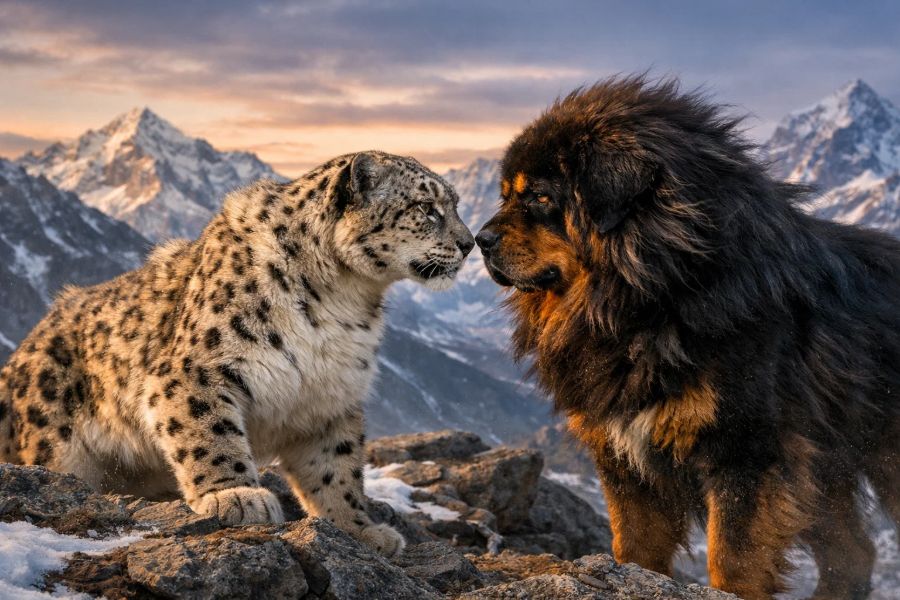
The short scientific answer is this: in a true one-on-one lethal encounter, I would cautiously favor the snow leopard, because wild felids are specialized for killing and are built for explosive, efficient violence. In a real pastoral setting, however, the Tibetan Mastiff’s value is deterrence rather than gladiatorial combat. A mastiff near livestock, people, enclosures, or other dogs may successfully drive a snow leopard away even if it is not the better solo killer. So the most honest conclusion is not “cat always wins” or “dog always wins,” but that the outcome depends heavily on whether we are discussing combat, deterrence, or livestock protection systems. This is partly a synthesis and inference from the available ecology and guardian-dog literature.
Quick Comparison Table
| Feature | Snow Leopard | Tibetan Mastiff | Why It Matters |
|---|---|---|---|
| Biological status | Wild big cat | Domestic dog breed | Predator vs guardian is not a like-for-like matchup |
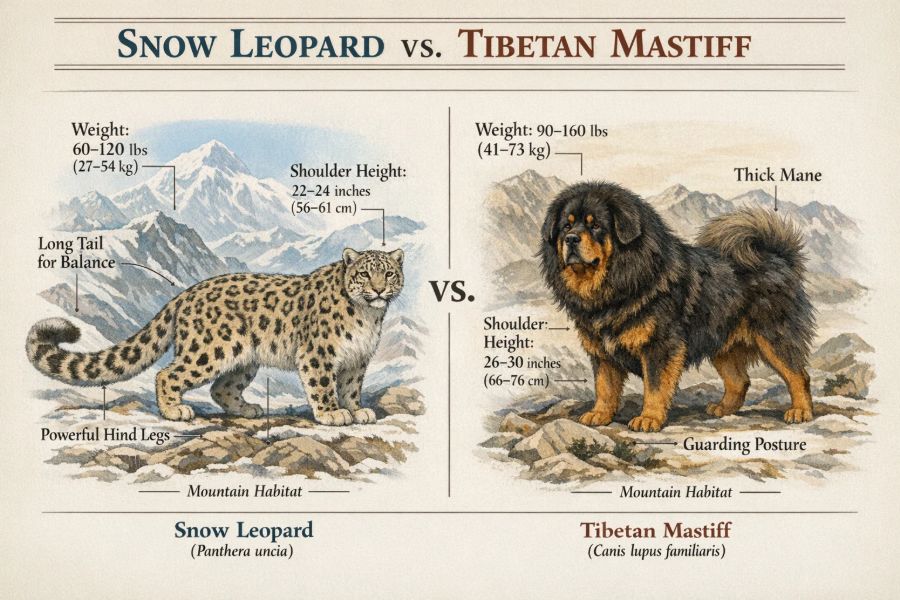
| Typical adult size | About 23–41 kg; about 0.6 m at the shoulder; total length about 2.1 m including tail | Males about 90–150 lb (41–68 kg), females about 70–120 lb (32–54 kg); males at least 26 in at the withers | The mastiff may equal or exceed the cat in mass, but not in predatory specialization |
| Main tools | Canines, claws, ambush bite, agility, jumping, mountain balance | Powerful jaws, body mass, thick coat, intimidation, guarding instincts | Cat is optimized for killing; dog is optimized for defense and warning |
| Natural fighting style | Solitary stalk-and-rush predator | Territorial guardian, usually most effective around people, herds, or property | Context changes the likely outcome |
| Best terrain | Steep, broken, rocky mountain habitat | Camps, corrals, homesteads, herd edges | Snow leopard is a mountain hunter; mastiff is a protected-space defender |
| Normal target type | Mostly wild sheep and goats, sometimes livestock | Not a predator by design; a guardian animal | Their evolutionary jobs are fundamentally different |
| Most realistic advantage | Lethal one-on-one encounter | Deterrence and livestock defense system | “Winning” depends on what problem is being solved |
Source note: Snow leopard size, status, and mountain adaptations come from Britannica, IUCN, WWF, and Snow Leopard Trust materials; Tibetan Mastiff size and guardian temperament come from AKC breed information and the AKC breed standard.
The Snow Leopard: A Mountain Predator Built for Precision
Snow leopards live across the high mountains of Central and South Asia, including the Himalaya and the Tibetan Plateau. Britannica describes them as cats of steep mountain country, and WWF and National Geographic emphasize the same theme: powerful hind limbs, a long tail for balance, and a body built for broken, vertical terrain. They are not especially large by big-cat standards, but they are highly specialized. Their long tail helps balance on cliffs and can also wrap around the body for warmth, while their hind limbs allow extraordinary jumping in rugged mountain environments.
That specialization is crucial. A snow leopard does not need to be as heavy as a Tibetan Mastiff to be dangerous. It is a wild felid that survives by locating prey, closing distance quickly, controlling body position, and inflicting decisive bites and claw injuries. In zoological terms, it is a killing specialist, not a general-purpose fighter.
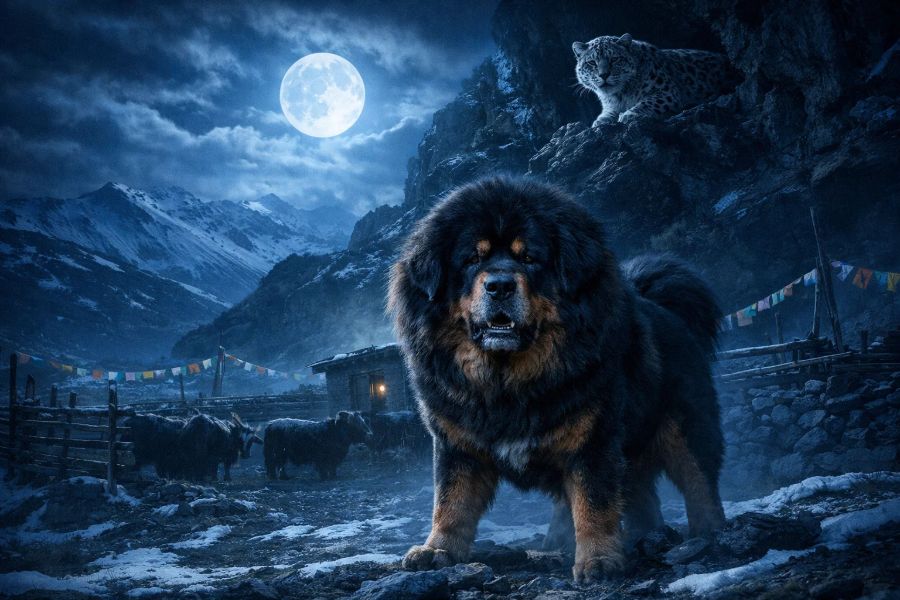
The Tibetan Mastiff: A Guardian, Not a Natural Apex Predator
The Tibetan Mastiff, by contrast, is a domestic working breed. The AKC describes it as watchful, aloof, imposing, and intimidating, while the AKC breed standard states that it has been used primarily as a family and property guardian for many millennia and is highly protective of its people and property. The standard also describes it as large, athletic, and substantial rather than truly gigantic.
This point is often missed in “who would win” discussions. A Tibetan Mastiff was not shaped by natural selection to stalk and kill dangerous mountain carnivores alone. It was shaped by people to guard, warn, stand ground, and make predation costly. That is a very different job from being a solitary predator. As a result, the mastiff’s real-world strength is often greatest when it functions as part of a protection system involving herders, enclosures, and sometimes multiple dogs. That last point is an inference from guardian-dog ecology rather than a direct statement of the breed standard.
Size: The Dog May Be Heavier, but Size Is Not the Whole Story
On paper, the Tibetan Mastiff can be heavier than a snow leopard. AKC breed information lists male Tibetan Mastiffs at roughly 90–150 pounds (41–68 kg), while Britannica gives adult snow leopards a weight of about 23–41 kg (50–90 pounds). So in simple body mass, many mastiffs match or outweigh the cat.
However, zoologists are usually cautious about treating body weight as the decisive factor. Snow leopards are ambush predators with claws, sharp canines, flexible spines, and highly refined prey-control behavior. Tibetan Mastiffs are powerful dogs, but they are still domestic canids whose selection history emphasizes guarding temperament more than solo predatory efficiency. In other words, the mastiff may have a mass advantage, but the snow leopard retains a likely weapon-system and killing-technique advantage. This is an inference from anatomy and ecology, not a direct field experiment.
What Snow Leopards Usually Hunt
Snow leopards mostly hunt wild ungulates rather than dogs. Snow Leopard Trust materials identify blue sheep, ibex, and argali among their most important prey, and a broad diet review found that snow leopards significantly preferred prey in roughly the 36–76 kg range, with blue sheep and Siberian ibex among the main preferred prey. Livestock can form an important part of the diet locally, but globally wild prey still dominates.
That preferred prey range is interesting because it overlaps with the weight of many Tibetan Mastiffs. But overlapping in weight does not mean a mastiff is just another prey animal. A defended, barking, retaliating guardian dog near people or livestock behaves very differently from a wild sheep or goat. Still, the overlap does show why size alone would not make a mastiff automatically “too big” for a snow leopard to handle.
How Human–Snow Leopard Conflict Changes the Picture
Much of the real ecological literature on snow leopards is not about dramatic duel-like encounters. It is about livestock predation, corrals, wild prey depletion, and coexistence. Studies from Nepal and conservation materials from Snow Leopard Trust show that snow leopards do kill livestock, that depredation can be a major source of conflict, and that poorly protected night corrals can be especially vulnerable. Snow Leopard Trust even notes that a snow leopard entering a livestock enclosure may kill many animals in a single incident.
This is where guardian dogs matter. A 2021 study in Conservation Science and Practice found that livestock guardian dogs reduced annual livestock losses to predation in Mongolia and concluded that LGDs are likely a viable protection method alongside predator conservation in Asia. That study was not about Tibetan Mastiffs specifically, but it strongly supports the broader principle that guardian dogs work mainly by deterring predation risk, not by proving themselves in cinematic one-on-one fights.
So Who Has the Edge?
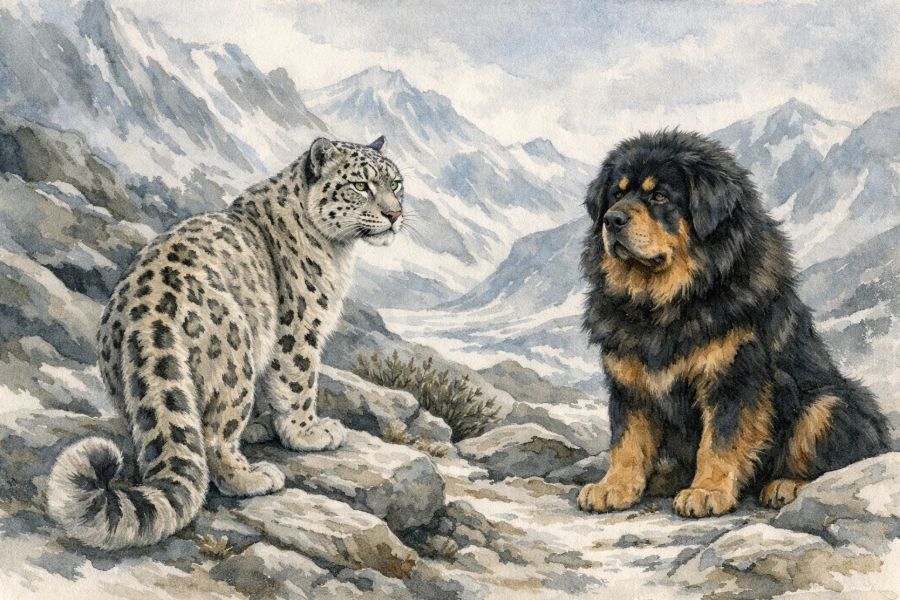
If the question is, “Which animal is more likely to win a single lethal encounter with no human help?”, the more cautious scientific answer is the snow leopard. The reason is not that it is always bigger—often it is not—but that it is a wild mountain cat specialized for stalking, seizing, and killing resistant prey. It has claws, fast directional changes, vertical agility, and the behavioral toolkit of an apex predator. The mastiff is formidable, but its selection history points more toward guarding than toward efficient solo killing of wild carnivores. This is a reasoned inference from comparative biology, not a claim backed by a large set of direct duel records.
If the question is, “Which is more likely to control the situation around a camp, corral, or herd?”, the answer shifts toward the Tibetan Mastiff system. A mastiff barking, patrolling, and acting near livestock and humans can make an attack too risky or too costly for a snow leopard. In that context, the dog does not have to kill the cat; it only has to prevent a successful attack. Guardian-dog research and snow-leopard conflict studies strongly support the importance of that kind of deterrence.
The Most Scientific Verdict
A zoologist would therefore separate the question into two different verdicts. In pure combat, the snow leopard is the more dangerous animal. In livestock defense, the Tibetan Mastiff can be the more effective actor. The first reflects predatory specialization; the second reflects human-animal cooperation and deterrence. The literature supports the second type of interaction much more clearly than the first.
Conservation Perspective
There is also an ethical and ecological reason to frame this carefully. The snow leopard is listed as Vulnerable on the IUCN Red List, whereas the Tibetan Mastiff is a domestic breed, not a wild species with an IUCN wildlife status. Real conservation priorities involve reducing livestock losses, protecting corrals, maintaining wild prey, and lowering retaliatory killing. That matters far more than turning a predator and a guardian breed into a fantasy deathmatch.
Conclusion
So, Snow Leopard vs Tibetan Mastiff does not have one universal answer. A snow leopard is the better natural killer and would be my cautious pick in a solitary, high-risk, one-on-one encounter. A Tibetan Mastiff, however, is not meant to play by the predator’s rules; it is meant to make predation fail through vigilance, territoriality, and defense near people and livestock. In the real world, that distinction is everything.
References
Encyclopaedia Britannica. Snow leopard. Current species overview including size, habitat, diet, and conservation background.
IUCN Red List search results. Panthera uncia listed as Vulnerable.
American Kennel Club. Tibetan Mastiff breed profile. Size range and general temperament summary.
American Kennel Club. Official Standard of the Tibetan Mastiff. Guardian role, temperament, and conformation standard.
Snow Leopard Trust. Snow Leopard Fact Sheet and Prey pages. Range, prey base, threats, and physical features.
Lyngdoh, S. et al. 2014. Prey Preferences of the Snow Leopard (Panthera uncia): Regional Diet Specificity Holds Global Significance for Conservation. PLOS ONE / PMC version.
Chetri, M. et al. 2019. Patterns of livestock depredation by snow leopards and other large carnivores in the Central Himalayas, Nepal. Global Ecology and Conservation.
Karki, A. et al. 2021. Factors affecting livestock depredation by snow leopards in the Himalayan region of Nepal. PeerJ / PMC version.
Lieb, Z. et al. 2021. Impact of livestock guardian dogs on livestock predation in rural Mongolia. Conservation Science and Practice.
WWF / National Geographic / Snow Leopard Trust fact materials on snow leopard movement and mountain adaptations.