When people imagine Komodo Dragon vs Venomous Snake, they often picture a giant lizard brute-forcing its way through a deadly bite. Zoologically, though, this matchup is more complicated. A Komodo dragon (Varanus komodoensis) is the world’s largest living lizard, a powerful ambush predator and scavenger with serrated teeth, a strong pulling bite, and venom that promotes blood loss and shock. A venomous snake is not one animal but a broad category, including cobras, pit vipers, kraits, and many others. So the most scientific way to handle this topic is to compare the Komodo dragon with large terrestrial venomous snakes of Southeast Asia, especially the king cobra as the best-known example.
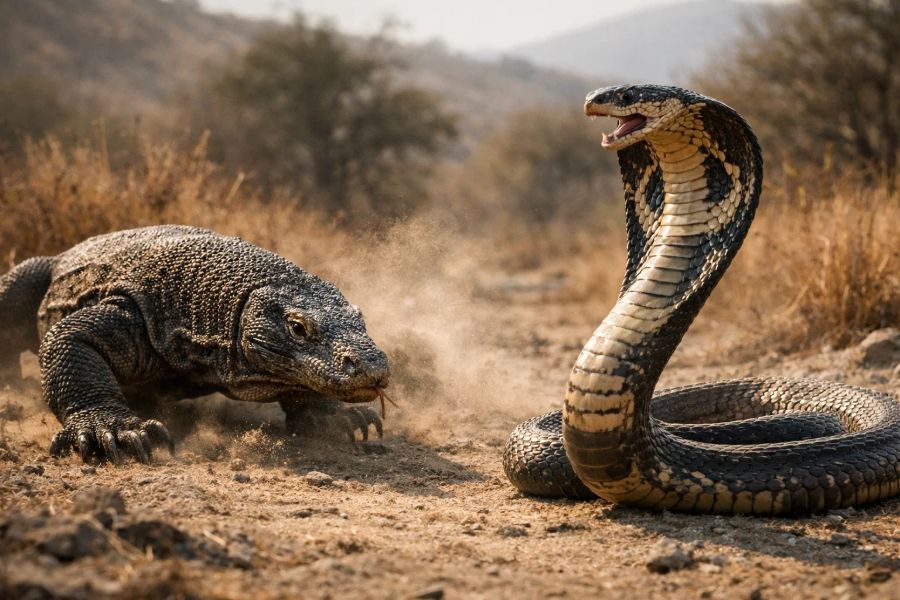
The short conclusion is this: a Komodo dragon usually has the advantage in a close, direct physical encounter because of its massive size, thick body, powerful jaws, and ability to absorb and keep fighting through trauma. A venomous snake has the advantage at distance, especially if it lands a clean early bite and avoids being pinned or crushed. So the real answer depends less on “who is more dangerous” in the abstract and more on distance, strike timing, species of snake, and whether the dragon can close the gap quickly.
Quick Comparison Table
| Feature | Komodo Dragon | Venomous Snake (example: King Cobra) | Why It Matters |
|---|---|---|---|
| Scientific identity | Varanus komodoensis | Varies by species; e.g. Ophiophagus hannah | “Venomous snake” is not one fixed opponent |
| Typical adult size | Wild adults often around 70 kg; largest verified individuals over 3 m and about 166 kg | King cobras usually under 3.6 m, with a confirmed maximum of 5.6 m | Dragon has far greater bulk; snake may have greater reach |
| Main weapons | Serrated teeth, powerful bite-and-pull action, claws, body mass, venom | Venom delivery through fangs, fast strikes, distance control | Dragon wins by contact; snake wins by successful envenomation |
| Body protection | Thick hide, heavy musculature, robust skull, armored skin with osteoderms | Flexible body, speed, strike range, threat display | Dragon is harder to disable quickly |
| Typical fighting style | Rush, bite, hold, tear, overpower | Warn, rear, strike, retreat, re-strike | Very different combat strategies |
| Best combat range | Close contact | Striking distance | Range decides much of the contest |
| Conservation status | Endangered | Varies by species; king cobra is Vulnerable | Both face conservation pressures |
These figures are drawn from Smithsonian, Britannica, National Geographic, and peer-reviewed venom research.
The Komodo Dragon: A Giant Lizard Built for Violent Contact
The Komodo dragon is the largest living lizard on Earth. Smithsonian notes that wild dragons typically weigh about 70 kilograms, while the largest verified specimen reached 3.13 meters and 166 kilograms. Britannica and National Geographic likewise describe them as massive island predators and scavengers capable of attacking deer, pigs, and other large prey. That size alone makes a Komodo dragon a radically different opponent from the mammals or smaller reptiles many venomous snakes usually deal with.
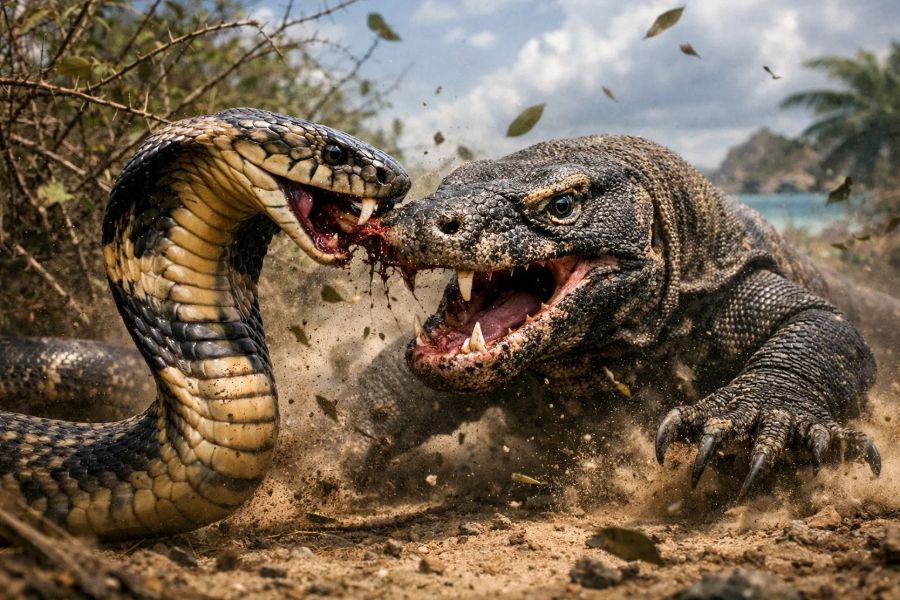
Komodo dragons are not just oversized lizards; they are specialized for forceful biting and tearing. Fry and colleagues showed that their skull is better adapted to resist pulling loads than to generate mammal-like crushing bite force, and that their bite is backed by venom with anticoagulant and shock-inducing effects. In other words, the Komodo dragon does not merely chomp—it bites, holds, rips, and lets trauma plus venom do the rest.
What “Venomous Snake” Really Means
“Venomous snake” covers a huge range of animals with very different weapons. Some are primarily neurotoxic species, like cobras and kraits, whose venom disrupts nerve and breathing function. Others are hemotoxic or tissue-damaging species, like many vipers, whose venom causes bleeding, swelling, pain, or tissue destruction. That means there is no single answer unless we define the opponent more precisely.
For a realistic Southeast Asian comparison, the king cobra is the most useful example. Britannica describes it as the world’s largest venomous snake, found from India through Southeast Asia to the Philippines and Indonesia, with most individuals under 3.6 meters and a confirmed maximum of 5.6 meters. Smithsonian and National Geographic note that its venom is not the most potent among snakes, but it can deliver a large quantity and cause rapid respiratory collapse.
Size, Mass, and Reach
This matchup is a lesson in tradeoffs. A king cobra may be longer than a Komodo dragon, but length is not the same as mass. A big dragon outweighs even a huge king cobra by a wide margin. That matters because body mass affects whether an animal can absorb impact, push through contact, pin the other animal, and survive initial trauma. The snake has the reach edge; the dragon has the weight edge.
In practical terms, the snake wants the fight to happen at the edge of its strike zone. The dragon wants to turn the interaction into a short-range collision. Once the Komodo dragon gets its jaws onto a snake’s body, the contest changes dramatically, because a long snake is extremely vulnerable to compression, tearing, and being shaken or pinned by a much heavier opponent. This is an inference from comparative anatomy and feeding biology, but it fits the way both animals are built.
Weapons: Fang Strike vs Bite-and-Tear
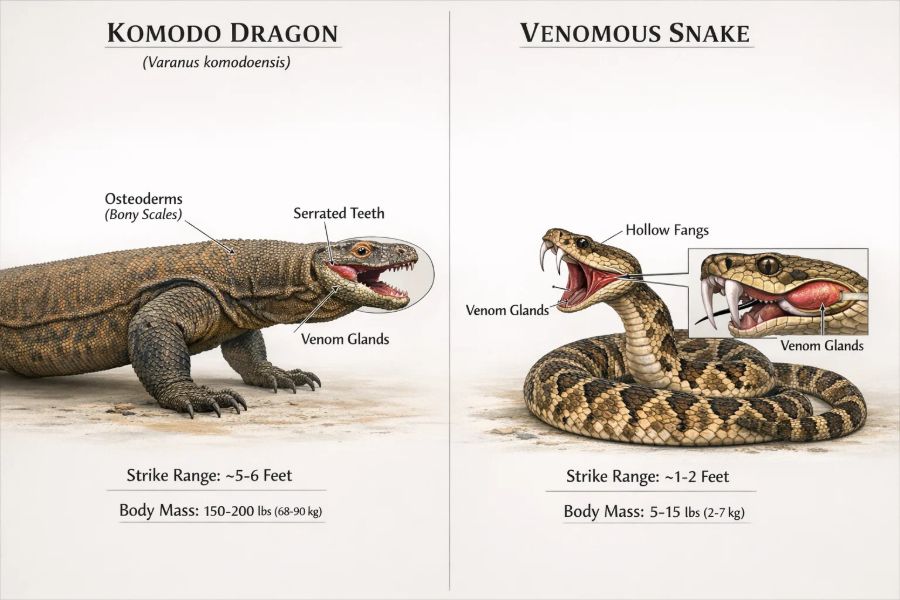
A venomous snake’s best weapon is precision. It does not need to overpower a Komodo dragon physically; it needs to land venom effectively, ideally before the dragon secures contact. Smithsonian explains that a king cobra bite sends venom through hollow fangs and can incapacitate prey quickly by attacking the nervous system, especially breathing. National Geographic adds that the volume of venom delivered can be enormous.
The Komodo dragon’s weapon system is cruder but devastating. Its teeth are serrated, its head and neck are built for pulling, and its venom promotes blood loss and shock. Fry’s 2009 study directly rejected the old popular idea that “mouth bacteria” were the primary killing mechanism and instead pointed to a combined arsenal of deep wounds plus venom. Against a snake, that means the dragon does not need a neat kill bite to the skull; any secure bite that tears tissue and destabilizes the snake can be decisive.
Body Protection: The Dragon’s Underrated Advantage
One reason this matchup tends to favor the Komodo dragon more than people expect is body protection. Komodo dragons are robust, muscular reptiles with heavily scaled skin, and adult skin is reinforced by osteoderms, bony structures embedded in the skin that function like natural armor. While that does not make them immune to snakebite, it does make them harder to disable mechanically than a softer-bodied animal of similar size.
A snake’s bite still matters enormously, especially if it lands on softer areas such as the face, throat, limb joints, or mouth tissues. But a dragon is not an easy target to penetrate deeply or control physically, and unlike many prey animals, it is built to continue attacking through pain and blood loss. That does not mean venom cannot work on a Komodo dragon; it means the snake often gets only a very small time window before the dragon’s mass and momentum become overwhelming. This is an inference, not a direct experimental result.
What Do Komodo Dragons Actually Eat?
Komodo dragons mainly eat carrion, but they also ambush and kill large prey such as deer, pigs, and cattle. Britannica states that carrion is their main diet item, while Animal Diversity Web notes that they also attack a variety of large vertebrates. Juveniles eat smaller reptiles, birds, and other animals. This makes them ecological generalists compared with many large snakes, which are often more taxonomically specialized.
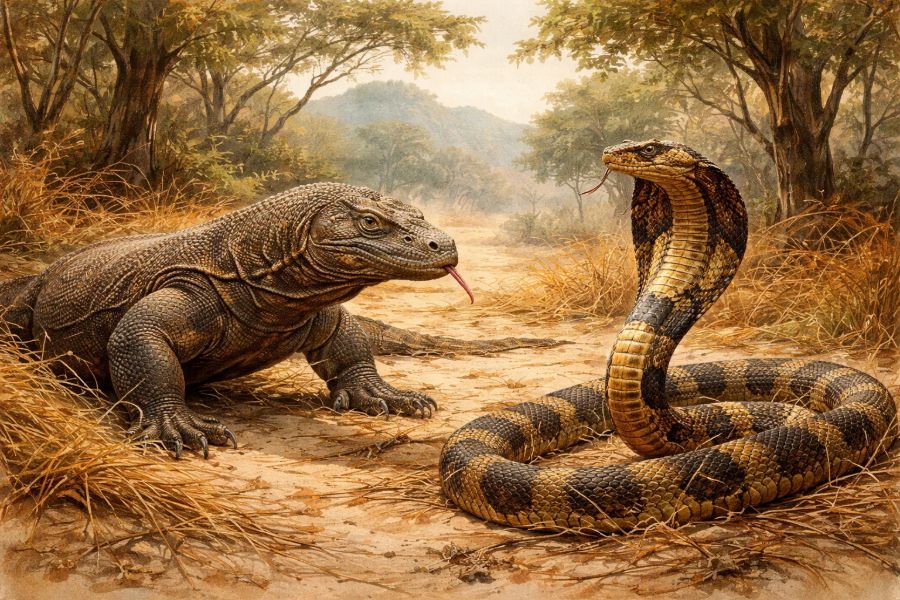
Importantly, Komodo dragons are also known to eat other reptiles, including smaller dragons. That does not prove routine combat with venomous snakes, but it shows they are not behaviorally naïve around elongated reptilian prey. A giant monitor lizard is a very different opponent from the mammals that many venomous snakes regularly envenomate.
What Do Large Venomous Snakes Actually Hunt?
Large venomous snakes such as king cobras are formidable predators, but their ecology differs sharply from that of the dragon. Britannica and Smithsonian note that king cobras feed chiefly on other snakes, including venomous ones. They are highly specialized, agile, and dangerous, but they are not built to wrestle down a 70-kilogram armored lizard by brute force. Their victory condition is early toxic success, not sustained body control.
That distinction matters. A king cobra is extremely efficient against prey it can bite, track, and subdue at range. A Komodo dragon, by contrast, is one of the few reptiles large and tough enough to make “just bite it once” a much less certain strategy. The snake remains dangerous—but the dragon is a bad matchup for any animal that relies on distance remaining intact.
So Who Has the Edge?
If the scenario is a clean opening strike by a large venomous snake, especially to a vulnerable area, the snake’s odds are real. Neurotoxic venom from a king cobra can act rapidly, and a dragon is not known to have special immunity to cobra venom. A successful early bite followed by disengagement is the snake’s best route to victory.
If the scenario is a close-range clash where the Komodo dragon gets hold of the snake, the balance shifts strongly toward the dragon. The dragon is heavier, harder to injure physically, and built to win messy contact fights. Its jaws, pulling action, and sheer body mass make it far more likely to destroy the snake once contact is secured.
So the most scientifically honest verdict is this: the venomous snake has the first-strike advantage, but the Komodo dragon has the overall edge in most direct confrontations because it is so large, armored, and dangerous at contact range. A cobra can absolutely kill; a Komodo dragon is simply the kind of reptile that gives the snake very little margin for error.
Conservation Context
The Komodo dragon is currently classified by IUCN as Endangered, with major concerns including habitat loss and climate-change-driven sea-level rise on its island range. The king cobra is widely listed as Vulnerable. So while the matchup is fascinating, the larger biological story is that both of these remarkable reptiles face growing human-driven pressures.
Conclusion
A zoologist would not reduce Komodo Dragon vs Venomous Snake to “venom beats size” or “size beats venom.” The real answer is more interesting. A venomous snake is the more elegant distance fighter. A Komodo dragon is the more formidable close-contact reptilian tank. If the snake lands first and escapes, it can win. If the dragon closes the gap, it usually becomes the favorite very quickly. In most realistic direct encounters, that makes the Komodo dragon the more likely overall winner, while still leaving room for a large venomous snake to prevail under the right strike-first conditions.
References
Fry, B. G. et al. 2009. A central role for venom in predation by Varanus komodoensis (Komodo Dragon). PNAS. Evidence that Komodo dragons use venom associated with anticoagulation and shock rather than relying mainly on mouth bacteria.
Encyclopaedia Britannica. Komodo dragon. General overview of size, diet, and predatory behavior.
Smithsonian’s National Zoo. Komodo dragon. Wild body mass and largest verified specimen.
Animal Diversity Web. Varanus komodoensis. Size, morphology, and diet summary.
Encyclopaedia Britannica. King cobra. Range, body length, and status as the largest venomous snake.
Smithsonian’s National Zoo. King cobra. Venom delivery and neurotoxic effects.
National Geographic. King cobra, facts and photos. Venom quantity and physiological effects.
IUCN-linked reporting on Komodo dragon status update to Endangered, 2021.
PBS Nature / other conservation summaries noting king cobra as Vulnerable.