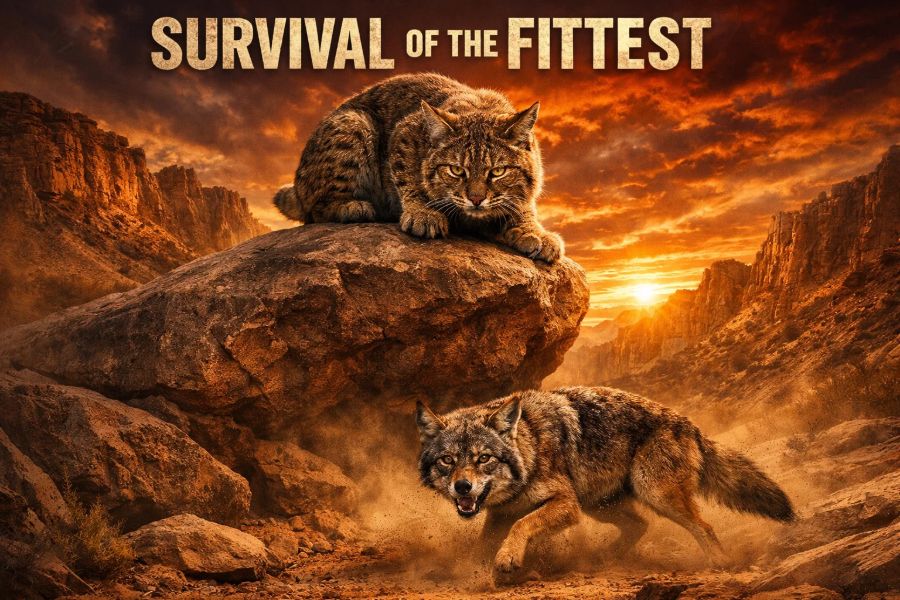
From a zoologist’s perspective, “lynx vs coyote” in North America usually means bobcat vs coyote. The bobcat (Lynx rufus) is the common North American lynx-like cat that overlaps broadly with the coyote (Canis latrans), while the Canada lynx has a more northern, snow-adapted range and a somewhat different ecological story. So the most realistic version of this matchup is a bobcat–coyote comparison, not a generic lynx-versus-dog fantasy fight.
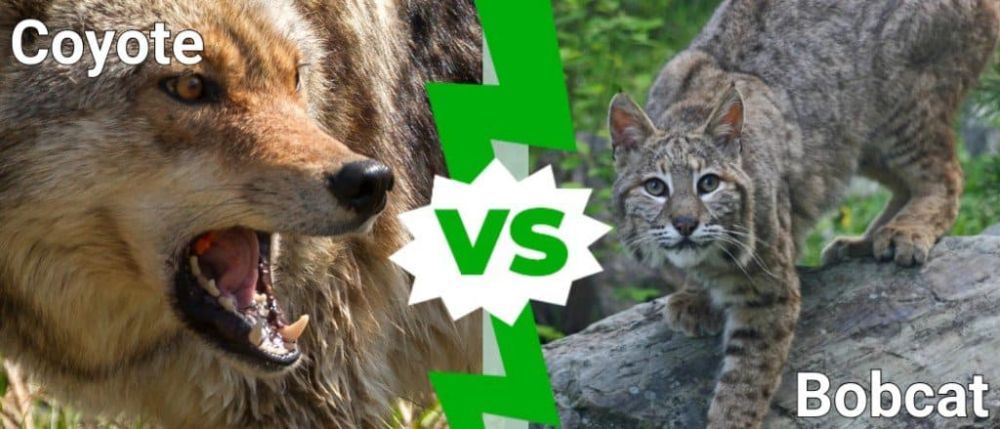
The short scientific conclusion is this: in a one-on-one close fight, a bobcat can be a very dangerous opponent, but coyotes usually hold the broader ecological advantage because they are often slightly larger, more flexible in open habitats, and can become overwhelming when more than one is involved. In the wild, the most important pattern is not dramatic duel behavior, but competition, avoidance, kill-site tension, and occasional intraguild predation.
Quick Comparison Table
| Feature | Bobcat (Lynx rufus) | Coyote (Canis latrans) | Why It Matters |
|---|---|---|---|
| Typical role | Solitary ambush cat | Solitary or social canid | Cats and canids solve predation differently |
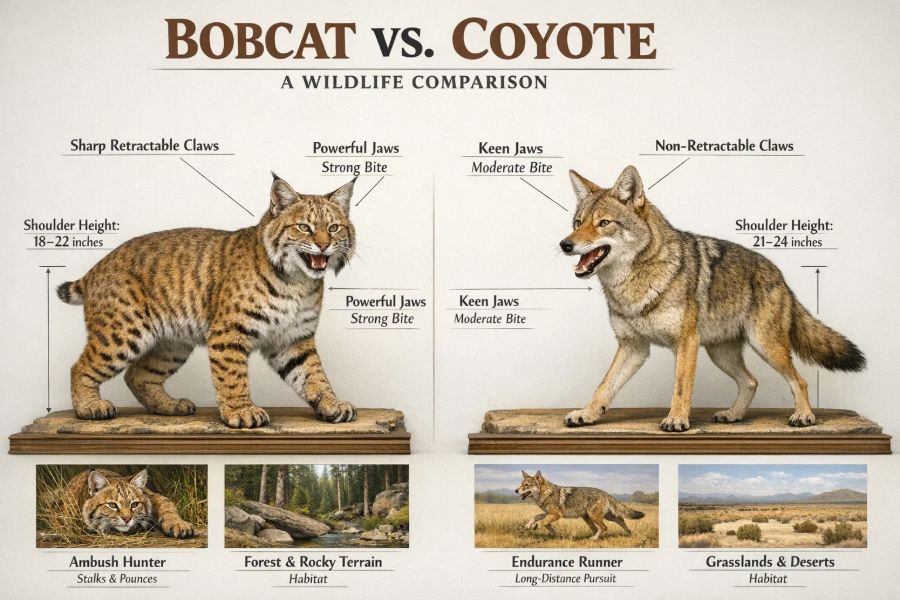
| Typical adult size | 4–15 kg; shoulder height 45–58 cm | 9–23 kg; shoulder height about 60 cm | Coyotes are often somewhat larger |
| Main weapons | Retractable claws, grappling forelimbs, short ambush rush, killing bite | Bite, stamina, speed, harassment, sometimes group pressure | Bobcat excels up close; coyote excels in pursuit and persistence |
| Social system | Mostly solitary | Flexible, from solitary to family groups | Numbers can change outcomes dramatically |
| Best terrain | Brushy cover, broken ground, ambush habitat | Open or mixed habitat, travel corridors, edge zones | Habitat strongly affects who has the edge |
| Typical interaction | Avoidance, occasional conflict | Avoidance, competition, occasional aggression | Real encounters are usually not “arena fights” |
| Likely edge in direct duel | Bobcat is dangerous at contact range | Coyote often has size and endurance edge | Outcome depends on terrain and surprise |
| Likely edge in broader landscape | Limited by coyote pressure in some places | Often behaviorally dominant | Coyotes can displace or kill bobcats in some systems |
Data summarized from Animal Diversity Web, Britannica, and peer-reviewed bobcat–coyote interaction studies.
Meet the Contenders
The bobcat is a medium-sized North American wild cat with a short tail, tufted ears, strong forelimbs, and a classic feline ambush design. Animal Diversity Web reports a body length of 65–105 cm, shoulder height of 45–58 cm, and a body mass of 4–15 kg. Britannica likewise describes the bobcat as a solitary and mostly crepuscular cat that thrives in forests, deserts, and even some suburban landscapes.
The coyote is a lightly built but highly adaptable North American canid. Britannica gives a typical shoulder height of about 60 cm, body mass of about 9–23 kg, and total length of roughly 1–1.3 m including the tail. Unlike the bobcat, the coyote has a more flexible social system and may live alone, in pairs, or in family groups, which matters enormously in any comparison.
Size and Build
In many regions, the coyote is somewhat larger on average than the bobcat. That size difference is not extreme, which is why the matchup is interesting, but it is real enough to matter. A bobcat is compact, muscular, and built for explosive control at close range. A coyote is taller-legged, longer-bodied, and better designed for movement over ground and sustained harassment.
That means the contest is not just about weight. The bobcat’s body is optimized for seizing, grappling, and delivering a short-range killing bite, while the coyote’s body is optimized for running, testing distance, and using mobility to manage risk. So even though the coyote often has the size edge, the bobcat remains extremely dangerous if the fight collapses into close contact. This is an inference from comparative anatomy and hunting style.
Hunting Style: Ambush Cat vs Opportunistic Canid
Bobcats are classic ambush predators. They usually rely on stealth, cover, and a short rush rather than long pursuits. This fits the general felid pattern: get close unseen, then win fast. In dense brush, broken terrain, or rocky edges, that approach can make a bobcat a very dangerous opponent.
Coyotes hunt differently. They are more flexible, using stalking, pouncing, scavenging, and longer chases depending on prey and habitat. Their advantage is not elegant feline grappling but adaptability, mobility, and persistence. When a coyote is alone, this does not automatically make it superior to a bobcat. But when a second coyote enters the situation, the balance changes sharply.
What the Scientific Literature Shows
The most important evidence comes from studies of intraguild competition. Fedriani and colleagues found behavioral dominance of coyotes over bobcats in the Santa Monica Mountains and reported that 2 of 5 recorded bobcat deaths in their dataset were due to coyote predation, while no coyotes were recorded as dying from interactions with bobcats. That does not mean coyotes always beat bobcats, but it is strong evidence that coyotes can be the dominant competitor in some systems.
Later work reinforced the idea that bobcats often treat coyotes as a danger to be managed rather than ignored. Wilson and colleagues found that bobcats used prey-mediated avoidance of coyotes, with some individuals avoiding risky areas while others were forced into them depending on prey distribution. More recently, Jensen and colleagues found large-scale overlap but fine-scale avoidance between bobcats and coyotes, noting that bobcats occasionally experience intraguild predation from coyotes.
A 2022 review of bobcat–coyote studies also concluded that interference competition between the two is a real and recurring pattern, especially in open habitat. In other words, the broad scientific picture is not “they ignore each other,” but “they often overlap, compete, and adjust behavior according to risk.”
So Who Wins in a Direct Fight?
If the scenario is one healthy adult bobcat versus one healthy adult coyote in close quarters, the answer is less one-sided than many people expect. The bobcat has claws, excellent grappling control, and the sort of close-range violence that makes cats dangerous even when slightly smaller. A careless coyote could absolutely be injured or killed.
But if the question is which animal is more likely to come out ahead overall, the balance tilts toward the coyote, mainly because it is often somewhat larger and because real encounters do not happen under fair-duel rules. Coyotes pressure space, force avoidance, and sometimes kill bobcats; the reverse pattern is much less supported in the literature I found.
If the scenario involves more than one coyote, the coyote side becomes heavily favored. The title “lynx vs coyote” sounds like an individual contest, but in real landscapes the coyote’s social flexibility is one of its biggest advantages. A bobcat can be formidable against one opponent; it is far less well positioned against two or more coordinated canids.
Habitat Changes the Odds
Habitat matters enormously. Studies and reviews suggest that coyote pressure on bobcats is often strongest in more open habitats, while bobcats tend to do better in areas with cover, roughness, and ambush-friendly structure. Jensen et al. found that terrain ruggedness mattered for both species, with bobcats showing the strongest preference for rugged terrain, while coyotes weakly avoided rugged areas. That makes ecological sense: the bobcat wants concealment and short engagement distances; the coyote does better where movement and detection are easier.
So a bobcat on rocky ground, in brush, or near cover is not the same matchup as a bobcat crossing open country. In an “arena” the comparison seems simple; in nature, terrain changes everything.
The Conservation Angle
Both species are currently widespread and generally classified as Least Concern in the sources available here. The bobcat’s IUCN assessment lists it as abundant, wide-ranging, and not declining fast enough to approach a threatened category, while coyote sources likewise reflect a broad, successful, expanding canid across much of North America. The more interesting ecological issue is not species-level survival, but how mesopredators affect one another across changing human-dominated landscapes.
Final Verdict
A zoologist’s verdict would be this: the bobcat is the more dangerous close-range individual fighter, but the coyote is usually the stronger ecological competitor. In a sudden one-on-one clash, the bobcat can absolutely hold its own and may win under the right conditions. Across real landscapes, though, the evidence shows that coyotes often impose enough risk that bobcats avoid them, lose access to space, or occasionally die from coyote attacks.
So the most scientifically honest answer is not “lynx always wins” or “coyote always wins.” It is this: in a single tight fight, the outcome is variable; in the broader contest of North American ecology, the coyote often has the upper hand.
References
Fedriani, J. M., Fuller, T. K., Sauvajot, R. M., & York, E. C. 2000. Competition and intraguild predation among three sympatric carnivores. Oecologia. Evidence of coyote dominance and coyote-caused bobcat mortality.
Wilson, R. R., Blankenship, T. L., & Hooten, M. B. 2010. Prey-mediated avoidance of an intraguild predator by its intraguild prey. Study showing bobcat spatial strategies around coyotes.
Jensen, R. et al. 2024. Large-scale overlap and fine-scale avoidance: assessing interactions between coyotes, bobcats, and cougars at multiple scales. Journal of Mammalogy.
Dyck, M. A. et al. 2022. When carnivores collide: a review of studies exploring the interactions between bobcats and coyotes. Review emphasizing interference competition, especially in open habitats.
Animal Diversity Web. Lynx rufus account. Body size and ecology.
Animal Diversity Web. Canis latrans account. Life history and coyote ecology.
Encyclopaedia Britannica. Bobcat. Range and general ecology.
Encyclopaedia Britannica. Coyote. Size and general ecology.
IUCN Red List / Cat Specialist Group sources for bobcat conservation status.