From a zoologist’s perspective, “Serval vs Snake” is not one fixed matchup. A serval (Leptailurus serval) is a medium-sized African wild cat adapted for stalking and pouncing in tall grass, while “snake” could mean anything from a small harmless colubrid to a thick-bodied puff adder or a highly dangerous cobra. So the most scientific way to treat this topic is to compare the serval with African snakes in general, while separating nonvenomous snakes from the more dangerous venomous species it may encounter in savanna and grassland habitats.
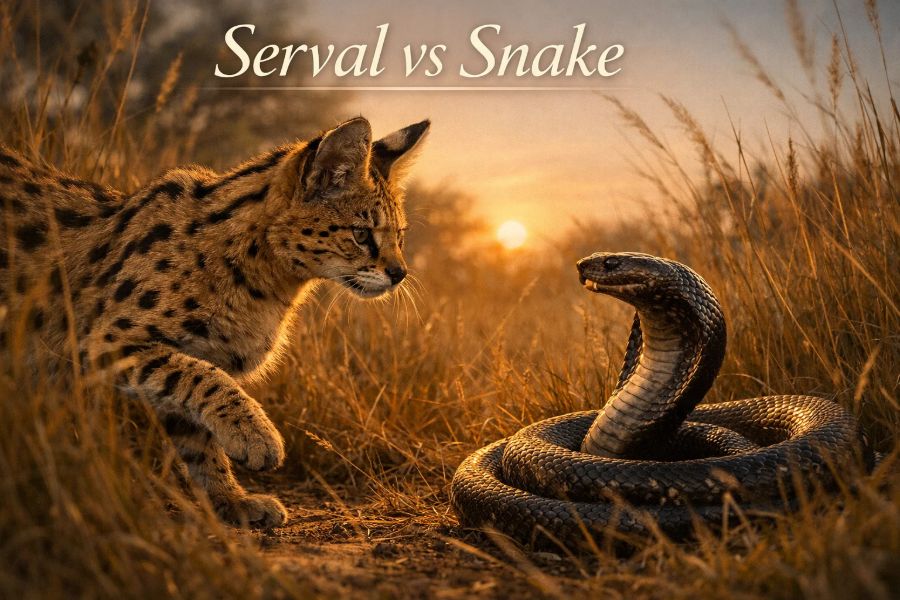
The short conclusion is this: against most small or moderate-sized nonvenomous snakes, the serval usually has the edge because it is faster, more mobile, and built to pin and bite small vertebrate prey. Against a dangerous venomous snake, especially a puff adder or cobra, the risk rises sharply, because one well-placed strike can turn a successful hunt into a lethal mistake. So the outcome depends less on “cat versus snake” in the abstract and more on snake species, body size, strike distance, and whether the serval controls the head early.
Quick Comparison Table
| Feature | Serval | Snake | Why It Matters |
|---|---|---|---|
| Scientific identity | Leptailurus serval | Many possible species | “Snake” is too broad to treat as one opponent |
| Typical adult size | 59–92 cm body length, 45–60 cm shoulder height, 7–18 kg | Small grassland snakes to large cobras or stout vipers | Serval is much heavier than many snakes, but some snakes gain reach or venom advantage |
| Main weapons | Speed, long legs, forepaw pinning, neck bite, rapid reflexes | Bite, strike speed, sometimes venom | The serval wins by control; the snake wins by landing a clean bite |
| Main hunting style | Stealth, listening, vertical pounce, pinning prey under front paws | Ambush, concealment, strike-and-release or defensive biting | Both depend on timing rather than brute force alone |
| Best range | Very close contact | Strike distance | Range control decides much of the contest |
| Highest risk opponent | Large venomous snake | Alert, fast cat with paw control | Each is dangerous when fighting on its own terms |
Serval measurements come from San Diego Zoo, and serval diet details from Animal Diversity Web. Puff adder risk and major African venomous snakes come from ScienceDirect Topics.
The Serval: A Cat Built for Precision Hunting
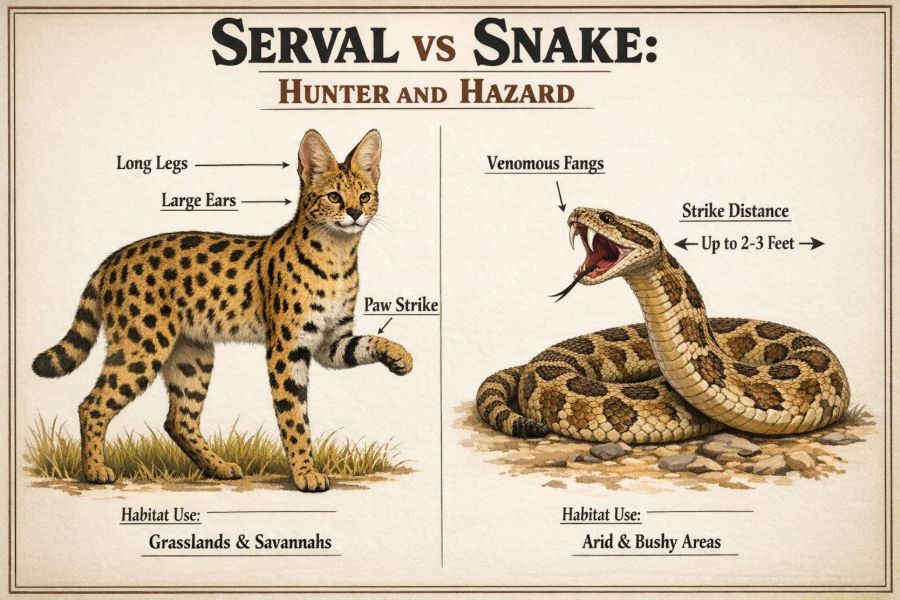
The serval is one of Africa’s most specialized small-to-medium wild cats. San Diego Zoo describes it as a highly successful predator with unusually long legs and exceptionally large ears for its body size. Adults stand about 45–60 cm at the shoulder, measure 59–92 cm in body length, and weigh about 7–18 kg. Those proportions matter because the serval is not built like a stocky lynx or housecat enlarged for Africa; it is built like a tall, spring-loaded listening machine for hunting in grassland and wet savanna.
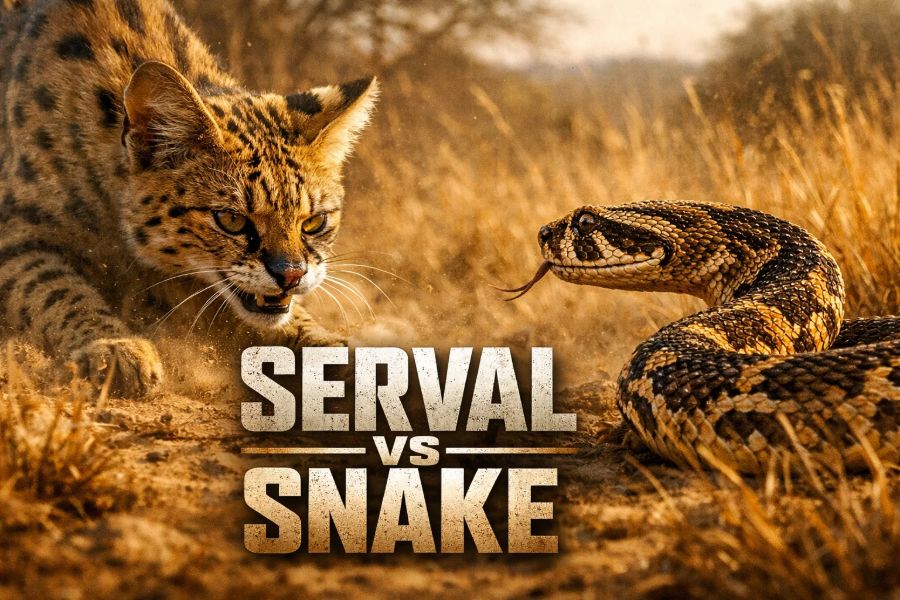
Its hunting method is especially relevant here. San Diego Zoo notes that servals often hunt by waiting in tall grass, listening for prey, then making a high leap and bringing their body weight down over the target before delivering a killing bite. That is an excellent strategy for rodents, birds, frogs, and other small animals hidden in vegetation. It also explains why a snake can be both potential prey and potential danger: the serval is evolutionarily equipped to pin fast-moving small vertebrates, but anything it pins that can strike upward with venom becomes a serious hazard.
What Do Servals Normally Eat?
Servals are not snake specialists. Animal Diversity Web reports that their diet is about 93.5% small mammals and 5% birds, with the rest including occasional insects, frogs, lizards, and very rarely carrion. That means reptiles are part of the serval’s prey spectrum, but they are not the dominant prey type. In practical terms, servals are best understood as small-vertebrate generalists with a strong rodent focus, not as dedicated snake hunters like secretary birds, some mongooses, or snake-eating raptors.
That matters because it changes how we should read the matchup. A serval can certainly kill snakes, especially smaller ones, but it is not an animal whose whole body plan or behavior evolved around defeating dangerous serpents. It is a cat optimized for stealth, hearing, and precision pouncing in grassy habitats. So when the snake is small, the serval is likely acting as an efficient opportunist. When the snake is large or venomous, the serval is entering a riskier contest outside its main specialization.
The Snake Side of the Matchup
“Snake” covers a huge range of ecological types. Some African snakes are small, relatively harmless, and vulnerable to mammalian predators. Others are major hazards. ScienceDirect Topics identifies the puff adder (Bitis arietans) as one of the most dangerous snakes across the African savanna, noting that it is stout-bodied, heavily armed with long fangs, and responsible for a large number of serious bites. The same reference also lists major dangerous African snakes more broadly, including mambas, the Egyptian cobra, puff adders, and carpet vipers.
This is why “serval vs snake” has to be broken into categories. A serval confronting a small nonvenomous grass snake is not facing the same biomechanical or toxic problem as a serval confronting a puff adder hidden in dry grass. One is mostly a prey-handling problem. The other is a high-risk encounter with a reptile that can inflict severe swelling, tissue damage, hemorrhage, or shock through a single bite.
Size, Reach, and Body Design
The serval’s main physical advantage is not raw mass alone, but height and leg reach. Compared with many similarly sized cats, it stands taller and can strike downward with its paws into grass cover. This makes it especially good at controlling prey from above. Against a snake, that vertical angle matters, because a paw strike from above can interrupt the snake’s ability to coil, align, or launch a forward strike.
The snake’s advantage is different. A snake is low to the ground, fast at short range, and often difficult to see in the same vegetation that helps the serval hunt. A viper such as a puff adder is not agile in the same way a cobra is, but it does not need to be; it only needs one effective strike within range. A cobra, by contrast, adds height and threat display, making head control more difficult. So the serval’s long-legged design is a real strength, but not a guarantee of safety.
Hunting Style: Why the Serval Can Be So Dangerous to Snakes
Cats are often good snake-killers not because they are immune to bites, but because they are good at timing, feinting, and paw placement. The serval’s hunting style already involves instant reactions to small, fast prey. San Diego Zoo emphasizes its hearing and pouncing behavior, and its reputation as a highly successful hunter fits a cat that can adjust rapidly to sudden movement. If a serval detects a snake early and starts batting or pinning at the right moment, the snake may never get a clean line for a bite.
This is why small or moderate-sized nonvenomous snakes would generally be at a disadvantage. A serval that keeps moving, attacks from above, and avoids placing its face too close can force the snake into defense rather than offense. Once the head is pinned or the neck is seized, the snake’s leverage collapses quickly. That is not specific proof from a serval-snake field study; it is a cautious inference from serval hunting mechanics and general cat prey-handling behavior.
Where the Snake Becomes Much More Dangerous
The danger rises fast when venom enters the equation. ScienceDirect Topics describes the puff adder as highly dangerous, with large quantities of potent venom, long fangs, and effects that can include massive swelling, necrosis, hemorrhage, and shock. This is exactly the type of snake that punishes a mammal for one misjudged pounce into cover. A serval does not need to lose a prolonged fight to die; it may only need to get bitten once in the wrong place.
The broader summary of dangerous African snakes also matters. Cobras and mambas bring different venom strategies from vipers. A cobra may rely more on precision and rapid envenomation, while vipers often inflict severe local tissue damage and systemic effects. That means “venomous snake” is not one danger profile either. A serval’s odds against a small rear-fanged snake are not the same as its odds against a puff adder or Egyptian cobra.
So Who Has the Edge?
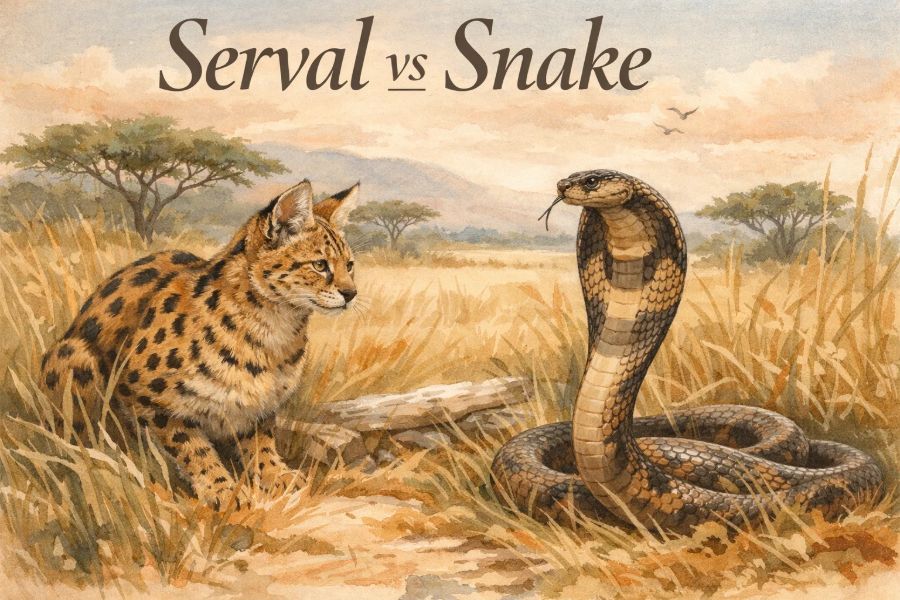
If the scenario is a serval versus a small or medium nonvenomous snake, the serval is usually the more convincing favorite. It is faster, heavier, and better able to control the encounter with paw strikes and close-range bites. Against that kind of snake, the cat is dealing with prey, not with a chemically armed ambush specialist.
If the scenario is a serval versus a large venomous snake, especially a puff adder or cobra, the contest becomes far less predictable. The serval still has the mobility and paw-control advantage, but the snake has a genuine chance to win with a single successful strike. In those cases, the serval is not an automatic winner at all; it is a skilled predator confronting prey that can become a lethal counterattacker.
So the most scientific verdict is this: the serval usually has the edge against ordinary snakes, but dangerous venomous snakes can absolutely turn the matchup if they strike first or if the serval misjudges distance. In other words, the serval is generally the better all-around physical hunter, while the snake’s best chance lies in ambush, concealment, and first contact.
Ecology Matters More Than the “Fight”
As dramatic as “Serval vs Snake” sounds, the more important biological story is that both animals are part of the same African grassland food web. Servals help regulate rodent populations, while snakes occupy multiple roles as both predators and prey. The overlap is ecological first and confrontational second. Most such interactions are probably brief, opportunistic, and decided in seconds, not prolonged showdowns.
That is why the matchup is best understood as a question of risk management. The serval is a hunter that sometimes takes reptiles. The snake is a hidden vertebrate that may be edible, harmless, venomous, or deadly depending on species. Nature does not label the difference in advance, which is exactly why these interactions are so dangerous and so interesting.
References
San Diego Zoo Wildlife Alliance. Serval species profile, including body size, hunting strategy, and general natural-history details.
Animal Diversity Web. Leptailurus serval account, including diet composition and prey categories.
Encyclopaedia Britannica. Serval overview.
ScienceDirect Topics. Bitis arietans overview, including puff adder danger, venom effects, and its importance in African snakebite.
ScienceDirect Topics. Viper Venom overview, including major dangerous African venomous snakes such as mambas, Egyptian cobra, puff adder, and carpet vipers.