Cuvier’s dwarf caiman is one of the smallest crocodilians in the world. It may be short compared with large crocodiles, alligators, and black caimans, but it is still a tough, well-armored predator that lives in South American rivers, forest streams, and wetland habitats.
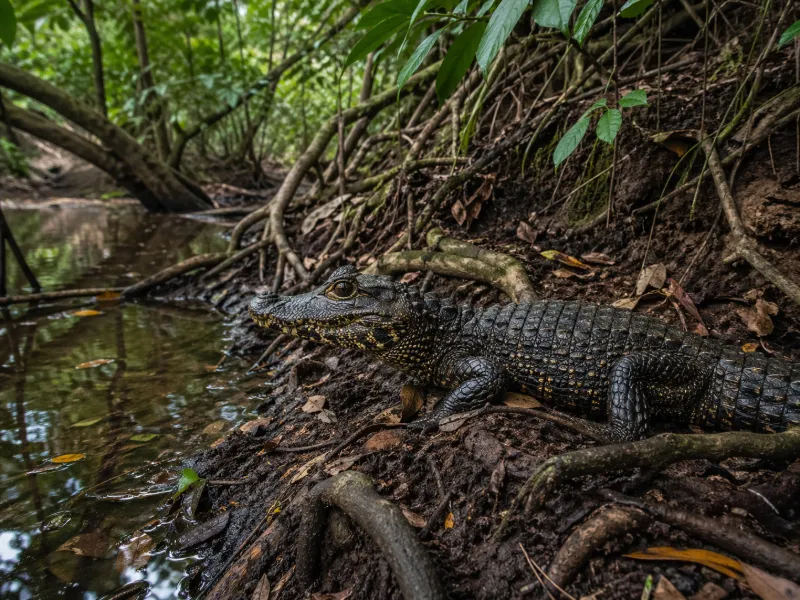
This species is known for its compact body, heavy bony armor, and dark, rugged appearance. It often lives in places with dense vegetation, muddy banks, roots, and shaded water, where it hunts fish, crustaceans, insects, amphibians, and other small prey.
In this guide, you will learn the most important Cuvier’s dwarf caiman facts, including its size, habitat, diet, behavior, appearance, and how it differs from larger caimans.
Quick facts
| Feature | Cuvier’s Dwarf Caiman |
|---|---|
| Scientific name | Paleosuchus palpebrosus |
| Group | Crocodilian in the alligator family |
| Range | Northern and central South America |
| Habitat | Forest streams, rivers, creeks, flooded forests, freshwater wetlands |
| Diet | Carnivorous |
| Typical prey | Insects, crustaceans, fish, amphibians, snails, and small vertebrates |
| Typical size | Small compared with most crocodilians |
| Main trait | Compact body, strong armor, and forest-linked freshwater lifestyle |
What is Cuvier’s dwarf caiman?
Cuvier’s dwarf caiman is a small crocodilian native to South America. It belongs to the genus Paleosuchus, which includes the dwarf caimans. Like other caimans, it is part of the alligator family rather than the true crocodile family.
It is often described as one of the smallest living crocodilians, but that does not make it weak. Its body is compact, muscular, and heavily armored, giving it a powerful and rugged look for its size.
This species is named after the French naturalist Georges Cuvier. In the wild, it is often more secretive and less obvious than larger caimans that rest in wide open marshes or riverbanks.
How big is Cuvier’s dwarf caiman?
Cuvier’s dwarf caiman is small by crocodilian standards. Most adults are much shorter than black caimans, large alligators, or the largest crocodiles.
Adult females are usually smaller than males. Many adults fall roughly between about 1.2 and 1.6 meters in length, while large males can exceed that and may approach around 1.7 to 2 meters in some cases.
Even at these lengths, the animal is not delicate. It has a stocky build, a strong tail, and heavy armor, so it often looks tougher and heavier than people expect from a “small” crocodilian.
In simple terms, Cuvier’s dwarf caiman is short compared with giant crocodilians, but still solid, muscular, and very well protected.
What does Cuvier’s dwarf caiman look like?
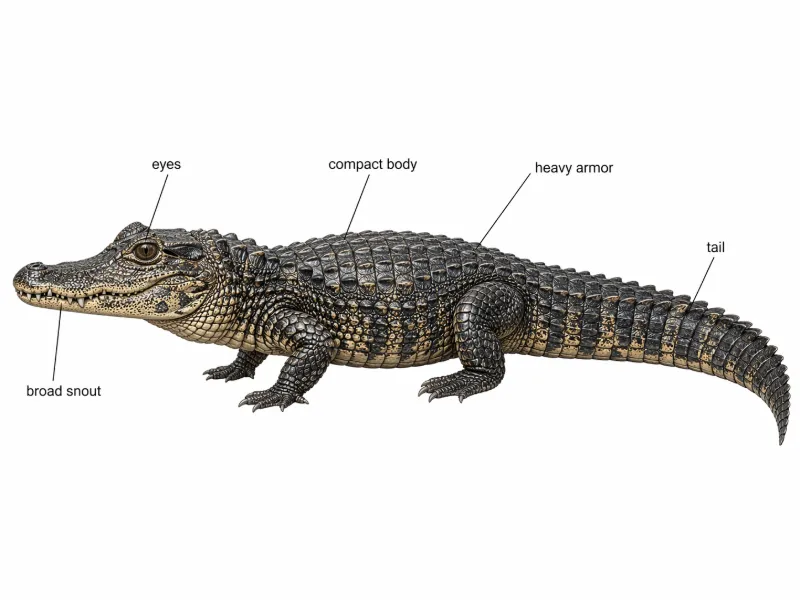
Cuvier’s dwarf caiman has a compact body, a broad and fairly short snout, a strong tail, and sturdy legs. Its skin is covered with heavy bony armor, giving it a hard, rugged appearance.
The color is usually dark brown, gray-brown, or olive-brown, which helps it blend into muddy water, shaded forest edges, and leaf litter. Juveniles often show clearer banding or patterning than adults.
One of the most noticeable features is the robust armor on the body and tail. The head also has a strong, low profile rather than the long narrow look seen in many crocodiles.
Overall, this animal often looks like a small, heavily protected tank built for life in dense tropical freshwater habitats.
Where does Cuvier’s dwarf caiman live?
Cuvier’s dwarf caiman lives in northern and central South America. Its range includes parts of countries such as Brazil, Colombia, Ecuador, Peru, Venezuela, Bolivia, Suriname, Guyana, and French Guiana, depending on local habitat and population patterns.
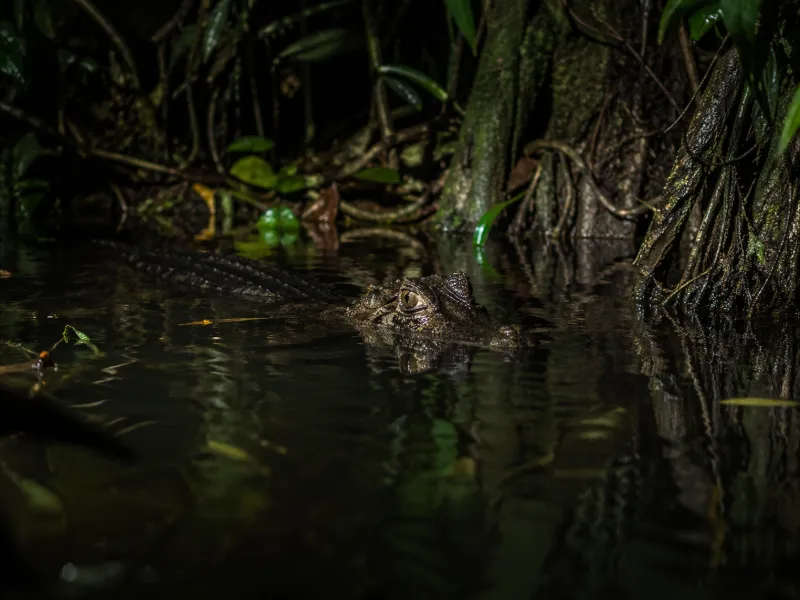
It is mainly a freshwater species. Typical habitats include forest streams, slow rivers, creeks, flooded forests, swamps, and wetland margins. In some areas, it may also use rocky or faster-flowing waters more readily than some larger caimans do.
This species often stays close to cover. Fallen branches, roots, dense bankside vegetation, and dark water can all help it remain hidden.
Because it prefers more sheltered and forested habitats, it may be harder to see than larger caimans that rest openly in broad sunlit wetlands.
What does Cuvier’s dwarf caiman eat?
Cuvier’s dwarf caiman is a carnivore and an opportunistic predator. Its diet changes as it grows.
Young individuals often feed on insects, spiders, small crustaceans, snails, tadpoles, and small fish. These prey items are common in shallow water and easy for a small crocodilian to catch.
As the animal grows, it can take larger prey such as crabs, fish, frogs, reptiles, and small mammals or birds when the opportunity appears. Its diet usually includes smaller prey than the diet of giant crocodilians, but it is still a capable hunter.
In many places, it is best thought of as a flexible predator of forest waterways that feeds on whatever suitable prey is available in streams, pools, and wetland edges.
How does Cuvier’s dwarf caiman hunt?
Like other crocodilians, Cuvier’s dwarf caiman is mainly an ambush hunter. It often waits quietly in shallow water or near the edge of a bank until prey comes close.
Its dark color and low body profile make it difficult to see in shadowy forest water. When prey moves within range, it strikes quickly with the jaws and secures the animal before swallowing or repositioning it.
Many individuals are active at night. Night activity is especially useful in forest habitats, where cooler temperatures and darkness can make hunting easier.
Although it is much smaller than giant caimans, it is highly efficient within its own habitat and prey size range.
Is Cuvier’s dwarf caiman dangerous?
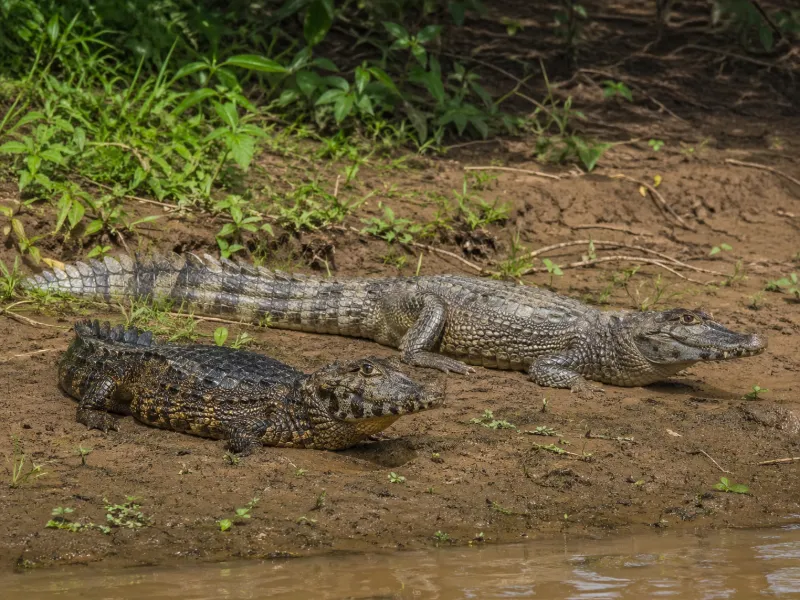
Cuvier’s dwarf caiman is still a wild crocodilian and should be treated with caution. It is much less massive than the largest crocodilians, but it can bite hard and defend itself if threatened or handled.
Its smaller size means it is not usually viewed in the same way as giant crocodiles or black caimans. Even so, it is not harmless. A cornered or stressed animal can react quickly and forcefully.
The safest approach is always to leave it alone, keep a respectful distance, and avoid handling wild individuals.
How is Cuvier’s dwarf caiman different from other caimans?
The main difference is size. Cuvier’s dwarf caiman is much smaller than species such as the black caiman and is usually smaller than spectacled and yacare caimans as well.
It also tends to be more closely associated with forest streams, shaded freshwater habitats, and sheltered waterways. Larger caimans are often more visible in open wetlands, marshes, and broad river systems.
Its heavy armor is another major feature. Many people notice that it looks especially rugged and strongly plated, even compared with larger relatives.
So if you see a compact, dark, heavily armored crocodilian in a South American forest waterway, it may be Cuvier’s dwarf caiman.
How is it different from Schneider’s dwarf caiman?
Cuvier’s dwarf caiman is often compared with Schneider’s dwarf caiman because the two are close relatives in the same genus. Both are small, armored, and associated with forest habitats.
In broad terms, Cuvier’s dwarf caiman is often described as the smaller and more compact-looking of the two. Schneider’s dwarf caiman often has a somewhat longer head and may appear slightly larger or more elongated overall, although the difference is not always obvious to casual observers.
For most general wildlife readers, the safest summary is that both are small forest-linked caimans, but Cuvier’s dwarf caiman is usually the more compact and classically “smallest crocodilian” type in popular descriptions.
Does Cuvier’s dwarf caiman live alone?
Adults are often seen alone, especially in forested habitats where visibility is low and individuals may stay hidden in separate stretches of stream or wetland edge.
This does not mean the species is completely isolated all the time. Several individuals may live in the same broader area if food and shelter are good, but they are not highly social in the way many mammals are.
Because of their secretive habits and sheltered habitats, they often seem rarer or more solitary than they really are.
How does Cuvier’s dwarf caiman reproduce?
Like other crocodilians, Cuvier’s dwarf caiman reproduces by laying eggs. The female builds a nest in a suitable area near water, often using vegetation and natural debris.
After laying the eggs, she may guard the nest area. When the young hatch, they face many dangers from fish, birds, snakes, mammals, and larger reptiles.
Only a small proportion survive to adulthood. Safe nesting sites and healthy freshwater habitats are important for the long-term survival of local populations.
What is the conservation outlook for Cuvier’s dwarf caiman?
Cuvier’s dwarf caiman is less heavily targeted in popular discussion than large crocodilians, but it still depends on healthy freshwater ecosystems. In many areas, remote habitat provides some protection, yet local threats can still include deforestation, water pollution, disturbance, and hunting pressure.
Because this species is closely tied to forest streams and wetland habitats, damage to tropical freshwater systems can affect local populations even when the animal is not widely seen.
Protecting rivers, flooded forests, and intact tropical landscapes is one of the best ways to support this species over the long term.
Why is Cuvier’s dwarf caiman important?
Cuvier’s dwarf caiman is an important part of tropical freshwater food webs. It helps control populations of fish, invertebrates, amphibians, and other prey in forest-linked water systems.
It also shows that crocodilian diversity is broader than many people imagine. Not all crocodilians are giant open-water predators. Some are small, secretive, and strongly tied to shaded tropical streams.
Protecting this species helps protect the overlooked waterways and forest margins that support many other animals as well.
Final takeaway
Cuvier’s dwarf caiman is one of the smallest crocodilians in the world and is known for its compact size, heavy armor, and forest-associated freshwater lifestyle. It lives in South American streams, rivers, flooded forests, and wetlands, where it hunts fish, crustaceans, insects, amphibians, and other small prey.
Although it is much smaller than a black caiman or a large crocodile, it is still a capable predator and an important part of tropical freshwater ecosystems.
FAQs
How big is Cuvier’s dwarf caiman?
It is small compared with most crocodilians. Many adults are roughly 1.2 to 1.6 meters long, while large males can exceed that.
Where does Cuvier’s dwarf caiman live?
It lives in freshwater habitats in South America, especially forest streams, rivers, creeks, flooded forests, and wetlands.
What does Cuvier’s dwarf caiman eat?
It eats insects, crustaceans, fish, amphibians, snails, and other small vertebrates depending on age and habitat.
Is Cuvier’s dwarf caiman dangerous?
It can be dangerous if handled or cornered. It is a wild crocodilian and should always be treated with caution.