Yes, sea otters really do have pockets. They are not sewn-in compartments or separate organs. Each pocket is a loose fold of skin beneath a forelimb, near the armpit. A sea otter can tuck shellfish and other prey into these folds while diving, then bring its catch to the surface to eat. Some sea otters also carry rocks that help them break open hard-shelled food.
The detail sounds like a cartoon, but it is well documented by marine-mammal scientists. The interesting part is not just that the pockets exist: it is how they help a hungry animal feed efficiently in cold water.
Sea Otter Pockets at a Glance
| Question | Evidence-based answer |
|---|---|
| Do sea otters have pockets? | Yes, loose skin folds under both forelimbs act as temporary storage pouches. |
| Where are the pockets? | In the armpit, or axillary, area beneath each foreleg. |
| What can they hold? | Prey such as clams and other invertebrates; sometimes a rock used as a tool. |
| Are they like a kangaroo pouch? | No. They are folds in the body skin, not a specialized pouch for raising young. |
| Do sea otters use rocks? | Some individuals use them as hammers or anvils to open hard-shelled prey. |
| Do they keep one rock forever? | An otter may reuse a rock across dives, but lifelong ownership is not established for every otter. |
Where Are a Sea Otter's Pockets Located?
Look just behind a sea otter's front paws, where each foreleg meets the body. The flexible skin in this region can fold into a space that holds objects against the animal's side. Anatomists call the armpit area the axilla; the pockets are often described as axillary pouches.
The folds sit under both forelimbs, not inside the paws and not on the belly. A photograph of a floating otter may not show the opening clearly, because dense fur, water and the animal's position can hide it.
The U.S. Fish and Wildlife Service describes the loose underarm skin as a place where otters store multiple food items. NOAA's sea otter anatomy explanation also identifies a pocket beneath each forearm.
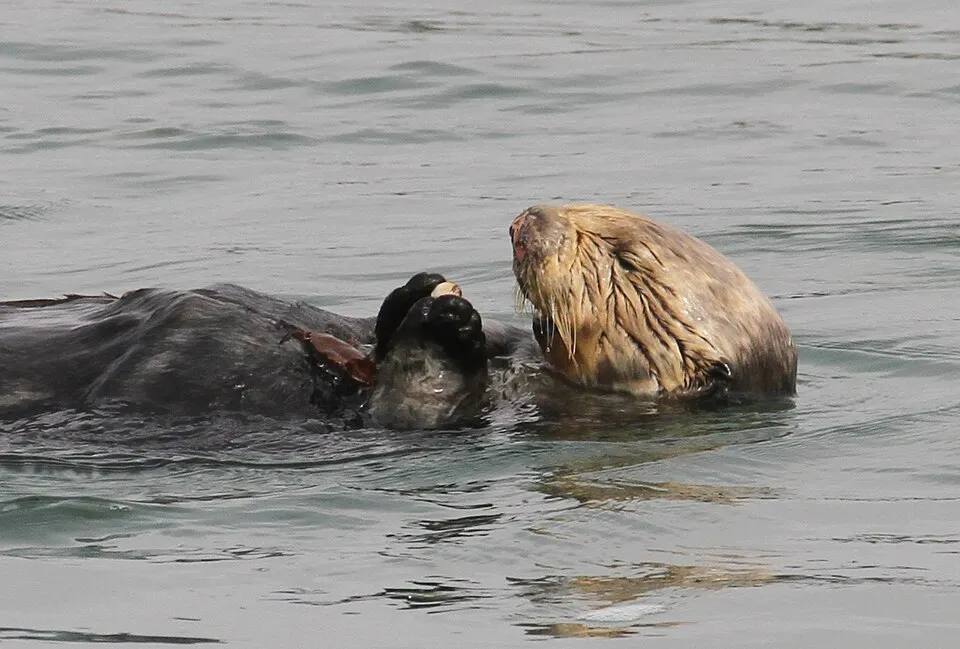
Photo: a sea otter handling shellfish on the surface. The underarm pocket itself is not visible in this image. Tony Hisgett / Wikimedia Commons / CC BY 2.0. Image resized in the browser.
How Do Sea Otters Use Their Underarm Pockets?
A sea otter often searches for food below the surface, feeling around the seafloor with sensitive forepaws and whiskers. When it finds something edible, it does not always need to swim up immediately. The loose skin under a forearm gives it somewhere to temporarily stash the catch.
Dive: The otter searches for clams, crabs, snails, urchins or other suitable prey.
Collect: It gathers one or more items, sometimes tucking them into the folds beneath its forelimbs.
Surface: It swims upward and turns onto its back, an effective position for handling food.
Eat: It pulls food out, manipulates it with its paws and, when necessary, breaks hard shells with a tool.
Think of the pouches as temporary carrying space rather than a permanent backpack. They let an otter collect more food during a dive without keeping every item in its mouth. That is useful for an animal with high energy demands.
For context, sea otters depend on exceptionally dense fur and rapid metabolism to stay warm instead of relying on a thick blubber layer. Carrying prey efficiently is one small but important part of their feeding system. Our guide to how cold-weather animals survive winter explains how sea otter fur fits into that wider picture.
Why Do Sea Otters Carry Rocks in Their Pockets?
Some food is easy to chew. A clam or a tough-shelled snail can be much harder to open. Sea otters are among the mammals best known for using objects as tools, especially stones that work as a hammer or an anvil.
An otter may place a rock on its chest and strike a shellfish against it. In other cases it can use an object to hit prey. When it needs both paws for another task, storing a usable stone under the forearm can keep the tool close by.
Not every sea otter uses a stone every time it eats. Tool use varies between individuals and according to the prey available. The 2024 study reported by researchers at the University of Texas at Austin and partners monitored 196 southern sea otters and found that tool use can help individuals access food with less damage to their teeth. This advantage was especially important for some females coping with hard-shelled prey.
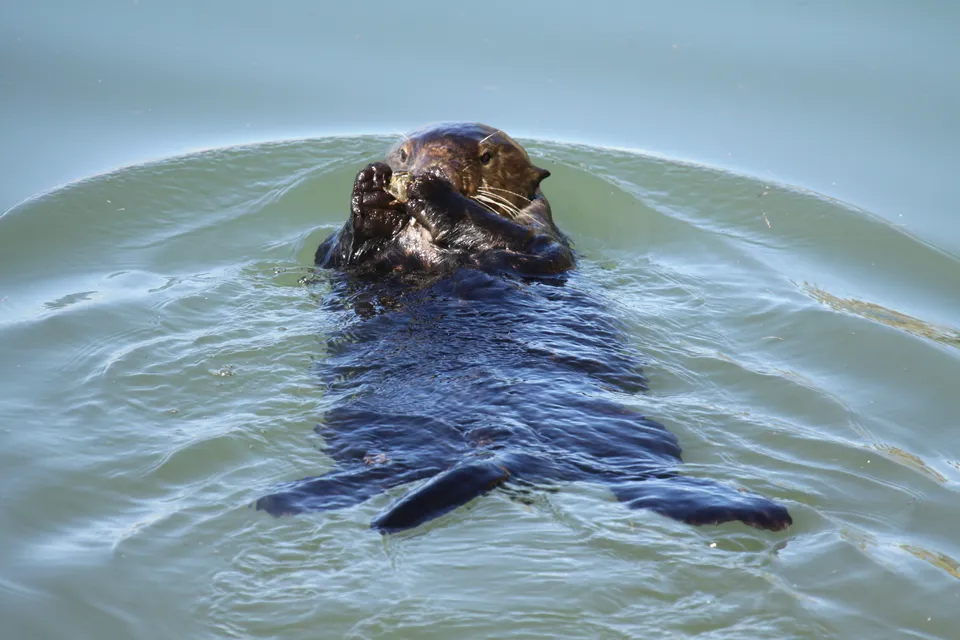
Photo: a male sea otter preparing to eat a green crab. This shows food handling, not a pocket or a rock in use. Lilian Carswell / U.S. Fish and Wildlife Service / Wikimedia Commons (U.S. government work; also labeled CC BY 2.0 on Commons).
Does Every Sea Otter Have a Favorite Rock?
Popular videos sometimes suggest that every sea otter chooses one special rock and keeps it for life. The documented behavior is more specific: an otter can reuse a particular rock over successive dives and store it in an underarm fold between uses. Historical wildlife observations describe repeated use across a feeding session.
That does not mean scientists have proved that every individual has exactly one favorite rock, or that one stone is kept for an entire lifetime. Some otters use tools often, some rarely, and the objects available to them are not always the same.
It is also important to distinguish carrying a rock from using a rock. A photograph of an otter holding food does not prove a tool is present. Strong wildlife explanations make that distinction instead of assigning imaginary behavior to an image.
Sea Otter Pockets vs. Kangaroo Pouches
Both animals have body structures people casually call pockets, but the similarity ends there. The sea otter's folds are for carrying objects during foraging. A kangaroo's abdominal pouch is a specialized part of reproduction and parental care, where its underdeveloped young continue growing.
| Feature | Sea Otter | Kangaroo |
|---|---|---|
| Location | Below each foreleg | On the abdomen |
| Main function | Carry food and sometimes tools | House and nurse a developing joey |
| Who uses it? | Both male and female otters | Female kangaroos |
| Typical contents | Prey and objects | Young animal |
| Type of structure | Loose skin fold | Specialized marsupial pouch |
Do River Otters Have the Same Pockets?
Sea otters and river otters are both mustelids, but they live differently. Sea otters spend most of their time at sea and often eat while floating on their backs. North American river otters are more comfortable moving and resting on land, and they use a different set of hunting and feeding behaviors.
The underarm storage pouches described by NOAA, the U.S. Fish and Wildlife Service and the Marine Mammal Center are a particularly well-documented adaptation of sea otters (Enhydra lutris). Do not automatically apply those descriptions to all otter species.
This distinction matters because wildlife websites sometimes say "otters have pockets" without identifying which otter. A more accurate statement is that sea otters have underarm pouches.
What Else Makes Sea Otter Anatomy Unusual?
The pockets work alongside other specializations. Sea otters have remarkably dexterous front paws, touch-sensitive whiskers for finding prey and broad hind feet that help them move through the water. Their flattened molars are well suited to crushing hard food.
They also have thick insulating fur that must be groomed carefully. Unlike many marine mammals, sea otters do not have a substantial blubber layer to keep them warm. They therefore spend much of their day finding food and maintaining the air-trapping properties of their coat.
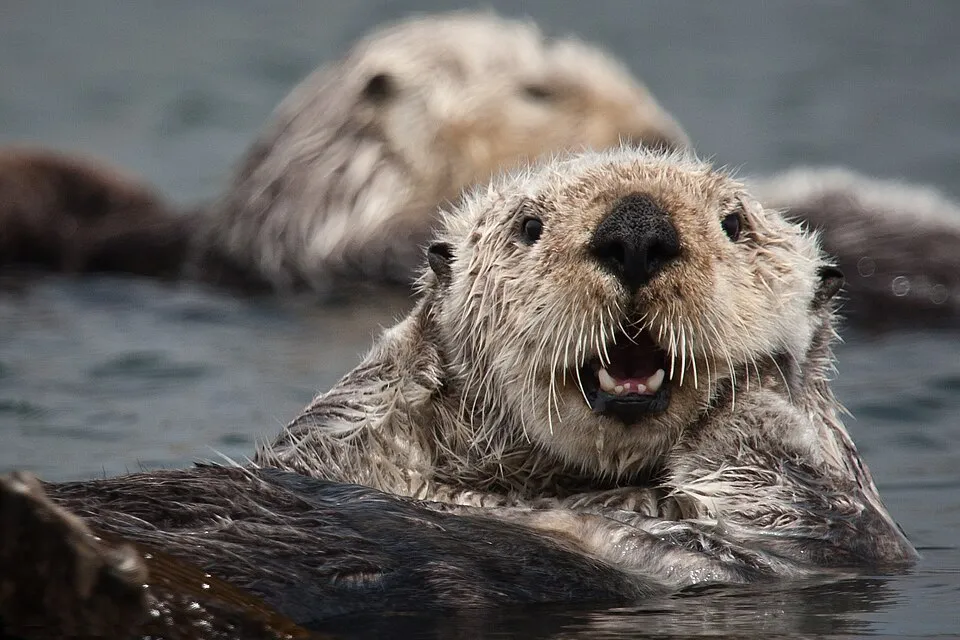
Photo: California sea otter resting among kelp in Morro Bay. This illustrates its habitat, not the underarm pocket. Mike Baird / Wikimedia Commons / CC BY 2.0. Wikimedia version has a removed watermark.
Sea otters may rest in kelp and sometimes gather in floating groups called rafts. If you have seen photos of otters linking paws, our separate explainer on why sea otters hold hands looks at that behavior without confusing it with feeding adaptations.
Why Do These Adaptations Matter for Ocean Ecosystems?
By eating sea urchins and other invertebrates, sea otters can influence coastal food webs. In some ecosystems, reducing heavy urchin grazing helps kelp forests survive. Those forests, in turn, provide habitat for many fish and invertebrates.
The underarm pockets are not themselves what makes an otter a keystone predator. Instead, they are one part of an animal built for frequent, effective foraging. The bigger conservation story includes marine habitat, prey availability, pollution and the challenges faced by recovering otter populations.
To explore that broader context, see our list of endangered marine animals and their threats.
Frequently Asked Questions
Do sea otters actually have pockets under their arms?
Yes. Loose folds of skin beneath both forelimbs can hold food during a dive. Scientists often call these areas axillary pouches.
Are sea otter pockets part of their fur?
The storage space is created by loose skin folds that are covered by fur. It is not a detachable pouch, nor simply a tuft of fur.
What do sea otters put in their pockets?
They can carry invertebrate prey such as clams or urchins and, in some cases, a rock used as a feeding tool.
Can sea otters use both pockets?
Yes. Sea otters have loose skin beneath each foreleg, though individual otters may favor one side during some feeding activities.
Why do sea otters keep rocks?
Rocks can help them open prey with tough shells. An otter may keep a useful stone available across repeated dives rather than searching for a new one each time.
Do sea otters keep the same rock for their whole lives?
There is evidence that some otters reuse rocks, but the popular claim that every sea otter keeps one particular stone for life is too broad.
Do baby sea otters live inside their mothers' pockets?
No. Sea otter mothers carry and groom pups on the surface of the water, usually on their chests. The underarm folds are for storing prey and objects, not for raising offspring.
Do all otters have food pockets?
Do not assume so. The special underarm storage behavior discussed here is documented in sea otters. Other otter species differ in anatomy and feeding behavior.
The Bottom Line
Sea otters have two practical underarm storage spaces made from loose folds of skin. They use these pockets primarily to carry food and sometimes to keep rocks ready for opening hard-shelled prey. This adaptation, together with sensitive paws, specialized teeth and dense insulating fur, helps sea otters feed in chilly coastal waters.
The most accurate takeaway is simple: sea otter pockets are real, but the idea that every otter keeps the same favorite stone forever is not established science.
Scientific Sources and Further Reading
NOAA Ocean Today — Sea Otter Anatomy. Explains underarm storage and tool use.
U.S. Fish and Wildlife Service — Southern Sea Otter. Covers loose underarm skin, prey and habitat.
The Marine Mammal Center — Sea Otters. Describes pouch use during foraging.
Government of Canada — Sea Otter Species Status Report. Describes paired axillary folds and differences from river otters.
University of Texas at Austin — Tool use and reduced tooth damage (2024). Summarizes research on 196 otters.