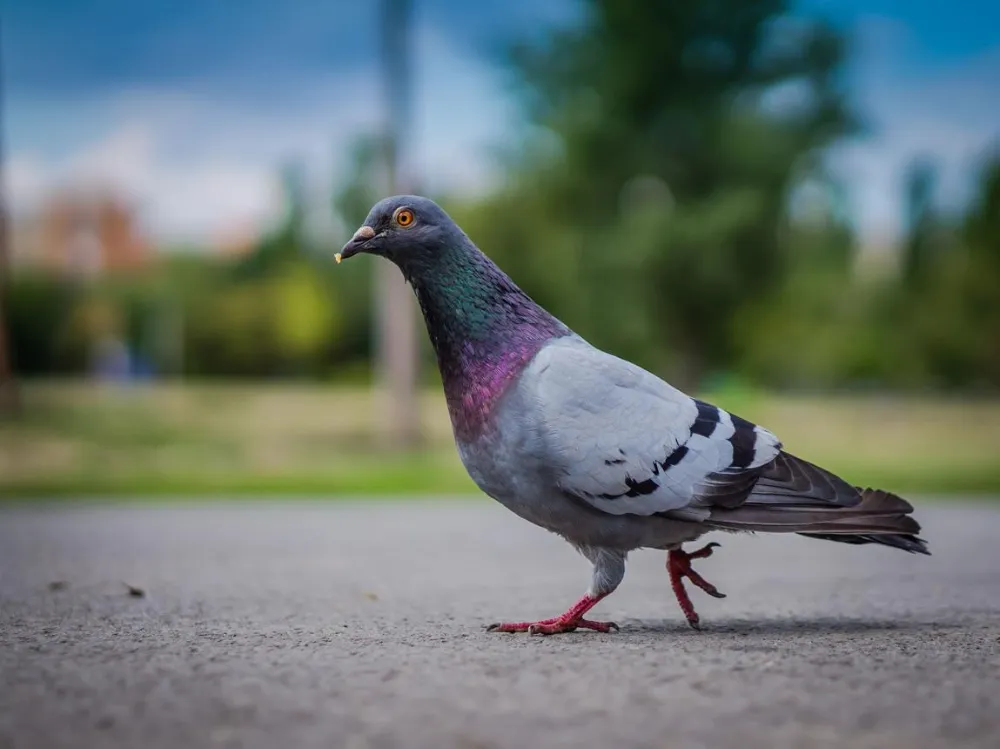
Pigeons bob their heads while walking mainly to stabilize their vision. The movement consists of two phases: a hold phase, when the head remains almost stationary relative to the surrounding environment while the body moves forward, and a thrust phase, when the head moves quickly to a new position. This pattern helps reduce unwanted movement of the visual scene across the eyes. Classic experiments showed that pigeons can stop bobbing their heads when walking on a treadmill without moving relative to the surrounding room, demonstrating that the behavior is strongly connected to visual information rather than being an unavoidable result of leg movement.
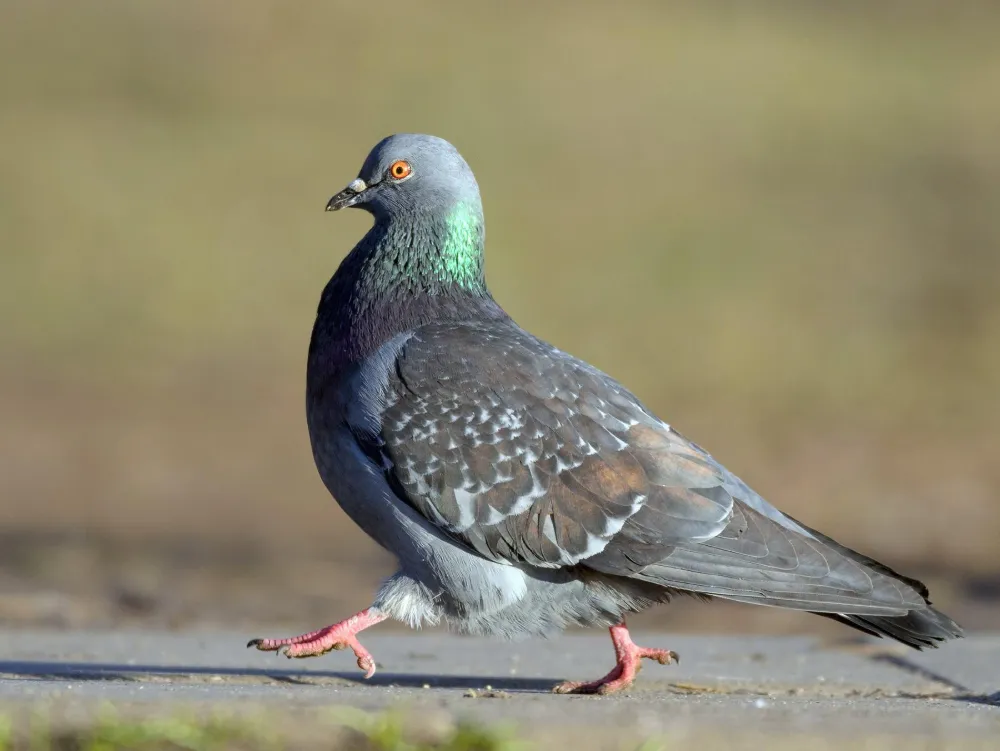
A walking pigeon uses alternating hold and thrust movements to control the position of its head relative to the surrounding environment.
Why Do Pigeons Bob Their Heads When They Walk?
Pigeons bob their heads because the movement helps them manage visual information while their bodies are moving.
When a pigeon takes a step, its body travels forward. However, its head may remain almost stationary relative to the ground for a brief period. This gives the bird a more stable view of its surroundings.
The head then moves quickly forward and settles into another stable position. The cycle repeats as the bird continues walking.
This behavior is not simply a consequence of having two legs. Experiments show that the visual movement of the environment is an important trigger.
How Does Pigeon Head-Bobbing Work?
The characteristic movement consists of two alternating phases called the hold phase and the thrust phase.
During the hold phase, the head remains approximately fixed in space while the body moves forward beneath it.
During the thrust phase, the head moves rapidly forward to a new position.
These movements create the familiar jerky appearance seen when pigeons walk along sidewalks, lawns, or other surfaces.
However, the phases are not identical under every condition. Their duration and movement patterns change with the bird's speed and behavior.
What Is the Hold Phase?
The hold phase is the part of the head-bobbing cycle when a pigeon stabilizes its head relative to the surrounding world.
As the body continues moving forward, the neck changes position so the head can remain nearly stationary.
This minimizes the movement of the external visual scene across the retina.
Researchers have demonstrated that the stabilization involves more than simple forward-backward movement. The pigeon also controls several rotational and vertical components of head position.
However, the head is not absolutely motionless. A small amount of movement remains even during well-controlled stabilization.
What Is the Thrust Phase?
During the thrust phase, the pigeon rapidly moves its head forward.
The movement brings the head into a new position ahead of the body. The pigeon can then begin another hold phase while its body catches up.
This quick repositioning creates the most noticeable part of head-bobbing.
Some researchers have suggested that the rapid forward movement also contributes useful information about the relative positions of nearby objects.
However, the exact visual functions of the thrust phase are more complex than simply turning vision off and on.
Hold Phase vs. Thrust Phase
| Feature | Hold Phase | Thrust Phase |
|---|---|---|
| Head movement relative to ground | Nearly stationary during ordinary walking | Moves rapidly forward |
| Body movement | Continues forward | Continues forward |
| Main demonstrated role | Visual stabilization | Repositions the head |
| Possible additional benefit | Detecting independently moving objects | Information from relative image motion |
| Visual processing | Active | Also active |
The phases work together. A pigeon cannot hold its head behind a moving body indefinitely, so periodic forward repositioning is necessary.
Do Pigeons Actually Move Their Heads Backward?
During ordinary walking, the apparent backward movement is largely an effect of observing the head relative to the moving body.
The pigeon keeps its head relatively stable in the surrounding environment while the torso advances underneath it.
From the perspective of someone watching the whole bird, the head appears to move backward along the neck.
However, relative to a stationary point on the ground, the head can remain almost motionless during this phase.
The truly rapid movement occurs when the head is thrust forward.
Why Does Keeping the Head Still Improve Vision?
When an animal moves, the positions of objects in its field of view change.
This movement can cause the image projected onto the retina to shift, making it more difficult to identify details or distinguish movement caused by the animal from movement caused by other objects.
By stabilizing its head, a pigeon reduces some of this unwanted visual motion.
This can make it easier to examine the environment while the body continues walking.
However, stable vision is not the same as complete visual stillness. Pigeons continue processing visual information during head movements.
What Is Retinal Image Stabilization?
The retina is a light-sensitive layer inside the eye that contains photoreceptors and neural circuits involved in vision.
Retinal image stabilization refers to keeping the visual image of an object relatively stable on the retina despite movement of the observer.
Humans accomplish much of this through coordinated eye movements, supported by head and body control.
Birds also use eye movements, but many species rely strongly on rapid, controlled head movements.
In pigeons, the characteristic hold phase provides a clear example of this strategy.
What Is an Optokinetic Response?
An optokinetic response is a movement triggered by visual motion across the retina.
Animals can use such responses to stabilize visual information as the environment appears to move around them.
Pigeon head-bobbing is strongly associated with optokinetic control.
As a pigeon walks through its surroundings, visual motion provides information that helps regulate the position of its head.
Research has shown that changing the movement of the visual environment can change or suppress the characteristic head-bobbing pattern.
What Did the 1978 Pigeon Treadmill Experiment Show?
In 1978, researcher Barrie J. Frost published The Optokinetic Basis of Head-Bobbing in the Pigeon in the Journal of Experimental Biology.
The study used motion photography and treadmill experiments to investigate the movement.
When pigeons walked forward through a room, they generally displayed the characteristic hold-and-thrust movement.
However, when pigeons walked on a treadmill at a speed that kept them approximately stationary relative to the room, typical head-bobbing was suppressed.
This result demonstrated that the behavior is strongly associated with visual movement relative to the environment.
It also challenged explanations that treated head-bobbing as a purely mechanical result of walking.
Why Don't Pigeons Bob Their Heads on a Treadmill?
A pigeon walking at the appropriate speed on a treadmill can remain in approximately the same position relative to the surrounding room.
Although its legs continue stepping, the surrounding visual environment does not move past the bird in the usual way.
Under the tested conditions, this greatly reduced the visual stimulus associated with head-bobbing.
However, this does not mean every pigeon on every treadmill will always hold its head completely still.
The result depends on the relationship between belt speed, walking speed, and the available visual environment.
Does Head-Bobbing Depend on Leg Movement?
Head-bobbing and stepping are often coordinated, but they are not mechanically inseparable.
The treadmill experiments demonstrated that a pigeon can continue walking while the characteristic head-bobbing movement is greatly reduced.
Other experimental observations have shown that visual motion can influence head movements independently of ordinary stepping.
Therefore, the movement cannot be explained simply as the head bouncing because the bird's feet hit the ground.
Visual control is a major component of the behavior.
What Did the 2000 Head Stabilization Study Find?
In 2000, researchers Nikolaus Troje and Barrie Frost published Head-Bobbing in Pigeons: How Stable Is the Hold Phase? in the Journal of Experimental Biology.
The researchers used video-based measurements to examine how accurately walking pigeons maintained head position.
They found that the head was stabilized across several directions and rotations during the hold phase.
The head nevertheless showed a small systematic slip that may provide information needed to correct movement.
The study strengthened the view that head-bobbing involves precise visual-motor control rather than a loose, uncontrolled rocking motion.
Can Pigeons See Clearly During the Thrust Phase?
Yes. Pigeons can process useful visual information during the rapid forward movement.
It was once suggested that the thrust phase might involve a strong reduction in visual perception because the head moves quickly.
However, a 2009 study tested pigeons on a visual shape-discrimination task while stimuli were presented during the hold phase or the thrust phase.
The researchers found that shape discrimination was equally good under the tested conditions.
This does not mean visual processing is identical in every respect during both phases, but it shows that pigeons do not simply become visually blind when their heads move forward.
What Did the 2009 Shape Discrimination Study Discover?
Researchers Laura Jiménez Ortega and colleagues published Vision During Head Bobbing: Are Pigeons Capable of Shape Discrimination During the Thrust Phase? in Experimental Brain Research.
They trained pigeons to identify visual shapes and presented the relevant information at different points in the head-bobbing cycle.
The experiments found no meaningful reduction in shape-discrimination performance during the thrust phase compared with the hold phase.
The results challenged a simple interpretation of head-bobbing in which the bird would need to stop processing visual detail whenever it moved its head.
Does Head-Bobbing Help Pigeons Judge Distance?
Researchers have proposed that head movement could help pigeons judge the relative positions of objects.
When an observer moves, nearby objects can appear to shift across the visual field differently from more distant objects.
This phenomenon is called motion parallax.
The 1988 research by Davies and Green discussed the possibility that rapid head movements provide useful information about relative object motion.
However, the role of motion parallax should be described as a proposed additional visual function rather than the sole experimentally established reason for all pigeon head-bobbing.
What Is Motion Parallax?
Motion parallax is a visual depth cue created when objects at different distances appear to move at different rates as an observer changes position.
For example, nearby objects may appear to move quickly across a visual scene, while distant objects appear to move more slowly.
Some animals can use this relative motion to estimate distance and spatial relationships.
Pigeons might obtain related information during rapid head movements.
However, scientists continue to investigate how strongly this mechanism contributes to their normal walking behavior.
Does Head-Bobbing Help Pigeons Find Food?
It may support the visual tasks involved in foraging.
Pigeons frequently walk while examining the ground for seeds and other food items.
Stabilizing the head can help the bird inspect small objects without continuous movement of the visual scene.
Changes in head position may also help distinguish objects that are close to the bird.
However, scientists should not conclude that head-bobbing exists only for feeding. The behavior occurs across several forms of locomotion and visual activity.
How Do Pigeons Look at Nearby Objects?
Pigeon vision involves specialized regions of the retina.
A 2022 study published in Scientific Reports used motion capture and three-dimensional visual-field reconstruction to investigate how pigeons examine objects.
The researchers found that pigeons tended to use their laterally oriented foveal regions to inspect distant targets.
For objects nearby on the ground, particularly within approximately 50 centimeters, they often used specialized lower-frontal retinal regions called red areas.
These results show that pigeon head orientation is closely linked to how the bird directs attention toward different objects.
What Are the Fovea and Red Area in Pigeon Eyes?
A fovea is a specialized retinal region associated with high-acuity vision.
Pigeons have foveal regions that project into lateral parts of their visual field, allowing detailed examination of objects to the side.
They also possess visually sensitive red areas associated with viewing nearby objects, especially those on the ground.
However, the organization of these retinal regions is more complex than a simple division between near and far vision.
The bird can adjust its head and eye orientation to use different visual areas according to the task.
What Did the 2022 Pigeon Vision Study Discover?
Researchers led by Fumihiro Kano used a sophisticated motion-capture system to track freely moving pigeons.
They reconstructed the directions in which the birds' specialized retinal regions were pointing while the animals examined different objects.
The pigeons used different visual regions depending on target distance and behavioral context.
For distant objects, the foveal regions were particularly important. For nearby ground-level objects, the red areas played a greater role.
However, the study examined visual attention and head orientation more broadly. It should not be misrepresented as proving a completely new explanation for the classic walking head-bobbing cycle.
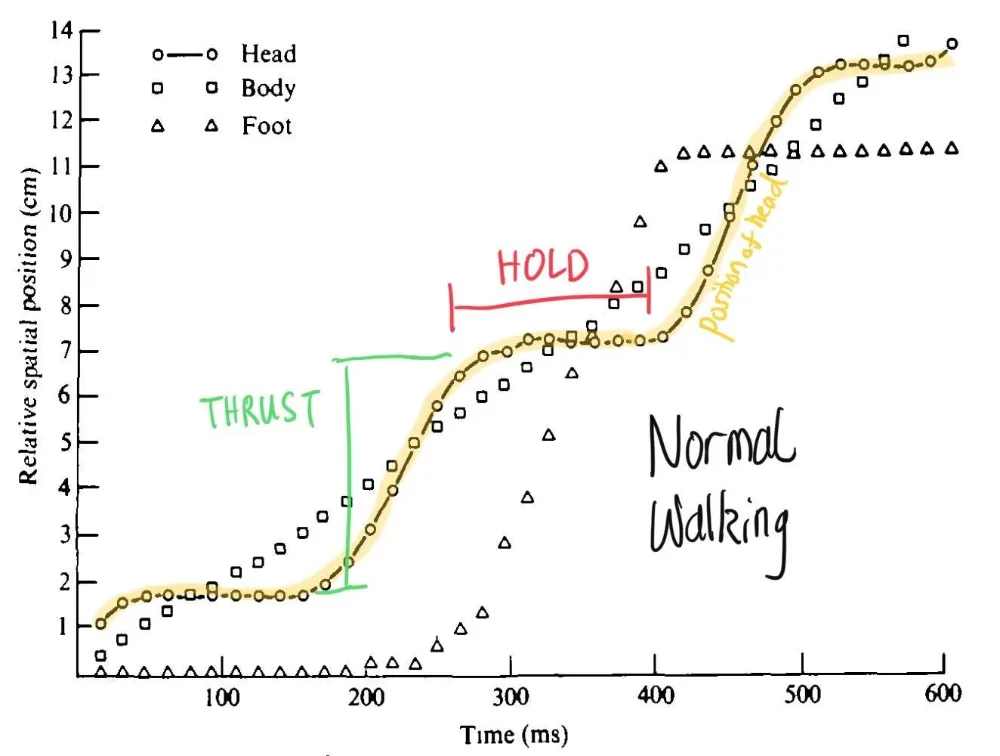
Scientific illustration: during ordinary walking, the pigeon's body advances while its head briefly holds position, followed by a quick forward thrust.
Is Head-Bobbing Mainly for Balance?
Visual stabilization is the best-supported primary explanation for ordinary pigeon head-bobbing.
However, researchers have also investigated possible relationships with balance and movement coordination.
A 2002 study examined the position of the pigeon's center of gravity during walking.
The results suggested that some aspects of the head movement might interact with whole-body stability, but the direct mechanical contribution of the forward thrust was small.
Therefore, the statement that pigeons bob their heads only to maintain balance is not supported by the strongest experimental evidence.
What Did the 2002 Balance Study Show?
Researcher Masaki Fujita published Head Bobbing and the Movement of the Centre of Gravity in Walking Pigeons in the Journal of Zoology.
The study combined anatomical measurements and movement analysis.
It found relationships between head-bobbing phases, foot support, and changes in the bird's center of gravity.
However, the mechanical effect of the forward head thrust on center-of-gravity positioning was relatively small.
The results suggest that visual and locomotor control may interact without making balance the sole cause of the behavior.
Why Do Pigeons Bob Their Heads While Running?
Head movement changes as pigeons increase speed.
A 1988 study compared pigeon head movements during walking, running, and flight toward a landing site.
During ordinary walking, the head could be held nearly stationary relative to the environment for part of each cycle.
During running, the head continued moving forward throughout the cycle, although rhythmic changes in movement speed remained.
Therefore, the familiar stationary hold phase is less applicable at higher speeds.
Do Pigeons Bob Their Heads While Flying?
Pigeons can show rhythmic head-motion patterns during certain flight behaviors, especially when approaching a perch.
However, those movements are not identical to the stationary hold phases seen during walking.
The 1988 study found rhythmic variations in head velocity during approach flight, but not during the observed takeoff sequences.
During landing approaches, the head continued moving forward rather than stopping in space.
Different flight conditions should therefore not be described as a simple extension of the ordinary walking pattern.
Why Do Pigeons Move Their Heads Before Landing?
Precise visual information is important when a pigeon approaches a perch or landing surface.
The bird must assess its speed, position, and distance from the target.
Researchers have proposed that rhythmic changes in head movement during approach flight may provide useful information about relative motion.
However, the exact role of these movements is still being investigated.
They should not be confused with the near-stationary head hold that occurs during slower walking.
Do Pigeons Bob Their Heads When Standing Still?
Pigeons can move or turn their heads while standing, watching nearby birds, examining objects, or responding to potential threats.
However, these movements are not necessarily the same as the rhythmic hold-and-thrust cycle associated with walking.
When a pigeon stands still, it may stabilize its head against changes in body orientation.
Research published in 2017 showed that visual, vestibular, and other sensory information can contribute to this stabilization.
The relative contribution of different sensory signals depends on the type of disturbance.
What Is the Vestibular System?
The vestibular system is involved in detecting head movement and orientation.
It provides information useful for balance and coordinated movements.
Pigeons combine vestibular information with vision and signals from muscles and joints.
However, the 1978 treadmill experiments demonstrated that the characteristic walking head-bobbing pattern cannot be explained entirely by vestibular or mechanical responses.
Different head-stabilization behaviors use different combinations of sensory feedback.
What Did the 2017 Head Stabilization Study Find?
Researchers Leslie Theunissen and Nikolaus Troje investigated how pigeons stabilize their heads while standing on a moving platform.
They applied controlled translations and rotations under light and dark conditions.
The results showed that pigeons were particularly effective at stabilizing the orientation of their heads against rotational disturbances.
Visual feedback contributed to some aspects of translational stabilization, while other sensory pathways were important for rotational control.
However, the study concerned responses to platform movement during standing, not simply the ordinary walking head-bobbing cycle.
Why Do Pigeons Have Eyes on the Sides of Their Heads?
Pigeons have laterally positioned eyes that provide wide visual coverage of their surroundings.
This arrangement can help them detect food, other birds, and potential threats.
However, their visual fields also include regions suitable for examining nearby objects.
The 2022 motion-capture study demonstrated how pigeons direct specialized retinal regions toward different targets.
Head orientation is therefore an important part of their visual behavior.
Can Pigeons Move Their Eyes?
Yes. Pigeons can move their eyes, although the range and functional role of eye movements differ from those of humans.
They often rely heavily on head movements to orient their vision.
The relationship between eye movement and head stabilization is more complicated than saying that pigeons cannot move their eyes at all.
Studies of pigeon visual fields and head control show that both eye orientation and head position matter.
Do Other Birds Bob Their Heads When Walking?
Yes. Head-bobbing is found in several bird groups.
Examples include pigeons, some doves, chickens, cranes, quails, and certain other ground-moving birds.
However, not every bird exhibits the same rhythmic pattern.
Some birds use different approaches to maintaining stable vision during locomotion.
The Library of Congress identifies bird head-bobbing as a behavior found across multiple bird families, not an adaptation exclusive to pigeons.
Why Do Chickens Bob Their Heads?
Chickens can use a similar hold-and-thrust pattern during walking.
Like pigeons, they must maintain useful visual information while the body moves through the environment.
Studies have examined how chick head-bobbing develops and how it responds to visual motion.
However, chicken and pigeon behavior is not identical in every respect.
Differences in body size, walking mechanics, development, and sensory control may influence the movement.
Why Don't All Birds Bob Their Heads?
Bird species differ in anatomy, movement patterns, habitat use, and visual requirements.
Some exhibit pronounced alternating head movements during walking, while others rely more on different stabilization strategies.
Research shows that rapid rotational head movements and stabilization occur widely in birds, but the characteristic forward-thrust and hold pattern is not universal.
However, a bird's lack of obvious head-bobbing does not mean it has poor vision.
It may simply use a different combination of visual and motor control.
Pigeon Head-Bobbing vs. Human Walking
| Feature | Pigeon | Human |
|---|---|---|
| Typical head movement during walking | Alternating hold and forward thrust | Relatively smooth head and body movement |
| Major visual stabilization strategy | Strong head-position control | Coordinated eye, head, and body control |
| Characteristic rhythmic head-bobbing | Common | Not typical |
| Uses vestibular information | Yes | Yes |
| Uses vision for movement control | Yes | Yes |
Both birds and humans must stabilize visual information while moving, but they employ different combinations of anatomical and behavioral strategies.
Is Head-Bobbing a Sign That a Pigeon Is Happy?
The characteristic rhythmic movement during ordinary walking is primarily associated with visual and locomotor control.
It should not automatically be interpreted as happiness, excitement, or an attempt to communicate with another bird.
However, pigeons also make other head movements during courtship, social interactions, and vigilance.
These behaviors should be distinguished from the normal hold-and-thrust walking pattern.
Can Pigeons Control Their Head-Bobbing?
Pigeon head-bobbing is a flexible and coordinated behavior rather than an entirely fixed mechanical motion.
Experiments demonstrate that changes in visual conditions can alter or suppress it.
Walking speed and movement context also affect the pattern.
However, this does not establish that pigeons consciously decide to begin or stop each individual head movement.
The behavior is organized by neural and sensory-motor systems that respond to environmental information.
How Can You Observe a Pigeon's Head-Bobbing?
One of the easiest ways to examine the behavior is to record a pigeon walking naturally from the side using a phone's slow-motion video setting.
Choose a stable background such as paving stones or a wall so that the movement of the head can be compared with objects in the environment.
When reviewing the recording, watch how the body advances while the head briefly holds its position, then rapidly moves forward.
However, the recording should be made without chasing, frightening, or otherwise disturbing the bird.
What Can Pigeon Head-Bobbing Teach Scientists?
Pigeon head-bobbing offers a useful model for understanding how animals combine sensory information with movement.
Researchers use motion tracking, high-speed video, behavioral tests, and controlled visual environments to investigate the process.
The findings contribute to the study of visual stabilization, motor coordination, attention, and perception of the surrounding world.
However, head-bobbing is not explained by one universal reflex operating identically in every bird species.
It reflects the interaction of visual requirements, neural control, and the demands of locomotion.
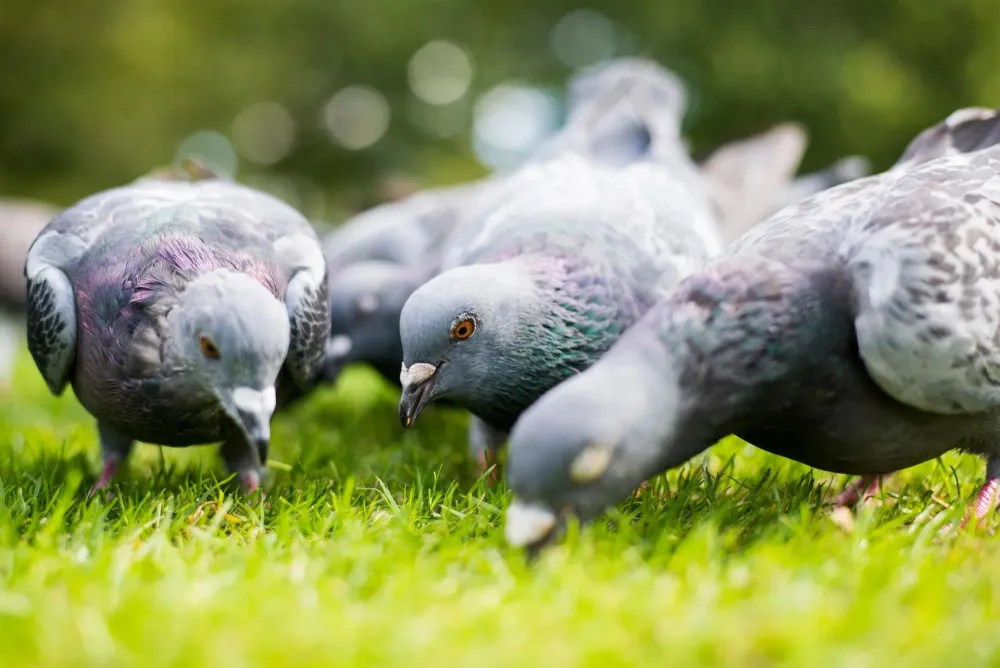
During everyday foraging, pigeons repeatedly coordinate walking movements with head stabilization as they examine their surroundings.
Frequently Asked Questions
Why do pigeons bob their heads?
Pigeons bob their heads mainly to stabilize visual information while walking. The movement alternates between a stable hold phase and a rapid forward thrust.
Why do pigeons bob their heads when they walk?
As the body moves forward, the head remains nearly stationary relative to the ground for a short time. It then quickly moves forward to a new position.
Are pigeon head movements related to vision?
Yes. Experimental studies show that visual motion is a major factor controlling the characteristic head-bobbing pattern.
Do pigeons actually move their heads backward?
During ordinary walking, the head often only appears to move backward relative to the body. It remains nearly stationary relative to the surrounding environment.
What is the hold phase in pigeon head-bobbing?
It is the stage when the head remains nearly fixed in space while the body advances.
What is the thrust phase?
It is the rapid forward movement that places the head in a new position before the next hold phase.
Why don't pigeons bob their heads on treadmills?
When walking speed matches treadmill speed, a pigeon can remain stationary relative to its surroundings. Under such conditions, the normal visual trigger for head-bobbing is reduced.
Does head-bobbing help pigeons maintain balance?
It may interact with locomotor stability, but experimental evidence points to visual stabilization as its primary function during ordinary walking.
Does head-bobbing help pigeons judge distance?
Researchers have proposed that rapid head movement can provide depth information through motion parallax, although the importance of this additional function is still being investigated.
Can pigeons see during the thrust phase?
Yes. A 2009 experiment found that pigeons could discriminate visual shapes during the thrust phase as well as during the hold phase.
Do pigeons bob their heads when running?
They can show rhythmic head movements while running, but the nearly stationary hold phase becomes less prominent at higher speeds.
Do pigeons bob their heads while flying?
Rhythmic head movements have been documented during some landing approaches, but these differ from the stationary hold pattern observed during walking.
Do all birds bob their heads?
No. Several bird groups exhibit this behavior, but others use different visual and locomotor strategies.
Why do chickens bob their heads?
Chickens use head movements associated with visual stabilization while walking, although the details may differ from pigeons.
Can pigeons move their eyes?
Yes. Pigeons can move their eyes, but controlled head orientation plays an important role in their visual behavior.
Is head-bobbing a sign that a pigeon is happy?
The typical walking movement is mainly associated with visual control. Other head movements may occur during social behavior or courtship.
How can you see the hold-and-thrust pattern?
Record a pigeon walking naturally from the side in slow motion, with a stationary background that makes the relative head and body movements easy to compare.
The Bottom Line
Pigeons bob their heads mainly to stabilize visual information while moving through their surroundings.
The familiar motion consists of a hold phase, when the head remains nearly stationary relative to the environment, and a thrust phase, when it rapidly moves forward.
Classic treadmill experiments demonstrated that visual movement, rather than the mechanical action of walking alone, is a major cause of this behavior.
Later studies showed that pigeons accurately stabilize their heads in several directions and can continue recognizing visual shapes during rapid head movement.
Researchers have also proposed additional roles involving depth perception and locomotor coordination, although visual stabilization remains the strongest explanation for the ordinary walking pattern.
The next time a pigeon walks past you, its seemingly funny head movements can be understood as part of a highly coordinated visual-motor system.
Sources & Further Reading
Library of Congress — Why Do Pigeons Bob Their Heads When They Walk? Authoritative explanation of visual stabilization and the treadmill experiment.
Frost (1978) — The Optokinetic Basis of Head-Bobbing in the Pigeon. Journal of Experimental Biology. Original treadmill and motion-photography experiments.
Davies and Green (1988) — Head-Bobbing During Walking, Running and Flying: Relative Motion Perception in the Pigeon. Journal of Experimental Biology. Study of head-motion patterns across locomotor conditions and possible visual functions.
Troje and Frost (2000) — Head-Bobbing in Pigeons: How Stable Is the Hold Phase? Journal of Experimental Biology. Measurements confirming precise head stabilization.
Fujita (2002) — Head Bobbing and the Movement of the Centre of Gravity in Walking Pigeons. Journal of Zoology. Research on the relationship between head movements and locomotor balance.
Jiménez Ortega et al. (2009) — Vision During Head Bobbing: Are Pigeons Capable of Shape Discrimination During the Thrust Phase? Experimental Brain Research. Behavioral evidence that visual shape discrimination remains effective during the thrust phase.
Theunissen and Troje (2017) — Head Stabilization in the Pigeon: Role of Vision to Correct for Translational and Rotational Disturbances. Frontiers in Neuroscience. Controlled motion-platform study of head stabilization and sensory feedback.
Pigeons (C. livia) Follow Their Head During Turning Flight: Head Stabilization Underlies the Visual Control of Flight. Research linking pigeon head orientation and flight control.
Kano et al. (2022) — Head-Tracking of Freely-Behaving Pigeons in a Motion-Capture System Reveals the Selective Use of Visual Field Regions. Scientific Reports. Study of head orientation, visual attention, and specialized retinal regions.