Are Greenland sharks blind? Not according to the latest scientific evidence. Although these enormous Arctic sharks are often described as nearly blind, a study published in January 2026 found that they retain a well-preserved visual system adapted to extremely dim light.
That is particularly surprising because Greenland sharks can live for centuries, spend much of their lives in dark waters, and often carry parasites attached to their eyes.
So why did scientists once think they were blind, and what changed? The answer lies in their retinas, light-sensitive proteins, and an unusual ability to preserve eye function over an exceptionally long lifespan.
What Does a Greenland Shark's Eye Look Like?
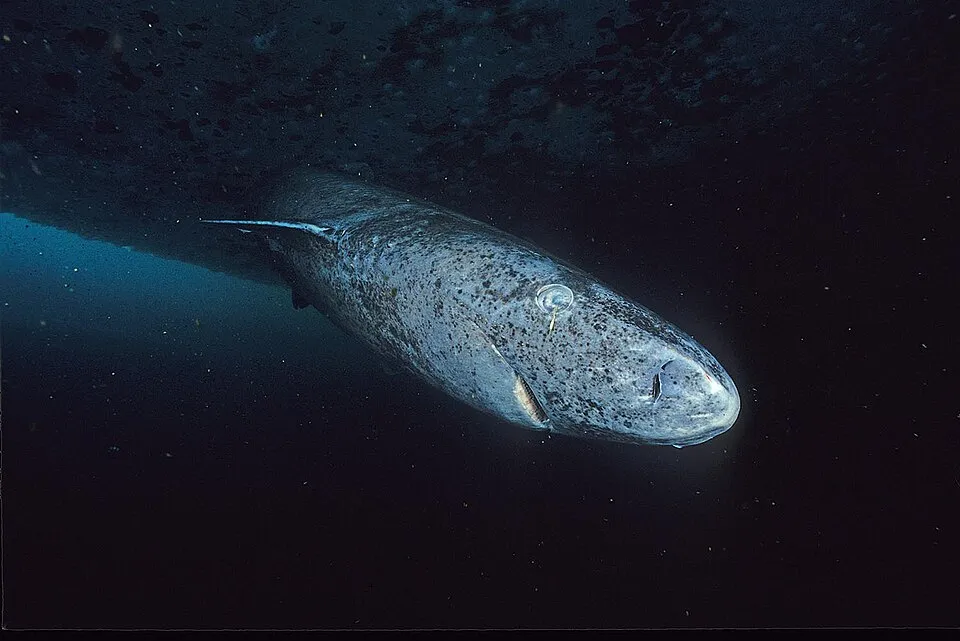
Greenland shark photographed in Admiralty Inlet, Nunavut, Canada. Photo: Hemming1952 / Wikimedia Commons, CC BY-SA 4.0. The photograph shows a parasite associated with the eye.
Greenland sharks (Somniosus microcephalus) have relatively small eyes compared with their enormous bodies.
They live in Arctic and North Atlantic waters, often at depths where sunlight is weak or absent.
Some individuals have parasites attached to their corneas, giving the eyes a cloudy or unusual appearance. This has contributed to the long-standing belief that Greenland sharks have little or no useful eyesight.
But the appearance of an eye does not tell scientists everything about whether its retina and visual pathways still function.
Why Were Greenland Sharks Thought to Be Blind?
Three observations helped create the idea that Greenland sharks were blind or nearly blind:
Deep-water habitat: Many Greenland sharks live where very little sunlight reaches.
Eye parasites: Their eyes can host a parasitic copepod called Ommatokoita elongata.
Extremely long lifespan: Scientists questioned whether their eyes could remain functional after more than a century of life.
These observations raised reasonable questions about the animals' eyesight. However, they did not prove that all Greenland sharks were blind.
Researchers needed to examine the actual structures and molecular mechanisms responsible for vision.
What Did Scientists Discover in 2026?
A study published in Nature Communications on January 5, 2026, investigated the visual system of the Greenland shark using several complementary scientific methods.
The researchers examined retinal structure, light-sensitive proteins, gene activity and the transmission of light through the cornea.
The results provided strong evidence that Greenland sharks retain a visual system adapted to low-light conditions.
Four Important Findings
| Finding | What It Means |
|---|---|
| Well-preserved retinal structure | The examined eyes retained the major cell types involved in vision. |
| Numerous rod photoreceptors | The retina is adapted to detecting weak light. |
| Functional light-sensitive proteins | The molecular machinery needed to respond to light remains active. |
| Light can pass through parasitized corneas | Eye parasites do not necessarily prevent all light from reaching the retina. |
The study is titled The visual system of the longest-living vertebrate, the Greenland shark.
Read the original 2026 research in Nature Communications.
How Can Greenland Sharks See in the Dark?
The key lies in specialized cells called rods.
Vertebrate retinas contain photoreceptor cells that convert incoming light into signals used by the nervous system.
Two important types are rods and cones.
| Photoreceptor | Main Function |
|---|---|
| Rods | Highly sensitive to low levels of light; important for dim-light vision. |
| Cones | Usually contribute to color vision and vision under brighter conditions. |
The 2026 study found that Greenland shark retinas contain densely packed, elongated rods, consistent with an adaptation to dim environments.
The researchers also found that genes associated with rod-based vision remain functional, while many genes associated with bright-light cone vision are missing or no longer functional.
This suggests that Greenland sharks rely heavily on detecting weak light rather than the kind of detailed color vision associated with daylight environments.
However, the study did not directly establish how clearly a living Greenland shark can recognize objects, prey or other animals at different distances.
Do Eye Parasites Make Greenland Sharks Blind?
Not necessarily.
The copepod Ommatokoita elongata can attach to the cornea of a Greenland shark. In some cases, the parasite may damage the eye or interfere with its optical performance.
Because these parasites are frequently observed, some older descriptions suggested that infected sharks were effectively blind.
The new research challenges that assumption.
Scientists measured how much light passed through Greenland shark corneas, including samples with parasites attached near their edges.
In the six shark corneas tested, measured light transmission varied substantially, but light was still able to pass through.
This matters because the retina needs incoming light to function. A parasitized cornea does not automatically mean that no light can reach the eye.
Important distinction: The findings do not show that parasites are harmless. Individual sharks may experience different degrees of damage or reduced vision.
Real Photo: A Greenland Shark in Deep Water
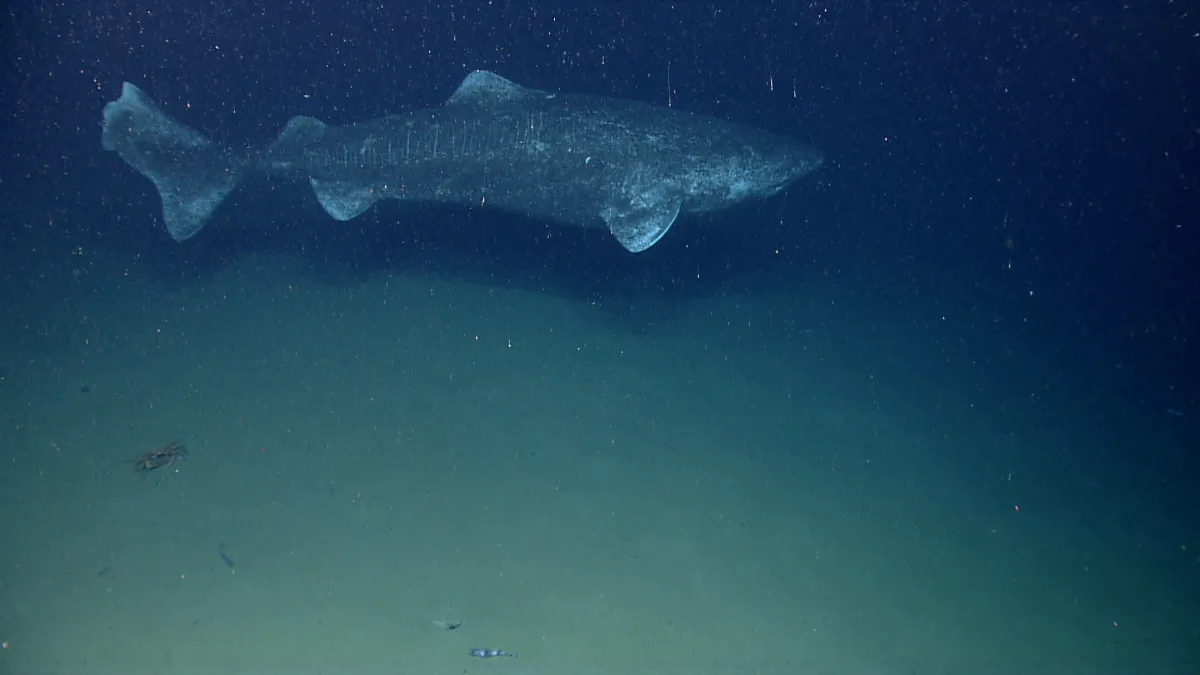
A Greenland shark recorded during NOAA's 2013 Northeast U.S. Canyons Expedition, at approximately 778–896 meters depth. Image: NOAA Okeanos Explorer Program / Wikimedia Commons. U.S. government public-domain material; the Commons file also carries a CC BY 2.0 attribution notice.
The photograph shows a Greenland shark moving through a deep-water environment.
At these depths, the underwater light environment is very different from that near the ocean surface.
Red wavelengths disappear relatively quickly as sunlight passes through seawater. Blue light generally penetrates farther, although the amount of light available also depends on depth, water clarity and local conditions.
The 2026 study found that Greenland shark visual pigments have properties consistent with sensitivity to short-wavelength light.
This is another reason why their eyes may remain useful in dim ocean habitats.
Can Greenland Sharks See Colors?
The available evidence suggests that Greenland shark vision is strongly specialized for low light rather than a wide range of color perception.
The study found that many genes associated with cone-based bright-light vision are no longer functional or are absent.
Meanwhile, the rod-based visual pathway remains well preserved.
That supports the idea that these sharks are adapted for detecting light in a dark environment.
However, scientists have not directly demonstrated exactly how a Greenland shark perceives colors or what its visual world looks like.
We should therefore avoid claiming that Greenland sharks see everything in black and white or that they have a particular degree of visual sharpness.
How Do Greenland Sharks Find Food?
Greenland sharks are opportunistic predators and scavengers.
Their diets can include fish, squid and other marine animals, as well as carrion such as large animal remains.
Like other sharks, they possess several sensory systems that can provide information about their surroundings.
These include:
Smell: Detecting chemical cues in the water.
Electroreception: Sensing weak electrical signals using specialized organs.
Mechanoreception: Detecting water movement and pressure changes.
Vision: Detecting available light and potentially useful visual cues.
Research now provides stronger evidence that vision should not be dismissed simply because Greenland sharks inhabit dark waters or carry eye parasites.
Scientists still need more direct behavioral research to determine how these animals combine their senses during hunting and navigation.
How Old Can Greenland Sharks Get?
Greenland sharks are famous for having the longest estimated lifespan of any known living vertebrate.
A study published in Science in 2016 used radiocarbon dating of eye-lens tissue to estimate their ages.
The researchers examined 28 female Greenland sharks.
The largest animal in the study had an estimated age of 392 years, with an uncertainty of approximately 120 years in either direction.
This means the study did not establish that the shark was exactly 392 years old. The estimated range was approximately 272–512 years.
Scientists also estimated that female Greenland sharks may not reach sexual maturity until roughly 150 years of age.
The exact maximum lifespan remains uncertain, but the evidence indicates that this species can survive for centuries.
Read more about exceptionally slow-moving species in our guide to the world's slowest animals.
Why Is Their Long Lifespan Important for Eye Research?
In many animals, aging can affect the eye, retina and nervous system.
That makes Greenland sharks particularly interesting because their eyes may remain structurally well preserved over exceptionally long lifespans.
The 2026 research reported no obvious retinal degeneration in the older specimens examined.
Researchers also identified activity in genes associated with DNA repair and cellular maintenance.
These findings suggest possible mechanisms that may contribute to the long-term preservation of retinal function.
However, finding DNA repair-related genes does not by itself prove that those genes are responsible for the shark's longevity or preserved vision.
Further research will be needed to establish the mechanisms involved.
Why Does This Discovery Matter for Conservation?
Greenland sharks grow slowly and may take well over a century to reproduce.
This makes them potentially vulnerable to fishing mortality and population losses.
In October 2026, Canada opened a consultation on whether the species should be listed under its Species at Risk Act.
The consultation follows a 2025 scientific status assessment and addresses ecological, cultural and economic considerations.
Improving knowledge of Greenland shark biology, including how they see and navigate, may help researchers better understand their behavior and habitat use.
The vision research also offers a reminder that scientists should be cautious about assuming that an unusual-looking animal has lost a particular ability.
Frequently Asked Questions
Are Greenland sharks completely blind?
No. Research published in January 2026 found strong anatomical, molecular and functional evidence of a preserved visual system adapted to dim light.
Why do Greenland sharks have parasites on their eyes?
Some Greenland sharks host the parasitic copepod Ommatokoita elongata, which attaches to the cornea. Infection can affect the eye, but it does not necessarily block all incoming light.
Can Greenland sharks see in total darkness?
No animal eye can form a light-based image without any light at all. Greenland sharks appear adapted to extremely low-light conditions, but their eyes still depend on available light.
Do Greenland sharks have good eyesight?
Their retinas retain features suited to low-light vision. However, researchers have not established their exact visual acuity or how well they identify objects in the wild.
Are Greenland sharks really 400 years old?
Some may reach ages around 400 years or more, but these are scientific estimates. The largest female in a 2016 study was estimated at 392 years old, with a broad uncertainty range.
Do Greenland sharks use smell instead of sight?
They possess several sensory systems, including smell and electroreception. Current evidence also supports a role for vision, although the relative importance of each sense during natural behavior remains uncertain.
The Bottom Line
Greenland sharks should not simply be described as blind. Despite their dark habitat, eye parasites and extreme lifespan, scientific evidence shows that they retain a visual system adapted to weak light.
The discovery does not mean their eyesight is identical to that of other sharks, or that parasites never cause damage.
Instead, it reveals how much scientists can learn by examining the structure and molecular function of an animal's eyes rather than relying only on their appearance.
For one of the longest-lived animals on Earth, the ability to preserve a functioning visual system may be among its most remarkable adaptations.
Scientific Sources and Photo Credits
NOAA — How Long Do Greenland Sharks Live?
Government of Canada — Greenland Shark Species at Risk Consultation (2026).
Photo 1: Greenland shark profile — Hemming1952, CC BY-SA 4.0.
Photo 2: NOAA Okeanos Explorer Program — Greenland shark in deep water.