The dwarf caiman is one of the smallest crocodilians in the world. Unlike giant crocodiles or large caimans that dominate open wetlands, dwarf caimans are compact, heavily armored reptiles that usually live in forested streams, rivers, and freshwater habitats in South America.
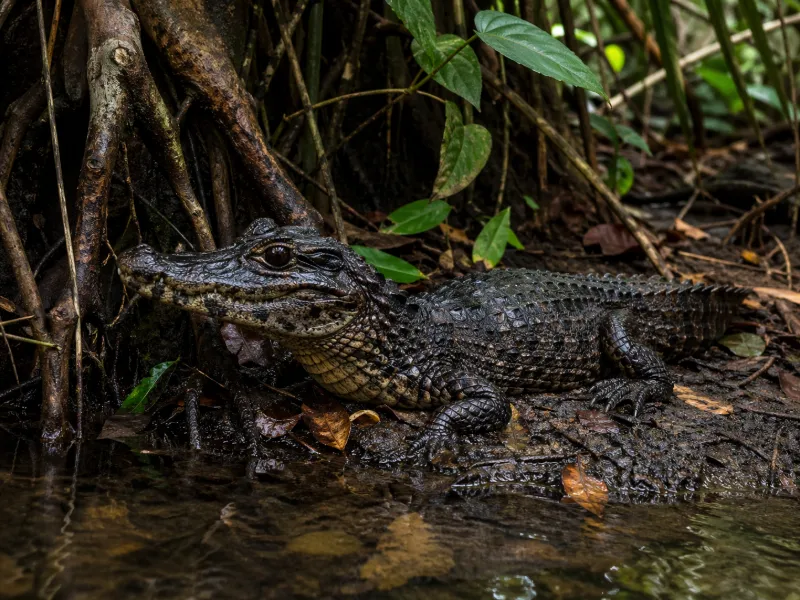
Even though they are small compared with many other crocodilians, dwarf caimans are still tough, capable predators. They feed on fish, crustaceans, insects, amphibians, and other small animals, and their strong armor helps protect them in dense tropical habitats.
In this guide, you will learn the most important dwarf caiman facts, including size, habitat, diet, appearance, behavior, and how these small caimans differ from larger species.
Quick facts
| Feature | Dwarf Caiman |
|---|---|
| Main meaning | Usually refers to the smallest caimans, especially Cuvier’s dwarf caiman |
| Group | Caiman in the alligator family |
| Range | Northern and central South America |
| Habitat | Forested streams, rivers, creeks, flooded forests, freshwater wetlands |
| Diet | Carnivorous |
| Typical prey | Fish, crustaceans, insects, amphibians, snails, small vertebrates |
| Typical size | Small compared with most other crocodilians |
| Main trait | Small size, heavy armor, forest-associated lifestyle |
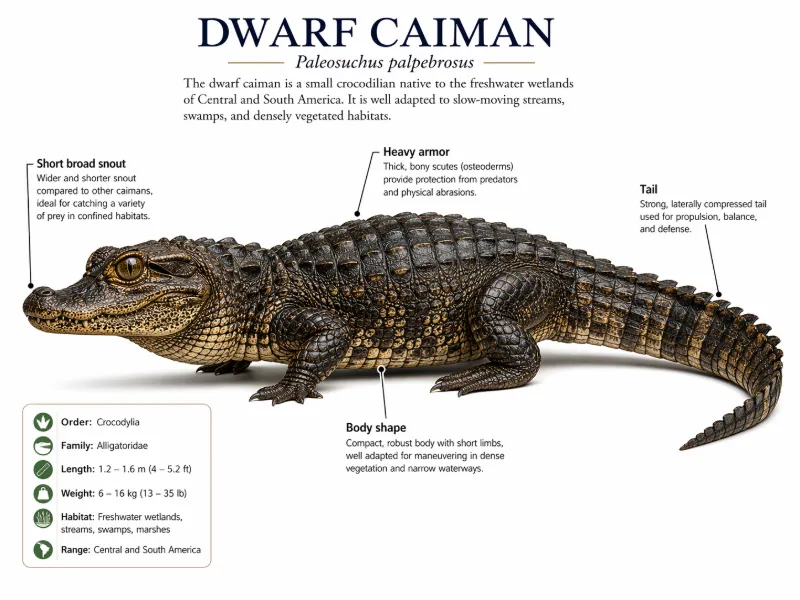
What is a dwarf caiman?
The term dwarf caiman is usually used for the smallest caimans, especially Cuvier’s dwarf caiman. In broader conversation, people may also use it for other very small caiman-like crocodilians, but Cuvier’s dwarf caiman is the species most often meant by the name.
Dwarf caimans belong to the alligator family, which means they are more closely related to alligators and other caimans than to true crocodiles. They are still crocodilians, but they are built for a smaller, more forest-linked lifestyle than large open-water species such as the black caiman.
Because of their compact size and strong armor, dwarf caimans often look especially tough and rugged for their body length.
How big is a dwarf caiman?
Dwarf caimans are small compared with most other crocodilians. Adults are usually much shorter than black caimans, large alligators, or the biggest crocodiles.
Many adults fall in the rough range of around 1.2 to 1.6 meters, although large males can exceed that and some individuals may approach around 1.7 to 2 meters depending on species, sex, and local conditions. Females are usually smaller than males.
Even at these sizes, dwarf caimans are not tiny animals. They are solid, muscular reptiles with heavy armor, and they can still be formidable predators for the prey they hunt.
So while the word “dwarf” sounds small, it only means small relative to other crocodilians.
What does a dwarf caiman look like?
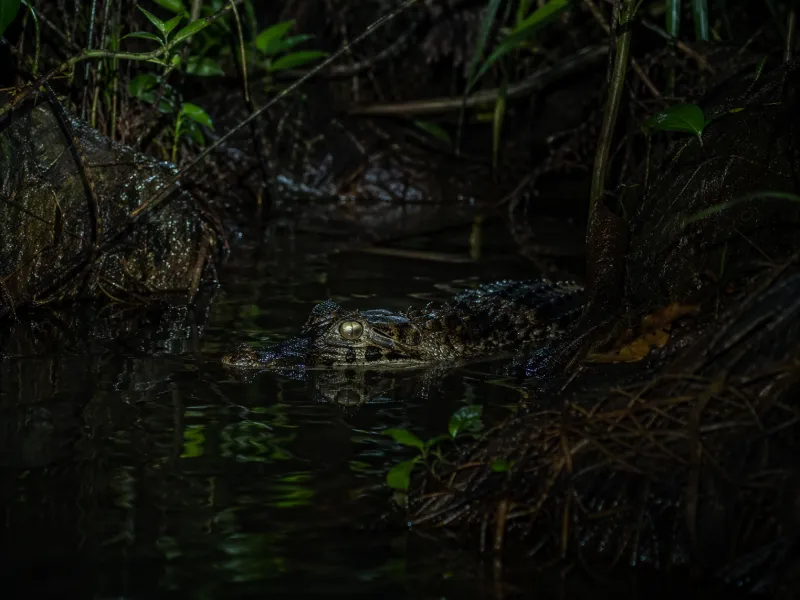
A dwarf caiman has a compact body, a strong tail, short powerful legs, and heavy armored skin. Its head is fairly short and broad compared with the long, narrow snout of many crocodiles.
One of the most noticeable traits is the armor. Dwarf caimans often have especially strong bony plates in the skin, giving them a rough, hard appearance. The body can look more heavily protected than that of many larger crocodilians.
The color is usually dark brown, gray-brown, or olive, often helping the animal blend into muddy banks, leaf litter, and shaded forest water. Juveniles may show more obvious patterning or banding than adults.
Overall, a dwarf caiman often looks like a tough little tank built for life in dark tropical waterways.
Where do dwarf caimans live?
Dwarf caimans live in South America, especially in tropical forest regions and river systems. Their range includes parts of countries such as Brazil, Peru, Ecuador, Colombia, Venezuela, Bolivia, and the Guianas, depending on the exact species and local habitat.
They are strongly associated with freshwater habitats. Typical places include forest streams, slow rivers, creeks, flooded forests, swamps, and wetland edges. Some populations also use rocky streams or small waterways in dense tropical forest.
Unlike some larger caimans that are often seen basking in broad open wetlands, dwarf caimans are frequently linked to more sheltered habitats with cover from vegetation, roots, logs, and shaded banks.
This habitat preference is one reason they are less conspicuous than some larger and more open-water crocodilians.
What does a dwarf caiman eat?
Dwarf caimans are carnivores. They eat a variety of small to medium prey depending on age, size, and habitat.
Young individuals often feed on insects, spiders, crustaceans, snails, tadpoles, and small fish. As they grow, they can take larger prey such as frogs, fish, crabs, aquatic invertebrates, reptiles, and small mammals or birds when the opportunity arises.
Because they are relatively small crocodilians, their diet often includes more invertebrates and smaller vertebrates than the diet of giant crocodilians. Hard-shelled prey can be important, especially because their jaws are well suited for gripping and crushing smaller animals.
In many habitats, a dwarf caiman is best thought of as a flexible forest-water predator that takes whatever suitable prey is available.
How does a dwarf caiman hunt?
Like other crocodilians, the dwarf caiman is mainly an ambush hunter. It often waits quietly in shallow water or near the edge of a stream until prey comes close enough to seize.
Because it often lives in smaller waterways and more enclosed habitats, it may hunt in tight spaces among roots, branches, and vegetation rather than in broad open marshes. Its dark coloration and low profile make it hard to spot in shadowy water.
Dwarf caimans are often active at night, when they search for prey along stream banks and in shallow pools. At this time, their eyeshine may reveal them during nighttime wildlife surveys.
They are not giant apex predators like the largest crocodiles, but in their own habitat they are efficient stealth hunters.
Are dwarf caimans dangerous?
Dwarf caimans are still wild crocodilians and should be treated with caution. They are much smaller than large crocodiles and black caimans, but they can bite, twist, and defend themselves if threatened or handled.
In general, they are less likely to be viewed as major danger animals than the largest crocodilian species, mainly because of their smaller size. Even so, they are not harmless pets or docile reptiles.
If cornered, captured, or disturbed at close range, a dwarf caiman can react quickly. The safest approach is always to observe from a respectful distance and avoid handling wild individuals.
How is a dwarf caiman different from other caimans?
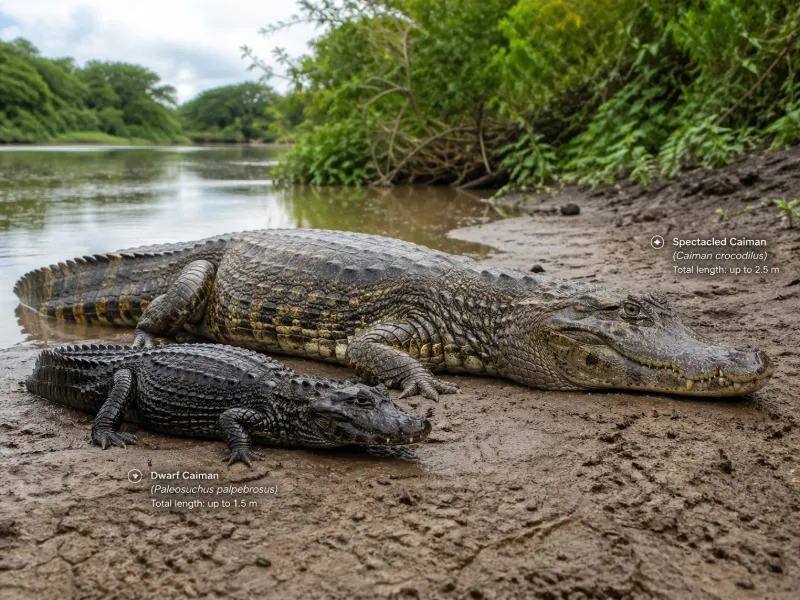
The main difference is size. Dwarf caimans are much smaller than species such as the black caiman and are usually smaller than spectacled caimans and yacare caimans as well.
They also tend to be more strongly associated with forest streams and shaded freshwater habitats, while larger caimans are often more visible in broad rivers, marshes, and open wetlands.
Another major difference is body armor. Dwarf caimans often look especially rugged and heavily plated, even compared with larger relatives. Their compact build and strong osteoderms give them a very distinctive appearance.
So if you see a small, heavily armored crocodilian in a tropical South American forest waterway, it may be a dwarf caiman.
Do dwarf caimans live alone?
Dwarf caimans are often encountered alone, especially adults, although several individuals may use the same broader stream system or forest wetland if habitat conditions are good.
They are not highly social animals in the mammal sense. Instead, their spacing depends on food availability, shelter, breeding season, and local water conditions.
Because they often live in covered habitats, they can be harder to observe than larger caimans that bask in open places. That can make them seem rarer or more secretive than they really are.
How do dwarf caimans reproduce?
Like other crocodilians, dwarf caimans reproduce by laying eggs. Females build nests in suitable places near water, often using vegetation and natural debris.
After laying the eggs, the female may guard the nest area. Once the young hatch, they face many dangers from birds, mammals, snakes, large fish, and larger reptiles.
Only a small proportion survive to adulthood, which is typical for many crocodilian species. The quality of forest wetland habitat plays an important role in their long-term survival.
What is the conservation status of dwarf caimans?
Dwarf caimans are generally not as famous as larger crocodilians, but they still depend on healthy freshwater ecosystems. Their conservation outlook varies by species and region.
In some areas, habitat destruction, forest loss, water pollution, hunting pressure, and disturbance can affect local populations. Remote forest habitats may offer protection in some places, but they are not immune to change.
Because these animals often live in forest-linked waterways, protecting streams, wetlands, and surrounding tropical forest is especially important for their future.
Why are dwarf caimans important?
Dwarf caimans are important because they are part of the ecological balance of tropical freshwater systems. They help regulate populations of fish, amphibians, invertebrates, and other small prey.
They are also a good reminder that crocodilian diversity is not limited to giant swamp predators. Some species are small, secretive, and closely tied to forest streams, making them important pieces of tropical biodiversity.
Protecting dwarf caimans also helps protect the lesser-known waterways and wet forests where many other animals live.
Final takeaway
The dwarf caiman is one of the smallest crocodilians in the world and is best known for its compact size, heavy armor, and forest-associated freshwater lifestyle. It lives in South American streams, rivers, flooded forests, and wetlands, where it hunts fish, crustaceans, insects, amphibians, and other small prey.
Although it is much smaller than a black caiman or a large crocodile, it is still a capable predator and an important part of tropical freshwater ecosystems.
FAQs
Is a dwarf caiman a crocodile?
No. A dwarf caiman is a crocodilian, but it belongs to the alligator family rather than the crocodile family.
How big is a dwarf caiman?
It is small compared with most crocodilians. Many adults are around 1.2 to 1.6 meters long, though large males can exceed that.
Where does the dwarf caiman live?
It lives in freshwater habitats in South America, especially forest streams, rivers, creeks, flooded forests, and wetlands.
Is a dwarf caiman dangerous?
It can be dangerous if handled or cornered. It is a wild crocodilian and should always be treated with caution.