Most sharks do not blink the way humans do. Some species can move a protective membrane across their eyes, especially while feeding, but this is not the same as the regular blinking we use to keep our eyes moist. Other sharks, including great white sharks, use a different protective response: they can roll their eyes backward when close to prey.
Whether a shark appears to “blink” depends on its species and the structure of its eye. Here is what shark researchers mean by eyelids, nictitating membranes, and eye protection.
Do Sharks Have Eyelids?
Sharks have eyelid structures, but most do not repeatedly open and close them like people do. Unlike human eyes, shark eyes are constantly surrounded by water, so they do not need frequent blinking to spread a tear film over the surface.
In many species, ordinary upper and lower eyelids move very little. A number of sharks have an additional movable protective covering commonly called a nictitating membrane. This membrane can cover much of the eye at moments when the shark might otherwise risk an injury.
That is why a short answer such as “sharks cannot blink” needs a qualification: most do not blink habitually like humans, but some have a specialized eye-covering movement.
What Is a Shark’s Nictitating Membrane?
The nictitating membrane is a protective structure that moves over the eye. Its main job is not to moisturize the eye; it is to reduce the risk of physical damage. When a shark approaches struggling prey, sudden movements, fins, spines, or debris may come dangerously close to its face.
The membrane provides a temporary shield. This feature occurs in many ground sharks, a group that includes a number of familiar coastal predators. A blue shark is a well-documented example of a species that can cover its eyes with the membrane.
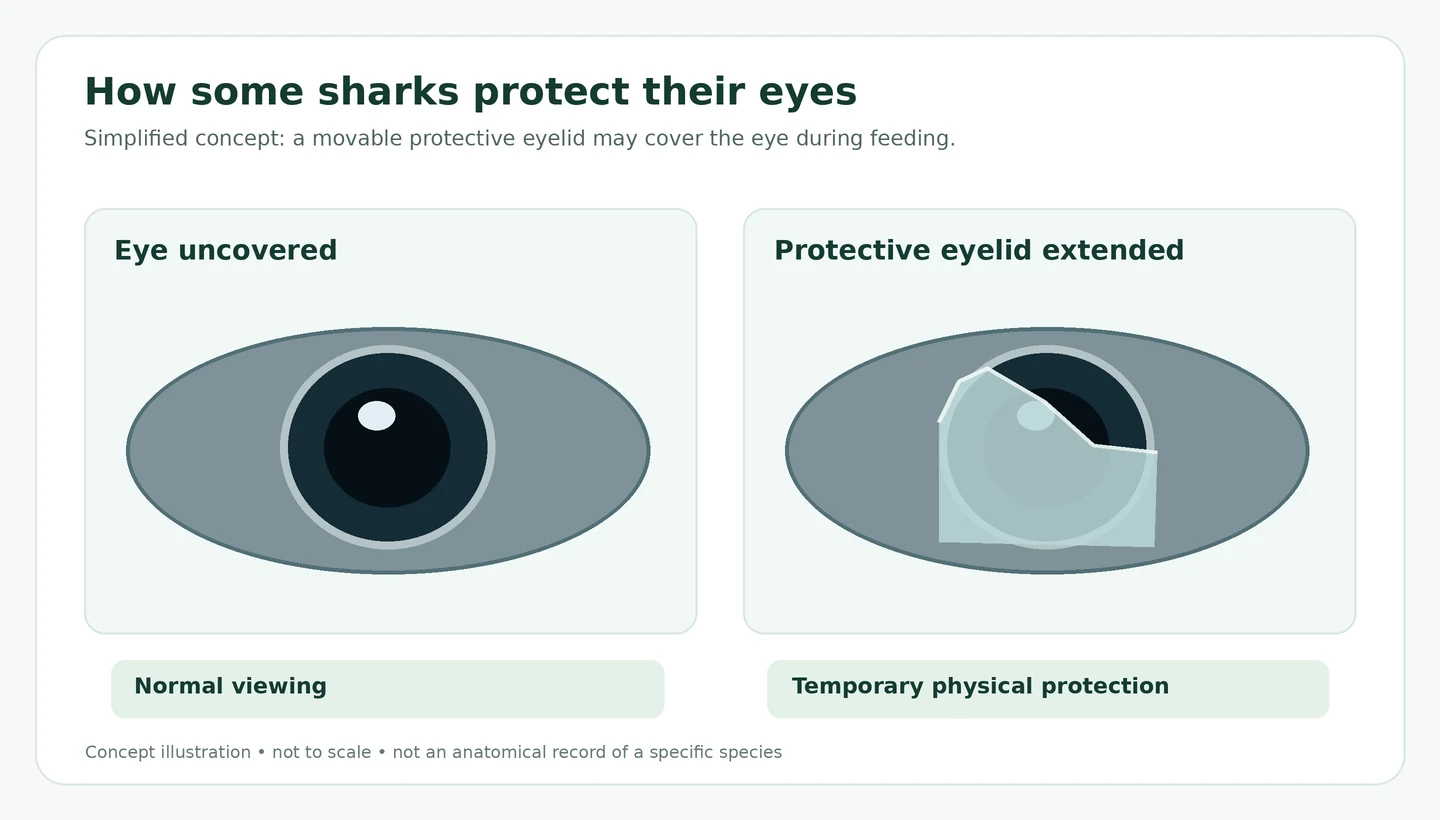
Simplified explanatory illustration of protective eye covering in some sharks, not a verified species-specific photograph.
Why Do Sharks Cover Their Eyes When They Bite?
Feeding can put a shark’s eyes at risk. The predator may be very close to a fish or other animal that is twisting, striking, or attempting to escape. A protective membrane allows some sharks to shield the eye during the final approach or bite.
However, sharks do not all use the same solution. Some species lack a movable nictitating membrane and can instead protect their eyes by rotating them backward. Eye protection is therefore a useful example of how closely related animals can evolve different ways to solve the same problem.
Do Great White Sharks Blink?
Great white sharks do not have the movable nictitating eyelid found in many other sharks. They are known to roll their eyes backward for protection, particularly during close encounters with prey. This behavior can make the eye appear pale or white for a brief moment.
The white appearance is not a new eyelid sliding across the eye. It happens because the eye rotates, changing which part is visible. Videos of feeding white sharks sometimes show this response, but it should not be treated as something that happens during every bite.
The difference matters: calling both responses “blinking” makes two distinct anatomical mechanisms sound identical.
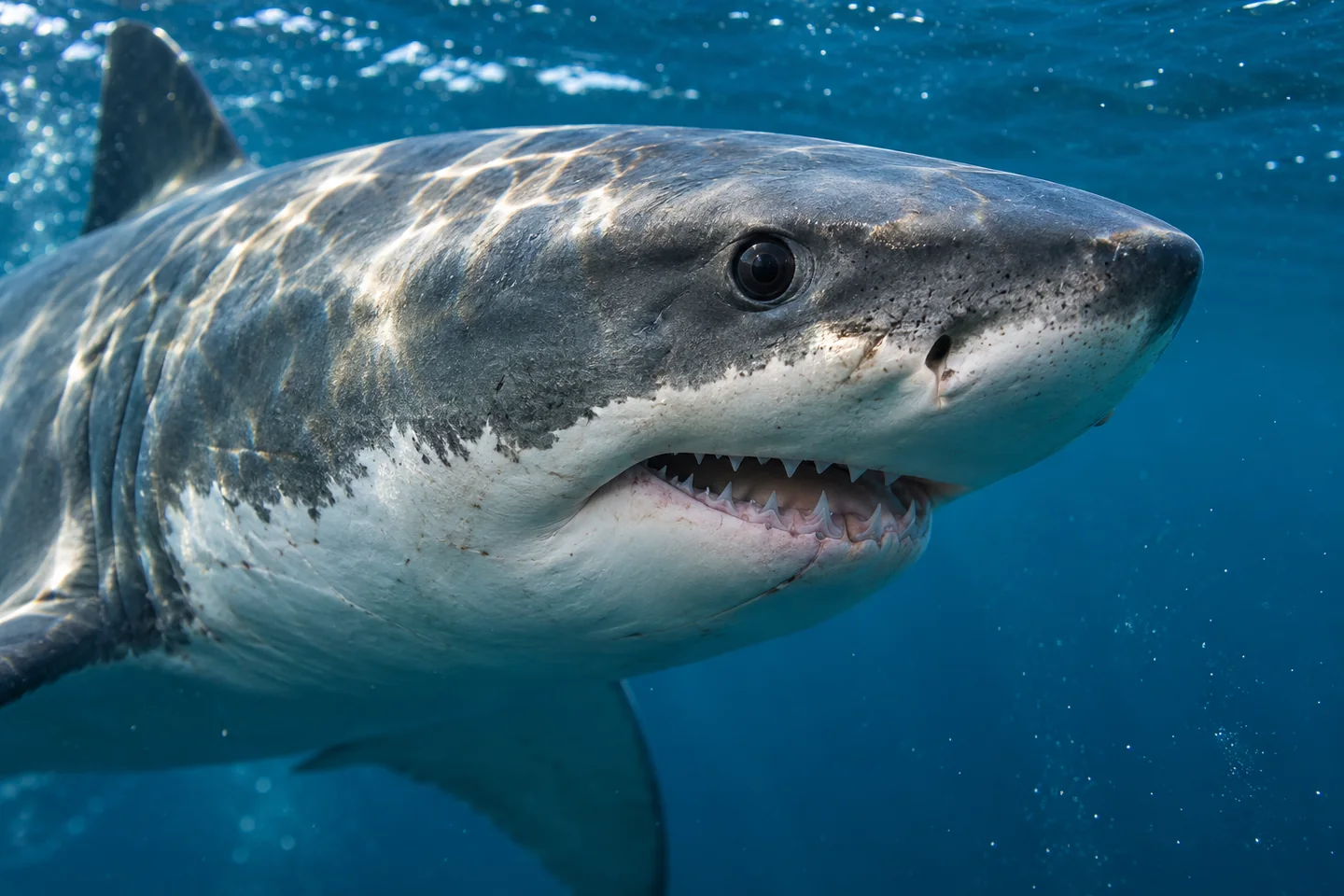
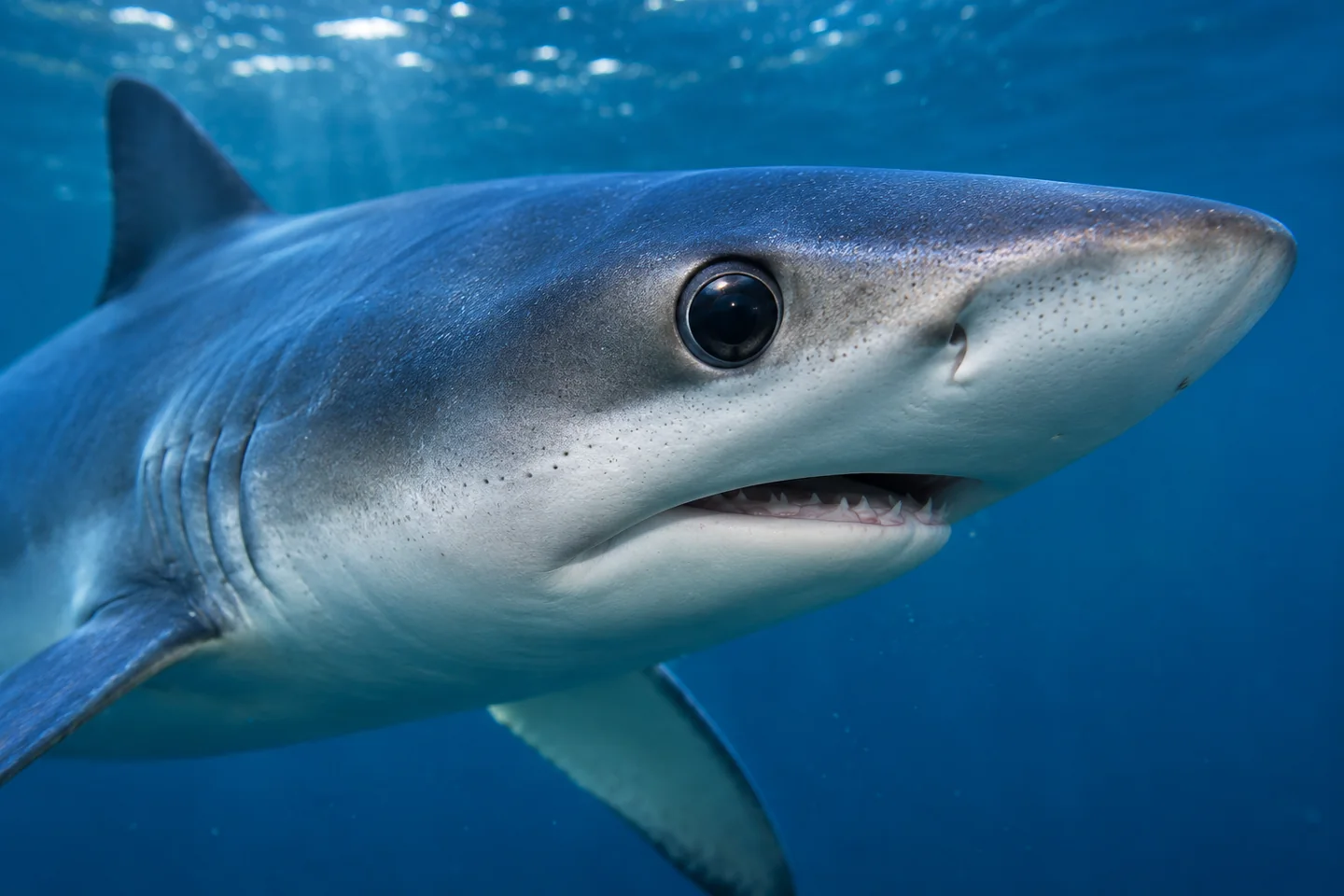
AI-generated illustration of a great white shark. The eye is shown open; this is not evidence of the eye-rolling behavior described above.
Which Sharks Have a Protective Eye Membrane?
| Shark or group | Eye-protection mechanism | Important distinction |
|---|---|---|
| Blue shark | Movable protective membrane | Can cover the eye during feeding |
| Many ground sharks | Nictitating eyelid or membrane | The precise movement varies among species |
| Great white shark | Eye rotation | Does not use a nictitating eyelid |
| Sharks generally | Species-specific eyelid structures | Do not assume all species protect their eyes in the same way |
The common name “nictitating membrane” is widely used in aquarium and museum explanations. Technical anatomical references sometimes distinguish sharks’ movable nictitating eyelids from the nictitating membranes of land vertebrates. For general readers, the key point is that it is a protective movable covering, not everyday human-style blinking.
Can Sharks See When Their Eye Is Covered?
An eye covering that shields the surface may also temporarily change what the animal can see. The protective response is most useful when the animal is already close enough to its target for physical contact to be a danger.
Sharks also rely on other sensory systems. Their lateral line helps them detect water movement, and their electroreceptive organs can detect weak electrical signals from nearby animals. Those senses are especially relevant during the last moments of approaching prey, when visual information may be limited.
For more context, read how sharks see, smell, and hear underwater.
Is Blinking Related to Shark Vision?
Not directly. Blinking and vision are different questions. The physical covering protects the eye, while the retina and other internal structures determine how light is detected.
Many sharks have a reflective layer called the tapetum lucidum behind the retina that can improve sensitivity in dim light. But shark eyesight is far from uniform: species live in environments ranging from brightly lit shallow water to deep, dark ocean habitats.
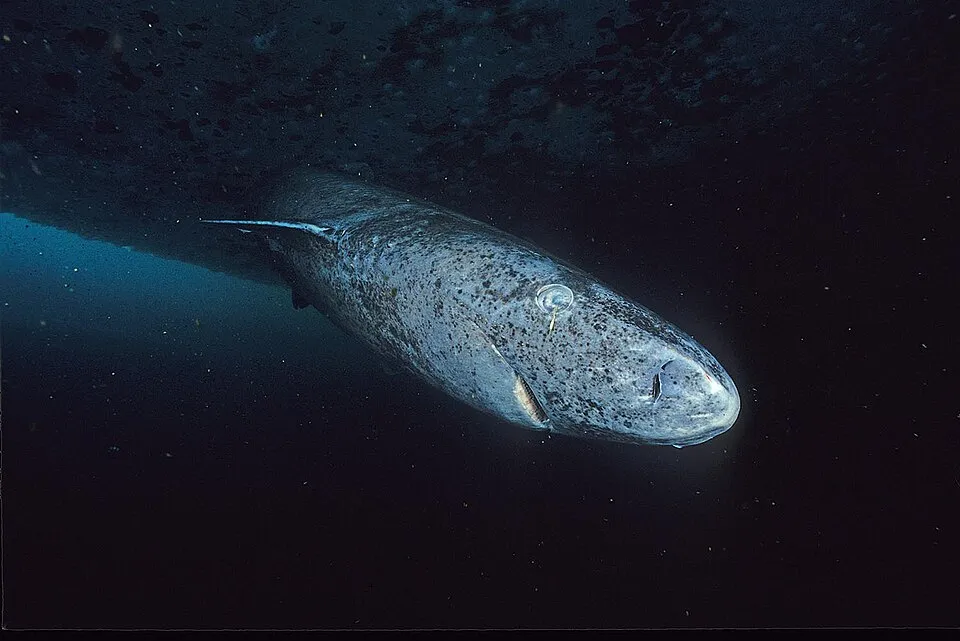
One especially interesting example is the Greenland shark. Research discussed in our guide to whether Greenland sharks are blind shows why the appearance of an eye alone does not prove how well an animal sees.
Do Sharks Close Their Eyes When They Sleep?
It is misleading to picture every resting shark shutting its eyes as a person does before sleeping. Shark resting behavior varies across species, and their eyelid systems differ from ours. A movable protective covering does not mean the animal follows a human-like pattern of repeatedly blinking or closing its eyes for sleep.
If you see an aquarium shark resting with an apparently open eye, that is not in itself evidence that the animal is awake. Eye position alone is not a reliable test of a shark’s resting state.
Quick Answers
Can a shark blink?
Some sharks can move an eye-protecting membrane, but they do not usually blink repeatedly like people. Other species rely on different methods, such as rolling the eyes backward.
Do all sharks have a third eyelid?
No. Movable nictitating eye coverings occur in many, but not all, sharks.
Why do a great white shark’s eyes turn white?
A great white shark can rotate its eyes backward, exposing a pale-looking surface. That is an eye-protection response, not a membrane sliding across the eye.
Do sharks need to blink to keep their eyes wet?
No. Sharks live in water, so the protective role of their eyelid structures is different from the tear-spreading role of habitual blinking in humans.
The Bottom Line
Sharks do not all blink, and there is no single eyelid mechanism that describes every species. Many have movable coverings that protect their eyes during feeding; great white sharks are among the species that instead roll their eyes backward. Understanding that difference tells us more about shark anatomy than a simple yes-or-no answer.
Sources and Further Reading
Florida Museum of Natural History — Shark Biology: description of the nictitating membrane and its protective function.
Fisheries and Oceans Canada — Shark Anatomy: blue shark eye protection and the membrane during feeding.
Smithsonian Ocean — Sharks: shark eyes, eyelids, and variations in vision.
University of Florida IFAS — Sharks for the Aquarium: protective membrane and eye rotation in great white sharks.