Male seahorses give birth because they have evolved a remarkable form of male pregnancy. During mating, a female transfers her eggs into the male's specialized brood pouch, where the eggs are fertilized and the embryos develop. The father protects the developing young and helps regulate their oxygen supply, salt balance, and nutritional environment. After a pregnancy lasting approximately two to four weeks in many species, the male releases fully formed baby seahorses into the water. Scientists are still investigating why this unusual reproductive strategy evolved, but it may allow males and females to share the costs of reproduction in a distinctive way.
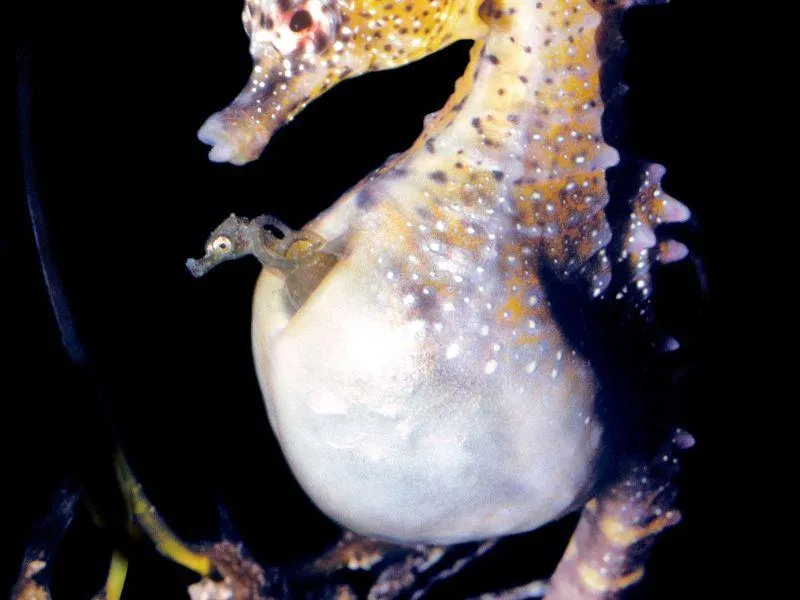
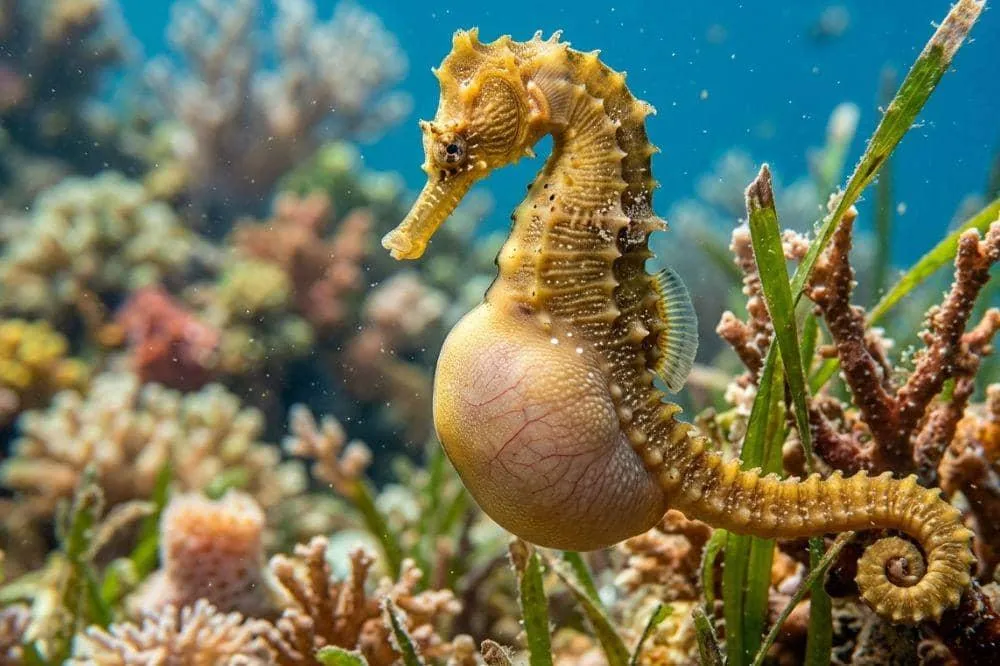
A pregnant male seahorse carries developing embryos in a specialized brood pouch on the underside of his body.
Why Do Male Seahorses Give Birth?
Male seahorses give birth because their evolutionary lineage developed a specialized system of paternal pregnancy. Instead of depositing eggs into an external nest, female seahorses transfer their eggs into a male's brood pouch.
The male then performs much of the physiological work associated with incubating the developing embryos. His pouch provides a protected environment while supporting important exchanges between the father's tissues and the offspring.
Scientists think this reproductive arrangement may provide advantages by dividing reproductive responsibilities between the sexes. Females produce eggs, while males provide a protected environment for their development.
However, there is no single experimentally established evolutionary explanation that applies to every seahorse species. Male pregnancy evolved within a diverse family of fishes whose members display different forms of parental care.
Do Male Seahorses Really Get Pregnant?
Yes. Male seahorses experience a genuine form of pregnancy. The developing embryos remain associated with specialized tissues of the male brood pouch rather than being left unprotected in the surrounding water.
The pouch is more than a simple bag for carrying eggs. Scientific research shows that its tissues change during pregnancy and participate in oxygen exchange, regulation of the internal environment, and certain forms of nutrient transfer.
However, male seahorse pregnancy is not anatomically identical to pregnancy in humans or other mammals. The two systems evolved independently and use different reproductive organs.
Are Seahorses the Only Animals Where Males Give Birth?
Seahorses are members of the fish family Syngnathidae, which also includes pipefishes and seadragons.
Male brooding and pregnancy-like reproductive strategies occur throughout this family. However, different species possess different forms of egg-carrying anatomy.
Seahorses are especially notable because their males carry embryos inside a specialized enclosed pouch.
Some pipefishes have enclosed pouches, while others carry eggs on exposed or partly covered body surfaces. Seadragons generally carry developing eggs attached to specialized areas on the male's tail.
Therefore, all these fishes should not be described as giving birth from an identical abdominal pouch.
How Do Male Seahorses Get Pregnant?
Male pregnancy begins with courtship between a male and a female seahorse.
During mating, the female uses a specialized tube-like reproductive structure called an ovipositor to transfer mature eggs into the male's brood pouch.
The male releases sperm, and fertilization occurs in association with the pouch.
The embryos then develop within the protective reproductive environment provided by the father.
However, exact courtship sequences and mating behavior vary among species. The process should not be described as identical in every seahorse population.
What Happens During Seahorse Mating?
Seahorse courtship often involves coordinated movements between potential partners.
They may change color, swim together, orient their bodies in similar directions, and move in repeated patterns that resemble a dance.
Some pairs wrap their tails around objects or briefly interact with one another's tails.
During the final egg-transfer stage, the female aligns her reproductive opening with the male's pouch opening.
However, courtship is not simply a decorative performance. It helps coordinate reproductive readiness and the transfer of eggs.
Do Female Seahorses Lay Eggs?
Yes. Female seahorses produce eggs and transfer them to males during reproduction.
However, in seahorses with enclosed brood pouches, the eggs are not typically deposited directly into the ocean.
They are transferred into the male reproductive structure, where fertilization and development occur.
This explains why the male can become pregnant without producing eggs himself.
The female contributes the egg cells, while the male contributes sperm and the physiological environment for gestation.
Do Male Seahorses Produce Eggs?
No. Male seahorses produce sperm, not eggs.
The female produces the eggs and transfers them to the male during mating.
This distinction is important because the reproductive sexes have not exchanged their basic gamete-producing functions.
Male seahorses remain biologically male while performing the unusual parental role of carrying embryos and giving birth.
Do Seahorses Change Sex to Get Pregnant?
No. A male seahorse does not need to change into a female to become pregnant.
Male and female seahorses produce different types of reproductive cells. The male produces sperm, and the female produces eggs.
Pregnancy occurs in the male because his body has evolved specialized reproductive tissues capable of supporting developing embryos.
This is an example of an unusual distribution of reproductive responsibilities, not a requirement for sex change.
What Is a Seahorse Brood Pouch?
A brood pouch is a specialized structure on the underside of the male seahorse's body, associated with the tail region.
It has an opening through which eggs are transferred and developing young are eventually released.
Inside the pouch, embryos remain closely associated with tissues that change substantially during pregnancy.
The pouch helps regulate oxygen availability, fluid chemistry, and exchanges between the father and embryos.
Its biological functions make it comparable in some respects to a mammalian uterus, although its evolutionary origin is different.
How Does the Seahorse Brood Pouch Work?
After the eggs have been transferred and fertilized, the brood pouch becomes a protected environment for embryonic development.
The developing embryos obtain nutrients from their original egg reserves and receive additional support from the father's tissues.
The pouch also helps regulate salt and water balance as the embryos mature.
Its lining contains specialized cells, and the surrounding tissues include blood vessels that support exchanges involving oxygen and other substances.
Research shows that the pouch changes its structure throughout pregnancy instead of functioning as an unchanged storage compartment.
What Does a Seahorse Brood Pouch Provide?
| Function | How It Helps Embryos | Scientific Evidence |
|---|---|---|
| Physical protection | Keeps developing embryos within the father's body | Direct anatomical and developmental observation |
| Oxygen exchange | Supports oxygen delivery to growing embryos | 2021 vascular and tissue-remodeling research |
| Osmoregulation | Helps regulate salt and fluid conditions | Physiological and gene-expression studies |
| Nutritional support | Transfers certain nutrients in addition to egg reserves | Biochemical studies, including 2024 protein research |
| Immune environment | Helps manage interactions with embryos and microorganisms | Genomic and microbiome studies |
| Birth and release | Allows developed young to enter the surrounding water | Behavioral and anatomical studies |
Do Male Seahorses Have a Placenta?
Seahorse brood pouches contain tissues that perform some functions comparable to a placenta.
In the scientific literature, these structures may be described as placenta-like or pseudoplacental tissues.
They help create an exchange surface between paternal tissues and developing embryos.
However, a seahorse does not possess a mammalian uterus or a placenta anatomically identical to the human placenta.
Similar functions can evolve independently through different developmental pathways. This is an example of convergent evolution.
Is Seahorse Pregnancy the Same as Human Pregnancy?
Both systems involve the development of offspring within a specialized parental reproductive environment.
They also share functional challenges, including nutrient supply, oxygen exchange, waste handling, and interactions between parental tissues and embryos.
However, the underlying organs and developmental histories differ substantially.
Human pregnancy occurs in the uterus of a female placental mammal. Seahorse pregnancy occurs in a specialized male brood pouch derived from skin-associated tissues.
Research demonstrates striking similarities in some molecular pathways, but those similarities do not make the two forms of pregnancy anatomically identical.
Seahorse Pregnancy vs. Human Pregnancy
| Feature | Seahorse | Human |
|---|---|---|
| Pregnant parent | Male | Female |
| Egg producer | Female | Female |
| Gestational organ | Specialized brood pouch | Uterus |
| Nutrient transfer | Egg reserves plus variable paternal provisioning | Extensive maternal-placental transfer |
| Oxygen exchange | Through specialized pouch tissues | Through the placenta |
| Birth process | Pouch opening and coordinated body movements | Uterine contractions and cervical changes |
| Care after birth | Usually little direct care from the father | Typically prolonged parental care |
How Do Baby Seahorses Get Oxygen?
Embryos need oxygen to support growth and cellular metabolism.
Inside an enclosed pouch, oxygen cannot reach every embryo simply through unrestricted exposure to seawater.
Research published in 2021 on the big-belly seahorse, Hippocampus abdominalis, investigated how paternal tissues change during pregnancy.
The scientists found that the pouch lining developed more complex folds, capillary density increased, and the distance between small blood vessels and the pouch interior decreased.
These changes support the interpretation that the pouch becomes increasingly specialized for respiratory gas exchange as embryos develop.
What Did the 2021 Brood Pouch Study Discover?
The researchers examined tissue samples from male big-belly seahorses at different stages of pregnancy.
They used microscopy and quantitative measurements to study the surface area and blood vessel organization of the pouch.
The results demonstrated substantial remodeling of the reproductive tissues.
These changes resemble certain functional adaptations observed in other pregnant vertebrates.
However, they arise in a male fish and evolved independently of the mammalian uterine system.
Do Male Seahorses Feed Their Babies During Pregnancy?
Yes. Developing seahorse embryos depend partly on nutrients initially supplied in their eggs, but the father can also contribute nutrients during pregnancy.
Studies have identified paternal provisioning of substances including lipids and calcium in particular seahorse species.
However, the amount and composition of this contribution may vary among species and developmental stages.
The presence of paternal nutrient transfer is one reason seahorse pregnancy cannot be described as merely carrying eggs in a waterproof pocket.
Do Seahorse Fathers Provide Protein to Embryos?
Research published in 2024 provides evidence that they do, at least in the studied big-belly seahorse.
The investigators compared the protein content of newly fertilized eggs and newborn seahorses.
They found that newborns contained significantly more total protein than the eggs from which they developed.
This supports the conclusion that protein or protein-building material was supplied through the paternal reproductive environment during pregnancy.
However, the result concerns a particular species and experimental comparison, not a precisely measured protein-transfer rate for every seahorse.
How Does the Pouch Protect Developing Embryos?
An enclosed brood pouch provides physical separation from much of the surrounding marine environment.
This can reduce direct exposure to some hazards that freely released eggs would face.
The pouch also contains immune-associated tissues and molecular pathways that help manage interactions between the father and embryos.
However, pregnancy does not guarantee complete protection from disease, stress, or environmental changes.
Scientists have investigated how the evolution of male pregnancy affected immune-system pathways in seahorses and pipefishes.
Do Seahorses Have to Prevent Immune Rejection?
Developing embryos carry genetic information from both parents.
This creates an important biological problem: parental tissues must accommodate developing offspring without responding to them in a harmful way.
A 2020 study published in PNAS identified unusual evolutionary changes involving parts of the adaptive immune system in syngnathid fishes.
These changes may be associated with the demands of male pregnancy.
However, researchers are still investigating exactly how different species balance immune defense with successful embryo development.
How Does the Pouch Protect Babies From Salt?
Marine fish must regulate the movement of water and dissolved salts between their bodies and the surrounding seawater.
Developing embryos face their own challenges as they mature.
The seahorse brood pouch helps regulate its internal fluid environment during pregnancy.
Scientific studies describe changes in pouch fluid composition that may assist embryos in adjusting to external seawater conditions before birth.
However, the precise regulation depends on species and developmental stage.
How Long Are Male Seahorses Pregnant?
Male seahorse pregnancy commonly lasts approximately two to four weeks, according to NOAA.
However, gestation duration varies among species and can be influenced by temperature and other environmental conditions.
Some short-snouted seahorses have been described as carrying young for approximately two weeks, while other species take longer.
Therefore, the statement that every seahorse gives birth exactly 21 days after mating is inaccurate.
How Many Babies Do Seahorses Have?
Seahorses may give birth to widely varying numbers of young.
NOAA describes broods ranging from a few dozen to as many as approximately 1,000 newborns.
However, the number depends heavily on species, adult body size, reproductive condition, and other factors.
Some small seahorse species produce relatively small broods, while larger species may produce considerably more.
The number of eggs transferred does not necessarily equal the number of living offspring eventually released.
How Does a Male Seahorse Give Birth?
When the embryos are sufficiently developed, the male begins a series of coordinated movements.
He may bend his body toward the tail, change posture, and perform repeated pressing or jerking motions.
The brood pouch opening widens, and small groups of newborn seahorses are expelled into the surrounding water.
This process can occur in repeated bursts rather than one continuous release.
However, the exact muscle control involved is still under investigation.
What Did the 2022 Seahorse Birth Study Find?
Scientists at the University of Sydney and collaborators examined the anatomy and physiology of male big-belly seahorse reproduction.
They found relatively little smooth muscle in the brood pouch wall compared with the uterus of a typical pregnant mammal.
In laboratory experiments, the fish hormone isotocin did not produce measurable contractions in the tested pouch tissue.
The investigators also identified enlarged skeletal muscles associated with structures near the pouch opening.
They proposed that these muscles help control opening of the pouch and, together with body movements, facilitate birth.
However, the precise contribution of each muscle remains a hypothesis requiring further direct biomechanical testing.
Does Seahorse Birth Involve Contractions?
Male seahorses perform repeated movements during birth that resemble contractions when viewed from outside the body.
However, this should not be assumed to involve the same uterine smooth-muscle mechanism used by mammals.
The 2022 experiments showed that the pouch had relatively limited smooth muscle and did not respond to isotocin in the predicted way.
Body movement and muscles around the pouch opening appear to play important roles.
Scientists continue to investigate how these movements are coordinated.
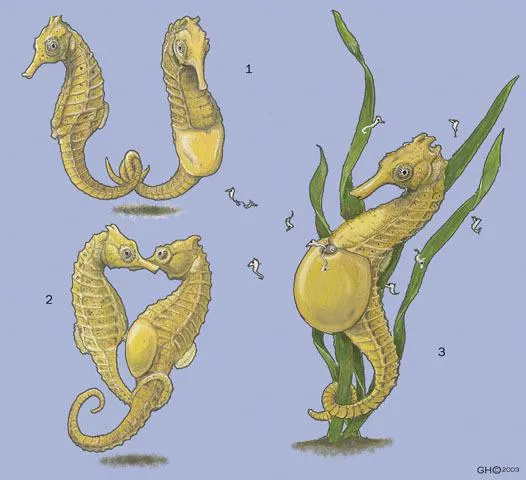
Scientific illustration: a female transfers eggs to a male's pouch, where embryos develop before the father releases the young.
What Did the 2025 Seahorse Pregnancy Study Discover?
In November 2025, scientists published Cellular and Molecular Mechanisms of Seahorse Male Pregnancy in Nature Ecology & Evolution.
The researchers used single-cell molecular techniques and comparative genomic analyses to investigate how the male brood pouch forms and functions.
They identified a population of epithelial progenitor cells involved in pouch development and found evidence that androgen signaling helps regulate their activity.
The study also identified cell populations with similarities to those involved in pregnancy-related exchange tissues in mammals.
These findings show that different vertebrate lineages can evolve functionally comparable pregnancy systems using overlapping molecular pathways, even though the organs have different evolutionary origins.
Do Male Hormones Control the Seahorse Brood Pouch?
Research indicates that androgens play an important role in the development of the seahorse brood pouch.
Androgens are hormones involved in multiple aspects of vertebrate physiology and reproduction.
A 2024 study experimentally investigated androgen signaling during pouch formation in the big-belly seahorse.
The later 2025 study used additional cell-level analyses and genetic experiments to examine related developmental mechanisms.
However, the reproductive system cannot be reduced to one hormone acting alone. Multiple cellular pathways contribute to its structure and function.
Why Is the 2025 Research Important?
Earlier studies demonstrated what the brood pouch does during pregnancy.
The 2025 research addressed another question: how does a male fish develop such an unusual reproductive organ in the first place?
By identifying relevant cells and molecular signals, the study connected reproductive anatomy with developmental genetics.
It also provided a way to compare pregnancy-related adaptations across very different vertebrate groups.
However, similarities in genetic pathways do not mean male seahorses possess the same developmental anatomy as female mammals.
Do Seahorses Give Birth to Live Young or Lay Eggs?
Female seahorses produce eggs, but those eggs develop within the male brood pouch.
The male ultimately releases developed young rather than simply scattering freshly produced eggs into the ocean.
For this reason, seahorses are scientifically discussed as an important example of male pregnancy and live-bearing reproduction.
However, the embryos initially receive nutrients from the eggs as well as support from paternal tissues. Seahorse reproduction should not be described as identical to mammalian live birth.
What Do Baby Seahorses Look Like?
Newborn seahorses are miniature fish with the characteristic elongated snout and body shape of the group.
They are much smaller than adults and remain vulnerable to predation and environmental changes.
After birth, the young must begin functioning independently in the surrounding marine environment.
Their appearance and developmental condition vary among species.
Some species also have particular early life-history stages adapted to dispersal.
Do Seahorse Fathers Care for Babies After Birth?
In most seahorse species, paternal care is concentrated during pregnancy.
Once the young are released, they generally do not receive prolonged feeding or guarding from the father.
The newborns must find suitable food and avoid predators on their own.
This creates an important distinction between carrying embryos before birth and raising offspring for an extended period afterward.
The absence of prolonged postnatal care does not diminish the substantial physiological investment made during pregnancy.
Why Do Seahorses Have So Many Babies?
Newborn seahorses face numerous challenges, including predators, food shortages, currents, and habitat changes.
Producing multiple offspring can increase the possibility that at least some survive to reproductive maturity.
However, brood size is not unlimited. It depends on the species and the reproductive capacity of the parents.
Large broods should not be interpreted as evidence that every newborn has a high chance of survival.
Can Male Seahorses Get Pregnant Again?
Yes. Male seahorses can undergo multiple pregnancies during suitable reproductive periods.
After giving birth, some males may be ready to receive another clutch of eggs relatively quickly.
However, the timing depends on species, environmental conditions, and reproductive state.
Repeated pregnancy requires continued physiological investment and is not a cost-free process.
Do Seahorses Mate for Life?
Some seahorse species form stable pair bonds during a breeding season or longer.
Pairs may engage in repeated courtship interactions and coordinated reproductive behavior.
However, the statement that all seahorses mate for life is too broad.
Different species and populations show different mating systems, and some individuals change partners.
Reproductive fidelity should therefore be described at the species or population level rather than as an absolute rule for all seahorses.
Does Male Pregnancy Reverse Male and Female Roles?
Male pregnancy changes how reproductive effort is distributed.
Females invest in producing eggs, while males invest in carrying and supporting embryos.
In some species and conditions, this can affect competition for mates and which sex is more selective.
However, sex-role reversal is not identical across every seahorse and pipefish species.
Researchers study how brood capacity, egg production, local mate availability, and parental investment influence mating behavior.
Why Did Male Pregnancy Evolve?
The evolutionary origin of male pregnancy is one of the most interesting questions in fish biology.
One hypothesis is that dividing reproductive responsibilities allows females to prepare additional eggs while males support embryos.
Other explanations involve the protection of offspring, reproductive success, environmental conditions, and sexual selection.
However, these ideas are not mutually exclusive, and the importance of each mechanism probably varies across the syngnathid family.
A major 2020 review emphasized that additional experiments are needed to establish the selective pressures responsible for different male-pregnancy systems.
How Did Male Pregnancy Evolve in Pipefish and Seahorses?
Members of the family Syngnathidae display different degrees of paternal egg protection.
Some males carry eggs attached to exposed body surfaces.
Others have skin folds that partly cover the developing eggs, while seahorses possess highly specialized enclosed pouches.
Researchers compare these anatomical forms and their genetic relationships to study the evolution of pregnancy complexity.
However, living species should not be treated as a simple ladder in which one modern species is the direct ancestor of another.
They are separate evolutionary lineages that have inherited and modified different reproductive structures.
Seahorse vs. Pipefish vs. Seadragon Reproduction
| Feature | Seahorses | Pipefishes | Seadragons |
|---|---|---|---|
| Family | Syngnathidae | Syngnathidae | Syngnathidae |
| Male carries developing eggs | Yes | Yes | Yes |
| Typical brooding anatomy | Enclosed pouch | Varies from exposed attachment to enclosed structures | Eggs attached to specialized tail surfaces |
| Embryonic development | Within the male pouch | On or in male brooding structures | Attached to the male's tail |
| Young released after development | Yes | Yes | Yes |
| Identical placental structures | No | No | No |
Are Seahorses Actually Fish?
Yes. Seahorses are bony fishes belonging to the family Syngnathidae.
They breathe through gills and have fins, even though their upright swimming posture looks unusual compared with many other fish.
Their bodies are supported by a series of bony plates beneath the skin.
However, their distinctive reproductive system does not make them mammals or another vertebrate group.
Where Do Seahorses Live?
Seahorses inhabit a range of coastal marine environments, including seagrass beds, mangrove areas, reefs, and other sheltered habitats.
Different species have different geographic distributions.
Some rely heavily on vegetation or branching structures that allow them to anchor themselves with their prehensile tails.
These environments can be especially important for feeding, courtship, and reproduction.
What Do Seahorses Eat?
Seahorses are predatory fishes that consume small aquatic animals.
Depending on species and habitat, prey may include tiny crustaceans and other small organisms.
Their tubular snouts help them draw prey into the mouth using suction feeding.
However, seahorses do not possess an ordinary stomach like that of many familiar vertebrates.
Their feeding anatomy is a separate subject from male pregnancy, although adequate nutrition supports reproductive health.
Are Seahorses Endangered?
Many seahorse populations face conservation pressures, but their precise status differs among species.
Threats include habitat loss, coastal development, pollution, accidental capture in fisheries, and some forms of wildlife trade.
However, it is inaccurate to describe every seahorse species as having the same conservation classification.
Reliable assessments should identify the species and population being discussed.
Why Is Seahorse Pregnancy Important to Science?
Male seahorses provide an unusual opportunity to investigate the evolution of pregnancy independently of the female mammalian reproductive system.
Researchers can compare how different animals solve the problems of oxygen delivery, nutrient exchange, immune regulation, and birth.
Studies from 2015 through 2025 have revealed important similarities in molecular pathways as well as striking differences in reproductive anatomy.
However, findings about seahorses do not automatically translate into medical treatments for human pregnancy.
The main scientific value is improving our understanding of how complex reproductive systems can evolve through different biological routes.
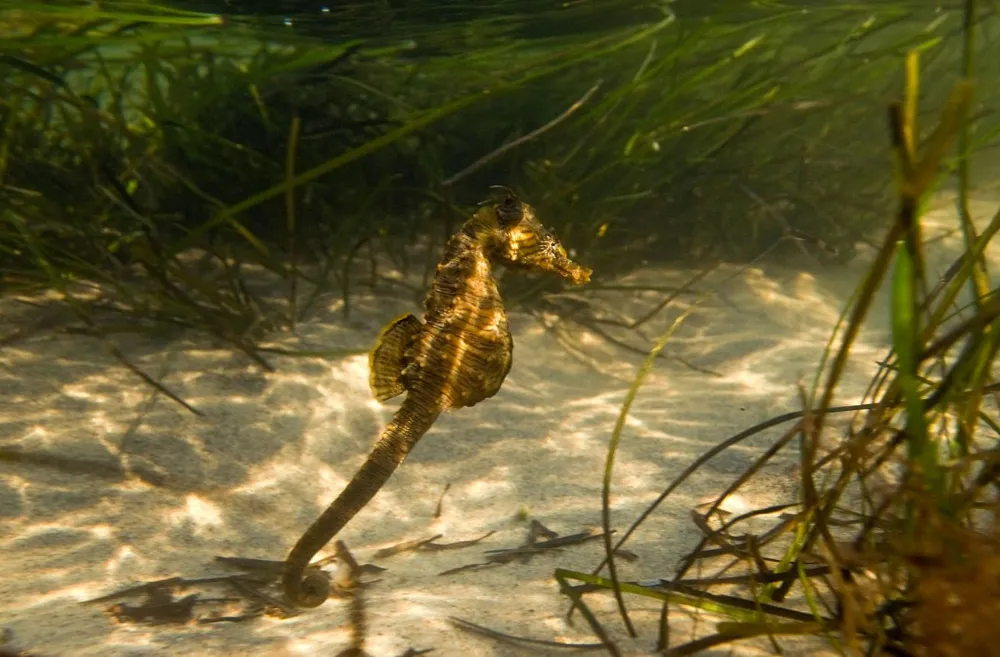
Seahorses reproduce in coastal habitats where seagrass and other structures can provide shelter and attachment points.
Frequently Asked Questions
Why do male seahorses give birth?
Male seahorses have evolved specialized brood pouches that allow them to incubate developing embryos and release newborn young. The exact evolutionary advantages of male pregnancy are still being investigated.
Do male seahorses really get pregnant?
Yes. Male seahorses carry developing embryos within specialized reproductive tissues and provide important physiological support during gestation.
How do male seahorses get pregnant?
A female transfers eggs into the male's brood pouch during mating. The male fertilizes them and carries the developing embryos until birth.
Do female seahorses give birth?
No. Female seahorses produce and transfer eggs. The male carries the developing offspring and releases the newborns.
Do male seahorses lay eggs?
No. Males produce sperm, while females produce eggs.
How long are seahorses pregnant?
Gestation commonly lasts approximately two to four weeks, although the duration varies among species and conditions.
How many babies can a seahorse have?
Brood sizes vary widely. Some species produce a few dozen young, while others may release hundreds or approximately a thousand under suitable conditions.
What is a seahorse brood pouch?
It is a specialized male reproductive structure that protects developing embryos and helps regulate their internal environment.
Do male seahorses have a placenta?
They possess placenta-like exchange tissues, but these are not anatomically identical to the placenta of a mammal.
Do male seahorses feed their babies during pregnancy?
Yes. Research has demonstrated paternal nutrient contributions, including evidence of protein transfer in the big-belly seahorse.
How do male seahorses give birth?
The male performs coordinated body movements that help open the pouch and expel developing young into seawater.
Do seahorses change sex to become pregnant?
No. Male seahorses remain male and produce sperm. They possess specialized anatomy for gestation.
Do seahorses mate for life?
Some form stable pair bonds, but lifelong monogamy is not universal across seahorse species.
Do seahorse fathers care for babies after birth?
In most species, the newborns become independent soon after release and receive little additional parental care.
Are seahorses the only animals with male pregnancy?
Male pregnancy-like brooding systems also occur among their close relatives, including pipefishes and seadragons, although anatomy varies.
Can male seahorses get pregnant more than once?
Yes. Many males can experience multiple pregnancies during suitable breeding conditions.
Are seahorses mammals?
No. Seahorses are marine bony fishes. Their form of pregnancy evolved independently of mammalian pregnancy.
The Bottom Line
Male seahorses give birth because they possess a specialized reproductive system in which females supply eggs and males incubate the developing young.
The male brood pouch provides protection and participates in oxygen exchange, fluid regulation, and some forms of nutrient transfer.
Scientific research has demonstrated important structural and molecular similarities between seahorse pregnancy and other vertebrate pregnancy systems, although the organs evolved independently.
Recent studies also show that birth may involve specialized skeletal muscles and body movements rather than the same smooth-muscle mechanism used in human childbirth.
The exact evolutionary causes of male pregnancy are still under investigation, but the seahorse provides a remarkable example of how parental care and reproductive biology can evolve in unexpected ways.
Sources & Further Reading
NOAA National Ocean Service — How Do Seahorses Differ From All Other Animals? Overview of egg transfer, pregnancy duration, birth and newborn independence.
Smithsonian Ocean — A Pregnant Seahorse. Photograph and background on male pregnancy in the short-snouted seahorse.
Whittington et al. (2015) — Seahorse Brood Pouch Transcriptome Reveals Common Genes Associated With Vertebrate Pregnancy. Molecular Biology and Evolution. Gene-expression research on physiological changes during male pregnancy.
Whittington and Friesen (2020) — The Evolution and Physiology of Male Pregnancy in Syngnathid Fishes. Biological Reviews. Scientific review of reproductive evolution and pregnancy-related adaptations.
Evolution of Male Pregnancy Associated With Remodeling of Canonical Vertebrate Immunity in Seahorses and Pipefishes (2020). PNAS. Research on pregnancy and immune-system evolution.
Structural Changes to the Brood Pouch of Male Pregnant Seahorses Facilitate Exchange Between Father and Embryos (2021). Anatomical measurements of oxygen-exchange adaptations.
Dudley et al. (2022) — Seahorse Brood Pouch Morphology and Control of Male Parturition in Hippocampus abdominalis. Placenta. Experiments on muscle anatomy and the birth mechanism.
Paternal Protein Provisioning to Embryos During Male Seahorse Pregnancy (2024). Reproduction. Evidence of protein transfer from male parents to developing embryos.
Changes to the Reproductive Microbiome of the Brood Pouch During Male Pregnancy in Seahorses (2025). Research on the microbial environment of the brood pouch.
Liu et al. (2025) — Cellular and Molecular Mechanisms of Seahorse Male Pregnancy. Nature Ecology & Evolution. Single-cell and genomic study of brood pouch formation and placenta-like tissue development.
iSeahorse — Frequently Asked Questions. Explanations of mating, fertilization, salt regulation and seahorse pair bonds.