Do sharks have tongues? Sort of. Sharks have a tongue-like structure called the basihyal, a relatively stiff piece of cartilage on the floor of the mouth. But it is not a muscular tongue like ours: most sharks cannot use it to lick, speak, or move food around in the same way mammals do.
One remarkable exception is the cookiecutter shark, which uses specialized mouth structures, including the basihyal, when taking circular bites from larger animals. And although sharks can taste food, their taste receptors are distributed through tissues of the mouth and throat rather than concentrated on a human-style tongue.
What Is the Basihyal in a Shark's Mouth?
The basihyal is a cartilaginous structure associated with the hyoid apparatus, located near the middle of the mouth floor. Cartilage is the strong but somewhat flexible material that also forms most of a shark's skeleton. Unlike the muscular tongue of a mammal, the basihyal is part of a supporting system of mouth and throat structures.
This is why two apparently contradictory answers both appear online. In a loose anatomical sense, a shark has a tongue-like organ. In the everyday sense of a movable human tongue, it does not.
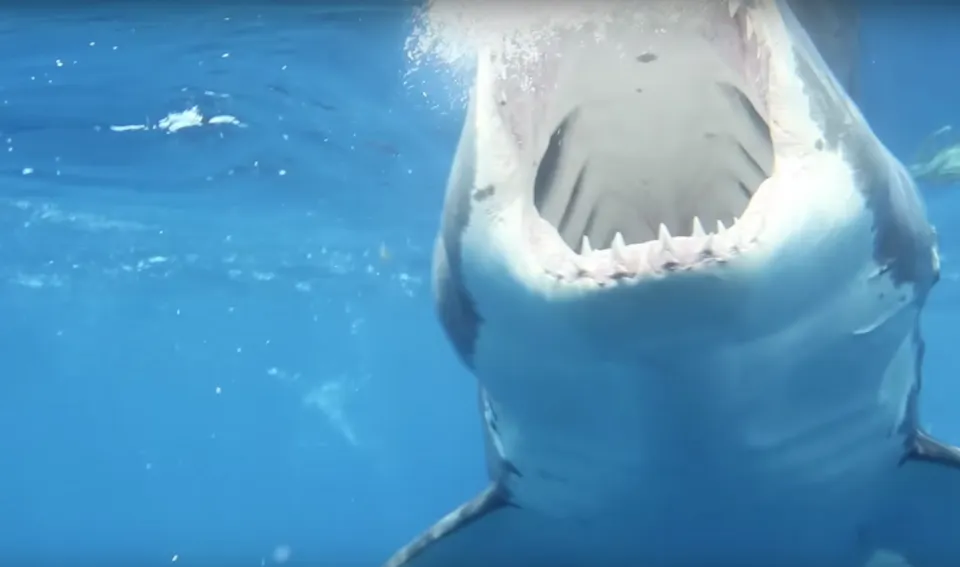
Great white shark with its mouth open near Guadalupe Island. Photo: Sharkcrew / Wikimedia Commons, CC BY-SA 4.0. This photograph shows the oral cavity but does not clearly identify the basihyal itself.
Is a Shark's Basihyal the Same as a Human Tongue?
No. A human tongue is a highly mobile muscular organ that helps manipulate food, form speech sounds, and detect tastes. Most shark basihyals are much less mobile and do not carry out those functions in the same way.
| Feature | Human tongue | Typical shark basihyal |
|---|---|---|
| Main tissue | Muscle, with supporting tissues | Cartilage as part of the hyoid apparatus |
| Movement | Highly flexible and independently mobile | Much more restricted |
| Food handling | Repositions food during chewing and swallowing | Usually a limited role; other mouth structures do most of the work |
| Taste | Many taste buds on the tongue | Taste is detected in the shark's oral and pharyngeal tissues |
| Speech | Important for articulating many sounds | No comparable role |
Important distinction: Saying sharks “have no tongues” is a useful shortcut, but it hides their real anatomy. Saying sharks “have tongues exactly like ours” is also incorrect.
Can Sharks Taste Food Without a Human-Like Tongue?
Yes. Sharks can assess food using taste receptors in their mouths and throats. This ability helps them evaluate material they have bitten before swallowing it. The tongue-like basihyal is not equivalent to the main taste-bearing surface of a human tongue.
Scientists study tiny raised structures called taste papillae and the distribution of taste buds in sharks and rays. Their position and density can differ across species and across parts of the oral cavity. That is why it would be too simple to claim that every shark has exactly the same arrangement of taste buds.
Sharks also use smell before contact and may combine it with vision, hearing, and electroreception. For more on how they locate prey, see our guide to how sharks see, smell, and hear.
Which Shark Uses Its Tongue-Like Structure to Feed?
The cookiecutter shark (Isistius brasiliensis) is the well-known unusual case. This small deep-water shark can remove a nearly circular plug of flesh from a much larger animal, including a fish or marine mammal. Its strong lips, specialized teeth, and mouth-floor structures work together during that distinctive feeding action.
The basihyal is involved in its specialized biting mechanism, but the shark does not use it as a mammal would use a tongue to chew or lick. The remarkable circular bite comes from a coordinated feeding apparatus, not from a tongue acting alone.
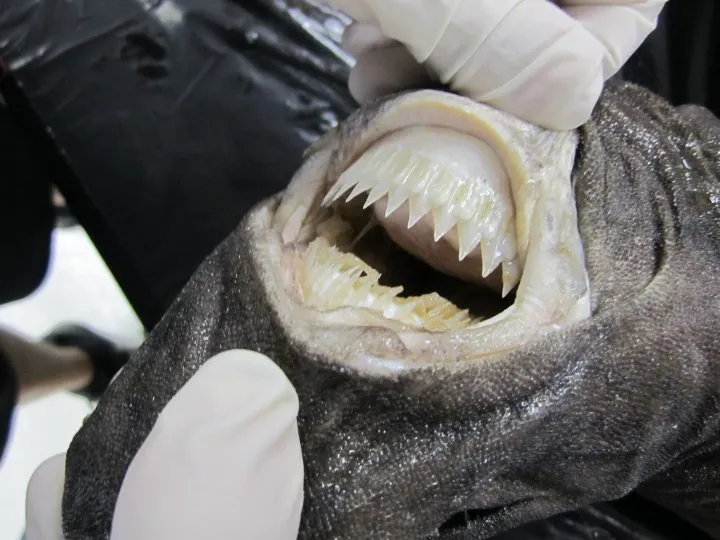
Close-up of cookiecutter shark teeth. Photo: JSUBiology / Wikimedia Commons, CC BY 2.0. The image documents the specialized jaws and teeth, not an isolated basihyal.
How Do Sharks Swallow Food Without a Flexible Tongue?
Different sharks have different ways of moving food from the mouth into the digestive tract. Powerful jaw movements, expansion of the mouth and throat, and suction can all be involved. Many predatory sharks swallow small prey whole or take pieces that can be swallowed without chewing like a mammal.
Researchers studying bamboo sharks found that movement of the shoulder girdle contributes to suction used to transport food toward the throat. With X-ray motion analysis, scientists could observe internal skeletal movements that would be difficult to detect from an ordinary underwater video.
This is not evidence that all sharks swallow food identically. It shows why the absence of a muscular tongue does not prevent a shark from eating efficiently.
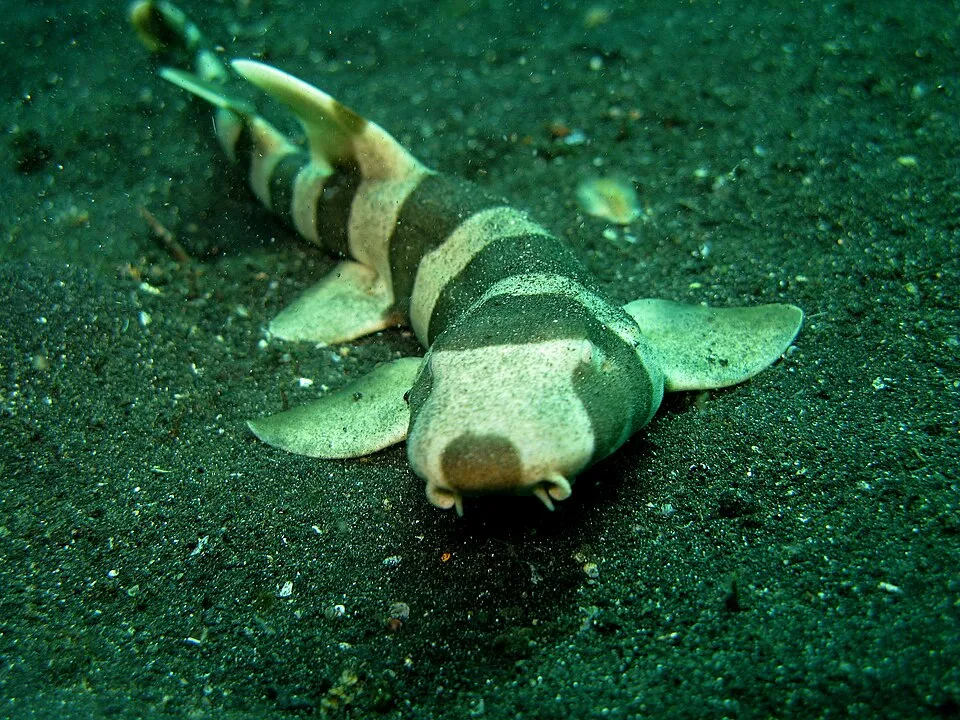
Juvenile brownbanded bamboo shark (Chiloscyllium punctatum) in the Lembeh Strait. Photo: Steve Childs / Wikimedia Commons, CC BY 2.0. Photograph for species context; it does not depict swallowing.
Do All Shark Species Have the Same Mouth Anatomy?
No. Sharks share a broad body plan but differ greatly in teeth, jaw shape, feeding strategy, and the relative importance of suction versus biting.
Great white sharks use powerful jaws and cutting teeth to take bites from large prey.
Cookiecutter sharks have a highly specialized mouth capable of removing circular tissue plugs.
Bamboo sharks are bottom-associated feeders; research on some species shows an important role for suction during food transport.
Whale sharks filter tiny organisms from water rather than cutting large pieces from prey.
Another dramatic feeding adaptation is the tail of the thresher shark, which can stun schooling fish before the shark captures them. Our illustrated article explains why thresher sharks have such long tails.
Three Common Myths About Shark Tongues
Myth 1: Sharks use their tongues to taste exactly as humans do
Not true. Sharks possess taste receptors, but they are distributed across the mouth and throat; their basihyal does not function like a mammalian tongue.
Myth 2: A shark tongue can reach out to grab prey
Not true. A typical basihyal cannot protrude and grasp prey in the way a chameleon's muscular tongue can.
Myth 3: Every shark feeds in the same way
Not true. Filter feeding, suction feeding, grasping, cutting, and other strategies occur across different species. The deep sea also contains some especially unusual sharks; explore our guide to deep-sea creatures for more examples.
Frequently Asked Questions
Do great white sharks have tongues?
Great white sharks have tongue-like cartilaginous structures associated with the floor of the mouth, but not a muscular tongue like a human's.
What is a shark tongue called?
The structure most often described as a shark's tongue is called the basihyal.
Can sharks move their tongues?
Not like humans. Most sharks cannot move or extend the basihyal independently as a mammal moves its tongue.
Do sharks have taste buds?
Yes. Sharks have taste receptors associated with their mouth and throat tissues, although their distribution varies by species.
Do sharks chew their food?
Not in the mammalian sense. Depending on the species and prey, sharks can swallow food whole, use suction to move it, or cut larger prey into swallowable portions.
Are cookiecutter sharks different from other sharks?
Yes. Their jaws, lips, teeth, and basihyal are part of a specialized feeding system that helps them take round bites from larger animals.
The Bottom Line
Sharks possess a tongue-like structure, the basihyal, but it is not the same as a human tongue. Most sharks rely on their jaws and other mouth and throat structures to capture and swallow food, and they can taste without needing a flexible mammalian tongue. The cookiecutter shark is an interesting exception because its basihyal has a more specialized role in feeding.
Scientific Sources and Photo Credits
Brown University — To Swallow Food, Some Sharks Shrug Their Shoulders.
Dean et al. — Eating without Hands or Tongue: Prey Processing in Cartilaginous Fishes.
Atkinson et al. — Oropharyngeal Taste Papillae in Sharks and Rays.
Photos: Sharkcrew (CC BY-SA 4.0); JSUBiology (CC BY 2.0); Steve Childs (CC BY 2.0). File-page and license links are included directly below each photograph.