Humpback whales have exceptionally long flippers because those wing-like limbs help them turn, roll and control their movements while hunting. Their pectoral flippers can reach about one-third of their body length. Unlike the tail, which supplies most of the forward swimming power, the flippers can generate lift and help a massive whale make surprisingly tight turns. The scalloped bumps along their leading edges also affect how water flows around them.
That combination is especially useful when humpbacks gather fish into bubble nets or lunge toward dense patches of krill. Modern research shows that the flippers are more than oversized steering paddles: during some feeding movements, they can actively produce forces that assist the whale.
How Long Are Humpback Whale Flippers?
An adult humpback whale's pectoral flippers are roughly one-quarter to one-third of its body length. On a whale measuring 15 meters (49 feet), one-third would be about 5 meters (16 feet)—although actual proportions vary among individuals.
Their scientific name, Megaptera novaeangliae, includes the Greek-rooted term Megaptera, commonly translated as “large-winged.” The name is an excellent clue to what makes these whales distinctive. To explore the full species profile, see our humpback whale facts and habitat guide.
| Feature | Humpback whale | Why it matters |
|---|---|---|
| Pectoral flipper length | About 1/4–1/3 of body length | Provides a large surface for lift and maneuvering |
| Flipper shape | Long, narrow, wing-like | Helps control banking and turning underwater |
| Leading edge | Rounded bumps called tubercles | Can modify water flow and delay stall under studied conditions |
| Main swimming drive | Tail flukes move up and down | Supplies most routine forward propulsion |
| Special feeding roles | Turning, herding and sometimes active flipper strokes | Can help capture concentrated fish or krill |
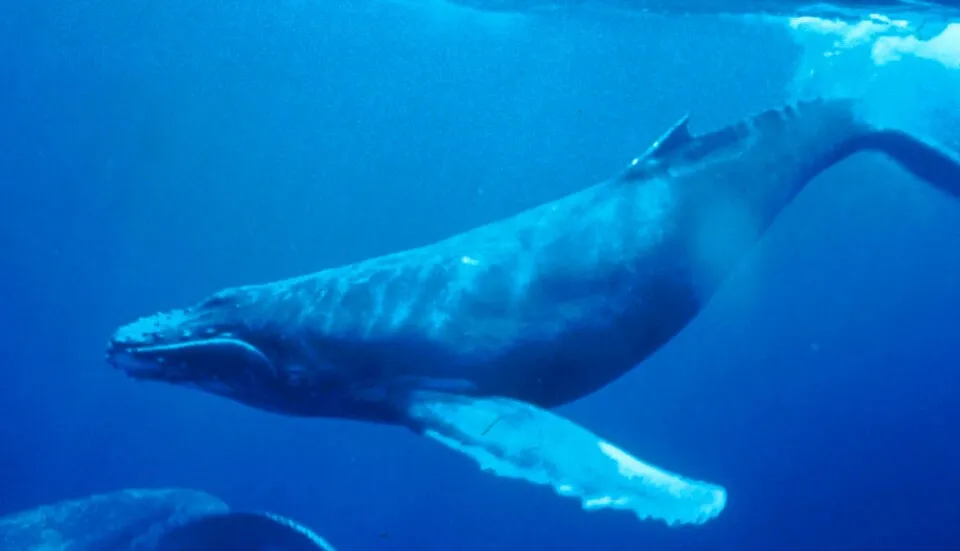
Photo 1. A humpback whale underwater, showing its long pectoral flipper. Source: NOAA-derived image, public domain, via Wikimedia Commons. No changes made to the source photograph.
Why Are Such Long Flippers Useful?
Picture a bus trying to make a sharp turn. A very large body carries momentum, so rapid changes in direction can be difficult. Humpback whales face a similar mechanical challenge in water, especially when trying to stay close to a moving school of fish.
Their oversized pectoral flippers provide the control surfaces needed to bank into a turn, change pitch and adjust their path. Water moving past a flipper creates forces in different directions. A carefully angled flipper can produce lift, which the whale uses to redirect its movement rather than simply push ahead.
This does not mean longer is automatically better for every whale. A streamlined blue whale and a maneuverable humpback whale face different feeding demands. Humpbacks have evolved a body and flipper combination suited to demanding turns during certain hunting behaviors.
What Did the 2025 Humpback Flipper Study Discover?
A study published in 2025 compared humpback whale turning performance with measurements from six other baleen whale species. Researchers used animal-borne movement tags and drone-based body measurements to investigate how whales maneuver during feeding.
The team found that humpbacks performing solitary bubble-net feeding achieved turns that were sharper, at the measured speeds, than the comparable turns recorded in the other six species. In the studied feeding turns, the researchers reported centripetal acceleration of about 0.46 m/s² and estimated flipper lift of approximately 7,800 newtons.
Those numbers describe the analyzed study conditions—not a constant force produced by every humpback flipper at all times. Their significance is that the flippers help a very large animal turn fast enough to stay around a concentrated patch of prey.
The result also helps explain a long-standing puzzle: why does the humpback have such unusually large side fins when many other large whales do not? At least part of the answer is that its hunting style places unusually high demands on maneuverability.
How Do Humpback Flippers Help With Bubble-Net Feeding?
During bubble-net feeding, one or more humpbacks release air bubbles around a school of fish. The bubbles may help keep the fish concentrated. A whale can then rise toward the trapped prey with its mouth open, engulfing fish and water before filtering the water through baleen.
Building or following the bubble pattern requires controlled movements. The whale may have to turn in a tight circle, roll inward and then accelerate into the food patch. This is where the long flippers become especially useful.
A 2019 field study also described pectoral herding in humpbacks feeding near salmon hatchery release sites in Alaska. The researchers reported flipper movements that seemed to help corral fish in several ways: forming a barrier, moving water toward the prey and presenting the pale underside of a flipper in a way that could influence fish movements.
That behavior was documented in specific encounters. It should not be presented as something every humpback uses during every hunt. However, it demonstrates that the flippers can interact with prey as well as steer the whale.
What Are the Bumps on Humpback Whale Flippers?
The rounded bumps along the front edge of a humpback's pectoral flipper are called tubercles. They give the edge a scalloped outline, unlike the relatively smooth leading edge on many other whale flippers.
Experiments on model fins suggest that properly shaped leading-edge tubercles can alter water flow and help postpone stall—the loss of lift that can happen when a lifting surface is angled too steeply into the flow. In certain tested configurations, this allows useful lift to persist at greater angles of attack.
The precise hydrodynamic benefit depends on the geometry and the test conditions. It would be an oversimplification to claim that tubercles always reduce drag or always make a whale faster. The better-supported conclusion is that they can help preserve maneuvering performance during demanding movements.
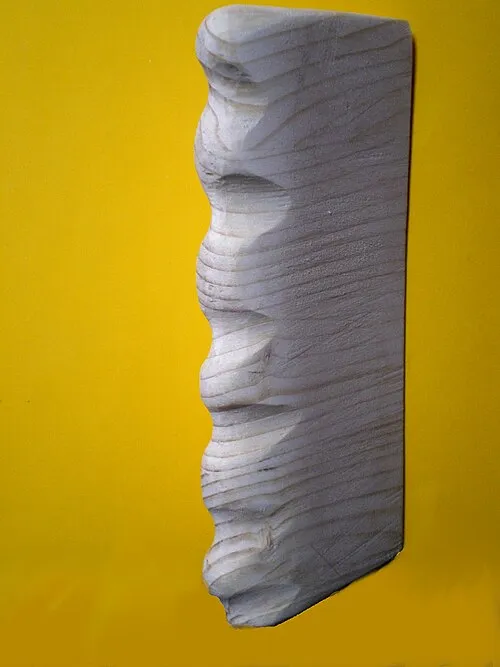
Photo 2. A physical model—not an actual whale flipper—showing rounded leading-edge tubercles. Photo by Nils Schlegel / Lucas Friese, CC BY-SA 3.0, via Wikimedia Commons. The photo is displayed here without modification.
Are Flipper Bumps the Same as Barnacles?
No. Tubercles are part of the whale's own body; barnacles are separate animals that can attach to the whale's skin. Humpbacks often carry barnacles, sometimes near the edges of their flippers, but a barnacle is not the anatomical bump responsible for the leading-edge shape.
Humpbacks also have rounded tubercles on the head and lower jaw. Those are not identical in function to the flipper's aerodynamic-style leading edge. A photograph of head bumps should not be used as proof of how flipper tubercles change water flow.
Do Humpback Whales Use Their Flippers Like Wings?
There is a real mechanical similarity, but it needs context. An airplane wing and a humpback flipper can both generate lift when fluid flows around them. For an airplane, the fluid is air; for a whale, it is water.
A humpback's flippers are not used for flying. Nor do they flap continuously like the wings of a bird. Most everyday swimming propulsion comes from the powerful up-and-down strokes of the horizontal tail flukes.
Still, a 2017 study described active flipper strokes during some lunge-feeding events that appeared capable of contributing lift and forward-oriented thrust. That means a humpback's flippers are not limited to passive steering in every situation.
Do Humpback Whale Flippers Have Bones?
Yes. A whale flipper is a modified mammalian forelimb. Inside are bones corresponding to the upper arm, forearm, wrist and digits of land mammals, even though the outline looks like a single smooth paddle.
This shared bone plan reflects whale evolution from land-dwelling ancestors. The long external shape of a humpback flipper is a specialized version of a familiar mammalian limb structure, not a fish-like fin made of fin rays.
What Is the Difference Between Flippers, Fins and Flukes?
Whale body parts are easy to confuse, especially in photographs where only a portion of the animal is visible. The three terms refer to different structures:
| Structure | Location | Main role |
|---|---|---|
| Pectoral flippers | One on each side of the body | Control, balance, turning, and some feeding movements |
| Dorsal fin | On the back | Helps stabilize the animal in water |
| Tail flukes | At the end of the tail | Primary propulsion during normal swimming |
Humpbacks are especially recognizable because their side flippers are strikingly long and often have contrasting black-and-white markings.
Why Do Humpbacks Slap the Water With Their Flippers?
Humpbacks sometimes roll at the surface and raise a long flipper before striking the water. This behavior is called pectoral slapping or flipper slapping.
Researchers have proposed several possible social and communication functions for surface displays, including signaling to other whales. Context matters: the same broad movement may occur in different social situations. Scientists cannot identify one universal intention behind every flipper slap seen at sea.
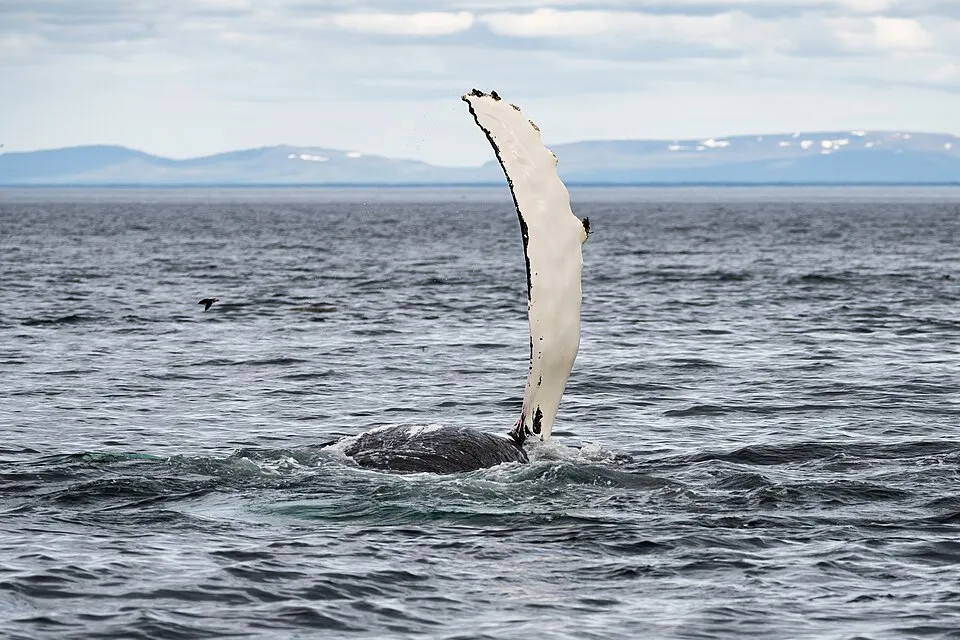
Photo 3. A humpback whale raises a white pectoral flipper in Iceland. Photo by Eric Kilby, CC BY-SA 2.0, via Wikimedia Commons. The photo is displayed without modification.
Can Humpback Flippers Help Defend Against Orcas?
They can be involved in defensive and aggressive encounters. Humpbacks have been observed swinging or slapping their large flippers and tail flukes when interacting with mammal-eating killer whales. The long appendages can be formidable when a whale is protecting itself or its calf.
Researchers have also documented humpbacks interfering with orca attacks on other species. However, observed behavior does not always reveal the whale's motivation, and researchers are careful not to assume that every intervention is an intentional rescue. For more context, read our separate evidence-based article on whether humpback whales really save seals from orcas.
Are Humpback Flippers Longer Than Blue Whale Flippers?
Proportionally, humpback flippers are much longer. A blue whale is a larger animal overall, but its pectoral flippers are relatively small compared with its body. Humpbacks have the characteristic extended, wing-like flippers associated with high maneuverability.
In other words, the biggest whale does not necessarily have the largest flippers relative to body size. The relevant comparison is flipper length as a fraction of body length, not just how large the entire animal is.
Frequently Asked Questions
Why do humpback whales have long pectoral fins?
The fins help humpbacks create lift, make tight turns, roll and control their bodies during complex feeding maneuvers.
How long can a humpback whale flipper get?
It can reach roughly one-third of the whale's total length. On an approximately 15-meter whale, that proportion is about 5 meters, although individual measurements differ.
What is special about humpback whale flippers?
They are unusually long, wing-shaped and lined with rounded leading-edge bumps called tubercles, which can change water flow.
Do humpback whales use their flippers to swim?
The tail flukes provide most routine forward propulsion. Flippers are especially important for control, though some feeding strokes can also contribute propulsive force.
Are humpback flipper bumps barnacles?
No. Tubercles are part of the flipper; barnacles are other organisms that attach to its surface.
Why do humpback whales slap their fins on the water?
Flipper slapping is a surface behavior that may serve social or signaling roles. No single explanation covers every observed slap.
Do humpback whales have fingers inside their flippers?
They have digit bones within their flippers, inherited from the mammalian forelimb skeleton, but not separate external fingers like a human hand.
Do humpback whales sleep while using their flippers?
Humpbacks need rest, but the specific movements and brain states involved in sleep are not as directly studied as those of some dolphins. See our guide to how whales sleep and continue breathing.
The Bottom Line
Humpback whale flippers are enormous for a reason. Their long, wing-like shape helps a giant animal maneuver through the water, while tubercles along the front edge can improve lift behavior under certain conditions. Field research shows that these flippers also assist in demanding feeding turns and sometimes help herd prey.
The most important distinction is between steering and propulsion: the tail powers most normal swimming, but the flippers give humpbacks remarkable control and can contribute force during specialized movements. That helps explain how such a large whale can hunt with such surprising precision.
Scientific Sources and Further Reading
Nemeth, C., et al. (2025). The key to bubble-net feeding: how humpback whale morphology functionally differs from other baleen whales. Journal of Experimental Biology.
Kosma, M. M., et al. (2019). Pectoral herding: an innovative tactic for humpback whale foraging. Royal Society Open Science.
Fish, F. E., & Battle, J. M. (1995). Hydrodynamic design of the humpback whale flipper. Journal of Morphology.
Fish, F. E., et al. (2011). The tubercles on humpback whales' flippers: application of bio-inspired technology.
Segre, P. S., et al. (2017). A hydrodynamically active flipper-stroke in humpback whales. Current Biology.
U.S. National Park Service: Humpback Whale. Species features and flipper proportions.
New Bedford Whaling Museum: Comparative Anatomy. Cetacean forelimb bone structure.